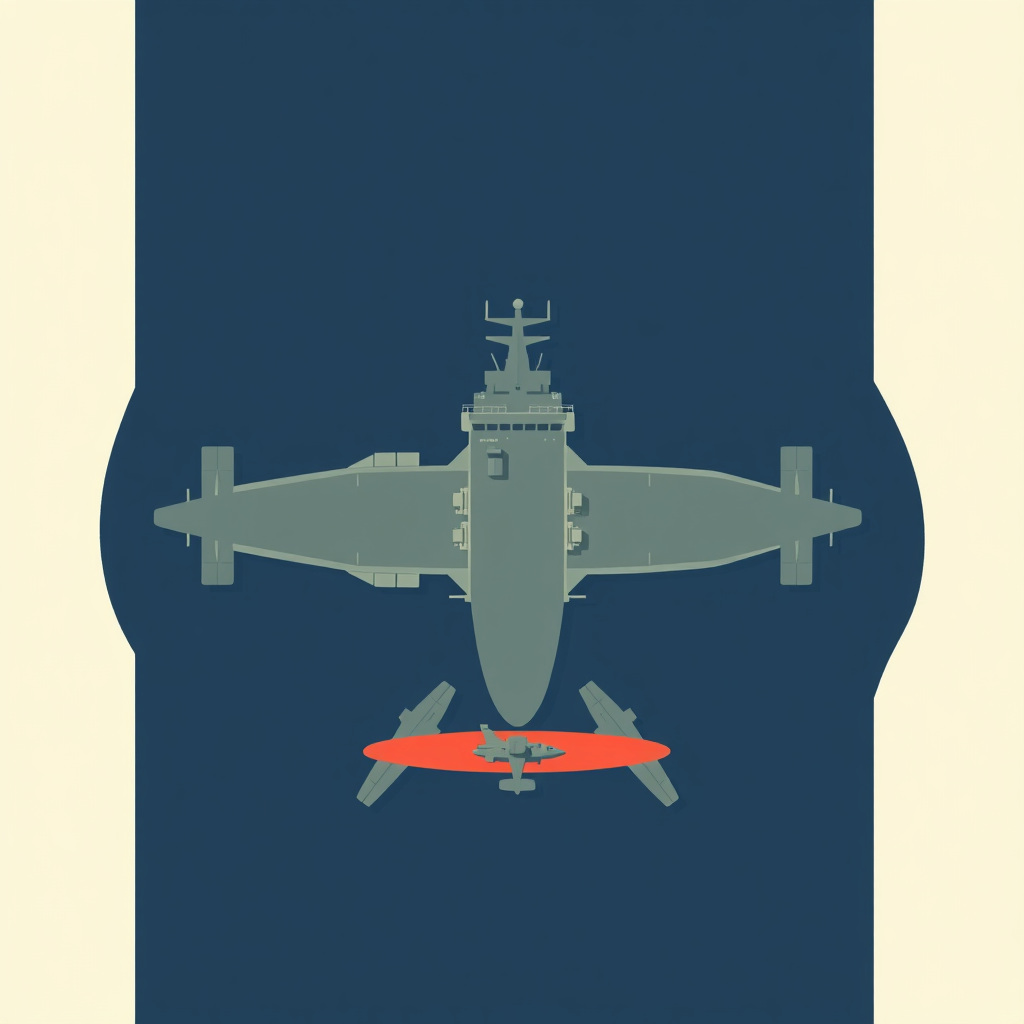
If you have been anywhere near the Haifa coastline over the last couple of days, you have seen it. It is hard to miss. A massive, gray, floating city sitting just off the coast, dominating the horizon. The United States Ship Gerald R. Ford has officially arrived, and seeing it in person really drives home the sheer scale of modern naval power. It is not just a ship, Herman. It is an island of steel, a sovereign piece of American territory that just happens to be parked in the Mediterranean.

It really is a sight to behold, Corn. Herman Poppleberry here, and I have to admit, I have been glued to the local marine traffic trackers and news feeds since it cleared the Straits of Gibraltar. This is the lead ship of the newest class of nuclear-powered aircraft carriers, the first new design in over forty years. It represents a massive leap in technology over the older Nimitz-class ships we have seen for decades. We are talking about a hundred thousand tons of displacement, standing twenty-five stories tall from the waterline to the top of the mast. It is a marvel of engineering that most people only see as a silhouette on the news, but having it right there in Haifa makes the abstract very real.
It is perfect timing for this visit, because Daniel’s prompt today is all about the mechanics of these massive vessels and the groups that surround them. He is curious about why the world’s largest warship needs a constant escort of cruisers, destroyers, and submarines. Is the carrier a central hub, or just a very expensive target? And what is the actual tactical advantage of something so huge and, relatively speaking, slow? He also asked about the command structure—who is actually calling the shots when a group like this moves into a sensitive area?
Those are fantastic questions, and they get to the heart of modern naval doctrine. I think a lot of people see a carrier and think of it as a lone fortress, a sort of floating castle. But in reality, a carrier alone is a very vulnerable thing. The term we use is the Carrier Strike Group, or C S G. It is a modular, integrated fighting force where the carrier is the primary offensive arm, but it relies on a whole ecosystem of other vessels to survive and function. It is less like a lone knight and more like a king traveling with a full battalion of knights, archers, and scouts.
Right, and Daniel mentioned that the Ford has been on a high-tempo deployment for months now. That brings up the human element and the logistical strain of keeping nearly five thousand people fed and sane while maintaining some of the most complex machinery on earth. But let us start with the "why" of the escort. If the Gerald Ford has its own R I M one hundred sixty-two Sea Sparrow missiles and rolling airframe missiles for defense, why does it need two or three Arleigh Burke-class destroyers and a Ticonderoga-class cruiser tagging along? It seems like a lot of redundancy.
Think of it as layered defense, or what military planners call defense in depth. A carrier is essentially an airfield that can move. Its primary job is to project power through its aircraft. To do that effectively, the carrier itself needs to be as unburdened as possible. While it does have point-defense systems, those are the absolute last line of defense. We are talking about the "oh no" scenario. If a carrier is using its own missiles to intercept an incoming threat, something has gone very, very wrong. You want to kill the threat hundreds of miles away, not hundreds of yards away.
So the escort ships are essentially the shield, while the carrier is the sword.
Exactly. The Ticonderoga-class cruiser usually acts as the Air Defense Commander for the entire strike group. It has the Aegis Combat System and a massive array of vertical launch cells—over one hundred and twenty of them. Its job is to look hundreds of miles out and manage the "air picture." It coordinates with the carrier's aircraft to make sure nothing gets within a hundred miles of that carrier. Then you have the Arleigh Burke destroyers. These are the workhorses. They handle everything from anti-submarine warfare to surface strikes with Tomahawk missiles. They are the versatile bodyguards that can pivot to whatever threat is most pressing. In twenty twenty-six, we are also seeing the newer Flight Three Burkes coming into play, which have the S P Y six radar. That radar is thirty times more sensitive than the older versions. It can see a bird-sized object from hundreds of miles away.
And then there is the silent partner. Daniel mentioned the attack submarine. You usually do not see it in the photos, for obvious reasons, but there is almost always a Virginia-class or Los Angeles-class fast attack sub lurking somewhere nearby. I imagine that is a lonely job, being the invisible guard dog.
That is perhaps the most critical part of the escort. The biggest threat to a carrier isn't necessarily another ship or even a plane; it is a torpedo from a quiet diesel-electric or nuclear submarine. The escort sub's job is to clear a path and ensure the "undersea domain" is secure. It is a constant game of cat and mouse beneath the waves that the rest of the world never sees. They are looking for "acoustic signatures"—the tiny sounds of another sub’s propeller or cooling pumps. If an enemy sub gets within torpedo range of the Ford, the entire mission is at risk.
It sounds like a massive amount of resources just to keep one ship safe. Daniel asked how much of the group is dedicated to protection versus missions. It seems like the vast majority of the escort's hardware is defensive. Is that a fair assessment?
It is a bit of a trick question, actually, because in modern warfare, defense and offense are deeply integrated. A destroyer's sonar suite is defensive because it protects the carrier, but that same destroyer can launch a Tomahawk missile at a land target a thousand miles away. That is offensive. The strike group is a single organism. However, if you look at the "weight of effort," you could argue that about sixty to seventy percent of the escort's daily activity is focused on situational awareness and protection of the "High Value Unit," which is the carrier. But remember, the carrier’s aircraft are the ultimate offensive tool. By keeping the carrier safe, the escorts are enabling that offensive power.
That brings us to the aircraft. We talked about the Electronic Attack Growler in a previous episode, and Daniel noted that the Ford has its own embarked air wing, Carrier Air Wing Eight. This isn't just a bunch of F thirty-fives and F eighteen Super Hornets. There are some really specialized birds up there that are essential to the command and control Daniel asked about.
Oh, absolutely. The E two D Advanced Hawkeye is the one that always catches people's eye because of the massive rotating radar dome on top. That plane is the "quarterback" of the sky. It flies high above the strike group and uses its radar to see over the horizon. Because the earth is curved, a ship's radar can only see so far—usually about twenty to thirty miles for low-flying objects. The Hawkeye extends that vision by hundreds of miles. It can see low-flying cruise missiles or enemy fighters long before the ships can. It then feeds that data back to the cruiser and the carrier in real-time.
So the "central hub" Daniel asked about isn't just the ship itself, but this distributed network of sensors?
Precisely. The Gerald Ford is the physical hub where the commanders sit, but the "brain" of the operation is distributed across the Hawkeyes, the cruisers, and even the satellites overhead. The Ford-class specifically was built with this in mind. It has what they call a "digital backbone." The amount of data moving between these ships and planes is staggering. They use something called Cooperative Engagement Capability, or C E C. This allows one ship to fire a missile at a target that only another ship or plane can see.
That is a wild concept. It is like me swinging a bat at a ball while I am blindfolded, because you are standing behind me telling me exactly when and where to swing.
It is even more integrated than that. The system can actually flight-correct the missile based on the other ship's data. So, back to Daniel's question about command and control: yes, the carrier is the central hub for the "mobile army at sea." There is a Flag Bridge on the carrier where the Admiral, the commander of the entire Strike Group, sits. This is separate from the ship's bridge where the Captain of the carrier sits. The Captain is responsible for the ship; the Admiral is responsible for the entire group of ships, subs, and planes. It is a distinction between the "platform" and the "mission."
I imagine that creates an interesting dynamic. You have the Captain of a hundred thousand ton ship who still has to answer to the Admiral sitting just one floor away. It is like the CEO of a company having the Chairman of the Board living in the office next door.
It is a very structured hierarchy. And the Ford-class has redesigned the "island"—that tower on the flight deck—to be smaller and further aft to make flight operations more efficient. They also replaced the old rotating radars with fixed-panel active electronically scanned array radars. This gives the ship itself much better self-awareness, but it still relies on the "spokes" of the wheel, the destroyers and aircraft, to complete the picture. The Ford also has more deck space for "pit stop" style aircraft servicing. They can refuel and rearm planes much faster than on the Nimitz-class, which increases what they call the "Sortie Generation Rate."
Let us talk about the "slow" part of Daniel's prompt. He pointed out that these ships move much slower than aircraft. If you are a supersonic jet, a ship moving at thirty knots is basically standing still. So why do we still invest billions in these massive warships in twenty twenty-six? Why not just have more long-range bombers?
It comes down to three things: persistence, sovereignty, and volume. An aircraft is fast, but it can only stay in the air for a few hours. Even with aerial refueling, the pilots get tired and the engines need maintenance. A carrier can stay on station for months. It is a permanent, floating piece of sovereign territory. If the United States wants to have an airfield near a conflict zone, they usually have to ask a neighboring country for permission to use their land bases. That comes with political strings attached, and those bases can be targeted by ground forces or local politics.
But with a carrier, you don't have to ask anyone. You just park it in international waters.
Exactly. It is ninety thousand tons of "diplomatic leverage." And then there is the volume. A carrier strike group carries more firepower than most countries' entire air forces. The Gerald Ford can launch up to one hundred and sixty sorties a day in high-intensity operations, and it can surge to over two hundred. It carries millions of gallons of jet fuel and thousands of tons of munitions. You cannot replicate that kind of sustained punch with land-based aircraft flying from thousands of miles away. The logistics of moving that much ordnance by air would be impossible.
I think people also underestimate how hard it is to actually hit a carrier. Daniel called it a "mobile army," and that mobility is key. While thirty knots, which is about thirty-five miles per hour, seems slow compared to a jet, it means the carrier can be anywhere within a seven hundred square mile area after just one hour of steaming from its last known position. After twenty-four hours, that search area grows to over seven hundred thousand square miles. That is a lot of ocean to hide in.
That is a great point, Corn. Finding a carrier in the open ocean is surprisingly difficult, even with modern satellites. Satellites have "revisit rates"—they aren't over the same spot twenty-four seven. And once you find it, you have to get past the Hawkeyes, the F thirty-fives, the Aegis cruisers, the destroyers, and finally the carrier's own point-defense systems. It is arguably the most well-defended spot on the planet. Even if you launch a long-range missile, the carrier has moved by the time the missile gets to the target area. The missile then has to use its own radar to find the ship, which is when the electronic warfare suites, like the S L Q thirty-two, start jamming it.
There is also the psychological aspect. When the Gerald Ford shows up in Haifa, or anywhere else, it sends a message that no other weapon system can. It is a very visible, very tangible commitment of power. It is one thing to see a headline about a bomber squadron being deployed; it is another thing to look out your window and see a nuclear-powered city sitting in your harbor.
It is "gunboat diplomacy" for the twenty-first century. But the Ford-class brings some specific technical advantages that are worth noting. Daniel mentioned the sewage system issues, which have been a bit of a P R headache for the Navy, but the real story is the E M A L S, the Electromagnetic Aircraft Launch System.
Right, the old carriers used steam catapults. They literally had huge pipes of high-pressure steam that would sling the planes off the deck. I remember reading that the steam systems were incredibly maintenance-intensive and could be quite jerky. What makes the electromagnetic version better, other than sounding like something out of a sci-fi movie?
It is much more precise. Steam catapults are very violent. They hit the aircraft with a massive jolt of force that is hard on the airframe, which shortens the life of the planes. E M A L S can be tuned. It can launch a heavy, fuel-laden fighter or a light, unmanned drone with the exact amount of force needed. It is a smooth acceleration. It also recharges faster and requires fewer people to operate. Then there is the A A G, the Advanced Arresting Gear. Instead of a simple hydraulic ram to catch the planes, it uses electric motors to provide a "water-brake" style resistance. Again, it is smoother and more reliable.
And all of that is powered by two A one B nuclear reactors that can go twenty-five years without refueling. The endurance of these things is just mind-boggling. They produce about three times the electrical power of the Nimitz-class reactors. That extra power is there specifically to support future weapons, like lasers or railguns, which the Navy is still testing. But Daniel also touched on the "disquiet" in the Navy about these long deployments. Eight months is a long time. Even with nuclear power, the human crew is the limiting factor.
That is the real bottleneck. You can build a ship that lasts fifty years, but you cannot keep a sailor at sea for eight months without it taking a toll on morale, family life, and readiness. The Navy is struggling with a high "optempo," or operational tempo. They have fewer ships than they used to—around two hundred and ninety ships compared to nearly six hundred in the nineteen eighties—but the demand for them around the world is higher than ever. When the Ford is in the Mediterranean, it means it isn't in the Atlantic or the Pacific. It is a constant shell game of global presence.
It makes you wonder about the future of these groups. As anti-ship missiles get faster and more accurate, like the hypersonic missiles being developed by China and Russia, does the "huge warship" model eventually become obsolete? If a single missile can sink a thirteen-billion-dollar ship, is it worth the risk?
That is the billion-dollar question. Some analysts argue we should move toward smaller, more numerous, "distributed" forces. Instead of one giant carrier, maybe ten smaller ones. But there are huge economies of scale with a supercarrier. You only need one set of nuclear reactors, one massive flight deck, and one specialized crew to support seventy-five aircraft. If you split that up into five smaller ships, you need five sets of reactors, five crews, and five sets of escorts. The costs explode. The Navy’s current strategy is "Distributed Maritime Operations," which means spreading the ships out further but keeping them digitally linked so they can still act as one unit.
It is the same logic as a massive cargo ship versus a hundred small boats. It is just more efficient, provided you can keep it safe. And from what we have seen of the Gerald Ford's testing and its current deployment, the U S Navy is betting heavily that they can keep it safe through electronic warfare and layered defense.
They are. And seeing it sitting there in Haifa, it is hard to argue with the sheer presence of it. It is a testament to engineering, but also to a very specific philosophy of global power. It is not just a ship; it is a statement that the ocean belongs to whoever can bring the most infrastructure to it. The Ford also features a lot of automation. It actually has a smaller crew than the Nimitz-class—about six hundred fewer people—because of things like the electromagnetic catapults and better internal logistics. That saves billions of dollars over the life of the ship.
So, for the practical takeaways for our listeners, what should they keep in mind the next time they see a headline about a carrier strike group?
First, remember that the carrier is never alone. If you see the carrier, there are at least five or six other major warships and a submarine nearby that you might not see. It is a "Strike Group" for a reason. Second, the carrier's primary weapon is its "reach." It doesn't need to be near the fight to influence it. Its planes can fly hundreds of miles, and its electronic warfare suites, like the Growlers we discussed, can shut down enemy communications from a vast distance. The carrier is a platform for the air wing; the ship itself rarely fires a shot in anger.
And third, the carrier is as much a communication tool as it is a weapon. Its arrival in a port like Haifa is a carefully calibrated signal to allies and adversaries alike. It is a mobile piece of the country's foreign policy. It says, "We are here, we are watching, and we have the capacity to intervene if necessary."
Exactly. It is also worth noting how much of the technology on a ship like the Ford eventually trickles down. The advances in power management, radar, and even the "digital backbone" for networking often find their way into civilian applications years later. The way they manage five thousand people in a closed environment also provides a lot of data for urban planning and resource management.
I am still stuck on the "mobile army" idea. It is essentially a self-contained society. They have their own doctors, dentists, lawyers, and even a television station. They produce four hundred thousand gallons of fresh water a day from seawater. They can move thirty-five miles every hour, indefinitely. The logistics of that, the "beans, bullets, and black oil" as they say, is almost as impressive as the catapults.
It really is. They have to resupply at sea, too. This is one of the most dangerous things they do. Every week or so, a massive supply ship—a T-A K E or a T-A O—will pull up alongside the carrier while they are both moving at fifteen knots. They will be only a hundred feet apart. They will transfer hundreds of pallets of food, spare parts, and thousands of gallons of jet fuel via cables strung between the ships. It is a high-wire act in the middle of the ocean, often in heavy seas. If you want to see true seamanship, watch an "Unrep," or Underway Replenishment.
It is incredible. I think we have covered the "why" and "how" of the Carrier Strike Group pretty thoroughly. It is a fascinating mix of old-school naval tradition—like the boatswain's whistle—and bleeding-edge tech like the E M A L S. It is a bridge between the nineteenth-century navy and the twenty-second-century one.
It really is. And Daniel, thanks for the prompt. It is a great excuse to look at something that is literally sitting right in our backyard at the moment. The Gerald Ford is going to be the face of the U S Navy for the next fifty years. They plan to build at least ten of these ships. The next one, the John F. Kennedy, is already in testing, and the Enterprise and Doris Miller are under construction.
It is a long-term commitment, for sure. Before we wrap up, I want to say a huge thank you to everyone who has been listening. We are up to episode eight hundred and one now, which is just wild to think about. We started this show talking about weird internet mysteries, and now we are deep-diving into nuclear-powered aircraft carriers. We have built a great community here, and we love hearing your thoughts.
We really do. If you have been enjoying the show, please take a moment to leave us a review on your podcast app or on Spotify. It genuinely helps other people find the show and keeps us going. We read every single one of them, even the ones that tell me I am being too much of a nerd about radar frequencies.
You can find all of our past episodes, including the one on the Electronic Attack Growler that Daniel mentioned, at myweirdprompts dot com. We have an R S S feed there for subscribers and a contact form if you want to send us your own weird prompts. We are always looking for new topics, whether it is military tech, urban legends, or strange scientific phenomena.
You can also reach us directly at show at myweirdprompts dot com. We are available on Spotify, Apple Podcasts, and wherever you get your podcasts. We try to respond to as many emails as we can, especially the ones with detailed technical questions.
Well, I think that is it for today. I am going to go grab my binoculars and see if I can catch a glimpse of the Ford's flight deck from the hills. Maybe I will see one of those E two D Hawkeyes taking off.
Good luck! It is a big target, you shouldn't miss it. Just remember, if you see the Hawkeye, it probably saw you five minutes ago.
Fair point. Thanks for listening to My Weird Prompts. We will see you next time.
Goodbye, everyone! Keep those prompts coming!