Hey everyone, welcome back to My Weird Prompts. I am Corn, and I am sitting here on our balcony in Jerusalem with my brother, looking out toward the Old City. It is a beautiful morning, though the air is a little bit crisp today.

It is indeed. Herman Poppleberry here, and I have to say, the smell in the air this morning is actually quite relevant to what we are talking about. You can always catch those faint traces of woodsmoke and spice when the wind blows from the east.
It is funny you say that, because our housemate Daniel sent us a really evocative prompt this morning. He has been going through what he calls his frankincense phase. He has been buying resins from the market in the Old City and even some high-end stuff from Oman. He was telling us about a conversation with his friend Marcus, who is a big history buff, about how frankincense was used in the ancient world.
Oh, I remember Daniel’s frankincense phase. The whole house smelled like a cathedral for three weeks. I actually quite liked it, though I think the frankincense-scented laundry detergent might have been the tipping point for some people.
Yeah, that was a bit much. But Daniel’s prompt really gets to something interesting. He wants to know about the role of frankincense in the ancient world, specifically here in ancient Israel and at the Temple. Marcus mentioned that it was used as a practical way to mask the smell of animal sacrifices and the general lack of deodorant in the ancient world.
That is a very grounded, practical take, and Marcus is not wrong. But as with everything in the ancient world, the practical and the spiritual were so tightly interwoven that you almost cannot separate them. Today we are going to peel back the layers of that fragrant smoke and look at the economics, the chemistry, and the sheer sensory overload of ancient Jerusalem.
I love that. Because when we think of the ancient world, we often see it in black and white or through the lens of clean, white marble statues. But the reality was probably an absolute assault on the nose. Let us start with the basics, Herman. What exactly is frankincense? We see the little pebbles in the market, but where does it actually come from?
So, frankincense is a resin. It comes from trees of the genus Boswellia. Specifically, Boswellia sacra is the one most prized, and it grows primarily in the Dhofar region of modern-day Oman and parts of Yemen and Somalia. The way they get it is fascinating and hasn't changed in thousands of years. You have to slash the bark of the tree, which is called tapping. The tree then bleeds this milky white sap to heal the wound. It hardens into these translucent droplets or tears, which are then scraped off and sorted by quality.
It is literally the blood of the tree. That adds a whole different layer to the sacrifice metaphor.
Exactly. And the quality varies wildly. You have everything from the dark, brownish resins that are full of bark and debris to the Hojari frankincense from Oman, which can look like pale green or silver pearls. In the ancient world, this stuff was worth its weight in gold. Sometimes more than gold.
Which explains why it was one of the gifts of the Magi in the Christmas story. Gold, frankincense, and myrrh. Those were the three most valuable commodities you could carry across a desert. But how did it get here? We are in Jerusalem, and Oman is thousands of miles away across some of the most inhospitable terrain on the planet.
That is where the famous Incense Route comes in. This was the ancient world’s equivalent of a high-speed data line, but for luxury goods. The Nabateans were the undisputed masters of this. We talked about their architectural prowess back in episode three hundred seventy-five when we looked at the built environment, but their real power was logistical. They knew where every secret water source was in the Negev and the Arabian deserts. They ran these massive caravans, thousands of camels strong, carrying frankincense and myrrh from the southern tip of the Arabian peninsula all the way up to the Mediterranean ports like Gaza and Ashkelon.
And Jerusalem was a major stop on that network. Or at least, a major customer.
A massive customer. The demand for frankincense in Jerusalem was driven almost entirely by the Temple. If you look at the Hebrew Bible, specifically in the book of Exodus, there is a very specific recipe for the Ketoret, the holy incense. It mentions four primary ingredients: stacte, onycha, galbanum, and pure frankincense. But if you look at the later rabbinic traditions in the Talmud, they actually list eleven different spices, including things like cinnamon, cassia, and saffron.
Eleven? That sounds like a very complex perfume. And the law was incredibly strict, right?
Incredibly. You were not allowed to make this specific blend for personal use. It was for the Divine only. If you tried to replicate it at home, the penalty was being "cut off" from the community. It was a total brand monopoly. This specific smell belonged to God. If you smelled this, you knew you were in a sacred space.
But let’s talk about Daniel’s point. The practical side. If you are at the Temple in the first century, what are you actually smelling? Because there is a lot of blood involved.
Right. This is where Marcus’s point about masking smells is so important. We have to visualize the scale of the operation. On a major festival like Passover, you had hundreds of thousands of pilgrims in the city. You had thousands of animals being sacrificed. We are talking about open-air slaughter on a massive scale. There is blood, there is offal, there is the smell of burning fat and meat. In the Jerusalem summer heat, that would be overwhelming.
Not to mention the lack of modern sanitation. No sewers, no trash collection, thousands of people packed into narrow stone streets.
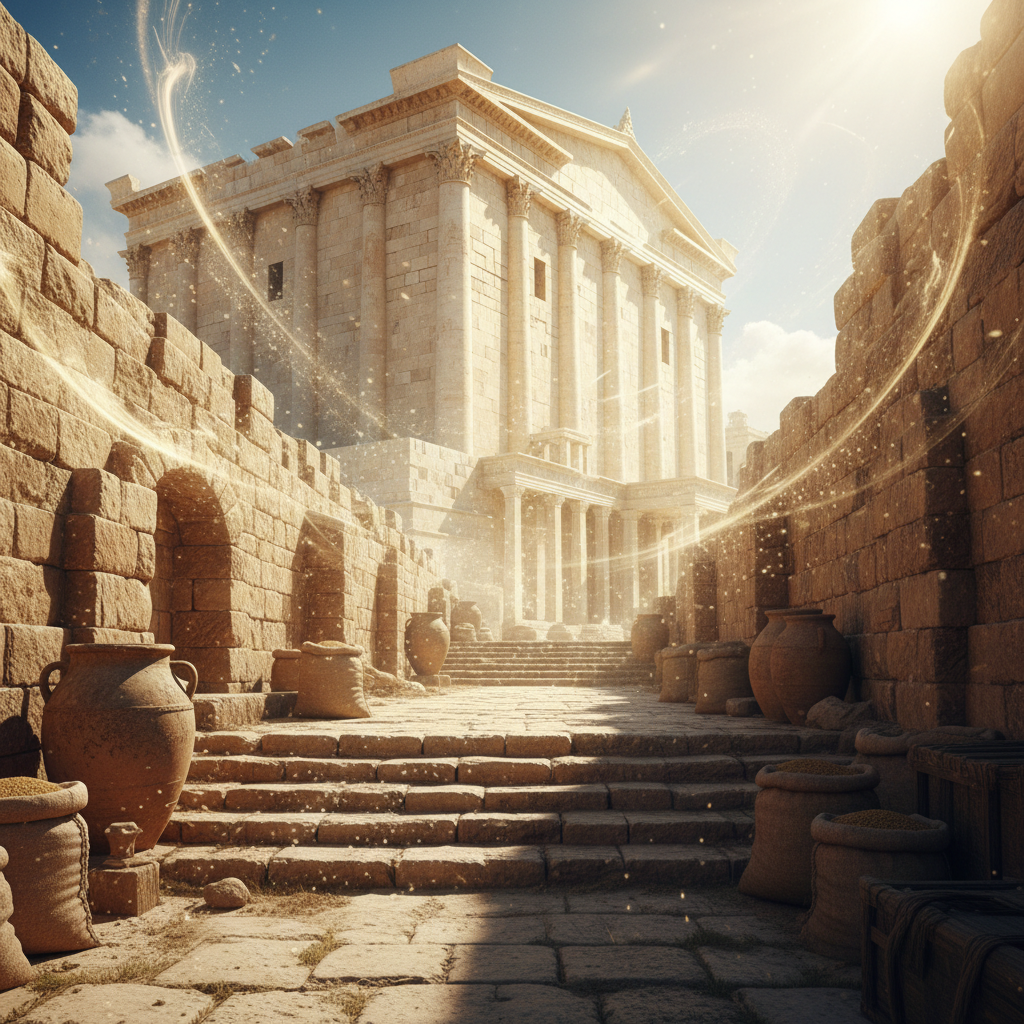
Exactly. So the incense served a very real, very biological purpose. It was an olfactory barrier. The Golden Altar of Incense stood inside the Temple building itself, right in front of the veil to the Holy of Holies. Twice a day, a priest would offer the incense. The smoke would billow out, filling the space. It created a sensory zone that was distinct from the smells of the street and the smells of the slaughter. It was a way of saying, this air is different. This air is purified.
I wonder if it actually worked as a disinfectant? I know some of these resins have antimicrobial properties.
They absolutely do. Frankincense and myrrh are both packed with compounds called terpenes and boswellic acids. In the ancient world, they didn't know about bacteria, but they knew that certain smells were associated with disease and decay. They used incense to fumigate houses and temples. It was a primitive but effective form of public health. If you can't see the germs, you at least try to kill the stench.
It is like the original air freshener, but with a side of spiritual transcendence. But I want to push on the "why" of the smell. Is it just about masking the bad stuff, or is there something about the chemistry of frankincense that actually affects the brain? Because anyone who has been in an incense-heavy service, whether it is an Orthodox church or a synagogue, knows it does something to your head.
You are hitting on some really cool science here, Corn. There is a compound in frankincense called incensole acetate. Researchers have found that when you burn frankincense, this compound is released and it actually has a psychoactive effect. It activates a protein called TRPV3 in the brain, which is associated with feelings of warmth and well-being. It also has an anti-anxiety and anti-depressive effect.
Wait, so the "religious experience" might have a literal chemical component?
It is a feedback loop. You have the beautiful architecture, the chanting, the communal gathering, and then you have this chemical compound that is literally lowering your anxiety and making you feel a sense of warmth and openness. It is not "faking" a spiritual experience, but it is certainly facilitating a specific neurological state. The ancients might not have had the double-blind studies, but they were master chemists of the soul. They knew which resins produced the most profound effects.
That is fascinating. It makes me think about that archaeological discovery from a few years ago that everyone was talking about. The one at Tel Arad.
Oh, the eighth century before the common era shrine! That was a massive find. For those who don't know, archaeologists found two limestone altars at the entrance to a small "Holy of Holies" in a desert fortress. They analyzed the black residue on top of the altars. One altar had frankincense on it, mixed with animal fat to help it burn at a high temperature. But the other altar had cannabis on it.
Right, and the cannabis was mixed with dried dung to keep it at a slow smolder. It shows that the use of aromatic, mind-altering substances was a standard part of the cultic practice in ancient Judah. Frankincense wasn't just a pretty smell; it was part of a complex technology of worship.
And it was expensive technology. To have frankincense in a remote desert fortress like Arad meant that the central government in Jerusalem was invested in keeping those trade routes open and flowing. It shows you how vital this stuff was to the national identity.
Let’s go back to the idea of the "Incense Route." We often talk about the Silk Road, but the Incense Route was just as influential for the Middle East. It created these massive, wealthy cities in the middle of nowhere. Petra is the obvious one, but there are dozens of others buried under the sand.
And the wealth it generated was staggering. The Roman historian Pliny the Elder was actually complaining about it in the first century. He was annoyed by how much Roman gold was flowing out of the empire to buy these "useless" luxuries like frankincense from the Arabs. He estimated that the Roman Empire was losing something like one hundred million sesterces a year to India, China, and the Arabian peninsula.
It is the ancient version of the trade deficit. We want the smell, they want the gold.
And the cost was driven up by the sheer difficulty of the journey. A camel caravan could take sixty-two days to get from Yemen to Gaza. You had to pay protection money to every local tribe along the way. You had to pay taxes at every gate. By the time those "tears" reached the market in Jerusalem, they were a luxury item of the highest order.
Which brings us to Daniel’s friend Marcus and his point about deodorant. If you were a regular person in Jerusalem, could you afford this? Or were you just smelling it from a distance when the wind blew from the Temple?
For the average person, pure frankincense was probably out of reach for daily use. They would use cheaper local resins, like terebinth or even just certain types of pine. But for the wealthy, for the elite in the Upper City, smelling like frankincense was a major status symbol. It told everyone that you had the money to import the finest products from the ends of the earth.
It is like wearing a very expensive designer perfume today. It is a signal.
Exactly. And the lack of personal hygiene meant that these scents were doing heavy lifting. People didn't bathe every day. They didn't have antiperspirant. They used "oil of myrrh" and other fragrant oils to treat their skin and mask body odor. In the Song of Solomon, there is all this incredibly sensuous language about the smell of the lover being like a bundle of myrrh or a hill of frankincense. It was a deeply eroticized part of the culture.
It is hard for us to imagine a world where smell is that dominant. We live in such a sanitized, deodorized world. We try to eliminate all smells. But in ancient Jerusalem, you were constantly navigating a landscape of odors.
There is a great line from a researcher who said that the ancient world was "smelly and loud." I think we underestimate how much the smell of the Temple defined the city. If you were a resident of Jerusalem, that specific blend of the Ketoret was the background radiation of your life. It meant the sacrifices were happening. It meant the covenant was being maintained. It meant God was "at home."
And when the Temple was destroyed, that smell vanished. That must have been a profound sensory trauma for the survivors. The city literally smelled different.
That is a really deep point, Corn. After the destruction of the Second Temple in seventy common era, the Jews could no longer offer the sacrifices or the incense. The rabbis had to figure out how to maintain that connection without the physical smoke. They eventually decided that prayer would take the place of sacrifice. But they kept the memory of the smell alive in the liturgy. Even today, in the Havdalah service at the end of the Sabbath, we smell spices to comfort the soul as the holiness of the day departs.
It is a phantom limb of the olfactory system. We are still reaching for that scent two thousand years later.
And it is why someone like Daniel gets so excited when he finds real frankincense in the market. He is tapping into a sensory chain that goes back three thousand years. When you burn that resin, you are smelling exactly what King Solomon smelled. You are smelling what the priests smelled. The chemistry of the resin hasn't changed.
Speaking of Daniel’s "frankincense phase," he mentioned getting stuff from Oman. You said that Oman is the "gold standard." Why is that? What makes Omani frankincense better than, say, the stuff from Ethiopia or Somalia?
It comes down to the microclimate of the Dhofar mountains. They have this very specific moisture level from the monsoon rains, called the Khareef. It allows the trees to produce a resin that is higher in those essential oils and lower in the harsh, acrid compounds. The Hojari frankincense from that region has this incredible citrusy, piney note that is very clean. It doesn't smell "smoky" or "burnt" in the way cheaper resins do. It is much more delicate.
It is like the difference between a cheap bottle of wine and a grand cru.
Precisely. And in the ancient world, the "Incense King" of the Dhofar region was the one who controlled the global market. They guarded those trees like they were military secrets. There are all these ancient myths about winged serpents guarding the frankincense trees to keep people away. It was early industrial espionage.
I love that. "Don't come near our trees or the flying snakes will get you." It is very effective marketing. But let’s talk about the modern world for a second. Daniel mentioned that frankincense is still popular today. Beyond the church and the synagogue, it has seen a huge resurgence in the "wellness" and essential oil communities.
It has, and it is actually causing some problems. Because frankincense has become so popular for everything from skin care to "anti-inflammatory" supplements, the trees are being over-harvested. Tapping a tree too many times weakens it and makes it vulnerable to beetles and disease. In some parts of Ethiopia and Yemen, the Boswellia populations are in serious decline. Some researchers estimate that ninety percent of these trees could disappear within fifty years if we don't change how we harvest.
So our modern obsession with "ancient wellness" might actually be destroying the very thing we are trying to preserve.
It is a real concern. But there is some hope. Recent research from Oman comparing wild-harvested resin to resin from cultivated plantations has found that the cultivated trees can produce essential oils with the same phytochemical complexity as the wild ones. This could be a huge step toward sustainable production without losing the quality that makes Omani frankincense so special.
It is a bit ironic, isn't it? The ancients used it because it was a rare, precious gift for the Divine. We use it because we want our bathrooms to smell like a spa.
It is a desacralization of the scent. But at the same time, I think it is beautiful that we are still drawn to it. There is something in our biology that responds to that resin. Whether you think of it as a chemical reaction in the TRPV3 protein or a spiritual connection to the ancestors, the effect is the same. It grounds us. It slows us down.
I remember when we were walking through the Old City last month, and we passed that little shop near the Christian Quarter. The guy had a charcoal burner out front with frankincense on it. Even in the middle of all the noise and the tourists and the chaos of the souk, that smell just... it stops you. It creates a little bubble of stillness.
That is the power of it. It is a "weird prompt" for the brain. It says, "Pay attention. Something different is happening here."
So, to summarize for Daniel and Marcus... Marcus is right that it was practical. It was the ancient world’s version of Febreze and Old Spice rolled into one. But it was also so much more. It was a trade engine, a status symbol, a chemical mood enhancer, and a literal bridge between the human and the divine.
And it is a reminder that the ancient world wasn't just a collection of dates and names. It was a sensory experience. If you want to understand the life of a resident of ancient Jerusalem, you have to understand what they were smelling. You have to understand the smoke.
I think I am going to go find where Daniel hid that Omani frankincense. I feel like the balcony needs a little bit of that ancient atmosphere right now.
Just stay away from the laundry detergent, Corn. I don't want to smell like a medieval monk for the rest of the week.
Fair enough. No frankincense socks for me.
Good call.
Well, this has been a fascinating deep dive. I think it is easy to overlook the "lower" senses like smell when we talk about history, but it is often the most direct way to connect with the past.
It really is. And it is a great reminder that our modern problems—like how to stay smelling fresh in a crowded city—are not as new as we think. We have just traded camel caravans for Amazon deliveries.
Exactly. Same human needs, different logistics.
And before we wrap up, I just want to say a huge thank you to everyone who has been listening. We have been doing this for four hundred eighty-one episodes now, and the community that has grown around My Weird Prompts is just incredible.
It really is. We love getting these prompts from Daniel and from all of you. It keeps us curious and it keeps us digging into these weird corners of history and science. If you are enjoying the show, we would really appreciate it if you could leave us a quick review on Spotify or whatever podcast app you use. It genuinely helps other people find the show and helps us keep this collaboration going.
Yeah, it makes a big difference. And remember, you can find all our past episodes, including the ones we mentioned today about architecture and the science of shadows, at our website, myweirdprompts.com. There is a contact form there too if you have a prompt you want us to tackle.
We are always looking for the next rabbit hole to jump down.
Well, I think the wind is shifting. I can smell the coffee from the kitchen. That is a different kind of ancient aromatic ritual that I am ready to participate in.
I am right there with you. Thanks for the deep dive, Herman Poppleberry.
Any time, Corn.
Thanks for listening to My Weird Prompts. We will be back soon with another exploration of the strange, the technical, and the deeply human.
Until next time, stay curious.
And keep your resins pure. Bye everyone!
Goodbye!