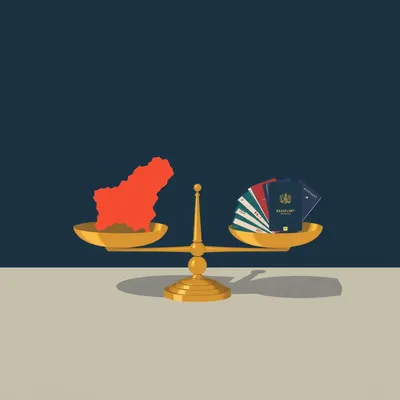
You know Herman, I was looking through some of the international news headlines this morning, and it feels like the word colonialist has just lost all its original meaning. It has become this ultimate linguistic weapon, a way to shut down a conversation before it even starts. We see it used as a primary tool for delegitimization, especially when the topic is Israel. It is no longer a political critique; it is a way of saying a nation has no right to exist because its very foundation is a crime.

It really has, Corn. It is what people call a thought-terminating cliché. If you can label a group or a movement as colonialist, you do not have to engage with their history, their legal rights, or their humanity. You just place them in the category of historical villain and move on. Herman Poppleberry here, by the way, and I have been chomping at the bit to dive into this one since our housemate Daniel sent over the prompt for today. This label is historically illiterate when applied to the Levant, but it is incredibly effective in a social media environment that rewards simplicity over accuracy.
Yeah, Daniel really hit on a nerve with this one. He was asking about how we deconstruct this specific narrative that gets leveled against Israel constantly. The idea that Jews are just European interlopers who showed up in nineteen forty-eight to steal a country. It is a very powerful story because it fits so neatly into the modern academic framework of the oppressed versus the oppressor. It is the dominant framework for anti-Zionist discourse today because it maps onto Western guilt about actual colonial history.
It is a framework that was built to describe the British in India or the French in Algeria, but when you try to stretch it over the Levant, the seams start to rip immediately. The problem is that most people using the term do not actually know the history, or they are intentionally ignoring the science that contradicts the narrative. We are seeing a shift from political disagreement to a total erasure of indigenous identity.
Well, that is where I want to start today. If we are going to debunk the myth of the European invader, we have to look at the actual physical evidence. We have talked about the legal history before, like back in episode four hundred eighty-three when we looked at the transition from the Ottoman Empire, but today I want to go even deeper. I want to talk about the genetic and historical continuity of the Jewish people. This is not just a religious claim; it is a biological and archaeological reality.
That is the right place to start because the science is remarkably consistent. For decades, there has been this attempt to claim that Ashkenazi Jews, the ones who lived in Europe for centuries, are actually descended from a Turkic group called the Khazars. It is a theory that antisemites love because it allows them to say that modern Jews have no connection to the land of Israel. But the genetic data tells a completely different story. If you look at the major studies conducted over the last fifteen years, the Khazar hypothesis has been thoroughly debunked.
Right, I remember reading about the studies by Doron Behar and Harry Ostrer. They looked at Jewish populations from all over the world, Ashkenazi from Europe, Sephardic from North Africa and Spain, and Mizrahi from the Middle East. What did they find when they compared these seemingly diverse groups?
They found a shared ancestral signature that is unmistakably Levantine. The study by Behar in two thousand ten, and Ostrer’s work in his book Abraham’s Children, showed that despite being separated for thousands of years in some cases, these populations are more closely related to each other and to other Levantine groups, like the Druze, Cypriots, or Palestinians, than they are to the European populations they lived among. There is a clear genetic line that leads straight back to the Levant. Even for a Jew whose family lived in Poland for five hundred years, their genetic markers are fundamentally Middle Eastern. They carry the signature of the Mediterranean.
It is fascinating because it proves that the Jewish people were not just a religious group that converted Europeans, but a displaced indigenous population that maintained its distinct identity in exile. It is a biological record of a people who were forced out but never fully integrated into the genetics of their host nations. And that is a crucial distinction when we talk about colonialism. In a colonial model, you have a mother country, a metropole, that sends people out to a foreign land to extract resources. Where was the Jewish metropole in nineteen forty-eight?
That is the question that collapses the whole colonialist argument. To have colonialism, you need a sovereign state, a home base, that is exercising control over a distant territory for its own benefit. The British had London. The French had Paris. The Dutch had Amsterdam. The Jews returning to Mandatory Palestine had nothing but the clothes on their backs and a few ancient scrolls. There was no Jewish king in London or Paris ordering the colonization of the Middle East. In fact, the British, who were the actual colonial power in the region at the time, were actively trying to keep the Jews out through the White Paper of nineteen thirty-nine.
That is such an important point. The Jews were not the agents of the British Empire; they were the ones fighting a guerrilla war against the British Empire to gain independence. The Irgun and the Lehi were blowing up British infrastructure to force the colonial power to leave. It was a national liberation movement, not an imperial expansion. The people coming back were refugees and survivors returning to the only place they had ever called their ancestral home. They were not expanding an empire; they were ending their displacement.
And the historical record backs this up perfectly. We are not just talking about genetics. We are talking about a continuous presence. People act like the Jews disappeared from the land in the year seventy after the Romans destroyed the Second Temple and then suddenly reappeared in the twentieth century. But there was never a time in the last two thousand years when there was not a Jewish community living in the land of Israel. We call this the Old Yishuv.
Not once. Even under the harshest Byzantine or Crusader rule, there were Jews in Jerusalem, in Hebron, in Tiberias, and in Safed. These are the four holy cities. In the middle of the nineteenth century, long before the modern Zionist movement really took off, Jews were already the majority population in Jerusalem. By eighteen forty-four, census data shows they were the largest single ethnic group in the city. By eighteen seventy, they were an absolute majority. This is not a story of an invasion; it is a story of a people who refused to stay gone despite multiple empires trying to erase them.
I think about the Roman renaming of the province as the ultimate example of this. After the Bar Kokhba revolt in the second century, the Emperor Hadrian was so frustrated by Jewish resistance that he literally tried to erase the name Judea from the map. In one hundred thirty-five A.D., he renamed it Syria Palaestina, naming it after the Philistines, the ancient enemies of the Jews who had been gone for centuries. It was an intentional act of colonial erasure. He wanted to sever the link between the people and the land.
It was the original colonial project in that region. The Romans were the colonizers. They conquered the indigenous Judeans, renamed their land, and forced them into a diaspora. So, when people use the name Palestine today as a way to deny Jewish indigeneity, they are actually using a Roman colonial tool. It is the height of historical irony. They are using the language of an ancient empire to argue against the rights of the people that empire tried to destroy.
Moving from the genetic evidence to the historical definition of colonialism, we have to look at how the word is being misused. Colonialism is a specific political and economic framework developed during the Age of Discovery. It involves a state-sponsored project of settlement and resource extraction. But for most of human history, the way nations and borders were formed was through movement, conquest, and conflict. It was the norm, not the exception.
This is where the academic construct of colonialism gets really messy. We live in this very specific historical moment where we view all conquest through a post-colonial lens. But if we define colonialism as any time one group moves into a territory and establishes a state, then every single nation on earth is a colonial project. The Arabs themselves, if we use this modern, broad definition, are original colonizers of the Levant. They came out of the Arabian Peninsula in the seventh century and conquered the entire region, displacing or subverting the indigenous Byzantine, Jewish, and Persian populations.
But nobody calls the Arab expansion colonialism in polite academic circles. It is just treated as a natural historical development. It seems like the word colonialist is only applied when the people moving are perceived as Western or white. It is a racialized definition of history rather than a functional one. If a group is perceived as white, their movement is colonization. If they are perceived as non-white, their movement is migration or expansion. It is a double standard that ignores the actual mechanics of how the Jewish state was formed.
Now, let us turn our gaze to a country that has been particularly vocal on this issue: Ireland. Ireland is currently one of the most vocal critics of Israel on the world stage. They often claim a special solidarity with the Palestinians because they see themselves as a fellow victim of British colonialism. But if we apply the same harsh standards to Ireland that they apply to Israel, the picture gets very complicated.
This is the Irish Paradox. If you look at Irish history, specifically the Gaelic expansion, you see a very similar pattern of conquest and displacement. Before the Gaels, who we think of as the true Irish, there were other populations on that island. The Gaels were invaders from the continent, likely from Iberia or Central Europe, who pushed out or absorbed the previous inhabitants, the Pre-Celtic peoples. They were the original colonizers of the island of Ireland.
And it goes even further. In the early Middle Ages, the Irish were not just victims; they were active colonizers of neighboring lands. They invaded what is now Scotland. The very name Scotland comes from the Scoti, which was the Latin name for the Irish invaders who crossed the sea and conquered the indigenous Picts. They displaced the local culture, imposed their language, and established the Kingdom of Dál Riata. By the modern definition of colonialism that Irish politicians use against Israel, the Irish colonized Scotland.
It is the ultimate paradox. You have a nation that bases its entire modern identity on being the victim of colonialism, yet their very existence as a dominant culture is the result of an earlier colonial process. They imposed the Gaelic language and the Christian religion on the Picts and the Britons. If the Jews are colonizers for returning to their ancestral home, then the Irish are colonizers for expanding into someone else’s home.
We call this the Righteousness Shield. We touched on this in episode nine hundred seventy-nine when we looked at that report on the massive spike in antisemitism in Ireland. There is this institutional sense of being so morally pure because of your history of victimhood that you cannot possibly be doing anything wrong in the present. It allows them to ignore the sixty percent increase in antisemitic incidents in their own streets because they are convinced they are just standing up for the underdog. The shield protects them from self-reflection.
It is a dangerous psychological state for a country to be in. When you believe your history makes you inherently righteous, you lose the ability to be self-critical. You start to see the world in black and white. Israel becomes the big bad colonizer, and you become the noble defender of the oppressed, even if your own history and your current actions contradict that. They compare the Irish Plantation history, where the British settled Ireland, to the Jewish return, but they ignore the fact that the Jews were the ones being planted back into their own soil, not a foreign one.
It is a chilling thought. If you accept the premise that the Jewish return to Israel is a colonial crime, then you are essentially saying that the Jewish people have no right to self-determination anywhere. Because if they are not indigenous to the Levant, and they are not welcome in Europe or Ireland, where are they supposed to go? This rhetoric has real-world consequences. We discussed this in episode nine hundred seventy-two, the Last Minyan.
The Jewish community is literally leaving Ireland. They do not feel safe there anymore. When the rhetoric of a nation becomes so saturated with this colonialist trope, it creates an environment where a specific group is viewed as an existential enemy. If Jews are colonizers by nature, then there is no place for them in a righteous society. The Last Minyan is a symptom of a broader societal shift where the Righteousness Shield has become a weapon against a tiny minority.
So, let us look at some practical takeaways for the people listening. When you hear someone use the colonialist trope against Israel, how do you actually dismantle it in a conversation? I think the first step is always to ask for their definition of the word. You have to point out that colonialism is a category error in this context.
That is the best way to start. Ask them, what is the mother country? If Israel is a colony, who is the colonizing power? Usually, they will fumble. They might say the British, but then you point out that the Jews fought a guerrilla war against the British to get them to leave. They might say the Americans, but the United States did not even provide significant military aid to Israel until the late nineteen sixties, long after the state was established. In nineteen forty-eight, the U.S. actually had an arms embargo on the region.
And then you bring in the genetic evidence. You mention that the Jewish people are a Levantine population that has maintained its connection to the land for three thousand years. You ask them if a person can be a colonizer in their own ancestral home. If an indigenous person returns to their land after being forcibly removed, is that colonization or is it decolonization?
Right. And you can use the Irish example as a way to show the inconsistency of their logic. Ask them if they believe the Irish are colonizers because of the Gaelic expansion or the invasion of Scotland. If they say no, then ask them why the rules are different for the Jews. It forces them to confront the double standard. It highlights that they are using the word colonialist as a slur rather than a description.
It is about forcing people to move beyond the slogans. The slogans are easy. They are designed to be shouted at protests. But the history is hard. The science is hard. And when you actually look at the facts, the colonialist narrative just falls apart. It is a modern academic construct that ignores three thousand years of continuity.
But we have to be prepared for the fact that for many people, this is not about facts. It is about identity. Their identity is tied to being a supporter of the underdog, and they have been told a very convincing lie about who the underdog is in this conflict. They see a powerful military and assume that must mean the nation is a colonial occupier, ignoring the fact that the military exists because of the constant threat of annihilation from neighbors who view them as interlopers.
That is where the Righteousness Shield comes in again. It is a psychological barrier. To admit that Israel is not a colonial project would mean admitting that their entire worldview is based on a false premise. Most people are not willing to do that. They would rather cling to the lie than face the complexity of the truth. It is easier to point a finger at a small country in the Middle East than to reckon with the fact that your own culture was built on the displacement of others.
This is why we do this show. We want to provide the tools for the people who are actually interested in the truth. We want to give them the data and the historical context they need to see through the noise. Because the stakes are incredibly high. This is not just an academic debate. This is about the survival of a people and the future of a region. If the colonialist label is accepted as objective truth, it justifies any level of violence against the so-called colonizer.
And it is about the future of the West as well. If we allow these historical revisionist tropes to become the dominant narrative, we are essentially giving up on the idea of objective truth. We are saying that history is just a tool for modern political agendas. And once you go down that road, there is no coming back. We see it in the rhetoric coming out of some of the most prestigious universities in the West. When you start hearing people say that there are no civilians in a colonial state, you are hearing the language of genocide.
It is the ultimate dehumanization. If you are a colonizer, you are not a person; you are a target. And that is why we have to be so precise with our language. We have to insist on using the correct historical and scientific terms. We have to talk about indigeneity, we have to talk about genetic continuity, and we have to talk about the actual definition of colonialism. We have to remind people that the Jews are the only group whose indigeneity is treated as a matter of debate or even a crime.
I want to circle back to the Roman renaming of the land one more time. I think that is such a powerful metaphor for what is happening today. We are seeing a modern attempt to rename and rebrand the history of a people. Just as Hadrian tried to erase Judea, modern activists are trying to erase the Jewish connection to the land by calling it colonialism. It is the same project, just with a different vocabulary. Instead of Roman legions, they use academic journals and social media campaigns.
But here is the thing. Hadrian failed. The Roman Empire is gone, and the Jewish people are still here. They are back in their land, speaking their ancestral language, and building a thriving society. No matter how many slogans people shout, they cannot change the physical reality of that continuity. The success of Israel is not a crime; it is a miracle of indigenous return. It is the most successful decolonization project in human history.
I love that perspective. Reclaiming the word decolonization. That is exactly what Zionism was. It was the decolonization of the Jewish mind and the Jewish land. It was the refusal to be a permanent victim of history. It was the movement of a people from the periphery back to their center.
And that is exactly why it is so hated by those who rely on the victim-oppressor binary. Israel breaks the model. It shows that an oppressed people can become strong and sovereign without becoming the monsters their enemies claim they are. It challenges the idea that victimhood is a permanent state.
Well, I think we have covered a lot of ground today. We have looked at the genetic markers that prove Jewish continuity, the historical reality of the Roman era, the flaws in the academic definition of colonialism, and the fascinating irony of the Irish stance. We have seen how the Righteousness Shield functions to prevent honest historical analysis.
It has been a deep dive, for sure. And I think it is one of those topics where the more you look, the more you realize how much of the mainstream narrative is built on sand. If you want to dig deeper into the Irish context, I really recommend checking out episode nine hundred seventy-nine about the antisemitism crisis there, or episode nine hundred seventy-two about why the Jewish community is leaving. It provides a lot of the real-world context for what we discussed today.
Definitely. And if you are interested in the broader historical and legal foundations of the state, episode four hundred eighty-three is a great place to start. We also have episode seven hundred forty-three, which discusses the fine line between legitimate criticism of Israel and the use of delegitimization tropes. We have a massive archive at myweirdprompts.com, and you can search for any of these topics there.
Yeah, we have been doing this for a long time, and it is amazing how these themes keep coming back. It feels like every few years, the same old myths get dressed up in new clothes, and we have to go through the process of debunking them all over again. But the facts remain the same. The genetics do not change, and the archaeology does not lie.
It is a never-ending job, but it is an important one. I want to thank Daniel for sending this in. It was a challenging one, but I think it is a conversation that needs to happen more often. We cannot let these tropes go unchallenged because they fuel real-world hostility.
And to our listeners, if you have been finding these discussions helpful, please consider leaving us a review on your podcast app or on Spotify. It really does help the show reach more people and get this information out there. We appreciate every single one of you who takes the time to do that.
It really does make a difference. We see those reviews, and they help us keep the momentum going. This has been a fascinating exploration of a very heavy topic, but I think we have found some real clarity here. We have to be the ones to insist on historical accuracy in an age of slogans.
I agree. It is about getting back to the basics. Facts, history, and a refusal to be bullied by slogans. That is the only way forward for a rational society.
Well said, Herman. Alright, I think that is a wrap for today. This has been My Weird Prompts. You can find us on Spotify and at our website, myweirdprompts.com. We will be back soon with another deep dive into the questions that matter.
Until next time, stay curious and keep looking for the truth behind the headlines. Do not let the Righteousness Shield blind you to the facts.
Thanks for listening, everyone. We will talk to you soon.
Take care, everyone. Goodbye for now.