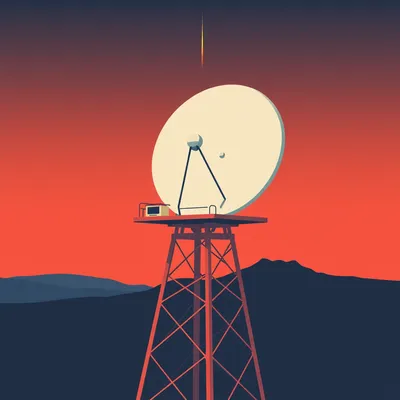
You know, Herman, I was looking out at the Jerusalem skyline from our balcony yesterday, and I noticed those small, drum-shaped antennas on top of some of the taller buildings. I always just assumed they were some kind of legacy radio equipment, but after listening to the prompt our housemate Daniel sent over this morning, I realized I might have been looking at the very thing he is asking about.

Herman Poppleberry here, and you are exactly right, Corn. Those drums are the unsung heroes of the modern internet. Daniel’s description of microwave technology as wireless fiber optic cable is actually a very common and very accurate analogy in the industry. It is fascinating because while we all obsess over five G Advanced on our phones or fiber to the home, the way that data actually moves between the towers and the core network often relies on these invisible beams of high frequency energy.
It is a great prompt because it touches on that hidden infrastructure we usually take for granted. Daniel was asking specifically about cellular backhaul and whether this technology could eventually replace physical cables in dense cities. I want to dig into that, but first, let us set the stage. When we talk about microwave networking, we are not talking about the thing that heats up your leftover pizza, right? Or is there a connection?
There is a connection in the physics, but not in the application. Both use electromagnetic waves in the microwave spectrum, which generally covers frequencies from one gigahertz up to about three hundred gigahertz. Your kitchen microwave usually sits around two point four five gigahertz, which is a frequency that happens to be very good at making water molecules vibrate and generate heat. But for networking, we use a much broader range of frequencies, often much higher than that, to carry data through the air.
And the reason we call it wireless fiber is because of the bandwidth, right? If you go high enough in frequency, you can theoretically pack as much data into those waves as you can into a glass strand.
Precisely. As you move up the frequency spectrum, the available bandwidth increases. In the lower microwave bands, maybe six to twenty-three gigahertz, you have great range but limited capacity. But when you get into the millimeter wave territory, like the E-band, which is seventy to eighty gigahertz, you can suddenly push twenty gigabits per second or more over the air. We are even seeing early deployments in the D-band now, around one hundred and forty gigahertz, which can push those speeds even higher. That is fiber-like speed without the need to dig a single trench.
Okay, so let us get into the cellular backhaul part of Daniel’s question. For those who are not familiar, backhaul is essentially the connection between the local cell tower and the provider's central office or the wider internet. Most people think there is just a cable running down every cell tower into the ground, but that is not always the case.
Far from it. In many parts of the world, especially where the terrain is difficult or where it is too expensive to bury fiber, microwave is the primary method for backhaul. Imagine you have a cell tower on a hill. To get fiber there, you would have to rent specialized equipment, dig through rock, navigate property rights, and spend hundreds of thousands of dollars. Or, you can put a two-foot microwave dish on that tower and point it at another dish ten miles away that is already connected to fiber. Boom, you have a high-speed backhaul link in a single afternoon.
That speed of deployment seems like the biggest selling point. But Daniel pointed out a major catch: line of sight. These waves do not like obstacles. If a new skyscraper goes up between those two dishes, or even if a very leafy tree grows too tall, the link drops. How do engineers deal with that in a world that is constantly changing?
It is the Achilles heel of the technology. Microwave signals at these high frequencies behave very much like light. They do not bend around corners, and they do not penetrate solid objects well. When engineers plan these links, they do not just look at the straight line between two points. They have to consider something called the Fresnel zone.
Oh, I remember reading about this. It is not just a thin line like a laser beam, right? It is more like an elliptical volume of space around the direct path.
Exactly. Think of it like a long, skinny football stretching between the two antennas. If anything enters that football-shaped zone, even if it does not block the direct center line, it can cause signal reflections that interfere with the main beam. This is called multi-path interference. So, when you see those dishes high up on towers, they are not just there for fun. They are positioned to stay clear of the ground, buildings, and even the curvature of the earth over long distances.
So, if line of sight is so critical, how can Daniel’s idea of using this in dense cities actually work? Cities are the opposite of clear lines of sight. They are canyons of steel, glass, and concrete. It seems like microwave would be the worst possible choice for a place like Manhattan or even here in the denser parts of Jerusalem.
You would think so, but this is where the technology has evolved. We are moving from the old model of one big tower talking to another big tower miles away, to a model of small cells and mesh networking. In a dense city, you might not have a clear shot for ten miles, but you probably have a clear shot from one street lamp to the next, or from the top of a bus stop to a nearby building. The industry calls this Integrated Access and Backhaul, or I A B.
So you are saying we create a relay system? A bucket brigade for data?
Exactly. This is often called V-band or E-band street-level backhaul. Instead of one long link, you have a series of short hops. Because the distances are short, maybe only a few hundred meters, you can use extremely high frequencies, like sixty gigahertz. At that frequency, you have massive capacity, but the signal is absorbed by oxygen in the atmosphere after a short distance.
Wait, oxygen absorbs the signal? That sounds like a flaw, but you are making it sound like a feature.
It is a feature for dense cities! Because the signal dies out quickly, you can reuse the same frequency just a few blocks away without the two signals interfering with each other. It allows for incredibly dense frequency reuse. This is how you get the capacity needed for five G and the upcoming six G standards without having to run fiber to every single lamp post in the city.
That is a brilliant way to look at it. It is localized high-capacity networking. But I have to push back on the fiber comparison. Daniel asked if it could replace physical infrastructure. Fiber is essentially immune to weather. Microwave, on the other hand, has to deal with rain, snow, and even heavy fog. I have heard the term rain fade used quite a bit in this context.
Rain fade is a very real phenomenon. When the raindrops are roughly the same size as the wavelength of the microwave signal, they absorb and scatter the energy. For high-frequency links, a heavy downpour can basically turn the air into a brick wall for your data.
So how does a network operator guarantee four nines or five nines of availability if a rainstorm can knock out the backhaul? If my phone stops working every time it rains, I am switching carriers.
They use a few clever tricks. One is adaptive modulation. When the weather is clear, the system uses a very complex way of encoding data to get maximum speed. When it starts to rain and the signal weakens, the system automatically shifts to a simpler, more robust encoding. The speed drops, but the connection stays alive. They also build in redundancy. You might have a high-speed microwave link as your primary path and a lower-frequency, slower radio link or even a secondary microwave path from a different angle as a backup. In twenty twenty-six, we are also seeing more multi-band antennas that combine E-band and traditional microwave in a single unit to handle this automatically.
It sounds like a constant balancing act between physics and economics. It is cheaper than fiber, but you have to be much smarter about how you manage the link. But here is something that blew my mind when I was researching this: the latency. Most people assume wireless is always slower than wired, but in terms of the time it takes a signal to travel from point A to point B, microwave can actually beat fiber.
I was hoping you would bring that up! This is one of my favorite technical trivia points. Light travels through a vacuum at about three hundred thousand kilometers per second. In a fiber optic cable, the light is traveling through glass, which is denser than air. That glass slows the light down by about thirty percent.
Right, so the refractive index of the glass acts as a speed limit.
Exactly. But microwave signals travel through the air, which has a refractive index very close to a vacuum. So, a microwave signal actually travels about fifty percent faster through the air than light travels through a fiber optic cable. For most of us, a few microseconds do not matter. But for high-frequency traders moving millions of dollars in milliseconds, that speed difference is everything.
I remember reading about those private microwave networks built specifically between Chicago and New Jersey for stock trading. They built these elaborate chains of towers just to shave off a few milliseconds. It is wild to think that the wireless option is actually the speed-of-light king in that scenario.
It really is. And that brings us back to Daniel’s question about replacing physical infrastructure. In the world of high-frequency trading, microwave did not just supplement fiber; it replaced it for the most critical paths. But for the average city dweller, the question is more about scale and reliability. Can we truly replace the fiber under our streets with these drums on our roofs?
I think the answer depends on how we define replace. If you mean removing every cable, probably not. Fiber has a theoretical capacity that is just staggering. We are talking about petabits per second over a single strand eventually. Microwave is limited by the available spectrum. There is only so much air, but you can always bury more glass.
That is the key distinction. Fiber is about ultimate capacity and long-term stability. Microwave is about agility and reach. I see them as a symbiotic pair rather than competitors. In a city like Jerusalem, where digging a trench might uncover a three thousand year old archaeological site and stop construction for six months, microwave is a godsend. It allows the network to grow and adapt while the slow process of laying fiber happens in the background.
That is a great point. The archaeological aspect is something we live with every day here. You cannot just put a backhoe in the ground without a team of historians standing by. In that context, the line-of-sight limitation of microwave seems like a small price to pay compared to the regulatory and historical hurdles of physical cables.
And let us talk about the second-order effects of this. If we can deploy high-speed backhaul wirelessly, it changes the economics of where we can put cell towers. It means we can put small cells in parks, on top of historical landmarks without damaging them, or in temporary locations for big events. It makes the network more fluid.
It also has implications for disaster recovery. If an earthquake or a flood severs the fiber lines under a city, those microwave links can keep the communication grid alive. You can even fly in portable microwave trailers to restore connectivity in hours.
Absolutely. There was a case during a major hurricane in the United States where the fiber backhaul for an entire region was washed away. The carriers were able to set up a chain of microwave hops to bypass the damaged area and get the cell towers back online while the physical repairs took weeks. It is the ultimate fail-safe.
So, looking forward, where does this go? We are talking about six G now in research circles. Does microwave technology have a role there, or are we hitting the physical limits of what we can do through the air?
We are going higher. The next frontier is the Terahertz range. These are frequencies between one hundred gigahertz and ten terahertz. At those levels, the capacity is virtually indistinguishable from fiber. We are talking about sub-millisecond latency and terabit-per-second speeds over the air.
But at that frequency, the line-of-sight issue must be even more extreme. I would imagine even a bird flying through the beam could cause a drop.
Or even a heavy puff of smoke! The engineering challenges are massive. You need massive multiple-input multiple-output antenna arrays, or M I M O, to beamform the signal so precisely that it can find a path through the clutter. But the potential is there. Imagine a city where every window has a transparent antenna that is part of a massive, self-healing mesh network. You would not need a single wire in the walls.
That sounds like a sci-fi dream, but we are seeing the early stages of it now. I think what most people get wrong, and what Daniel’s prompt helped us clarify, is that wireless is not just the last ten feet between your phone and the router. It is a sophisticated, high-stakes game of long-distance geometry.
It really is. And it is a game of persistence. People have been trying to kill off microwave for decades, saying fiber would eventually be everywhere. But every time a new generation of mobile tech comes out, microwave evolves to meet the challenge. It is the flexible backbone that makes the rigid fiber network actually usable in the real world.
I love that framing. The flexible backbone. It makes me look at those drums on the buildings around here with a lot more respect. They are not just old tech; they are precision instruments doing the heavy lifting for our digital lives.
Exactly. And for our listeners, next time you are stuck in traffic in a city, look up. Look for those small white or gray drums on the tops of buildings or the sides of towers. Think about the fact that right at that moment, gigabits of data—maybe even this very podcast—might be flying through the air in a perfectly straight line right above your head.
It is a good reminder that the internet is not just a cloud; it is a physical thing, even when it is invisible. I think we have given Daniel a pretty thorough answer here. Microwave is not going to replace fiber in the sense of making it obsolete, but it is going to make fiber’s job possible in places where cables just cannot go.
Well said, Corn. It is about the right tool for the right environment. And in the dense, complex, ever-changing environment of a modern city, that wireless fiber is often the only tool that works.
Before we wrap up, I want to pivot slightly to the practical side for anyone listening who might be in a position to influence these things, like city planners or small business owners. One of the biggest takeaways here is that we need to think about our skylines and our line-of-sight as a valuable resource, almost like a public utility.
That is a profound point. If we block all the lines of sight in a city with poorly planned skyscrapers, we are effectively cutting the invisible wires of our communication network. Some cities are actually starting to include line-of-sight protections in their zoning laws, specifically for telecommunications.
It is the modern version of protecting a view of the ocean or a mountain. You are protecting the data-view.
Precisely. And for small businesses in areas where fiber is too expensive to install, looking into point-to-point microwave or millimeter-wave links can be a game-changer. You can get symmetrical gigabit speeds for a fraction of the cost of a fiber build-out, provided you have a clear shot to a nearby provider.
It really levels the playing field. Well, this has been a fascinating dive into a topic that I thought was going to be much drier than it actually turned out to be. Thanks for the deep dive, Herman. Your Poppleberry brain never ceases to amaze me.
Always a pleasure, Corn. I think we managed to bridge the gap between kitchen appliances and high-frequency trading in one go.
We certainly did. And hey, to everyone listening, if you are enjoying these deep dives into the hidden plumbing of our world, we would really appreciate it if you could leave us a review on your podcast app or on Spotify. It genuinely helps other curious minds find the show.
It really does make a difference. We love seeing the community grow. And a big thanks to Daniel for the prompt. It is always good to have a housemate who keeps us on our toes with these technical puzzles.
Absolutely. You can find all of our past episodes and a way to get in touch with us at our website, myweirdprompts.com. We have got a searchable archive there if you want to dig into other networking topics we have covered.
This has been My Weird Prompts. Thanks for hanging out with us in Jerusalem today.
Until next time, keep looking up. You never know what is flying over your head.
Take care, everyone.