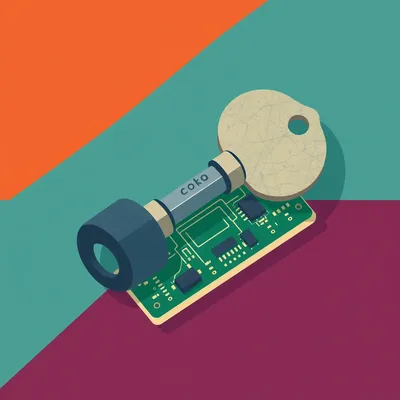
Imagine walking into a suburban bedroom in a quiet neighborhood. Maybe it is in Nashville, or outside of Des Moines, or a leafy street in Seattle. It looks normal enough from the outside, but inside, there are shelves lined with dozens of laptops, all humming with the same low whir of cooling fans. Each one of those machines has a tiny, unassuming plastic box plugged into its side. This isn't a crypto mining rig, and it isn't a hobbyist lab. It is a laptop farm, and it is the physical bridge for the most sophisticated insider threat operation we have seen in decades. Today's prompt from Daniel is about how North Korean operatives are using these hardware setups, specifically something called an IP-KVM, to maintain persistent access to United States infrastructure. It is a wild intersection of geopolitics, miniaturized electronics, and the fundamental trust we place in our hardware.

It is a massive story, Corn. My name is Herman Poppleberry, and I have been digging into the technical reports on this for weeks. What happened in June twenty twenty-five really pulled the curtain back. The Federal Bureau of Investigation executed search warrants on twenty-one premises across fourteen states. They were looking for these laptop farms that were part of a campaign Microsoft calls Jasper Sleet. By the end of that month, they had seized around two hundred laptops across twenty-nine different farms. The scale is what gets me. We are talking about over three hundred companies, including Fortune five hundred firms, that unknowingly hired North Korean IT workers between twenty twenty and twenty twenty-two. And as of March twenty twenty-six, we are still seeing the fallout from these infiltrations.
It sounds like something out of a spy novel, but it is actually quite a practical business model for the Kim regime. The workers aren't sitting in Pyongyang. They are physically located in China, Russia, or Southeast Asia. But they need to look like they are sitting in an apartment in Des Moines or a house in Seattle to keep their high-paying corporate jobs. So they use these US-based facilitators who receive the company-issued laptops, set them up in these farms, and then provide the remote access.
These facilitators are the "mules" of the digital age. They are often just people looking to make a quick buck. They are told they are helping a "startup" manage its remote fleet. They get sent the laptops, they plug them in, they get a monthly fee, and they don't ask questions. But the technical genius, or the terrifying part, is how they handle that remote access. In the past, you might use something like TeamViewer or AnyDesk, which is software-based Remote Monitoring and Management, or RMM. But modern enterprise security, what we call Endpoint Detection and Response or EDR, is really good at spotting that stuff. If a random piece of remote control software starts running on a sensitive workstation, alarms go off. So, the Jasper Sleet operatives moved down the stack to the hardware level. They started using IP-KVM devices.
For the folks who don't spend their weekends in a server room, break down what a KVM actually does. Because the acronym stands for Keyboard, Video, and Mouse, right?
That is it. A traditional KVM switch lets you control multiple computers with one set of peripherals. An IP-KVM takes that and puts it on a network. It captures the video output from the laptop’s HDMI or DisplayPort, and it emulates a physical USB keyboard and mouse. To the laptop, there is no software running. It just thinks a human being has plugged in a monitor and a keyboard and is typing away. It is completely invisible to the operating system's security logs because it is happening at the hardware interface level. It is essentially a "Hardware-as-a-Service" model for espionage.
So the security software is looking for suspicious processes or unauthorized network connections originating from the OS, but the KVM is essentially a ghost. It is pretending to be a human hand and a human eye.
That is the core of the bypass. These devices, like TinyPilot or the open-source PiKVM project, are legitimate tools. System administrators use them all the time to manage servers that are halfway across the world. But in the hands of a threat actor, they are the ultimate backdoor. The laptop sits in a house in the United States, plugged into a residential internet connection so the IP address looks legitimate. The North Korean worker connects to the IP-KVM from abroad, sees the screen, moves the mouse, and does their work. They are committing code, attending meetings, and getting paid six-figure salaries that go straight into the North Korean ballistic missile program.
Let's talk about the specific hardware because this is where it gets really interesting. You mentioned TinyPilot and PiKVM, which are often built on Raspberry Pi boards. But there has been some recent drama with even cheaper, smaller hardware that really highlights the supply chain risk.
You are thinking of the Sipeed NanoKVM. This story broke in December twenty twenty-five and it is a perfect example of the risks we are facing. Sipeed is a company based in Shenzhen, and they released this tiny IP-KVM that costs between thirty and sixty euros. It is remarkably cheap. But a security researcher in Slovenia did a deep dive and found some really disturbing things.
I saw that. They found an undocumented microphone, right?
A surprisingly high-quality microphone. When the researcher asked about it, the company basically said it was for future features or was just a leftover from the hardware development board they used. But it wasn't just the mic. The device had hardcoded encryption keys that were identical across every single unit sold. It was also making routine DNS queries through Chinese servers. So, you have IT professionals buying these cheap devices to manage their own sensitive infrastructure, and they are potentially installing a hardware-level bug with a direct line back to a foreign power. It is the ultimate Trojan horse. You buy a tool to help you secure and manage your systems, and that tool itself is the breach.
It reminds me of the discussion we had in episode twelve hundred thirty about how the most dangerous breaches are the ones that never trigger a public notification because they happen in the shadows of the hardware layer. If the OS doesn't know the device is there, it can't report the breach.
And the Sipeed NanoKVM is just one example. The barrier to entry for this kind of hardware is dropping to almost zero. We are seeing a proliferation of these tiny, powerful single-board computers, or SBCs. The miniaturization is the part that really keeps me up at night. Think about the Raspberry Pi Zero two W. It is sixty-five millimeters by thirty millimeters. That is smaller than a credit card and only about five millimeters thick. It runs a full version of Linux. It has built-in Wi-Fi. You could hide that inside a box of breath mints, or a hollowed-out power brick, or even inside a thick USB cable.
There was an academic paper titled Camouflaged with Size that came out a few years ago that demonstrated how these SBCs could be used for network infiltration with just a few seconds of physical access. It is arXiv eighteen zero nine dot zero four one one two for the listeners who want to look it up.
That paper was prophetic. It showed how an attacker could use a device like a Raspberry Pi Zero to bridge an air-gapped network or exfiltrate data over a covert Wi-Fi channel. And that was years ago. Today, we have even more powerful boards like the Milk-V Duo S or the Orange Pi Zero. These things cost less than a lunch at a fast-food joint, but they have the computing power of a server rack from fifteen years ago.
If you are an IT manager, how do you even defend against that? If someone walks into your server room or even just a cubicle and plugs a Raspberry Pi Zero into the back of a workstation, it can act as a bridge. It can sit there, quiet as a mouse, exfiltrating data over its own Wi-Fi connection or tunneling back out through the company network.
This is why physical security is becoming a massive subset of cybersecurity. We have reached a point where if you can't trust the physical integrity of the device, you can't trust anything that happens on the screen. The MITRE ATT&CK framework actually added a specific sub-technique for this, T twelve nineteen point zero zero three, specifically for Remote Access Hardware. It is an acknowledgment that this isn't just a freak occurrence anymore. It is a standard part of the modern adversary’s toolkit.
The Department of Justice released some staggering numbers on the economic side of this. One indictment from January twenty twenty-five identified two North Korean nationals and three US-based facilitators who generated at least eight hundred sixty-six thousand, two hundred fifty-five dollars from just ten of the sixty-four companies they infiltrated. And that is a tiny slice of the pie. Some estimates suggest these workers generate hundreds of millions of dollars annually for the regime. It is a literal gig economy of treason.
We actually touched on the structure of these state-sponsored gig networks back in episode eight hundred eleven, though that was focused more on Iranian recruitment. This North Korean operation is much more professionalized. These guys are actually good at their jobs. They have to be. If they don't produce high-quality code, they get fired, and the revenue stream disappears. They are using AI-generated profile photos and deepfakes to pass video interviews. They use AI writing tools to smooth over language barriers. It is a full-spectrum digital deception.
It makes me think about the human element. These North Korean workers are often very good, but they have tell-tale signs. They might never want to go on camera. Their commit logs might follow a specific timezone pattern that doesn't match where they claim to be. They might be unusually resistant to certain types of identity verification.
That is where the behavioral analysis comes in. If you are running a company in twenty twenty-six, you have to look for those patterns. But even that is getting harder. I have heard of companies requiring a "live" verification where the employee has to hold up a specific physical object or perform a specific task on camera to prove they aren't a deepfake. But as the AI gets better, even that might not be enough.
So what are the practical takeaways for IT managers and security professionals? If you can't stop hiring remote workers, and you can't weld every USB port shut, what do you do?
It starts with physical inspection protocols. If you are shipping a laptop to a remote employee, you have to verify that it arrived in the state it was sent. Some companies are starting to use tamper-evident seals on the ports. If the seal is broken when the laptop arrives, it is a red flag. But more importantly, you have to look at the network layer for the footprint of an IP-KVM.
Wait, I thought you said they were invisible to the OS?
They are invisible to the OS on the laptop, but they still have to communicate on the local network to get the video out to the North Korean worker. If you see a device on a residential network that is consistently streaming high-bandwidth video data to an IP address in a high-risk jurisdiction, or even just to a known VPN exit node, that is a red flag. Of course, a clever operative will tunnel that traffic through a local VPN or another compromised device in the house, but it is still a signal you can look for.
It brings us back to that visual of the laptop farm. Rows and rows of machines, all working for a regime that is technically at war with the country they are "working" in. It is such a stark contrast to the way we usually think about hacking. We think of people in dark rooms typing fast on glowing green screens. We don't think of a spare bedroom in a ranch-style house in the suburbs with a bunch of laptops sitting on a plastic folding table.
It is the industrialization of the insider threat. And it is not just North Korea. While they are the leaders in this specific "laptop farm" model, other state actors are watching and learning. The miniaturization of SBCs means that a physical implant doesn't have to look like a piece of hardware. It can be integrated into the motherboard, or hidden inside a peripheral that looks completely legitimate. We are moving toward a world where "zero trust" has to extend to the physical layer of the silicon itself.
The Jasper Sleet operation really highlights the dual-use nature of this technology. I love single-board computers. They are incredible for education, for home automation, for building cool projects. You can buy a microcontroller for five dollars that can do things that used to require a workstation. But that same five-dollar chip can be a keylogger, or a network bridge, or a persistent backdoor. We are living in an era where the tools of innovation and the tools of infiltration are exactly the same hardware.
It is a paradox. The same Raspberry Pi that a kid uses to build a weather station is being used to fund a nuclear weapons program. The technology is neutral; it is the intent that matters. And the economics are definitely in favor of the attacker. When you can generate nearly a million dollars from ten employees using sixty-dollar pieces of hardware, the return on investment is astronomical. That money isn't just disappearing into a black hole; it is buying centrifuges and rocket engines. Every time a security team misses one of these workers, they are indirectly contributing to a global security crisis.
It really underscores why we need to be more vigilant about the "boring" parts of security. Physical access, supply chain vetting, and behavioral analysis aren't as flashy as "quantum-resistant encryption" or "AI-driven threat hunting," but they are where the real battles are being fought right now.
The Sipeed NanoKVM situation should be a wake-up call for anyone in IT. If you are buying management hardware, you need to know exactly where it came from and what is inside it. Cheap hardware is expensive if it costs you your entire network. We have to treat every device that plugs into our systems as a potential adversary until proven otherwise.
It is a tough way to live, but in twenty twenty-six, it is the only way to stay secure. We have to assume that the "insider" might not even be in the same hemisphere as the computer they are using. It makes me wonder about the future of the laptop farm. As AI gets better at generating high-quality work, do these physical farms become obsolete? Or do they just become more efficient?
I suspect the physical element will stay for a while because it provides that "last mile" of authenticity. Having a real, company-issued serial number on a real piece of metal sitting in a real house in America is a very strong signal of legitimacy. It is much harder to fake than a virtual machine. But you are right, the AI side will make the workers themselves even harder to spot. Maybe instead of twenty laptops, you have one high-powered server running twenty virtual machines, each with its own hardware-level identity spoofing.
It is a sobering thought. The very devices we use to build the future are being used to undermine it. And the cost of the hardware is so low that even if the FBI busts twenty-nine farms today, fifty more could pop up tomorrow for the price of a few used cars.
It is the ultimate extension of the remote work revolution. We opened the doors to working from anywhere, and some people took that very literally.
Well, on that cheerful note, I think we have covered the depth of the laptop farm rabbit hole. It is a fascinating and terrifying look at how the physical and digital worlds are colliding.
It really is. The power packed into these tiny boards is amazing, but we have to respect the threat they represent. Physical security is no longer just about locks on doors; it is about the ports on your devices.
Thanks to everyone for listening to our deep dive into the Jasper Sleet operations and the world of miniaturized espionage. Big thanks to Modal for providing the GPU credits that power this show.
And a huge thank you to our producer, Hilbert Flumingtop, for keeping the gears turning behind the scenes.
If you enjoyed this exploration of hardware-level threats, you might want to check out episode twelve hundred thirty, where we talked about the limitations of breach notifications and how silent compromises can persist for years.
This has been My Weird Prompts. You can find us at myweirdprompts dot com for our full archive and all the ways to subscribe.
If you are enjoying the show, a quick review on your podcast app really helps us reach new listeners who might be interested in these deep technical dives.
See you next time.
Take care.