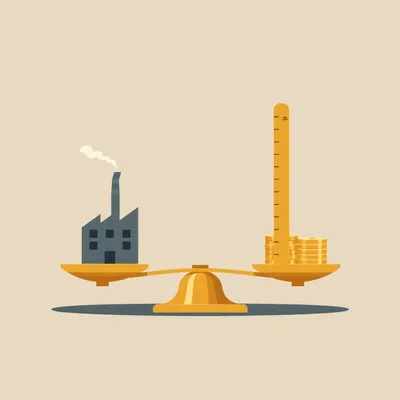
I was looking at a set of financial statements the other day, and it struck me how much of a fiction they actually are. We act like the bottom line is this immutable truth, but it ignores almost everything that actually makes the world go round. Today's prompt from Daniel is about that friction, specifically the move to go beyond carbon footprints and start pricing the rest of the world into the balance sheet.

This represents a significant shift, Corn. I am Herman Poppleberry, and I have been focused on this specific transition for months. We are moving out of the carbon math era, where we at least had a single unit of measurement, and into the era of everything else accounting. It is technically difficult, and the International Foundation for Valuing Impacts, or I-F-V-I, is currently at the center of a loud debate about what a company actually owes society.
You are talking about the I-F-V-I trying to subtract environmental damage directly from earnings before interest, taxes, depreciation, and amortization, or E-B-I-T-D-A. It sounds like a total overhaul of how we define profit. If I am a manufacturing firm and I am suddenly told my air pollution costs more than my net income, that is not just a footnote anymore. That is an existential crisis.
That is the central issue. We have spent the last decade getting somewhat comfortable with the social cost of carbon. As of March twenty-sixth, the Environmental Protection Agency, or E-P-A, has that pegged at two hundred fifteen dollars per metric ton. It is a big number, but it is manageable because carbon is fungible. A ton of carbon emitted in Dublin has the same global warming potential as a ton emitted in Jerusalem. But Daniel's prompt points us toward the fungibility gap, which is where this whole project starts to get complicated.
The fungibility gap. I like that term because it sounds like something an accountant says right before they tell you that you are broke. Explain why carbon is the easy part and why things like water or land use are the difficult scenario for standardization.
Think about it this way. If you emit carbon, the atmosphere mixes it globally and the damage is distributed. But if you consume a billion gallons of water, the impact depends entirely on where you are. If you are in a rainforest, the impact might be negligible. If you are in a drought-stricken basin, you are literally depriving a community of a basic right. You cannot have a global social cost of water the way you have a global social cost of carbon. The I-F-V-I and the Value Balancing Alliance, or V-B-A, just released a technical update on March twelfth addressing this. They are trying to bridge that gap, but the math is hyper-local.
So we are moving from a global commodity approach to a site-specific accounting. That sounds like a data challenge. Most companies barely know where all their Tier three suppliers are, let alone the local water stress levels of every factory. Is the accounting profession actually ready to become the arbiter of local ecological health?
They are being forced into it. There is a divide right now between the International Sustainability Standards Board, or I-S-S-B, and the I-F-V-I. The I-S-S-B is focused on what we call financial materiality. They want to know how the environment risks the company's profits. If a flood hits your factory, that is a financial risk. But George Serafeim, the CEO of the I-F-V-I, is pushing for double materiality. He wants to measure the impact the company has on the world, regardless of whether it hits the company's wallet today.
That is the big philosophical divide. One side says, tell me how the world hurts my business. The other says, tell me how your business hurts the world. And the I-F-V-I wants to put a dollar sign on that hurt. Let's look at the air pollution case Daniel mentioned. The World Health Organization just put out a report this month stating that seven point four million people die prematurely every year due to air pollution. How do you even begin to financialize that on a corporate profit and loss statement, or P-and-L?
You use something called the Social Cost of Atmospheric Release, or S-C-A-R. This is controversial because to calculate S-C-A-R, you have to use a proxy called the Value of a Statistical Life. Currently, United States regulators have that at about eleven point two million dollars. If a company's particulate matter emissions can be statistically linked to three premature deaths, the I-F-V-I methodology would suggest an impact cost of over thirty-three million dollars.
I can see why industry lobbyists are concerned. If you are a mid-sized manufacturing firm with a net income of twenty million dollars, and your air pollution impact is priced at thirty-three million, you are technically operating at a massive societal loss. You are a value destroyer, not a value creator. But Herman, is the Value of a Statistical Life a stable enough metric for a balance sheet? It feels like something that could swing based on which political party is in power or which study you cite.
That is the primary criticism. Critics argue it is too volatile for formal accounting standards. But the counter-argument is that leaving it at zero is a far more inaccurate representation of reality. By pricing it at zero, we are effectively saying those seven point four million lives have no economic value, which we know is false. The Harvard Impact-Weighted Accounts project has shown that for many firms in the industrial sector, these environmental costs actually exceed their entire profit margin. The lack of a compliance market for air pollution, unlike the cap-and-trade systems we see for carbon, creates this disclosure void.
And that void is where the laggards hide. If there is no law saying I have to trade air pollution credits, why would I volunteer to tell the world that my business model relies on eleven million dollar life-units of collateral damage? It seems like the incentives are backwards. The worse your impact, the more you have to gain by staying opaque.
You have hit on the disclosure paradox. The companies with the most to lose are the ones fighting the hardest against transparency. Look at the Taskforce on Nature-related Financial Disclosures, or T-N-F-D. They released data on March fifth showing that only eighteen percent of high-impact firms, specifically in mining, industrial agriculture, and chemicals, are actually disclosing site-specific land-use data. That is less than one in five.
Eighteen percent is low when you consider how long we have been talking about Environmental, Social, and Governance, or E-S-G, and corporate responsibility. It suggests that voluntary disclosure is a failed experiment for the sectors that matter most. If I am a mining company displacing a local community or clearing primary forest, I am not going to provide the evidence for my own prosecution unless a regulator is standing over my shoulder.
And that is why the lobbying battle in the European Union and the United States is so fierce right now. Industry groups are trying to keep impact out of the actual financial statements. They are fine with it being in a separate sustainability report, but they do not want it touching the E-B-I-T-D-A line. Because once it touches E-B-I-T-D-A, it affects executive bonuses, credit ratings, and stock valuations.
It changes the definition of success. Right now, success is how much cash you can extract from a system while externalizing the costs. The I-F-V-I vision is to internalize those costs. But let's go back to the land use issue. Land displacement and biodiversity loss are even harder to price than air pollution. If you cut down a hectare of old-growth forest in the Amazon versus a hectare of secondary forest in Germany, how does the V-B-A methodology distinguish the value?
They look at ecosystem services. They try to calculate the value of the carbon sequestration, the water filtration, the local climate regulation, and even the cultural value. But the uncertainty ranges on those numbers are massive. This is where the technical difficulty really bites. With carbon, we have a relatively tight consensus on the social cost. With biodiversity, you might have five different models giving you five different orders of magnitude.
If the underlying data is that unstable, aren't we just opening the door for a new kind of greenwashing? A company could just pick the impact model that makes them look the least destructive.
This is why the joint technical update from the I-F-V-I and V-B-A on March twelfth is so important. They are trying to standardize the models. They are saying, if you are going to report impact, you have to use these specific coefficients. It is an attempt to take the choice away from the company and put it into a standardized framework. It is not perfect, but it is better than the current situation where everyone just makes up their own narrative.
I wonder about the political economy of this. We are seeing a lot of pushback against E-S-G in certain parts of the United States. If the I-F-V-I is seen as this globalist body trying to tax American industry through the back door of accounting standards, how does it ever get adopted? Especially if it relies on a Value of a Statistical Life metric that feels like an arbitrary calculation.
The adoption will likely come through the capital markets first. Large institutional investors are starting to realize that environmental impact is a leading indicator of future regulatory risk. If a company has a massive S-C-A-R metric, even if it is not paying for it today, an investor knows that eventually, a government will step in and tax that pollution. So the investors are the ones demanding this data so they can price that future liability today.
So it is a shadow tax before it becomes a real tax. The investors use the I-F-V-I data to discount the stock price, which effectively raises the cost of capital for the polluter. That is an elegant market mechanism, assuming the data is actually available. But we are back to that eighteen percent disclosure rate. How do you get the data from a company that refuses to give it?
You use satellite imagery and machine learning. We are seeing a rise in third-party providers who do not wait for the company to disclose. They use geospatial data to track land-use changes, they use sensors to monitor air quality around factories, and they use water stress maps to estimate consumption. The era of being able to hide your impact is ending because the world is becoming too transparent to ignore.
That is a notable development. The accounting of the future isn't just about looking at a ledger provided by the Chief Financial Officer. It is about an analyst looking at a satellite feed and saying, I don't care what your report says, I can see the forest disappearing in real-time. It turns accounting into a branch of earth science.
The profession is definitely integrating environmental data into its core methodology. And that brings us to the practical takeaways for anyone following this. If you are an investor or an analyst, you have to start looking at the footnotes. There are hidden liabilities in these reports that haven't hit the income statement yet but are lurking in the environmental data. You need to be tracking the I-F-V-I and V-B-A technical updates because those shifts in how impact is quantified will eventually dictate which companies are seen as viable in a resource-constrained world.
It also means we need to be much more critical of the term net zero. If a company is net zero on carbon but is absolutely devastating local water tables or killing thousands of people through particulate matter, calling them sustainable is a lie. We have to stop letting carbon be the one metric that rules them all. It is a useful proxy, but it is a narrow one.
The shift from voluntary to mandatory disclosure is the next big hurdle. We are seeing the European Union move in that direction with the Corporate Sustainability Reporting Directive, and even with the pushback, the momentum seems irreversible. The question is whether the standards can be harmonized fast enough to prevent companies from just jurisdiction-shopping for the weakest accounting rules.
It is the same old game, just with higher stakes. Instead of hiding profits in the Cayman Islands, you hide your air pollution in a country with no monitoring stations. But as you said, the satellites are watching. Herman, do you think the accounting profession is actually capable of this? These are people trained in double-entry bookkeeping, not atmospheric chemistry or ecology. It feels like a massive skill gap.
The major accounting firms are already pivoting their recruitment. They are hiring ecologists, data scientists, and public health experts. The audit of the future is going to look a lot more like a scientific peer review than a financial check. It is an exciting time, but it is also high-stakes because if we get the math wrong, we end up misallocating billions of dollars of capital.
I keep coming back to the philosophical weight of this. If we can't agree on the price of a human life or the value of a hectare of land, can we ever truly have impact-weighted accounting? Or are we just creating a more sophisticated way to lie to ourselves about the cost of our lifestyle?
I think we have to accept that the numbers will never be perfect. But as the saying goes, it is better to be roughly right than precisely wrong. Right now, by pricing these things at zero, we are precisely wrong. Moving to a model where we acknowledge a social cost of carbon at two hundred fifteen dollars and a value of life at eleven million is an attempt to be roughly right. It is an admission that our economy exists within a physical world, not in a vacuum.
It is a move toward honesty, even if it is a messy, complicated kind of honesty. I think we have covered the technical and political hurdles pretty thoroughly. It is a lot to digest, but the bottom line is that the balance sheet is finally growing a conscience, whether the companies like it or not.
And that conscience is backed by some very heavy data. If you want to dive deeper into how we got here, I highly recommend checking out episode thirteen thirty-eight where we talked about the rise of impact-weighted profits and the early history of the I-F-V-I. It provides a lot of the foundational context for why George Serafeim is pushing this so hard now.
That is a good one to revisit. We also did a deep dive on why even the easy part of this, the carbon math, is still a bit of a disaster in episode thirteen forty-seven. It is worth a listen if you think the transition to everything else accounting is going to be smooth. Spoiler alert, it won't be.
Not at all. But it is the work that needs to be done. We are finally starting to treat the planet like it is part of the economy, which is a fairly radical idea when you think about it.
Radical and long overdue. Well, I think that is a solid place to wrap this one up. We have peered into the fungibility gap and lived to tell the tale.
It was a pleasure, Corn. This topic really highlights the intersection of technical standards and global ethics.
Thanks as always to our producer Hilbert Flumingtop for keeping the production running. And a big thanks to Modal for providing the Graphics Processing Unit, or G-P-U, credits that power the research and generation behind this show.
This has been My Weird Prompts. If you are enjoying these deep dives into the weird corners of tech and policy, a quick review on your podcast app really helps us reach new listeners who might be looking for this kind of substance.
You can find us at myweirdprompts dot com for the full archive and all the ways to subscribe. See you next time.
Goodbye.