Hey everyone, welcome back to My Weird Prompts. I am Corn, and I am joined as always by my brother.

Herman Poppleberry, present and accounted for. And we have got a heavy hitter today. Our housemate Daniel sent over an audio prompt about a book he has been reading called Shrinks: The Untold Story of Psychiatry by Jeffrey Lieberman. It is a fascinating look at the history of a field that, frankly, has had a pretty rocky road to respectability in the medical world.
Yeah, Daniel was pointing out something really striking from the book. Psychiatry is in this unique, and honestly kind of difficult, position because it lacks the objective diagnostic tools that other branches of medicine take for granted. If you think you have a broken leg, you get an X-ray. If you think you have diabetes, you get a blood sugar test. But if you are experiencing profound despair or hearing voices, there is no blood test for that. Even now, in February of two thousand twenty-six, while we are seeing some incredible research into biomarkers for depression, there is still no brain scan that can definitively say, yes, this is exactly what is happening at a molecular level for every patient.
Right. It is what Lieberman calls the "shame" of psychiatry—this historical struggle to be seen as a "real" science. And the other part of Daniel's question was about the timeline. Modern psychiatric drugs are incredibly recent. Thorazine, which was the first real antipsychotic, only hit the scene in the nineteen fifties. Before that, we are talking about a very different world. Daniel was asking, what happened to people before then? Was it just asylums and prayers, or did they have other tools in the shed?
It is a sobering question. Because we are not talking about ancient history here. The nineteen forties are within living memory. My grandfather was a young man then. So, if someone in nineteen thirty had what we now call a major depressive disorder or schizophrenia, what was the "standard of care"? Because it definitely was not a bottle of Prozac or Abilify.
It is a grim picture, Corn, but also a deeply human one. Doctors were desperate. Families were desperate. And when you are desperate, you try things that, in hindsight, look like torture. But before we get into the "heroic" treatments of the twentieth century, we have to understand the nineteenth-century asylum movement. Because for a long time, the "treatment" was actually just the environment itself.
Right, the "Moral Treatment" era. I remember we touched on this briefly when we were discussing the history of social architecture a few hundred episodes ago. The idea was that the chaos of the modern world, the "civilization" of the industrial revolution, was what was driving people mad. So, the cure was to take them out of that environment and put them in a quiet, pastoral setting with structure and manual labor.
Yes. Philippe Pinel in France and William Tuke in England were the pioneers there. They literally unchained people. Before them, if you were "mad," you might be kept in a cellar or a cage. Pinel and Tuke said, no, these are human beings. If we treat them with dignity, give them fresh air, and keep them busy with gardening or weaving, their minds will heal. And for a while, it actually seemed to work. The early asylums were often small, family-like institutions.
But then the population exploded, right?
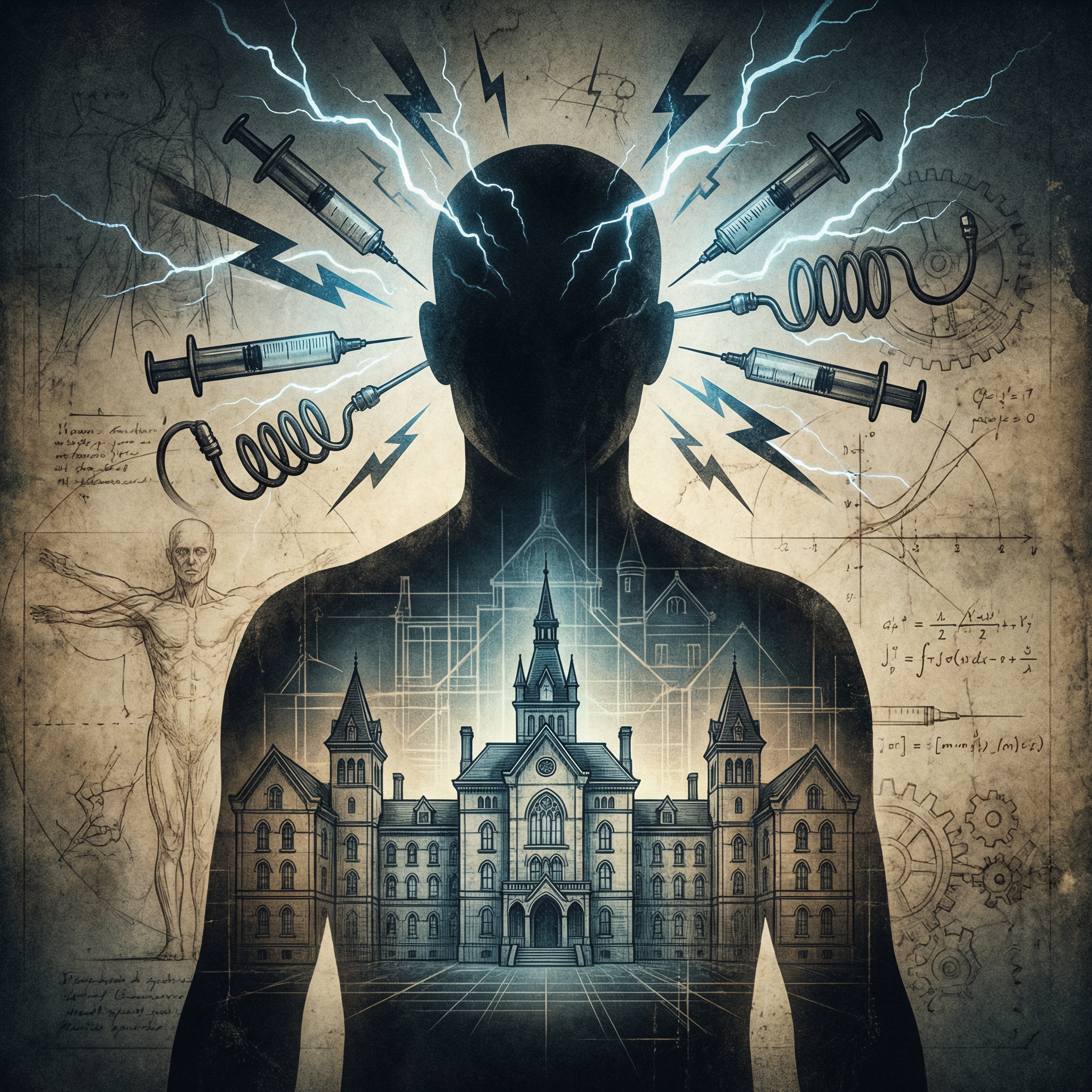
That was the tragedy of the asylum. It was a victim of its own perceived success. By the mid-to-late eighteen hundreds, these institutions were completely overwhelmed. What was supposed to be a peaceful retreat for thirty people became a warehouse for three thousand. This is when we see the rise of the Kirkbride Plan buildings—those massive, bat-wing shaped stone structures designed to maximize sunlight, but which eventually became overcrowded nightmares. Once you have three thousand people in a building designed for a fraction of that, "moral treatment" goes out the window. It becomes about management, containment, and, unfortunately, neglect.
This is where that building Daniel mentioned in Cork, Ireland, comes in. That would be Our Lady’s Hospital, formerly the Eglinton Asylum. It was the longest building in Ireland—nearly a quarter of a mile long. These massive, imposing Victorian structures were built with the best of intentions, but they became these dark, crowded places where people were often forgotten. But even in those warehouses, doctors were trying to do something. They were not just sitting there watching people suffer. They were experimenting.
Oh, they were experimenting alright. And this is where it gets really intense. If you look at the period between nineteen hundred and nineteen fifty, it is often called the era of "physical" or "biological" psychiatry. Doctors were convinced that if they could just "shock" the system, they could reboot the brain.
I have read about some of these. One of the big ones was hydrotherapy, right? Which sounds like a spa treatment, but it really was not.
Not at all. Hydrotherapy could mean the "wet sheet pack," where a patient was wrapped tightly in freezing cold, wet sheets like a mummy for hours. Or it could mean being strapped into a bathtub for days at a time with a canvas cover over you, with water kept at a specific temperature to "calm" the nerves. Or the opposite: "needle showers" where high-pressure cold water was blasted at the patient. The idea was that the physical sensation would distract the mind or reset the circulatory system.
And then there was the fever therapy. I think that one actually won a Nobel Prize?
It did! Julius Wagner-Jauregg won the Nobel Prize in Medicine in nineteen twenty-seven for "malariotherapy." It sounds insane now, but at the time, neurosyphilis was a huge cause of mental illness. It was a death sentence. Wagner-Jauregg noticed that patients with psychosis sometimes improved after they had a high fever. So, he intentionally infected psychiatric patients with malaria to give them a high fever, which would kill the syphilis bacteria. Then he would treat the malaria with quinine. It actually worked for some people, which gave doctors this huge boost of confidence. They thought, okay, we can cure mental illness with physical intervention.
But that led to much more dangerous "shocks." Like the insulin coma therapy. Can you walk us through that? Because that sounds incredibly risky.
It was terrifyingly risky. Manfred Sakel, a Viennese psychiatrist, started this in the early nineteen thirties. He would inject patients with massive doses of insulin to plummet their blood sugar until they went into a deep coma. Then, after an hour or so, he would "bring them back" by giving them glucose, either through a tube or an injection. He claimed it "cleared" the minds of people with schizophrenia.
Why did they think a coma would help schizophrenia?
The theory was pretty hand-wavy. Something about "resetting" the metabolic rate of the brain. But the reality was that it was incredibly dangerous. Mortality rates were sometimes as high as ten percent. People had massive seizures or suffered permanent brain damage. But because there was literally nothing else to offer, and because some patients did seem more manageable or less agitated afterward, it became a standard treatment in asylums all over the world for twenty years.
It is amazing how much of this was driven by the sheer desperation of the doctors. Imagine being a psychiatrist in nineteen forty. You have a ward full of people who are suffering, screaming, or catatonic. You have no pills. You have no way to talk them out of a delusion. You are going to try anything that offers even a glimmer of hope.
And that desperation led to the most infamous one of all: the lobotomy. Egas Moniz, a Portuguese neurologist, developed the leucotomy in nineteen thirty-five. He thought that mental illness was caused by "fixed circuits" in the frontal lobes. So, he decided to physically sever those connections. He also won a Nobel Prize for this, by the way, in nineteen forty-nine.
And then Walter Freeman took it to the extreme in the United States with the "ice pick" lobotomy.
Yeah, Freeman was a true believer. He thought he could solve the overcrowding in asylums by performing these quick, transorbital lobotomies. He would literally go through the eye socket with a tool that looked like an ice pick and wiggle it around to sever the frontal fibers. He did thousands of them. He had a "Lobotomobile" and traveled the country. It is one of the darkest chapters in medical history because, while it did stop the agitation, it often left people as "human vegetables," as their families would later describe them. They lost their personality, their spark, their drive.
It is easy for us to look back and judge, but as you said, the context was a total lack of alternatives. But I want to push back on one thing Daniel asked. He asked if there were no medications at all before Thorazine. Were there really zero pills?
That's a good point. There were drugs, but they were not "psychiatric" drugs in the sense we think of them today. They were mostly sedatives. We are talking about things like bromides, chloral hydrate, and paraldehyde.
Paraldehyde? I think I have heard of that in old movies.
It smells terrible. Like old, rotting fruit. Doctors used it to basically knock people out. If a patient was having a violent psychotic episode, they would give them a heavy sedative to put them to sleep. It did not treat the underlying condition; it just managed the behavior. There were also things like laudanum, which is basically an opium tincture. It was used for everything from "melancholia" to "nerves." But obviously, that led to massive addiction problems.
What about for things like depression or A D H D? Because the "rest cure" was the big thing for depression for a long time, right? The Silas Weir Mitchell approach?
That's right. The "rest cure" was primarily for women diagnosed with "neurasthenia" or "hysteria," which we would now likely categorize as depression or anxiety. The treatment was: stay in bed, do not read, do not write, do not see anyone, and eat a lot of fatty foods. It was meant to "recharge" the nervous system. Charlotte Perkins Gilman wrote a famous short story called The Yellow Wallpaper about how this treatment basically drove her insane.
It is interesting because it is the exact opposite of what we tell people to do for depression now. Now we say: get exercise, stay social, find meaning, stay active. The rest cure was basically forced sensory deprivation.
And for A D H D, which obviously was not called that then, you just had the "fidgety child." There was no medical treatment until nineteen thirty-seven, when Charles Bradley accidentally discovered that Benzedrine—an amphetamine—helped children with behavioral issues focus. But that did not really become a mainstream "standard of care" until much later. Before that, those kids were usually just considered "bad" or "lazy" and were punished or eventually dropped out of school.
So, before nineteen fifty, if you had O C D or a panic disorder, you were basically on your own?
For the most part, yes. If you were wealthy, you might see a psychoanalyst. This is the other side of the coin. While the asylums were doing hydrotherapy and lobotomies, the elite were doing Freud. Psychoanalysis was the "talk therapy" of the era. But it was incredibly expensive, it took years, and it was mostly focused on the "worried well"—people with neuroses rather than severe psychosis. If you had severe schizophrenia, psychoanalysis was generally considered useless.
This really highlights why Thorazine was such a revolution. It was not just another sedative. It was something different.
It was the "chemical lobotomy," as some people called it, but in a good way. It was the first "major tranquilizer." Chlorpromazine, which is the generic name for Thorazine, was originally developed as an antihistamine. But a French surgeon named Henri Laborit noticed that it made patients feel "disinterested" in their surgery. They were awake, but they did not care. He suggested psychiatrists try it in nineteen fifty-two.
And the results were immediate, right?
It was like a miracle. People who had been catatonic for years started talking. People who had been screaming at voices in their heads became calm and could hold a conversation. It allowed for "deinstitutionalization." For the first time, you could give someone a pill and they could potentially go home. They did not have to be locked in a Victorian warehouse in Cork for the rest of their lives.
But that also led to its own set of problems, which we have seen play out over the last seventy years. We closed the asylums, but we did not always provide the community support people needed. Many of those people ended up homeless or in prison.
You're right. The "pharmaceutical revolution" was a double-edged sword. It gave us a way to treat symptoms, but it also let us ignore the social and environmental factors that contribute to mental health. And, going back to Lieberman's point that Daniel mentioned, we still do not have that objective test. Even with all our drugs, we are still largely diagnosing based on symptoms and self-reporting.
That is the part that fascinates me. We have moved from "humors" and "vapors" to "chemical imbalances," but even that term "chemical imbalance" is now being criticized as too simplistic. It is like we are still groping in the dark, just with better flashlights.
I love that analogy. We are definitely in the flashlight era. We have brain imaging like functional M R I and P E T scans, which can show us activity, but they are still not diagnostic tools for an individual patient. You cannot go to your doctor, get a scan, and have them say, "Ah, I see your dorsal anterior cingulate cortex is underactive, you have exactly twelve units of Major Depressive Disorder." It just doesn't work that way yet.
Why is it so much harder for the brain than for, say, the liver?
Because the brain is the most complex object in the known universe! It has eighty-six billion neurons and hundreds of trillions of synapses. And mental illness isn't just a "broken part." It's a functional issue. It's about how those billions of cells are communicating, or not communicating, in real-time. It's like trying to diagnose a software bug by looking at the hardware of a computer with a magnifying glass. You can see if the motherboard is fried, but you can't see why the operating system is crashing just by looking at the silicon.
That's a good way to put it. So, what did people do for O C D before the nineteen fifties? Because that is a very specific, agonizing condition. If you are washing your hands a hundred times a day in nineteen twenty, what does the doctor tell you?
Honestly, they might tell you it was "scrupulosity"—a religious obsession. Or they might call it "obsessional neurosis." The treatment would likely be psychoanalysis, trying to find some repressed childhood trauma that caused the behavior. And if that didn't work—and it often didn't for O C D—you were just seen as an eccentric or, in severe cases, you ended up in the asylum where you might get the "shocks" we talked about. There was no Prozac to turn down the volume on those intrusive thoughts.
It makes me think about the "lost generations." All the people throughout history who had these conditions and were just... lost. They were the "village idiot," or the "hermit," or the "madwoman in the attic." Or they were the people Daniel mentioned, placed in asylums like the one in Cork, which were reputed to be haunted. And honestly, if you think about the suffering that happened in those places—the insulin comas, the ice baths, the lobotomies—it is no wonder people think they are haunted.
The trauma is baked into the walls of those buildings. But I think it's also important to remember the "aha" moments. Like the discovery of Lithium. That was another huge one that happened right around the same time as Thorazine. John Cade, an Australian psychiatrist, discovered it in nineteen forty-eight. He was actually looking at uric acid and used lithium urate as a control, and he noticed it made his guinea pigs really calm.
Guinea pigs?
Yeah, he was doing experiments in a kitchen, basically. He then tried it on himself to make sure it wasn't toxic, and then he gave it to a patient who had been in a state of manic excitement for five years. Within weeks, the man was back at his job. Lithium is a simple salt! It's an element on the periodic table. And it's still one of the most effective treatments for bipolar disorder today. That discovery was purely accidental, but it changed everything for people with mania.
It is amazing how much of medical history is just "stumbling into things." But it also makes me wonder what we will look back on in fifty years and think was barbaric. Will we look back at our current antidepressants and think, "I can't believe they just flooded the whole brain with serotonin"?
Oh, I'm almost certain of it. We're already seeing a shift toward more targeted treatments. Things like Transcranial Magnetic Stimulation or ketamine infusions for treatment-resistant depression. We're starting to look at the brain as a circuit that needs tuning rather than a soup that needs more salt.
I like that. "Tuning the circuit versus salting the soup." That is very Herman Poppleberry of you.
I try. But seriously, the second-order effects of this history are everywhere. The stigma that Daniel mentioned? That comes directly from this era of "warehousing." When you take people with mental illness and hide them away in massive, scary buildings on the edge of town, you are sending a message that they are "other," that they are dangerous, and that they are beyond help. We are still fighting that legacy today.
And the fact that we don't have those objective tests—those blood tests or X-rays—contributes to the stigma too. People still hear things like "it's all in your head," as if that means it isn't real. But as we always say, the head is where the brain lives! It's a biological organ.
That's the key. If your pancreas stops producing insulin, nobody says "it's all in your abdomen, just think your way out of it." But because we can't "see" the depression on a scan yet, there's this lingering societal doubt. Lieberman's book is so important because it shows that psychiatry is trying to bridge that gap. It's moving from a world of "philosophy and asylums" to a world of "neuroscience and medicine."
So, let's talk about some practical takeaways. If someone is listening to this and they are struggling, or they know someone who is, what does this history tell us about the present?
First, it should give us an incredible sense of gratitude for how far we've come. We are not doing lobotomies. We are not doing insulin comas. The medications we have now, while imperfect, are infinitely safer and more effective than anything available in nineteen forty. Second, it tells us that "treatment" is a moving target. If one thing doesn't work, don't give up. The field is evolving faster than ever.
And I think it also tells us to be patient with the process. Because there is no "blood test" yet, your doctor has to work with you to find the right fit. It's a collaborative exploration. It's not a failure of the doctor or the patient if the first medication doesn't work; it's just the nature of the complexity we're dealing with.
Totally. And the third thing is that environment still matters. The "Moral Treatment" pioneers weren't entirely wrong. While they couldn't cure schizophrenia with gardening, we know that social support, stable housing, and meaningful activity are crucial for recovery. We can't just throw pills at a problem and expect the environment not to matter.
That is such an important point. We went from "only environment" to "only biological shocks" to "mostly pills," and now we are hopefully landing in a place that integrates all of it. The "bio-psycho-social" model, as they call it.
Right. You need the biology—the medications to stabilize the system. You need the psychology—the therapy to process the experience. And you need the social—the community to provide the structure and support.
I want to go back to the A D H D and O C D mention in Daniel's prompt. It is interesting to think about how those conditions might have actually been beneficial in certain historical contexts. If you have "hyper-focus" or "high-vigilance," maybe you were a great scout or a great craftsman. It's only when we put everyone in a standardized classroom or a nine-to-five office job that those traits become "disorders."
That's the "evolutionary psychiatry" perspective. Some of these traits might have been adaptive in our ancestral environment. But in a modern, highly structured society, they become a mismatch. It doesn't mean the person is "broken," it means the environment is a poor fit for their specific brain wiring.
This has been a really deep dive. It's a bit heavy, but I think it's so necessary to understand where we came from to appreciate where we are. Daniel, thanks for sending this one in. It definitely made us think.
Yeah, Jeffrey Lieberman's book is a great resource if anyone wants to go even deeper. It's called Shrinks: The Untold Story of Psychiatry. It really puts the "weird" in My Weird Prompts.
It really does. And hey, before we wrap up, if you are enjoying these deep dives and the brotherly banter, we would really appreciate it if you could leave us a review on your podcast app or on Spotify. It genuinely helps other people find the show and keeps us motivated to keep digging into these topics.
Yeah, it really does make a difference. We see every one of them.
You can find all of our past episodes—all five hundred twenty-one of them now—at our website. There is an R S S feed there, and a contact form if you want to send us a prompt like Daniel did. We are also on Spotify and most other podcast platforms.
This has been My Weird Prompts. I'm Herman Poppleberry.
And I'm Corn. Thanks for listening, and we will talk to you in the next one.
Goodbye everyone.