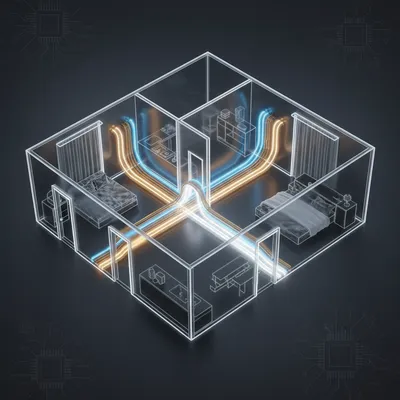
Imagine you are standing in the lobby of a thirty-story luxury apartment building in the heart of Jerusalem. It is Friday night. The sun has set, and for the next twenty-five hours, you are stepping into what is effectively the world's oldest digital detox. But here is the catch. You live on the twenty-ninth floor. You cannot use the stairs because you have three small children and a week's worth of groceries, and the Torah prohibits you from pressing a button to call the elevator because that would complete an electrical circuit. This is the paradox of modern observance. We live in a world designed for instant responsiveness, but for one day a week, a significant portion of the population has to figure out how to live in a smart building that they are technically not allowed to talk to.

It is the ultimate collision of ancient law and modern engineering. I am Herman Poppleberry, and today's prompt from Daniel is about that exact tension. He wants us to look at how Orthodox Jewish communities navigate the world of smart homes, high-rises, and security tech while staying true to laws that were codified thousands of years before the first light bulb ever flickered. We are talking about a three-thousand-year-old tradition meeting twenty twenty-six hardware.
Before we dive into the deep end of halachic engineering, we should probably put out a very clear disclaimer. Neither Herman nor I are rabbis. We are not religious authorities. We are just two brothers who love dissecting complex systems and looking at the weird ways humans adapt to constraints. If you have a practical question about your own observance, you definitely need to talk to your local rabbi. We are here for the technical and philosophical exploration of how these systems actually function.
And what an exploration it is. Most people think of Shabbat as just a day of rest, which it is, but in Jewish law, or Halacha, the focus is on refraining from thirty-nine specific categories of creative labor called melachot. These were derived from the tasks required to build the Tabernacle in the desert. We are talking about things like sowing, reaping, weaving, and, crucially for our discussion, lighting a fire or building a structure.
Right, but electricity is not explicitly mentioned in the Bible for obvious reasons. There were no lithium-ion batteries in the Sinai. So, how did we get from "do not light a fire in your dwellings on the Sabbath" to "I cannot walk past a motion-activated doorbell"?
That is the core of the debate. When electricity first started appearing in homes, the great legal minds had to figure out which category it fell into. Some, like the Chazon Ish, who was Rabbi Avraham Karelitz, argued that closing a circuit is a form of boneh, or building. You are completing a functional entity. Others argued it was a form of esh, or fire, especially with incandescent bulbs where a filament glows. Then you have Rabbi Shlomo Zalman Auerbach, who suggested it might be a new category altogether called molid, which is creating a new entity that did not exist before. There is even the concept of makeh b'patish, the "final hammer blow," which refers to completing a functional object.
It feels like the rabbis were essentially doing early-century systems analysis. They were trying to map a new phenomenon onto an existing logical framework. But as technology got more complex, the mapping got harder. It is one thing to avoid a light switch. It is another thing to avoid a sensor you do not even know is there.
This is where the Zomet Institute comes in. They are based in Alon Shvut, in Gush Etzion, and they are basically the premier halachic engineering firm in the world. They were founded by Rabbi Yisrael Rosen, and their whole mission is to find high-tech solutions for these low-tech constraints. They do not look for loopholes; they look for engineering workarounds that respect the technical definitions of the law. They have a science center there that is basically a playground for halachic tech.
One of the biggest tools in their shed is something called grama, or indirect causation. I remember you explaining this to me once, but give me the refresher. How do you make an action "indirect" in a world of instant signals?
In Halacha, if you do an action and the result happens immediately, you are responsible. But if there is a significant delay or a secondary mechanism that actually triggers the event, it is often viewed differently, especially in cases of great need like medical or security situations. Zomet engineers circuits that operate on a cycle. Imagine a light that checks its own status every few seconds. When you "flip the switch," you are not actually sending power to the bulb. Instead, you are just moving a plastic tab that the system will notice the next time it runs its internal check. The human action is just a passive state change that the machine eventually reacts to on its own schedule.
So it is like the difference between pushing someone into a pool and opening a gate that might eventually let water flow into the pool?
That is a great way to put it. You are not the direct cause of the result. This principle is what allows for things like the Shabbat elevator. You mentioned that twenty-ninth-floor apartment. In two thousand one, the Knesset actually passed a law requiring new residential buildings with multiple elevators to have a Shabbat mode.
I have seen these. They just stop at every floor automatically, right? You just stand there and wait for the doors to open and close. It feels like the ultimate "dumb" tech solution.
On the surface, yes. But the engineering is actually much deeper. Even if you do not press a button, your weight matters. When you step into an elevator, the motor has to work harder to lift you up, or the braking system has to work harder to lower you down. That change in weight causes a change in the electrical current the motor draws. Some strict authorities, like the late Rabbi Yosef Shalom Elyashiv, argued that this increase in current is a violation of the law. He was very skeptical of these technological workarounds.
Wait, so even just being heavy is a problem? That feels like a tough break for anyone who enjoys a good Friday night meal.
It is a real concern! The Zomet-certified elevators use specific controllers that mask the weight fluctuations or use timing mechanisms so that the motor's power draw is not directly reactive to the passenger in a way that violates the prohibition. It is all about decoupling the human presence from the electrical response. This has massive implications for the Haredi housing crisis in Israel. If you cannot use an elevator, you cannot live in a high-rise. But the Sephardi Chief Rabbi recently clarified that certified Shabbat elevators are permitted, which literally opens up thousands of apartments in Jerusalem and Bnei Brak to families who were previously locked out of the vertical housing market.
That is a second-order effect I had not considered. Technology, or the halachic adaptation of it, is actually driving urban planning and real estate prices. It is wild how much effort goes into making a piece of technology act like it does not know you are there. We spent years making tech more responsive, more "smart," and for Shabbat, we are essentially trying to make it "dumb" again, or at least indifferent.
Indifference is the goal. We actually touched on some of the underlying electrical infrastructure issues in Israel back in episode four hundred fifty-four, where we talked about the sixteen-amp ceiling. When you add these complex Shabbat controllers to an already strained grid, the engineering has to be incredibly precise. You cannot just slap a timer on a high-voltage motor and hope for the best.
What about the security side of things? Daniel mentioned the Western Wall, the Kotel. That is one of the most heavily surveyed spots on the planet. If you are a religious Jew walking there on a Saturday, you are being captured by dozens of cameras. Is that a problem?
It was a massive problem for a long time. Rabbi Elyashiv actually prohibited visiting the Kotel on Shabbat at one point because of the cameras. The concern was two-fold. First, your image is being "written" to a hard drive, which could be a violation of the ban on writing. Second, your movement might trigger a motion sensor that activates a light or a higher frame rate on the recording.
So how did they fix it? You cannot just turn off the security at a holy site in twenty twenty-six.
Zomet worked with the security teams to reconfigure the system. They set the cameras to record in a continuous loop where the data is automatically overwritten within a very short window unless a human security guard manually intervenes for a real threat. Because the data is temporary and the recording is "passive" and continuous, it moves the act out of the realm of prohibited "writing." They also used those grama-based metal detectors we talked about earlier. The detector is constantly "scanning" on a cycle, and your presence just slightly alters the baseline that the machine checks on its own.
It is funny how these solutions are basically just very clever buffer management and signal delay. It is like the engineers are playing a game of "I am not touching you" with the law.
But it is a game with very high stakes. Let's pivot to the smart home, because that is where the average person is really feeling the friction. Daniel's prompt mentioned the smart alarm that sends a signal when you open a door. That is a classic P-I-R sensor problem. Passive Infrared.
These things are everywhere now. My thermostat knows when I walk into the room. My lights turn on when I enter the hallway. In a normal week, that is great. On Shabbat, it is a legal minefield.
It is a minefield because of the "unintended consequence" rule, or Pesik Reisha. If I open a door to let some air in, and that action triggers a sensor that logs my entry in a cloud database and turns on a porch light, I have performed a melacha even if I did not "intend" to. In episode four hundred sixty-one, we talked about whether a DIY smart home is actually secure, but for an observant Jew, the question is whether it is actually "Sabbath-compliant."
I assume the answer for most off-the-shelf stuff is a hard "no."
Mostly. If you have a Nest or an Ecobee thermostat, it has a proximity sensor. If you walk past it to go to the kitchen, the screen wakes up. That is a direct electrical result of your movement. To be compliant, you have to go into the settings and disable all those features before Friday evening. But as these devices get "smarter," they get harder to lobotomize. They are designed to be "always on" and "always sensing."
This is why we see "Sabbath Mode" appearing on major appliances now, right? I have seen the Star K logo on refrigerators and ovens from Samsung and Whirlpool.
Star K is one of the big certification agencies that works with manufacturers. A "Sabbath Mode" on a fridge is not just a timer. It disables the light, obviously, but it also prevents the compressor from kicking in immediately when it senses a temperature drop from the door opening. It might also disable the digital display and the ice maker. On an oven, it prevents the auto-shutoff after twelve hours and disables all the tones and icons. It is about locking the device into a static state.
What about the "writing" problem? Every time a sensor trips, it creates a log entry. If you are using a cloud-based system like Alexa or Google Home, that data is being sent to a server and written to a database.
That is one of the reasons the Conservative movement's Rabbi Daniel Nevins issued a famous responsa in twenty-twelve. He argued that while you could use lights or fans, you should avoid digital devices that generate data because that violates the rabbinic ban on writing. In the Orthodox world, the ban on voice assistants is even stricter. Rabbis like Moshe Feinstein ruled long ago that speech that triggers an electrical action is the equivalent of "one's arrows." If you tell Alexa to turn off the lights, you are the direct cause of that circuit closing. You are essentially firing an arrow of sound that hits a digital target.
I love the idea of Alexa commands being compared to arrows. It is a very vivid way of looking at causation. But what if the home is just doing its own thing? If I set a complex series of automations on Thursday—lights at sunset, A-C at ten P-M, slow cooker on Saturday morning—is that okay?
Generally, yes. That is the "Shabbat clock" or timer principle. If the action was set in motion before the day began, the machine is just continuing its work. It is like a fire you lit on Friday that keeps burning. The challenge with modern I-O-T is that these systems are rarely truly "set and forget." They are constantly polling, updating, and reacting. If your smart home system updates its firmware on Saturday morning and that causes a light to flicker, did you cause that?
It feels like we are reaching a point where the only way to truly observe the spirit of the day is to go completely analog, or to have a very expensive, custom-engineered home.
And that is a major philosophical debate within the community. Is halachic engineering an authentic way to live, or does it undermine the "spirit" of the day? If you spend your whole Saturday in a home that is perfectly automated to serve your every need without you ever touching a switch, are you really "resting" in the way the Torah intended? Some argue that the "intent firewall" Zomet builds into their hardware is actually a beautiful thing. It allows humans to live in the modern world without being slaves to its immediate responsiveness.
I can see both sides. On one hand, the tech makes the ritual easier to maintain in a modern world. On the other hand, the friction of the day is kind of the point. The fact that you cannot just press a button is what makes the day different from the other six. It forces a different kind of mindfulness.
I mean, it is the difference between a "digital detox" and just having your phone taken away. One is a choice to disconnect; the other is a technical constraint. It is also worth noting the specific technical hurdles with things like smart doorbells. If someone rings your Ring doorbell on Shabbat, your phone is going to buzz. You did not ask them to ring it, but your device is now reacting.
This is making me realize how much "invisible" work our homes are doing all the time. We talked about this a bit in episode one thousand fifty-two when we discussed the Hebrew calendar and Unix epochs. We live in these overlapping systems of time and logic that we usually ignore until they crash into each other.
It is a perfect example of why this show is called "My Weird Prompts." This is a deeply weird, deeply specific intersection of disciplines. You have guys in Alon Shvut looking at oscilloscope readings to see if a human's weight on an elevator cable causes a "significant" enough change in voltage to count as a violation of a three-thousand-year-old law. It is basically the ultimate edge-case debugging.
For the tech-savvy listener who wants to implement this, what are the actual takeaways? If you are trying to build a "Sabbath-compliant" smart home, where do you start?
First, understand the difference between "passive" automation and "reactive" automation. Timers are your best friend. Sensors are your enemy. If you are buying appliances, look for that Star K certification. It means the manufacturer has actually worked with engineers to ensure the digital logic of the machine respects these rules. Second, look for systems that can be hardware-locked into a "manual" mode. You want to be able to "lobotomize" the smart features for twenty-five hours.
And what about the "writing" issue?
That is the hardest one. Almost every smart device logs data. If you are strictly observant, you might need to look into local-only hubs that do not sync to the cloud, or simply accept that some level of background data generation is an unavoidable part of modern existence, provided you are not the direct cause of it. But really, the "Sabbath Mode" is as much a setting for the human as it is for the oven.
That is a great point. The goal of all this engineering is to create a space where the technology becomes invisible so the human can be present. It is the opposite of the "attention economy" we usually talk about. Instead of tech screaming for your attention, halachic tech is designed to ignore you.
We are seeing more of this even in secular tech. "Focus modes" and "screen time" limits are basically just very basic, personalized versions of a Shabbat mode. We are all starting to realize that "always on" and "always responsive" might not be the optimal state for a human being. We are all looking for that "intent firewall" in one way or another.
So, looking ahead to the rest of twenty twenty-six and beyond, do you think we will see more "halachic engineering" or a return to the analog?
I think we will see both. As A-I gets more integrated into our homes, the questions are going to get even weirder. If an A-I agent decides to turn on the lights because it "sensed" you were cold or dark, is that your fault? We are moving into a world of "delegated agency," and Halacha is going to have to figure out how to handle that. I can already see the future Zomet project: a Shabbat-compliant A-I that is programmed with "halachic indifference." It would be an A-I that specifically ignores your presence unless there is an emergency.
I would not be surprised if they are already working on it. They have already done everything from electric wheelchairs to military radios for the Israel Defense Forces. The intersection of "must function" and "must observe" is where the most interesting engineering happens. It forces you to rethink the very nature of causation.
It really is a deep, deep rabbit hole. If you want to dive into the technical specs of how those elevators work or read the responsa on security cameras, the Zomet website is actually a goldmine of technical papers. They have detailed diagrams of grama circuits that are fascinating even if you are not religious.
Just maybe do not read them on a Saturday if you are trying to stay off the grid.
Fair point.
Alright, I think that covers the bulk of what Daniel was asking about. It is a reminder that technology is a tool, and we have the power to define the boundaries of how it serves us. Whether it is a three-thousand-year-old law or just a personal desire to unplug, we can engineer our environment to support our values.
And that the "weirdest" solutions often come from the most rigid constraints. When you cannot flip a switch, you invent a whole new way to think about electricity.
Thanks as always to our producer, Hilbert Flumingtop, for keeping the gears turning behind the scenes.
And a big thanks to Modal for providing the G-P-U credits that power the research and generation of this show. We could not do these deep dives without that horsepower.
This has been My Weird Prompts. If you enjoyed this exploration of the "digital detox" that predates the internet, please consider leaving us a review on your favorite podcast app. It really helps us find more curious minds like yours.
You can also find our full archive and all the ways to subscribe at myweirdprompts dot com.
Until next time, stay curious and maybe try turning off a sensor or two this weekend. See how it feels to be ignored by your own house.
See you then.