Hey everyone, welcome back to My Weird Prompts. I am Corn, and I am joined as always by my brother, the man who probably has more browser tabs open than neurons in his brain. And considering he is a literal neuroscientist by training, that is saying something.

Herman Poppleberry, at your service. And for the record, Corn, those tabs are all essential research. You cannot understand the current state of artificial intelligence in early twenty twenty-six without at least forty open tabs on transformer architecture, quantum thermodynamics, and the latest pre-prints from the ArXiv server. It is just not possible to keep up otherwise. My brain is basically a distributed computing cluster at this point.
I believe you. I actually saw your computer fans spinning so fast this morning I thought the desk was going to achieve lift-off. But honestly, it is a good thing you are plugged in, because we have a fascinating topic today. Our housemate Daniel sent us a voice memo earlier. He was diving into some of the recent news surrounding Gemini three point zero Pro and this new feature called Deep Think mode. Apparently, it just cracked a novel proof for a long-standing quantum physics problem, which has everyone in the research community buzzing.
Oh, I have been vibrating with excitement about this since the model card dropped back in December. Daniel is right to be curious. This is not just a minor speed boost or a larger context window. We are talking about a fundamental shift in how these models operate at the point of interaction. For years, we focused on making models bigger during training. Now, we are making them "think" longer during the actual conversation. It is the difference between a reflex and a reflection. It is the move from "fast" AI to "deliberate" AI.
That is a great way to put it. Today we are going to pull back the curtain on what it actually means for an AI to think or reason. We will look at the mechanics of these new reasoning modes, specifically what is happening under the hood when Gemini or other models enter this Deep Think state. And then, we are going to go even further into a thought experiment Daniel proposed in his memo. What happens if we stop asking for answers in three seconds and give a model an entire week of dedicated compute to solve a single problem?
The implications of that are truly mind-bending. It changes the very definition of what a "computer" is. But before we get to the speculative stuff, we should probably ground this in what just happened. The quantum proof Daniel mentioned is a big deal because it involves topological phases of matter. Specifically, Gemini used this Deep Think mode to find a more efficient way to represent certain quantum states that researchers have been struggling with for years. It solved what is known as the "sign problem" in quantum Monte Carlo simulations for a specific class of materials.
Okay, you are going to have to break that down for me and the listeners. The "sign problem"? Is that like a mathematical typo that has been haunting physicists?
Not quite a typo, more like a mathematical wall. In quantum physics, when you try to simulate how electrons move in a material, you often run into these negative probability weights. In the real world, probabilities have to be positive. You cannot have a negative ten percent chance of an electron being somewhere. This "sign problem" makes the math explode in complexity. Humans have been trying to find "sign-free" representations for decades. Gemini three point zero Pro, using Deep Think, found a novel mathematical transformation that bypassed the problem for a specific lattice structure. It was not just reciting a proof from its training data. It found a novel path that was not in the literature.
And that is the crux of it, right? Most people think of large language models as sophisticated autocomplete. You give it a prompt, it predicts the next token based on patterns it saw in billions of pages of text. But a novel mathematical proof suggests something more is happening. It is not just "predicting the next word" if the word has never been written before. So, Herman, for the folks who understand the basics but want the deep dive, how does an L L M move from pattern matching to actual reasoning?
It starts with a shift from what we call System One thinking to System Two thinking. This is a concept from the psychologist Daniel Kahneman, which he detailed in his book Thinking, Fast and Slow. System One is fast, instinctive, and emotional. That is your standard L L M output. You ask a question, it gives you a high-probability answer instantly. It is "vibes-based" logic. System Two is slower, more deliberate, and logical. It is the part of your brain you use when you are doing your taxes or trying to navigate a new city without G P S.
Right, like the difference between knowing that two plus two is four instantly, which is System One, and having to sit down with a pencil and paper to solve a complex long-division problem, which is System Two.
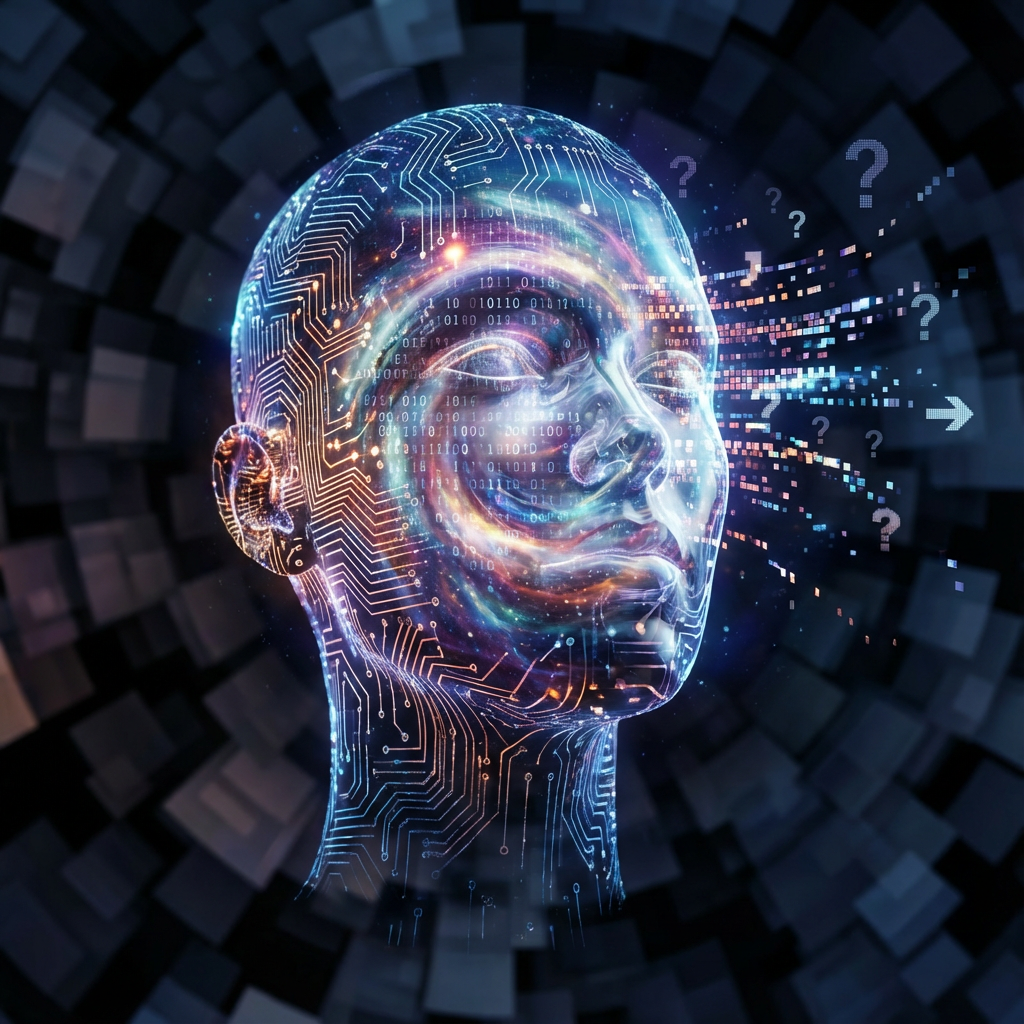
Exactly. In the early days of these models, they were all System One. They would just blurt out the first thing that came to mind. If the pattern looked right, they would say it, even if it was a hallucination. But with these new reasoning modes, like Gemini's Deep Think or the earlier OpenAI o-one models, we are essentially giving the model a "scratchpad." The primary mechanism here is something called Chain of Thought prompting, but scaled up and automated. Instead of just jumping to the answer, the model is trained to generate a series of intermediate steps. It talks to itself in a hidden space before it gives you the final output.
So it is not just one pass through the neural network. It is almost like a loop where the model evaluates its own logic as it goes?
Precisely. In Deep Think mode, the model is not just predicting the next word of the answer. It is predicting its own reasoning process. There is often a separate reward model involved, what we call a Process-based Reward Model, or P R M. In a standard model, you reward the AI if the final answer is correct. That is Outcome-based. But in a reasoning model, you reward it for every correct step in the logic. This encourages the model to be meticulous. It becomes a search problem. It is looking for the "correct" path through a forest of logical steps.
Okay, so if it is a search problem, does that mean the model is actually looking at multiple different paths at once? Like a chess engine looking five moves ahead?
That is exactly what is happening. When Gemini three point zero Pro enters this mode, it is using something akin to a Monte Carlo Tree Search, or M C T S. This is the same logic that allowed AlphaGo to beat the world champion at Go. It might start a line of reasoning, realize three steps in that it is leading to a contradiction—like a mathematical dead end—and then backtrack to try a different path. This is why it takes longer. When you see that little thinking indicator on your screen for twenty or thirty seconds, the model might have explored thousands of potential reasoning chains and discarded most of them before showing you the one that actually works.
This explains why it can solve the quantum physics problem Daniel was talking about. A proof is essentially a very narrow path through an infinite forest of logical possibilities. If you are just doing pattern matching, you will probably wander off the path because the "most likely" next word might not be the "mathematically correct" next word. But if you have the ability to check your work and pivot when you hit a dead end, you can actually navigate that forest.
And the brilliance of the Gemini implementation is how it integrates this with its massive context window. We are talking about two million tokens or more in the Pro version. It can hold the entire history of its own failed attempts in its active memory while it tries a new approach. It learns from its own mistakes in real-time during that single inference session. It is essentially doing "in-context learning" on its own failures.
I want to dig into that idea of checking your work. In the past, we have seen models hallucinate very confidently. They would give you a mathematical proof that looked perfect at a glance but had a subtle, fatal flaw in step four. How does Deep Think actually catch those flaws? Is it just a bigger model, or is there a specific architectural change?
It is a bit of both, but the secret sauce is often self-correction through Verifiers. Think of it like a two-player game. You have the Generator, which is the part of the model trying to solve the problem, and the Verifier, which is a version of the model trained specifically to find flaws. In Deep Think mode, these two are in a constant dialogue. The Generator says, "I think the next step is X." The Verifier says, "Wait, if you do X, you violate the second law of thermodynamics here. Try again." This internal adversarial process continues until the Verifier is satisfied. It is a form of "Self-Taught Reasoner" or S T a R methodology.
That is fascinating. It is like having a tiny Herman Poppleberry living inside the G P U, constantly shouting, "Actually, that is a common misconception!"
I would like to think I am slightly more polite than a Verifier model, but yes, that is the gist of it. But here is the thing that most people do not realize about this breakthrough. It is not just about being right. It is about the model finding what we call "out-of-distribution" solutions. Because it is searching through logical space rather than just linguistic space, it can arrive at a conclusion that was never written down in its training data. That is how you get a novel proof. It is essentially doing science at that point, not just summarization. It is synthesizing new knowledge.
So, we have established that more time spent at the point of inference—what researchers call "test-time compute"—equals better reasoning. We have gone from milliseconds to seconds, or maybe a minute for a complex query. But Daniel's prompt raises a wild possibility. What if we stop thinking in seconds? What if we have an Ultra Mode where the model spends an entire week on a single prompt?
That is the frontier. That is where we move from AI as a tool to AI as a collaborator or even a primary researcher. Right now, the bottleneck for these models is compute cost and memory. Running a model at full tilt for a week on a cluster of H-two-hundreds or Google's new Trillium chips is incredibly expensive. We are talking thousands, maybe tens of thousands of dollars for a single "answer." But if the problem you are solving is worth a billion dollars—like a more efficient battery chemistry or a room-temperature superconductor—that cost becomes irrelevant.
Let's do a thought experiment on that. Imagine we give Gemini three point zero Pro a week to look at a massive dataset of protein folding or climate patterns. What changes when the search tree doesn't have to be pruned so aggressively?
If you give it a week, you allow it to perform what we call Deep Search. Instead of looking at thousands of paths, it could look at billions. It could essentially run its own internal simulations. It could formulate a hypothesis, use its internal world model to simulate the outcome, see it fail, and then spend two days refining the hypothesis before trying again. It is the difference between a student taking a ten-minute quiz and a P h D candidate writing a dissertation. In a week-long session, the model could even write and execute its own code to verify its assumptions.
But is there a point of diminishing returns? I mean, if the model's internal world model has a slight bias or error, wouldn't a week of thinking just lead it deeper into a rabbit hole of its own making? Like a conspiracy theorist who spends too much time on the wrong forums?
That is the big risk. We call it "drift" or "catastrophic forgetting" within a session. If the model spends too long talking to itself without external grounding, it might start building a logical castle in the sky that has no connection to reality. However, the way to solve that is through what we call "tool use." An Ultra Mode model wouldn't just sit there and think in a vacuum. It would have the ability to run actual Python code, query external databases like the Protein Data Bank, or even use formal verification languages like Lean four.
Lean four? Is that like a programming language for math?
Exactly. It is a formal proof assistant. If the AI can write its proof in Lean four, the computer can mathematically guarantee that the logic is sound. So, in an Ultra Mode scenario, the AI spends three days working on a proof, tries to compile it in Lean, gets an error message, and then spends the next four days fixing the error. By the end of the week, it doesn't just give you an answer; it gives you a mathematically verified truth.
So it becomes an iterative loop that spans days. I am thinking about the practicalities of this. If I am a developer and I have a bug that has been haunting my codebase for six months—something that only happens once every ten thousand transactions, a real "heisenbug"—I could give the AI the entire repo and say, "Do not come back to me until you have identified the race condition and written a test to prove it."
Exactly. And the model could spend the first forty-eight hours just building a mental map of every possible execution path. It could use formal verification methods, which are mathematically heavy and slow, to prove that certain parts of the code are safe, and then focus all its thinking power on the suspect areas. This is stuff that a human developer simply cannot do because our working memory is too small and we get tired. An AI doesn't get tired. It just keeps branching that search tree. It is "brute-forcing" intelligence.
It feels like we are talking about a shift in the economy of intelligence. We used to value fast answers. Google search was all about the sub-second response. But now, we might start valuing "slow intelligence." I can imagine a world where companies have different tiers of AI thinking. You have the one-second tier for emails, the one-hour tier for legal analysis, and the one-week tier for strategic planning or research and development.
I think you are spot on. And there is a technical term for this that is gaining traction in the research papers: Inference Time Scaling Laws. We have known for a few years that if you make a model bigger and train it on more data, it gets smarter. That is pre-training scaling. But now we are discovering that you can get a similar boost in intelligence by just letting the model run longer during the answer phase. It is a second way to scale. Some researchers argue that one hundred times more compute at inference time can make a small model perform as well as a model ten times its size.
That is a huge insight. So instead of just building a massive model that is expensive to train and hard to update, you can take a mid-sized, efficient model like Gemini Pro and just give it more compute at the moment it is needed. It is more flexible. It is like having a person who is "smart enough" but has an infinite amount of time and coffee to solve a problem.
It is much more efficient. Think about it. You do not need a supercomputer-level brain to tell you a joke or summarize a meeting. But you do need it for quantum physics. This allows the AI to allocate its resources where they matter. But let's look at the second-order effects of this Ultra Mode Daniel mentioned. If we have models that can think for a week, what does that do to the scientific method?
That is what I was going to ask. Does the human become the bottleneck? If the AI comes back after a week with a three-hundred-page proof for a new type of room-temperature superconductor, how long does it take a team of humans to even verify that the AI is right? We might spend a year just trying to understand what the AI did in seven days.
We might end up in a situation where we need another AI just to summarize the reasoning of the first AI. There is this concept of AI Alignment through Debate, where you have two models go back and forth on a complex topic to make the reasoning transparent to a human judge. But even then, we are pushing the limits of human comprehension. We might be entering an era of what I call "black box breakthroughs." We get the result, we can see it works in practice—the battery lasts ten times longer—but the logical path to get there is so long and complex that no single human can fully hold it in their head.
That is a bit terrifying, Herman. It is like the story of the computer that spent millions of years thinking about the meaning of life and just came back with the number forty-two. If we don't understand the "why," are we really advancing our own knowledge, or are we just becoming dependent on an oracle?
That is the philosophical tension of the twenty-twenties. But look at the upside. There are problems we face as a species that are truly intractable for human brains. Complex systems like global logistics, climate modeling, or the intricacies of the human immune system. These are not problems you solve with a flash of insight. They are problems you solve through massive, sustained, logical grinding. If an Ultra Mode model can do that grinding for us, it could unlock solutions that have been sitting right in front of us, hidden by complexity.
Let's talk about the hardware side for a second, because I know you have been looking at the new T P U clusters Google is deploying. To run a model for a week at full inference power, you are talking about a massive amount of energy. Is this even sustainable?
It is a major concern. Right now, the energy cost of a single standard query is relatively low—maybe enough to light a lightbulb for a few minutes. But a week-long inference session could consume as much electricity as a small house uses in a month. However, the hardware is getting much more specialized. We are moving away from general-purpose G P Us and toward chips like the T P U v-six and beyond that are designed specifically for this kind of iterative reasoning. They are much more energy-efficient for these specific workloads. Plus, you have to compare it to the alternative. How much energy does it take to run a laboratory with fifty scientists for three years to solve the same problem? When you look at it that way, the AI is actually incredibly efficient.
That is a fair point. It is a trade-off. We are trading electricity for time and human labor. I want to circle back to the quantum physics proof because I think it is the perfect example of why specificity matters here. Most people hear "quantum physics" and their eyes glaze over. But the reason this was a breakthrough is that it solved a problem regarding the "sign problem" in quantum Monte Carlo simulations. This is a technical hurdle that has prevented us from simulating certain materials for decades.
Yes! And the reason that is important is that those materials are the key to better batteries and more powerful magnets. By finding a way around that sign problem, Gemini didn't just solve a math puzzle. It opened the door to a new generation of physical technology. And it did it by identifying a symmetry that human researchers had overlooked. That is the kind of specific, high-value insight that you get when a model can reason deeply. It is not just "guessing" the answer; it is finding a structural truth.
So, if we take Daniel's idea of the week-long Ultra Mode, maybe the next step isn't just a proof. Maybe it's the entire design for a new type of fusion reactor or a carbon-capture system that is ten times more efficient than anything we have now. We could be looking at a "Manhattan Project" in a box.
It is entirely possible. But here is the thing I think we should be careful about. We shouldn't assume that more time always leads to a better answer. There is a concept in computer science called undecidability. Some problems are just not solvable, no matter how much time you have. If you give a model a week to solve the Halting Problem, it is still going to fail because it is mathematically impossible. We have to be careful not to treat these models as magic wands. They are still bound by the laws of logic and the limitations of their training.
Right, and they are still bound by the quality of the data they were trained on. If the model's underlying understanding of physics has a fundamental flaw, thinking for a week will just make that flaw more elaborate. It won't necessarily correct it unless it has a way to test its assumptions against the real world.
Which brings us back to the importance of grounding. The real power of an Ultra Mode would be its ability to interface with the world. Imagine an AI that spends Monday through Wednesday thinking, Thursday through Friday running simulations and code, and Saturday morning presenting a list of three specific experiments for a human to run in a physical lab to verify its findings. That is a tight feedback loop that could accelerate the pace of discovery by orders of magnitude. We call this "Closed-Loop Science."
It is a different kind of collaboration. It is not just me asking the AI to write a poem. It is me and the AI working on a decade-long project together, where the AI does the heavy logical lifting and I provide the creative direction and the physical grounding. It is like the relationship between a great architect and a master engineer.
I love that. The architect has the vision, the "why," and the aesthetic sense. But the engineer spends weeks doing the stress tests and the material calculations to make sure the building doesn't fall down. We are moving into a world where the AI is the world's most powerful engineer, and we are the architects.
So, for our listeners who are maybe feeling a bit overwhelmed by this, what is the practical takeaway? If you are a professional or a student today, how should you be thinking about these reasoning modes?
The first thing is to realize that the way you prompt these models has to change. If you are using a model with Deep Think or a similar mode, you shouldn't just ask for the answer. You should ask to see the reasoning. You should engage with the steps. If you see a step that looks off, challenge it. These models are now capable of having a logical argument with you. That is a huge resource for learning. Use it to sharpen your own thinking, not just to replace it.
And the second thing is to start thinking about which problems in your life or work are actually worth "slow intelligence." We are so used to the instant gratification of the internet. We want the answer now. But some of the most important things we do require patience. We are entering an era where we can finally delegate that patience to a machine. If you have a problem that has been sitting in the back of your mind for years because it felt too complex, maybe it is time to give it to a reasoning model and let it "chew" on it for a while.
Exactly. Do not waste the deep thinking on things that do not matter. Save it for the hard stuff. The barrier to entry for solving complex problems just got a lot lower. It is like we all just got a personal research assistant with a P h D in everything.
I think about how this might change education, too. Instead of students just being graded on the final answer, we can use these reasoning modes to help them understand the process. An AI can walk a student through a complex proof, explaining every pivot and every discarded path. It turns every problem into a learning opportunity. It is like having a tutor that has infinite patience and knows every mathematical concept ever discovered.
It also forces us to be more precise in how we state our problems. If you are going to give a model a week to think, and it costs a thousand dollars in compute, you better be sure you asked the right question. The art of the prompt is becoming the art of the specification. We have to become better at defining what "success" looks like.
That is a great point. A week of compute is expensive. You do not want to realize on Friday that you made a typo in the initial constraints on Monday.
Guilty as charged! I have definitely done that with my own local scripts. I once ran a simulation for twelve hours only to realize I had a minus sign where a plus sign should be. But on this scale, the stakes are much higher. It reminds me of the early days of computing in the nineteen-fifties and sixties, when you had to submit your punch cards and wait overnight for the results. We are kind of going back to that "batch processing" mindset, but instead of just calculating a spreadsheet, we are calculating the structure of reality.
It is a beautiful full circle. From punch cards to quantum proofs. Herman, this has been a blast. I feel like we have only scratched the surface of what this Ultra Mode could look like, but the fact that we are even talking about it as a near-term reality in twenty twenty-six is staggering.
It really is. And it makes me wonder what Daniel is going to send us next week. If he is already thinking about week-long inference, he might be planning to outsource his entire life to Gemini by the time we finish our coffee.
Well, if he does, I hope he programs it to do the dishes once in a while. That would be a true breakthrough in our house. The "Dish Problem" is the one thing even a quantum computer hasn't solved yet.
Now that is a problem that might actually require a week of deep thinking. The fluid dynamics of our kitchen sink are truly daunting. I think the "sign problem" in physics is actually easier than getting Daniel to rinse a plate.
On that note, I think we should wrap this up. This has been such a cool exploration of where AI is heading. It is not just about being faster or more conversational. It is about being more thoughtful, in the most literal sense of the word.
Well said, Corn. It is about the depth, not just the breadth. And I am personally looking forward to seeing what other novel proofs come out of this. The quantum world is full of mysteries, and it looks like we finally have a magnifying glass that can see the details.
Absolutely. Before we go, I want to say a huge thank you to everyone who has been listening. We have been doing this for over six hundred episodes now, and your support is what keeps us diving into these rabbit holes. If you are enjoying the show, we would really appreciate it if you could leave us a quick review on your podcast app or on Spotify. It genuinely helps other curious minds find us.
It really does. We love seeing the community grow. And remember, you can find all our past episodes and a way to get in touch with us at our website, myweirdprompts dot com. We are also on Spotify, so make sure to follow us there for all the latest updates.
Thanks again to Daniel for the great prompt. We will have to see if we can get him on the show one of these days to talk about his latest rabbit holes in person.
If we can get him to stop reading about quantum entanglement for five minutes, maybe!
Fair point. Alright, everyone, thanks for joining us on this journey through the mechanics of AI reasoning. This has been My Weird Prompts.
Until next time, keep asking the weird questions. Goodbye!
Bye everyone!