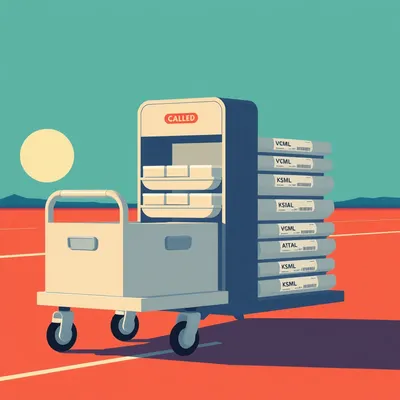
You book a flight, you click "vegan gluten-free" from a dropdown, and you assume it'll work out. What you don't see is that meal traveling from a kitchen in Frankfurt to your seat at thirty-five thousand feet, tracked by RFID tags that trigger an automatic discard if the cart exceeds eight degrees Celsius for more than thirty minutes. And here's the thing — post-pandemic, airlines have slashed catering contracts and centralized production. Delta dropped several niche meal codes in twenty twenty-three, forcing passengers with strict diets to just bring their own food. Daniel's been thinking about this whole invisible machinery, and he wants to know how airlines actually track, source, and load thousands of dietary permutations across a global network of airports. The modular galley carts, the just-in-time supply chain, the whole logistical miracle. So where does this even start?

It starts with a four-letter code. When you select "vegan" from that dropdown, what actually gets stored in your booking is VGML — that's the IATA standardized meal code. And there are over thirty of these codes. You've got KSML for kosher, MOML for Muslim, GFML for gluten-free, BBML for baby meal, HNML for Hindu, DBML for diabetic, LCML for low-calorie, LSML for low-sodium, PFML for peanut-free — the list goes on. Some airlines even have their own proprietary variants on top of the IATA standard. A single long-haul flight with three hundred passengers might carry twenty to thirty different meal types.
Twenty to thirty. That's not a menu, that's a taxonomy.
It is a taxonomy. And the taxonomy is what makes the whole system work. That code gets embedded in your PNR — your Passenger Name Record — the moment you book. Then, somewhere between twenty-four and seventy-two hours before departure, the airline's departure control system extracts every meal code for that flight and transmits a catering order to the local provider at the departure airport. So if you're flying out of JFK, the order goes to the caterer at JFK. But here's where it gets tricky — if you're connecting from Chicago, your meal has to be coordinated across two different caterers at two different airports, and the second one only gets the order once your first leg is confirmed.
So the system is propagating meal codes through a network that spans hundreds of airports, each with its own independent catering contractor, and all of it has to converge on a single aircraft door twenty minutes before pushback.
Exactly that. Airlines don't own catering kitchens. Almost none of them do. They contract with local caterers at every airport they serve. Lufthansa's catering hub at Frankfurt — which is one of the largest in the world — produces forty thousand meals daily across two hundred different menu types. And they're not cooking for Lufthansa exclusively. They're handling meals for dozens of carriers that pass through Frankfurt. The kitchen has separate production lines for kosher meals, which are prepared under rabbinical supervision — typically OU certification — separate lines for halal, which require specific slaughter methods, and separate lines for vegan to avoid any cross-contamination.
Separate production lines. So every additional meal type isn't just another recipe — it's another physical lane in the kitchen.
Right. And that's why Delta dropping several niche meal codes in twenty twenty-three wasn't just a menu simplification. Each additional meal type adds fifteen to twenty percent to catering costs because of the separate production lines and the increased waste. When you're running a kitchen that produces tens of thousands of meals a day, adding a "raw vegan" or "bland diet" option means dedicating physical space, staff, and ingredient sourcing to a meal that maybe three people on a given flight will order.
The bland diet code — that's a real thing?
It's a real thing. BLML — bland meal. No spices, no irritants, designed for passengers with gastrointestinal conditions. It exists. And someone in a kitchen at four in the morning is preparing it alongside the kosher meal and the fruit platter and the diabetic meal.
Let's talk about that four in the morning part, because the timeline here is brutal. These meals aren't being cooked days in advance.
They're not. Caterers produce meals in a single shift, typically four to six hours before departure. For a ten AM flight, the kitchen starts at four AM. Specialty meals are cooked first because they have stricter preparation requirements and because they need to be individually labeled and tracked. The regular meals — the standard chicken-or-pasta — are produced in bulk toward the end of the shift. Everything is chilled to four degrees Celsius — that's about forty degrees Fahrenheit — during transport and storage. The cold chain is non-negotiable.
And the cold chain is enforced by RFID tags on every cart.
Every cart. The RFID tag logs temperature continuously. If a cart exceeds eight degrees Celsius for more than thirty minutes, the entire contents are discarded. Not inspected — discarded. The system flags it automatically. That's a food safety protocol that's stricter than most restaurants on the ground.
Which makes sense when you think about it. A restaurant can send food back to the kitchen. At thirty-five thousand feet, the consequences of food poisoning are a lot more complicated.
And that's the clinical reality. I spent years in pediatrics, and I can tell you — foodborne illness at altitude, in a pressurized cabin, with limited medical resources, is a genuinely dangerous scenario. The cold chain isn't bureaucracy. It's the difference between a meal and a liability.
So we've got meals produced in a four-hour window, chilled to four degrees, tracked by RFID, and now they have to get onto the aircraft. Daniel specifically asked about the loading operation — the modular boxes you see at the gate.
This is where the Eurobox cousin comes in. The galley carts are standardized containers — either ATLAS or KSSU specifications — and they're designed to fit precisely into the aircraft galley. The dimensions are exact. A cart that's off by a centimeter won't lock into place, and an unsecured cart in turbulence becomes a projectile. The carts are color-coded or labeled by meal type — regular meals in one set of carts, specialty meals in another, each one tagged with the flight number and the specific galley position it needs to occupy.
So the catering truck pulls up to the aircraft, and a loader is lifting these carts in one by one.
Via a belt loader or a high-loader, depending on the aircraft type. For a widebody — a triple seven or an A three eighty — the entire loading operation takes twenty to forty minutes. The loader has a manifest that tells them exactly which cart goes to which galley position. The flight attendants then verify the cart labels against their own cabin manifest. If a specialty meal cart gets loaded into the wrong galley, the passenger who ordered that meal might be sitting twenty rows away with no way to get it.
And that has happened.
It has. In twenty nineteen, a British Airways flight from London to Tel Aviv had to return to the gate because the kosher meals were loaded onto the wrong aircraft entirely. The catering truck delivered to the wrong stand. That's a failure mode that costs thousands in fuel, causes delays that ripple through the network, and leaves a plane full of passengers without the meals they ordered — which, for a Tel Aviv flight where a significant portion of passengers order kosher, is a major problem.
Returning to the gate for missing meals. That's not a minor inconvenience — that's a logistical collapse.
And it illustrates the fragility. The system works beautifully when everything aligns, but it has very little slack. The just-in-time nature means there's no warehouse of backup meals sitting at the gate. The meals for your flight were produced that morning specifically for that flight. If they go to the wrong aircraft, there's no Plan B.
Let's back up to the booking system, because I want to understand how the meal code actually propagates. You click "vegan" on the airline website. That generates VGML. Where does it go from there?
It gets stored in your PNR, which is the master record for your entire itinerary. The airline's catering system — and these are specialized modules within larger systems like Sabre Airline Solutions or Lufthansa Systems — polls the departure control system starting about seventy-two hours before departure. It extracts every meal code for every passenger on that flight and aggregates them into a catering order. That order specifies exactly how many of each meal type are needed, broken down by cabin class and by galley position.
And that order goes to the caterer at the departure airport.
Correct. But here's the subtlety — the order isn't static. It updates. If a passenger changes their seat, their meal code follows them to the new seat assignment. If a passenger cancels, the meal code drops off. If a passenger books a last-minute ticket with a specialty meal request less than twenty-four hours before departure, the system may or may not accommodate it, depending on the airline's cutoff policy. Most airlines require meal requests at least twenty-four to forty-eight hours in advance. Some require seventy-two hours for kosher meals because of the separate preparation requirements.
So the window for ordering a specialty meal closes well before you get to the airport. The idea that you can request a vegan meal at the gate is a fantasy.
It's a complete fantasy. At the gate, the meals are already on the truck. The catering order was finalized hours ago. The best a gate agent can do is see if there's an extra specialty meal onboard — maybe from a no-show passenger — but that's pure luck.
What about the overproduction? I've read that airlines over-produce specialty meals by five to ten percent to account for no-shows and last-minute upgrades.
They do. And that's a buffer that the system absolutely needs. But it's also a source of enormous waste. Up to thirty percent of specialty meals are never consumed. Passengers change flights, miss connections, or simply don't eat the meal they ordered. Sometimes a passenger orders a vegan meal and then decides the regular chicken looks better, so they eat that instead. The caterers have to account for this by loading extra regular meals — the ratio is roughly one point two regular meals per passenger on long-haul flights.
Thirty percent waste. That's staggering.
It's staggering, and it's a problem the industry has been trying to solve for years. Some airlines — Emirates, Singapore Airlines — are piloting pre-order systems where passengers select their meals two to three weeks in advance. The caterer then produces exactly what's needed, which reduces waste by fifteen to twenty percent. But it requires passengers to plan ahead, and that's a behavioral hurdle. Most people don't want to think about what they're going to eat on a flight three weeks from now.
Emirates takes this even further with their Dine on Demand system in first class.
That's a completely different logistics model. Dine on Demand gives first-class passengers a menu of about fifty items, and they can order any of them at any time during the flight. The meals aren't pre-plated — they're stored in bulk, and the galley crew cooks them to order. It's essentially a restaurant kitchen at altitude. But that only works in first class, where you have a high crew-to-passenger ratio and a dedicated galley. You can't scale that to three hundred economy passengers.
The contrast between first class and economy is almost two different industries. In first class, you're getting a meal cooked to order from a fifty-item menu. In economy, your vegan meal was produced in a Frankfurt kitchen at four AM, chilled, trucked, and loaded into a color-coded cart, and it'll be reheated in a convection oven somewhere over the Atlantic.
And both of those meals are part of the same catering order. The same kitchen produced them. The same truck delivered them. The difference is entirely in how they're stored and served onboard.
Let's talk about the modular container system beyond the galley carts. Daniel mentioned the Eurobox standard, and we've talked about air cargo containers before. How does that standardization apply to catering?
The same principles. The catering trucks use standardized pallets — LD3 and LD7 containers — that fit into the cargo hold. These pallets carry dry goods, beverages, and non-perishable meals. The galley carts themselves are modular units that lock into the galley infrastructure. The entire supply chain, from the kitchen prep tables to the aircraft galley, is designed around these standard dimensions. A cart produced for an ATLAS galley will fit any ATLAS-compatible aircraft, whether it's a Lufthansa A three fifty or a Singapore Airlines triple seven.
So the standardization means a caterer in Frankfurt can produce meals for dozens of different airlines using the same equipment, the same carts, the same loading procedures.
Without that standardization, every airline would need its own dedicated kitchen infrastructure at every airport. The costs would be astronomical. The ATLAS and KSSU standards are the unsung heroes of airline catering — they're the reason you can get a vegan meal on a regional carrier flying out of a mid-size airport.
What happens when the system breaks? You mentioned the British Airways Tel Aviv incident. Are there other failure pattern?
The most common failure is a last-minute aircraft swap. If an airline substitutes a different aircraft type — say, a triple seven for an A three thirty — the galley configuration changes. The carts that were loaded for the original aircraft may not fit the new one. The caterer has to scramble to re-pack the meals into different carts, and sometimes there isn't time. Meals get left behind.
And the passenger who ordered the kosher meal three days ago just gets... nothing?
They get an apology and whatever the crew can scrounge together. Maybe a fruit plate, maybe some bread. It's one of the reasons airlines recommend that passengers with strict dietary requirements always carry a backup snack. The system is impressive, but it's not foolproof.
That's a practical takeaway right there. Always carry a backup snack. But there's another one I want to highlight — the meal code itself. If you're booking a flight and you type "vegan" into a special requests field, that's not the same as selecting VGML from the dropdown.
That's a critical distinction. The IATA meal code triggers the automated catering system. If you just type "vegan" in a free-text field, that request may be handled manually, and manual requests get missed. The code is what the system understands. VGML means something specific to every caterer in the world. "Vegan" in a text box might mean anything or nothing.
So the advice is: use the dropdown. Select the code. Don't rely on free-text special requests.
And do it at least forty-eight hours in advance. The system is designed for lead time. Last-minute changes are where things fall apart.
Let's zoom out for a moment. The airline catering system is essentially a just-in-time manufacturing operation. It's Toyota's production system, but with a harder constraint — Toyota can stop the line if a part is missing. An airline can't delay a flight for missing meals.
That's the key difference. In a factory, you can halt production, fix the problem, and resume. In aviation, the departure slot is fixed. If the meals aren't on the aircraft when the door closes, they're not going. The safety stock buffer — that five to ten percent overproduction — is the only cushion. And that buffer generates waste, which generates cost, which is why airlines are constantly trying to optimize it.
Compare this to cruise ships. A cruise ship has similar dietary complexity — thousands of passengers, dozens of dietary requirements — but they can produce meals over multiple days. They have onboard kitchens, onboard storage, and no hard departure deadline. Airlines are uniquely constrained by turnaround time.
A cruise ship galley is a floating restaurant complex. An aircraft galley is a closet with convection ovens. The difference in capability is enormous, but the passenger expectation is similar. People board a twelve-hour flight expecting a meal that accommodates their dietary needs, and the system mostly delivers. The fact that it works at all is remarkable.
The waste problem keeps nagging at me. Thirty percent of specialty meals uneaten. What happens to all that food?
It depends on the airport. Some airports have composting programs — San Francisco and Seattle have been leaders in that. But most airports incinerate uneaten meals. The meals can't be donated because of food safety regulations — once a meal has been on an aircraft, even if it was never served, it's considered potentially contaminated and must be destroyed. International flights add another layer of complexity because of agricultural quarantine rules. A meal loaded in Frankfurt that flies to the US and isn't consumed has to be incinerated under USDA regulations.
So the system produces waste by design. The safety buffer, the no-shows, the quarantine rules — it all adds up to tons of food being burned every day at major airports.
And that's the tension at the heart of this. The system is a marvel of logistics, but it's also an environmental problem. The pre-order systems that Emirates and Singapore are testing are one solution. AI-driven demand forecasting is another — using historical data to predict exactly how many of each meal type will be needed for a given flight on a given day, reducing overproduction without increasing the risk of shortages.
Which brings us to the future. Some airlines are testing real-time meal tracking via RFID — letting passengers see exactly where their meal is in the supply chain, from kitchen to cart to oven.
It's still in early stages, but the idea is compelling. You'd get a notification on your phone: your vegan meal is being prepared, your vegan meal is on the catering truck, your vegan meal is in galley position three. It's transparency that turns an invisible system into something you can see.
The question is whether that transparency makes passengers more forgiving or more frustrated. If you can see that your meal is on the wrong truck, do you feel empowered or just anxious?
Probably both. But I think the broader trend is toward pre-order and personalization. The "surprise meal" — where you board a flight not knowing what you'll be served — might eventually disappear. Instead, you'll select your meal weeks in advance, the caterer will produce exactly what's needed, and waste will drop significantly.
But that requires passengers to engage with the system in a way they currently don't. Most people don't think about their in-flight meal until the flight attendant hands them the tray.
And that's the behavioral hurdle. The system works because it's invisible. Passengers don't need to know about meal codes and cold chains and RFID tags. They just click a dropdown and expect the meal to appear. Making the system visible — through pre-order requirements or real-time tracking — asks something of passengers that they're not used to giving.
There's a philosophical question here about whether the complexity of human dietary preferences will always outpace logistics. Every year, new dietary identities emerge. Raw vegan, paleo, low-FODMAP, nightshade-free — the taxonomy keeps expanding. Can any logistics system keep up?
It can, but at a cost. Each new meal code adds complexity to the kitchen, the ordering system, the loading manifest, and the waste stream. Airlines have to decide whether the revenue from accommodating a niche dietary need outweighs the operational cost. Delta's decision to drop several meal codes in twenty twenty-three suggests that for some airlines, the answer is no.
So the future might not be more choice, but less. A consolidation of meal codes to the most common dietary categories, with everyone else expected to bring their own food.
That's the direction some carriers are heading. And for passengers with less common dietary requirements, that means the golden age of airline meal accommodation might already be behind us.
Which makes understanding how the system works right now all the more valuable. If you know the meal codes, if you know the lead times, if you know where the failure points are, you can work with the system instead of against it.
Use the IATA code when you book. Order at least forty-eight hours in advance. Carry a backup snack. And next time you're at the gate, look out the window at the catering truck. Those color-coded carts being lifted into the galley are the visible edge of a global logistics system that most passengers never think about.
And maybe, when your meal doesn't arrive, you'll be a little more forgiving. The system that failed you is also the system that, most of the time, delivers a kosher meal prepared under rabbinical supervision in Frankfurt to your seat on a flight out of Delhi. That's not a small thing.
It's remarkable. A just-in-time manufacturing system that spans continents, handles thousands of dietary permutations, and resets every single day. Forty thousand meals from one kitchen in Frankfurt. Multiply that by every major airport in the world.
The question we opened with — will pre-order systems and AI forecasting mean the end of the surprise meal? I think the answer is that the surprise will become optional. If you want to be surprised, you can leave it to the algorithm. If you want certainty, you'll pre-order. The system will accommodate both, but the era of the universal default meal is probably ending.
And the next time you board a flight, you might get a notification telling you exactly where your VGML is in the supply chain. From kitchen to cart to oven to tray table. The invisible made visible.
Thanks to our producer Hilbert Flumingtop for keeping this show running. This has been My Weird Prompts. If you enjoyed this episode, tell someone about it — or better yet, send us your own weird prompt at show at my weird prompts dot com. We'll be back soon.