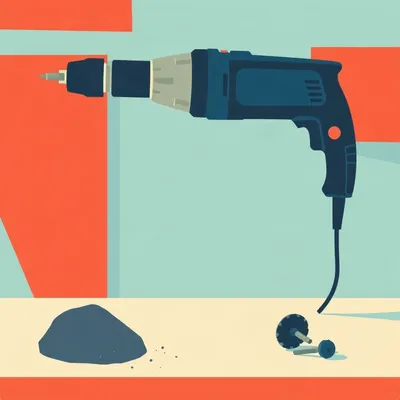
Daniel's got a whole thing about drilling into a mamad with a twelve volt drill and being surprised it worked. He picked up a Bosch GSB one twenty L I, which he describes as having an impact setting but not being a true hammer drill — in Israel those are patishons. His wife had what he calls a mystery collection of rusted drill bits, he tried one, probably HSS, and it just sat in the wall helplessly. So he bought the Bosch Expert multipurpose set, the blue coated ones, about twenty dollars, and drilled two holes into reinforced safe room concrete without too much trouble. His questions: would a dedicated masonry bit set meaningfully outperform the multipurpose set in a non SDS tool? Is the difference geometry or material hardness? And should he buy the dedicated set now, or hold off and eventually get a real hammer drill with SDS bits?

Before we go anywhere, the premise needs a correction. The GSB one twenty L I is a hammer drill. It has a genuine axial percussion mechanism. Twenty two thousand five hundred impacts per minute, and the vibration rating for impact drilling is ten point two meters per second squared. That is not a gimmick setting. That is a compact twelve volt combi drill with a real hammer function.
So Daniel's been walking around thinking he doesn't own a patishon, when actually he's been carrying one in his toolbox the whole time.
A small one. Think of it as the difference between a hatchback and a truck. Both are cars. One of them is not hauling a piano up a hill. But the hatchback does have an engine, and it does move.
And that reframes the whole question. He's not asking whether a non hammer drill can do concrete with good bits. He's asking how much a small hammer drill can do with good bits, and where that ceiling is.
The ceiling is real. But before we hit the ceiling, let's talk about what actually happened in that wall. Because the first bit failed, the second bit succeeded, and the reason is materials science, not luck.
So what actually happened inside that wall?
The HSS bit. High speed steel. It's designed for cutting metal and wood. Hardness somewhere around sixty to sixty five on the Rockwell C scale. Concrete is full of silica aggregate — sand, essentially, but bonded into a matrix. Silica is abrasive. It chews through HSS like sandpaper through soft cheese. But the bigger problem is geometry.
HSS bits have sharp cutting edges.
Sharp edges with a positive rake angle. They're designed to shear material away, like a knife peeling a potato. Concrete doesn't shear. It's brittle. It needs to be pulverized, fractured, crushed into dust. A sharp HSS edge hits concrete and just... polishes it. Heats up. Spins. Goes nowhere. Which is exactly what Daniel described — the bit sitting in the wall helplessly.
It wasn't drilling. It was burnishing.
That's the word. Burnishing. Generating heat and friction and accomplishing nothing. The bit was probably glowing at the tip after thirty seconds, and the wall just sat there being a wall.
So what does a masonry bit do differently?
Two things. Material and geometry. The tip is tungsten carbide. Hardness around ninety on the Rockwell A scale — completely different league. Typically eight to ten percent cobalt as a binder for toughness, because pure tungsten carbide is hard but brittle. The cobalt lets it take impact without shattering. And the geometry is inverted compared to an HSS bit. Negative rake angle. Obtuse cutting edge. A thicker web. It's not a knife. It's a chisel.
And the hammer action drives that chisel into the concrete.
Right. The axial percussion mechanism delivers rapid blows, twenty two thousand five hundred per minute on this tool, and each blow fractures a tiny amount of concrete at the tip. The carbide edge grinds the fractured material away, and the flutes — the spiral grooves — evacuate the dust. It's a smashing action, not a cutting action. Completely different physical process.
So the Bosch Expert multipurpose bits. What's actually going on with those?
The blue coating is a multi layer titanium nitride or similar. It reduces friction and heat buildup. That's the marketing visible on the surface. But the real story is the carbide grade and the flute geometry. Bosch designed those to work across metal, wood, and masonry by using a compromise tip angle and a flute design that clears dust reasonably well without being optimized for any single material.
A compromise that's actually competent at everything.
Modern multipurpose bits are good. The old reputation — that a bit that claims to do everything does nothing well — is outdated. The Bosch Expert line is a legitimate engineering solution. It's not optimal for concrete. But optimal and adequate are different words.
And adequate was enough to punch through a mamad wall.
Which is worth pausing on. Israeli safe room concrete is typically rated at three to four hundred psi compressive strength — that's roughly twenty to twenty eight megapascals — with dense rebar. This is not the soft cinder block you find in an American basement. This is concrete designed to stop rockets. And a twelve volt drill with a twenty dollar bit set went through it.
Not effortlessly. He said without too much difficulty. Which is not the same thing.
And the tool was working hard. Ten point two meters per second squared of vibration. That's high for a twelve volt class. The drill was at the edge of its envelope. But it did the job. Two holes. Six millimeter anchors, presumably. Small diameter.
The diameter matters here, doesn't it?
Enormously. The impact energy per blow on the GSB one twenty is roughly zero point eight to one point two joules. A full size SDS rotary hammer delivers two to three joules per blow. That's a factor of two to three. But for a small diameter hole — five or six millimeters — the volume of concrete that needs to be fractured per blow is tiny. The frequency of blows, twenty two thousand five hundred per minute, compensates for the low energy per blow. You're taking many small bites instead of a few big ones.
So the tool's limitation is energy per blow, and the bit's job is to make the most of whatever energy arrives.
And that's where Daniel's actual question gets interesting. Would a dedicated masonry bit set outperform the multipurpose set in this tool?
Let me guess. Marginally.
For holes under eight millimeters in a twelve volt tool, the difference is marginal. Because the limiting factor is the tool's impact energy, not the bit's cutting ability. A dedicated masonry bit has a more aggressive tip angle and a steeper negative rake, and a wider flute for faster dust evacuation. In a full size hammer drill, that translates to faster drilling and longer bit life. In a twelve volt tool, the bit is waiting for the tool to deliver energy. The bit can't create energy that isn't there.
It's like putting racing tires on a car with forty horsepower.
The tires are better. They're not making the car faster. The engine is the constraint.
So the dedicated set would drill a little faster, maybe run a little cooler, last longer in repeated concrete use. But it wouldn't transform the experience.
And the real distinction Daniel's asking about — geometry versus material — the answer is that geometry matters more at the margin. A multipurpose bit with good carbide and a universal geometry will drill concrete adequately. A dedicated masonry bit with the more aggressive tip angle and reinforced web will drill faster and survive more holes. But both are using tungsten carbide. The material is essentially the same. The geometry is what changes.
So what's the practical answer? Should he buy the dedicated set or not?
For occasional concrete work — a few holes a year — a dedicated masonry set is a reasonable fifteen to twenty five dollar purchase. Not because it will dramatically outperform the multipurpose set, but because it will preserve the multipurpose set for the materials it's actually optimized for. Every concrete hole you drill with a multipurpose bit is wearing down a compromise geometry that you also want to use on wood and metal. A dedicated masonry set takes that wear instead.
It's about keeping the generalist general.
That's the argument. But — and this is the important part — the dedicated set does not replace the eventual SDS rotary hammer. It's a stopgap. For holes up to eight millimeters, occasional use, the twelve volt tool with quality bits is fine. For holes ten millimeters and above, or for drilling multiple holes in rapid succession, or for anything renovation scale, the twelve volt tool will stall, overheat, and wear out its mechanism prematurely.
And that vibration number tells the story. Ten point two meters per second squared. The tool is working hard. Repeated concrete use will shorten its life.
The mechanism is compact. The bearings, the percussion assembly, the chuck — they're all sized for light duty. Daniel's proof of concept is valid. But proof of concept is not a production license.
Let's talk about what the SDS tool actually does differently. Because that's the upgrade path, and it's worth understanding why it's not just a bigger version of the same thing.
The SDS system is fundamentally different. In a standard chuck, the bit is held rigidly by three jaws. The hammer action is transmitted through the chuck — the whole chuck assembly pistons back and forth, which wastes energy and stresses the tool. In an SDS system, the bit has a splined shank that locks into the chuck but is free to move axially. The bit itself pistons. The hammer strikes the bit directly, and the bit slides forward into the concrete.
So the energy goes straight from hammer to bit to wall. No middleman.
No chuck inertia. No energy lost to accelerating a heavy metal assembly back and forth. That's why an SDS rotary hammer with two to three joules per blow can drill a twelve millimeter hole in concrete faster than a twelve volt combi drill can drill a six millimeter hole. It's not just more power. It's a more efficient delivery system.
And the SDS bit has a different shank entirely. You can't put an SDS bit in a standard chuck.
Correct. They're incompatible. Which means the upgrade path is a package deal — the tool and the bits together. That's why Daniel's instinct to hold off on the dedicated masonry set and eventually buy the SDS system is reasonable. But the dedicated set is cheap enough that it's not really an either or.
So the prudent move is: buy the dedicated masonry set now, use it for the occasional hole, and when renovation scale work appears, buy the SDS rotary hammer with its own bits. The fifteen to twenty five dollars now doesn't meaningfully delay the bigger purchase later.
And there's a secondary benefit. The dedicated masonry set gives him a reference point. When he eventually uses an SDS tool, he'll feel the difference immediately. He'll understand what two to three joules per blow actually means in his hands. The contrast is educational.
Daniel's last question was whether you can get significantly better performance out of a multipurpose drill without the hammer setting simply by choosing high quality bits. And the answer is no, because his drill does have the hammer setting. He's been using it. The bits didn't do the work alone.
That's the reframe. He thought he was testing whether good bits could compensate for a non hammer drill. What he actually tested was whether good bits plus a small hammer drill could handle light concrete. And the answer is yes, within limits. The hammer setting was doing real work the whole time. That's why the HSS bit failed and the carbide bit succeeded — the hammer action was there in both cases, but only the carbide bit could survive it.
The HSS bit wasn't just too soft for the concrete. It was too soft for the hammer action itself. The percussion would have shattered the cutting edge even if the concrete had been softer.
Right. HSS and impact don't mix. The sharp edge chips under repeated blows. That's another reason the bit just spun helplessly — it was probably losing its edge within the first few seconds.
So the system is tool plus bit plus technique. And the technique part matters too. Pressure, speed, clearing the dust.
For a twelve volt tool in hard concrete, you want moderate pressure — enough to keep the bit engaged, not so much that you stall the percussion. Let the hammer do the work. Pull the bit out periodically to clear dust. Keep the speed moderate. And if you hit rebar, stop, move the hole, or switch to a metal bit to get through the rebar, then back to masonry.
Hitting rebar in a mamad is not hypothetical.
It's practically guaranteed if you drill enough holes. The rebar grid in safe room concrete is dense. That's the point of the structure. A six millimeter hole might slip between bars. A ten millimeter hole is much more likely to find steel. And the twelve volt tool will not enjoy that encounter.
So the size of the hole is the real decision point. Six millimeters, occasional, the twelve volt tool is fine. Ten millimeters or above, or anything structural, you want the SDS tool.
And the bit set is not the variable that changes that equation. The bit set is about convenience and preserving the generalist set. The tool is about capability. Different layers of the problem.
Let's put a number on it. Daniel's multipurpose set was about twenty dollars. A dedicated masonry set is about the same, maybe fifteen to twenty five. An entry level SDS rotary hammer with a basic bit set is what — two hundred, two fifty?
Something in that range for a corded model. A cordless SDS in a battery system he already owns would be more. But for occasional use, corded is fine. You're not drilling concrete in a field. You're in a mamad with an outlet nearby.
So the dedicated masonry set is less than ten percent of the eventual SDS purchase. It's not a meaningful delay. And it solves the immediate problem of not wrecking the multipurpose bits.
Which is the argument I'd make. Buy the masonry set. Use it for the occasional concrete hole. Keep the multipurpose set for wood and metal and drywall and whatever else. And when the renovation comes, buy the SDS tool and never look back.
There's something almost elegant about the fact that the right bit unlocked the tool's potential. Daniel had the hammer drill all along. He just didn't know it.
And the bit was the missing piece. Not because the bit was magical, but because the system was incomplete. Tool with hammer action, check. Bit with carbide tip and appropriate geometry, check. Technique — moderate pressure, let the hammer work — check. And suddenly the wall that stopped an HSS bit cold is just a wall.
The wall didn't change. The system did.
That's the whole episode in one line.
So what's the number on impact energy again? The twelve volt versus the SDS.
Roughly zero point eight to one point two joules per blow for the twelve volt class. Two to three joules for a full size SDS rotary hammer. And the SDS delivers that energy more efficiently because the bit pistons directly instead of the whole chuck assembly moving.
So it's not just three times the energy. It's three times the energy arriving at the bit instead of being wasted on chuck inertia.
Right. The standard chuck is a three jaw clamp. It's heavy. Accelerating it back and forth twenty two thousand times a minute is a huge waste. The SDS spline system eliminates that. The bit slides. The hammer hits the bit. The bit hits the concrete. Clean.
And that's why the SDS tool feels so different in the hand. It's not just more powerful. It's more direct.
People who've used both describe the SDS as going through concrete like it's not there. The twelve volt combi drill goes through concrete like it's there, but it's willing to negotiate.
And the negotiation worked for two holes. Which is all Daniel needed.
For now. The question is what he'll need next year.
At what point does the convenience of a dedicated tool outweigh the cost of bits? For Daniel, it depends on how many holes he plans to drill in the next year.
If the answer is six holes for shelving anchors, the twelve volt tool and a masonry bit set is the right answer. If the answer is mounting a television, running conduit, installing a security camera, or anything that needs a ten millimeter hole or bigger, the SDS tool starts looking essential.
And there's a middle path. Rent or borrow an SDS tool for the occasional big job. In Israel, the hardware stores rent these things by the day. For a one time renovation, that might be the smartest move.
The tool rental market in Israel is mature. You can rent a proper SDS rotary hammer for a day, drill everything you need, and return it. No storage, no maintenance, no battery system to commit to.
So the decision tree is: small holes, occasional — twelve volt tool with dedicated masonry bits. Big holes or many holes — rent or buy SDS. And the dedicated masonry bit set is worth buying regardless, because it's cheap and it protects the multipurpose set.
That's the framework. And it's worth saying plainly: the multipurpose bit set did the job. It's not a failure. It's a competent generalist. The dedicated masonry set is a specialist that will do the same job slightly better and last longer. The SDS tool is a different category entirely.
And the HSS bit was never in the running. It failed because it was the wrong material and the wrong geometry for the job. Not because it was old or rusted. A brand new HSS bit would have failed the same way.
That's worth emphasizing. The rust on Daniel's wife's mystery bits wasn't the problem. The steel was the problem. HSS is excellent for metal. It's useless for concrete. No amount of sharpening or cleaning would have changed that.
So the mystery collection wasn't a failure of maintenance. It was a category error.
And Daniel's instinct to buy new, validated bits was correct. Not because the old bits were bad, but because they were the wrong bits for the material. The Bosch Expert set was the right call for a diverse twelve volt drill.
The proof is in the wall. Two holes, done, shelf mounted.
The shelf is up. The system worked. The question now is just optimization.
Which brings us to the purchasing decision. Is the dedicated masonry set worth it?
I'd say yes, with the caveat that it's not a performance upgrade so much as a resource allocation decision. You're spending twenty dollars to keep your forty dollar multipurpose set from wearing out on concrete. That's just good tool management.
The geometry difference is real but subtle. The dedicated bit will drill a little faster, clear dust a little better, and survive more holes. In a twelve volt tool, those differences are small. In a full size hammer drill, they'd be more noticeable.
Because the full size tool can actually exploit the more aggressive geometry. The twelve volt tool can't push the bit hard enough for the geometry to matter much. The bit is waiting for energy that never arrives.
The dedicated set in a twelve volt tool is like a sports car in city traffic. The capability is there, but the conditions don't let it express itself.
That's the image. And the SDS tool is the open highway.
Let's talk about the vibration number once more, because it's the canary in the coal mine. Ten point two meters per second squared.
For context, that's high for a twelve volt tool. It means the percussion mechanism is working hard. The tool is doing real hammer work, and the vibration is the signature of that work. Over time, that vibration translates to wear on the bearings, the chuck, the motor mounts.
Daniel's proof of concept was real, but it wasn't free. The tool paid for those two holes with a little bit of its lifespan.
That's the honest framing. Occasional light concrete work — the tool will last years. Weekly concrete work — the tool will die young. The vibration rating is the warning label.
The SDS tool, with its more efficient energy transfer, doesn't vibrate as much relative to the work done. The energy goes into the wall, not into the tool.
Right. The SDS bit pistons, the tool body stays relatively stable. The impact is absorbed by the concrete, not by the operator's wrist. That's why SDS tools can drill all day without destroying themselves or the user.
The upgrade path is not just about speed. It's about tool longevity and user comfort.
Safety. A twelve volt tool working at the edge of its envelope is more likely to bind, kick, or snap a bit. The HSS bit that failed — imagine if it had been a carbide bit that snapped under the hammer action. Flying carbide fragments are not a joke.
That's a sobering thought. The right bit in the wrong tool can still fail catastrophically.
Which is why the system matching matters. The bit has to survive the tool's hammer action. The tool has to deliver enough energy for the bit to work. The technique has to keep the bit cool and the dust clear. Break any one of those, and the system fails.
Daniel's system worked because all three were in place. Carbide bits, hammer action, and presumably reasonable technique.
The result was two clean holes in a wall designed to stop rockets. That's impressive for a twelve volt tool.
The wall didn't know what hit it.
The wall has seen worse. But still.
What's the one thing Daniel should take from this?
The tool he owns is more capable than he thought. The bit set he bought was the right call. The dedicated masonry set is a reasonable small investment. And the SDS tool is the eventual upgrade when the work scales up.
The HSS mystery bits should probably go in the metal drawer, not the concrete drawer.
Or the bin, if they're as rusted as he says.
Rusted HSS bits. There's a reason they were in a mystery collection.
Every household has that drawer. The bits that came with something, the bits someone gave you, the bit you found on the floor of a rental apartment. None of them labeled, all of them rusted, and you keep them because throwing away a drill bit feels wasteful.
Then one day you need a hole in a mamad and you reach for the mystery bit and it sits there helplessly.
The mystery bit did its best. It was never going to win.
The lesson is: know your materials, know your tool, and don't ask a knife to do a chisel's job.
When the chisel needs to be a jackhammer, buy the jackhammer.
That's the episode.
We should probably talk about the fact that the GSB one twenty L I has a brushless motor. That matters for this discussion.
Go on.
The brushless motor is more efficient, which means more of the battery's energy becomes mechanical work. In a twelve volt tool, that efficiency is critical. A brushed motor would waste more energy as heat, and the tool would stall sooner in hard concrete. The brushless design is part of why this little tool punches above its weight class.
The motor is doing its part too.
The whole system is optimized. Brushless motor, axial percussion mechanism, carbide bits. Each component is doing real work. The result is a twelve volt tool that can handle light concrete, which would have been unthinkable fifteen years ago.
The technology has moved. A twelve volt drill in two thousand ten was a toy. Today it's a legitimate light duty tool.
Battery chemistry improved, brushless motors became standard, and the engineering trickled down. Daniel's tool is the beneficiary of all that progress.
The bits improved too. The Bosch Expert line with its multi layer coating and optimized carbide grade — that's not the same as the cheap masonry bits from a decade ago.
The coating reduces friction, which reduces heat, which extends bit life. The carbide grade is selected for toughness across multiple materials. The flute geometry is computer optimized. It's a engineered product, not a commodity.
The twenty dollars bought real technology.
It did. And the dedicated masonry set, if he buys it, will buy a little more specialized technology. But the returns are diminishing in a twelve volt tool.
Because the tool is the bottleneck.
The tool is the bottleneck. The bits are not the constraint. The impact energy is the constraint.
The answer to Daniel's question — would a dedicated masonry set significantly outperform the multipurpose set — is no, not in this tool. Slightly, yes. Significantly, no.
The answer to whether the difference is geometry or material is: geometry, mostly. Both sets use tungsten carbide. The dedicated set has a more aggressive geometry. But the tool can't exploit that geometry fully.
The answer to whether to buy the dedicated set or save for the SDS tool is: buy the set now, save for the tool later. The set is cheap insurance. The tool is a separate category.
That's the whole decision in three sentences.
Daniel's going to appreciate the clarity.
He's going to buy the masonry set and then drill one more hole just to feel the difference.
The wall will still be there, unimpressed.
The wall is always unimpressed. It's a wall.

The tip angle on the Bosch Expert multipurpose bits is one hundred thirty five degrees, not one eighteen.
Wait.
The one eighteen is the standard point angle for general purpose HSS bits in metal. The multipurpose carbide bits use a blunter angle, one thirty five, because the carbide is brittle and a sharper point would chip under impact. The dedicated masonry bits are even blunter, one forty or one forty five, with a reinforced web and a wider flute for dust. The difference between multipurpose and masonry is smaller than you said.
The multipurpose set is closer to a masonry bit than I gave it credit for.
That's why it worked in the mamad. The geometry was already most of the way to a masonry bit. The coating and the carbide grade did the rest. The dedicated set would drill maybe ten percent faster and last maybe twenty percent longer. That's it.
The marginal improvement is even smaller than we thought.
In a twelve volt tool, you wouldn't feel the difference. In a full size hammer drill, maybe. In an SDS rotary hammer, the dedicated bits are pointless anyway because you're using SDS shanks.
The whole question of dedicated versus multipurpose is almost moot.
For his use case, yes. The multipurpose set is fine. The dedicated set is a nice to have. The real jump is the SDS tool.
That's a useful correction. I had the tip angles backwards.
Easy mistake. The numbers all sound the same after a while.
How do you know the tip angles?
I used to mount lighting rigs in Tel Aviv studios. Concrete walls, rented spaces, no time to do it properly. I learned which bits survive and which ones snap. I've still got a scar on my left hand from a carbide bit that shattered under a hammer drill. The shard went through my glove.
That's the safety point I was reaching for. The right bit in the wrong conditions can still fail violently.
The bit wasn't the problem. The tool was. I was using a cheap hammer drill with a worn chuck, and the bit was wobbling. Wobble plus impact equals fracture. The shard went into the webbing between my thumb and forefinger. Four stitches.
That's when you learned about system matching.
That's when I learned to borrow the maintenance man's patishon. Massive old Bosch SDS. Weighed as much as a small dog. Went through concrete like a hot knife through hummus. I stopped using the cheap drill for concrete after that.
The difference between a toy and a tool.
I kept a dedicated masonry set in my kit after that, but not because it was faster. Because it saved the good multipurpose bits from concrete dust and heat. The masonry bits were sacrificial. When they wore out, I threw them away and bought more. The multipurpose set stayed sharp for the work it was actually good at.
The dedicated set is about protecting the generalist set, not about performance.
That's what I said. Cheap insurance. Twenty dollars to protect a forty dollar set. The math works.
The geometry correction — the multipurpose bits are already blunter than I thought, so they're already most of the way to masonry bits.
The marketing says multipurpose. The engineering says masonry with a coating. The coating is what lets it work in metal without burning up. The carbide and the geometry are masonry first.
Daniel's multipurpose set was actually a masonry set in disguise.
Pretty much. Which is why it worked. He didn't get lucky. He bought the right product without knowing it.
That's a good place to land. The tool had the hammer action, the bits had the masonry geometry, and the system worked.
The dedicated set is still worth buying, but for resource allocation, not performance.
Buy it when the multipurpose set starts to show wear. Not before.
That's the practical answer. Wait until the current bits need replacing, then buy the dedicated set.
The SDS tool is the real upgrade when the work scales.
The question of whether the dedicated set is worth it resolves to: not yet. The multipurpose set is doing the job. When it wears out, replace it with a masonry set for concrete and keep a fresh multipurpose set for everything else.
That's the system.
The open question for Daniel is how many holes he plans to drill in the next year. If it's six, the twelve volt tool is fine. If it's sixty, the SDS tool becomes inevitable.
That's the threshold. The tool rental option covers the middle ground.
The elegance of the solution is that the right bit unlocked the tool's potential. But knowing the tool's limits is the real skill.
Daniel now knows both. The tool can do light concrete. The tool cannot do heavy concrete. The bits are not the variable that changes that.
This has been My Weird Prompts. Thanks to our producer, Hilbert Flumingtop.
Email us at show at my weird prompts dot com. We'll be back soon.