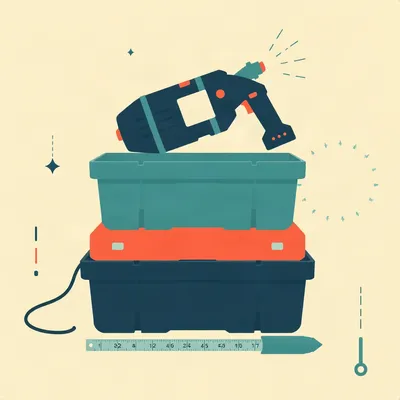
Daniel's got a whole thing about the drill he bought. The Bosch GSB 120 LI, twelve volt, recommended by an AI tool after he explained he needed more power than his Xiaomi screwdriver but still wanted to drill into walls. And his prompt is basically a love letter to the thing with a physics question folded inside. He points out that all three settings, driving, regular drilling, and what he calls the impact setting for concrete, all look identical from the outside. A chuck spinning a bit. But they feel different in the hand, they sound different, and they do wildly different things to the material. So his questions are: what is actually different mechanically? Why does the same spinning motion produce such different results? Are there more than three permutations? And what's the hardware inside that translates the motor's input into these very different torque profiles?

And he's right to be suspicious of the visible motion. The eye sees rotation. The hand feels three different machines. That's the puzzle.
It's a good puzzle. A drill is one of those objects where the user interface is almost insultingly simple. You twist a ring. The tool changes personality. And most people never ask what happened in there.
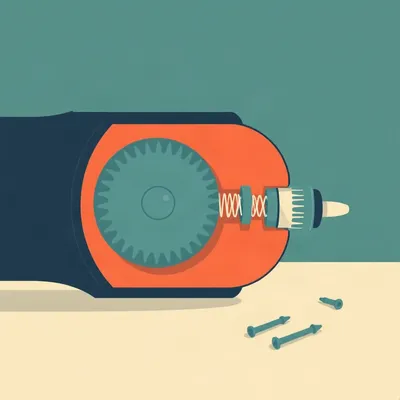
Let's open the housing and see what's actually different, because the answer is not what you'd expect from looking at the outside.
So the reference point is Daniel's specific drill. Let's ground ourselves in its numbers before we get into the guts. Twelve volts. Torque rated at fourteen newton meters soft and thirty newton meters hard. Two speed gearbox, zero to four hundred rpm in low, zero to fifteen hundred in high. And on the hammer setting, a maximum impact rate of twenty two thousand five hundred beats per minute. Plus a clutch with twenty variable torque settings and two fixed positions, one for drilling and one for hammer drilling. That's the twenty plus two.
And I want to flag something early because it's the single most common confusion in cordless tools, and Daniel used the word impact setting. He's right for this specific drill. But it's not the same mechanism as an impact driver. A hammer drill hammers forward. An impact driver hammers rotationally. They are mechanically opposite in orientation, and the tool industry has done a terrible job of naming them distinctly enough that people know the difference.
So Daniel's third setting is hammer drilling, not impact driving.
Correct. And that distinction is going to do a lot of work for us today. But before we get there, let's talk about what each setting actually does mechanically. Because the first one is already more clever than most people realize.
Driving.
Driving. Pure rotation, yes, but with a clutch. The clutch is the part that makes a drill safe for furniture assembly. Inside the tool, there's a spring loaded collar pressing against a set of balls or rollers. When you set the torque ring to one of those twenty positions, you're adjusting how much spring pressure holds those balls in place. When the resistance on the bit exceeds the threshold you've set, the balls slip out of their seats and the chuck stops turning while the motor keeps spinning. You hear it as a clicking. That click is the tool giving up before the fastener does.
So it's a calibrated failure.
A deliberate, repeatable failure. And that's what makes driving feel soft. The tool stops fighting when the screw is seated. Without a clutch, the motor would keep driving and either strip the screw head or cam out and chew up the material. Daniel's old screwdriver didn't have this, which is why it was only good for electronics. No clutch means no control over the final torque.
The clutch is protecting the screw from the tool. Which is backwards from what most people assume. They think the tool is doing the work. The tool is actually stopping itself from doing too much.
And the twenty positions matter. Not all screws want the same torque. A small brass hinge screw wants very little. A long deck screw into hardwood wants a lot. The clutch lets you match the tool's give up point to the fastener's tolerance. That's the whole game.
So that's setting one. Rotation plus a mechanical referee.
Setting two is simpler. Drilling mode locks the clutch out. No slipping, no give up. The motor spins the chuck through the gearbox at full available torque, continuously. This is where the two speed gearbox earns its keep. Low gear, zero to four hundred rpm, gives you high torque for metal. High gear, zero to fifteen hundred, gives you speed for wood. The feel is steady. No ratcheting, no clicking. Just continuous cutting.
And the material doesn't want continuous cutting in every case. Metal work hardens if you spin too fast with too little pressure. Wood wants speed to clear chips. So the gearbox is doing a second job beyond just changing speed. It's changing the torque to speed ratio.
That's the trade. Gears don't create power. They trade speed for torque. Low gear turns the chuck slower but with more force. High gear turns it faster but with less force. Same motor, same battery, different mechanical advantage.
So we've got two settings that both look like spinning, but one has a slipping clutch and the other doesn't. Now the third one.
The third one is where it gets interesting. Hammer drilling. Inside the drill, there are two ratcheting cam plates facing each other. As the chuck rotates, these plates ride up and over each other's teeth, then snap back down. That snapping produces rapid axial percussion. The bit doesn't just spin. It hammers forward thousands of times per minute. On Daniel's drill, up to twenty two thousand five hundred beats per minute.
So the bit is being thrown forward and pulled back while it's also rotating.
The rotation cuts. The percussion pulverizes. And that's the key to why hammer drilling works on masonry. Concrete and brick don't cut cleanly. They fracture. The axial hammering creates micro fractures ahead of the bit, and the rotation sweeps the debris out of the hole. Without the hammering, a standard drill bit just skates on concrete and burns itself up.
That's the part most people don't get. Masonry isn't machined. It's broken. The drill is doing demolition at a very small scale.
And here's the number that tells the tactile story. Bosch's own spec sheet lists vibration at one point five meters per second squared for both metal drilling and screwdriving. But hammer drilling in masonry is ten point two meters per second squared. That's nearly a sevenfold jump. Daniel said the settings feel different in the hand. That number is the difference. The hammer mechanism physically shakes the tool at a rate your hand reads as a distinct buzz. It's not just a spin. It's a vibration that's strong enough to be measured and regulated.
Seven times the vibration. That's not subtle. That's the difference between holding a drill and holding a small jackhammer.
And it's the cam plates doing it. Two pieces of hardened metal slamming into each other twenty two thousand times a minute. That energy has to go somewhere. Some of it goes into the bit and the masonry. Some of it goes back into your hand.
Now, the distinction you flagged earlier. Hammer drill versus impact driver. Let's make that clean.
A hammer drill delivers axial percussion. Forward hammering, combined with rotation. It's for masonry. An impact driver delivers rotational torque pulses via a hammer and anvil mechanism. When the resistance gets high, the hammer winds up against a spring, releases, and smacks the anvil in the direction of rotation. That's why impact drivers are so good at driving long screws and lag bolts. The torque pulses break the friction and drive the fastener in bursts. The hammering is rotational, not forward.
So the hammer drill punches forward. The impact driver punches sideways, rotationally.
Mechanically opposite in orientation. And the sound is different too. An impact driver has that characteristic high pitched hammering when it's under load. A hammer drill has a lower, rattling chatter. Confusingly, both get called impact tools in casual conversation. Daniel's drill is a hammer drill. Its third setting is hammer drilling. It is not an impact driver.
And that's why his twelve volt drill can try concrete but wouldn't be great at driving lag bolts. Wrong mechanism for that job.
Right. A hammer drill doesn't help you drive screws. It helps you make holes in brick. The impact driver is the screw driving specialist. Daniel's drill drives screws through its clutch, not through impact.
So those are the three settings on Daniel's drill. Clutched rotation, pure rotation, and cam plate percussion. Three different physical mechanisms sharing a motor and a housing.
And the user interface hides all of it. A selector ring. That's the whole interface. Twist it one way and you've engaged a clutch. Twist it another and you've locked the clutch out. Twist it a third and you've brought two ratcheting cam plates into contact. Fifty years ago, you'd have needed three separate tools.
Now let's talk about the audio profiles, because Daniel specifically mentioned the sound. What's happening there?
Pure rotation produces a continuous whine. The pitch tracks the gearbox ratio and the motor speed. Low gear is a lower whine. High gear is higher pitched. That's just the sound of the motor and gears spinning at whatever speed you've selected. Hammer drilling adds a superimposed rattling chatter. The cam plates engaging and disengaging at thousands of cycles per minute. That's not a smooth sound. It's a mechanical stutter layered on top of the whine.
And the clutch has its own signature. The clicking when it slips.
That click is the sound of the tool protecting the fastener. It's the balls or rollers slipping out of their seats and then reseating as the motor continues to spin. In a quiet room, it's actually a very informative sound. You can hear exactly when the screw is seated because the clicking starts.
So you've got three audio signatures. A whine, a whine plus chatter, and a whine plus clicks. All from the same motor.
And the material physics dictate which signature you hear. Wood fibers cut cleanly under rotation. The sound is smooth. Metal requires slower rotation with higher torque to avoid work hardening the surface. The sound is lower and more strained. Masonry doesn't cut at all. It fractures. The sound is the chatter of the percussion doing its work.
That's the part Daniel's twelve volt drill is doing when he says it's trying. The mechanism is right. The energy is marginal.
The numbers back him up. Twenty two thousand five hundred beats per minute sounds impressive. But the impact energy per blow is low compared to a rotary hammer. A twelve volt cam plate hammer drill can start the fracture process in soft brick or old plaster. It can't sustain it in dense aggregate. The bit bounces, the battery drains, and the hole takes forever. Daniel's trying caveat is physically accurate.
The mechanism is correct, but the scale is insufficient.
It's the right type of hammering. It's just not enough of it. Which brings us to the wider landscape. Are there more than three permutations? Yes. Quite a few more.
Let's build outward.
The rotary hammer, often called an SDS drill, replaces the cam plates with a pneumatic piston mechanism. Instead of two plates riding over each other, a piston compresses air and drives a striker forward. That delivers far higher impact energy per blow. This is what you see on construction sites for serious concrete work. The SDS refers to the chuck system. Slotted Drive System. It allows the bit to move axially while staying locked in rotation.
The bit slides forward and back in the chuck while it's spinning. That's the slotted part.
Right. The bit isn't rigidly fixed. It floats axially so the piston can drive it forward. A cam plate hammer drill keeps the bit fixed in the chuck and hammers the whole chuck assembly. A rotary hammer lets the bit move independently. That's a fundamentally different mechanical arrangement.
That's why rotary hammers are so much better in concrete. The energy goes into the bit, not into shaking the whole tool.
The cam plate design wastes energy vibrating the housing. The rotary hammer directs it into the bit. That's why a rotary hammer can drill a hole in reinforced concrete that a hammer drill can only dream about.
What else is out there?
Impact drivers with the rotational hammer and anvil mechanism we already covered. Oil impulse or hydraulic impact drivers, which replace the mechanical hammer with a hydraulic pulse unit. They're quieter and smoother, and they deliver torque in a more controlled way. Brushless motors with electronic modes that modulate power delivery via software rather than mechanical gearing. Three and four speed gearboxes on higher end tools that add intermediate ratios between the standard two.
The landscape is broader than three settings. It's a family tree of mechanisms.
Daniel's drill is the compromise tool. It does three jobs adequately rather than one job excellently. A dedicated impact driver would drive screws better. A rotary hammer would drill concrete better. But the twelve volt hammer drill occupies the sweet spot for apartment dwellers and light DIY. It's the Swiss Army knife of the drill world.
The twenty plus two clutch settings make it safe enough for furniture assembly. The hammer mode makes it capable enough for a curtain rod. That's the trade Daniel is living with.
It's a good trade for his context. He's in an apartment. He's not framing a house. He's not drilling into reinforced concrete for a living. The compromise is the point.
The deeper insight here is that what looks like one tool with three settings is actually three different physical mechanisms sharing a motor and a housing. The user interface, a simple selector ring, hides a mechanical complexity that would have required three separate tools fifty years ago.
That's the thing I keep thinking about. The selector ring is the entire user interface. And behind it, there's a clutch, a gearbox, and a percussion mechanism. All of them brought in and out of engagement by rotating a single collar.
Most people will never know any of this. They'll twist the ring, feel the difference, and move on. Which is fine. But the engineering is worth appreciating.
It is. And the fact that this all runs on a twelve volt battery is remarkable. The motor has to spin the chuck, drive the gearbox, and power the percussion. All from a battery that fits in the handle.
Now, let's talk about where this is going. Brushless motors and electronic control are changing what's possible. Some high end tools already blur the line between mechanical and electronic torque control.
A brushless motor doesn't have the carbon brushes that wear out in a traditional motor. It uses electronic commutation. That means the motor controller can adjust power delivery in real time. In some tools, the electronic modes are starting to replace what used to be mechanical gearing. The motor just delivers different power profiles on demand.
The clutch and the cam plates could eventually be replaced by software modulated torque delivery.
It's already happening at the high end. Some drills have electronic clutch modes that mimic the feel of a mechanical clutch without the physical slipping mechanism. The motor just stops applying torque when it senses the threshold. No balls, no springs, no clicking. Just a sensor and a controller.
That's a different kind of elegance. But there's something lost too. The mechanical clutch gives you a physical click you can hear and feel. The electronic version gives you silence and smoothness.
The mechanical version fails in predictable ways. If a spring wears out, you replace a spring. If an electronic controller fails, you replace a circuit board. The repair economics are different.
That's a whole other episode. The right to repair angle on cordless tools.
It is. But for now, the mechanical mechanisms are still the standard, and Daniel's drill is a beautiful example of them.

Twenty two thousand five hundred beats per minute doesn't mean the bit is moving forward twenty two thousand five hundred times. It means the cam plates are engaging that many times. The actual bit travel is a fraction of a millimeter per impact. People hear that number and think the bit is jackhammering. It's not. It's vibrating forward.
The impact rate is the frequency, not the amplitude.
Right. And the amplitude is tiny. That's why a twelve volt drill can't do what a rotary hammer does. The rotary hammer's piston actually moves the bit. The cam plate just rattles it.
That's a useful correction. The impact energy is a function of both the frequency and the mass and travel of the striker. The cam plate has low mass and low travel. The rotary hammer piston has more of both.
I worked a summer on a demolition crew in Manchester in the late nineties. My entire job was drilling anchor holes into reinforced concrete for safety barriers. We used a hundred and ten volt rotary hammer that weighed more than I did. The bit moved. You could see it. You'd put your hand on the chuck and feel the bit sliding forward and back. That's a real hammer. What Daniel's drill does is the same physics scaled down to a toy.
But you said it's the same physics.
It is. Cam plates and pistons both do axial percussion. The difference is scale. And scale matters. The foreman used to call the rotary hammer the jackhammer's polite cousin. Because it's a miniaturized jackhammer. The piston drives the bit forward. The bit breaks the concrete. Same principle, smaller package.
Daniel's drill is the jackhammer's very distant nephew.
Very distant. Twice removed. Doesn't get invited to family reunions.
But you said something earlier about defending the twelve volt drill's concrete ambitions.
I hung shelves in my current flat. The walls are a brutalist nightmare. Reinforced concrete with aggregate the size of golf balls. I borrowed a neighbor's GSB one twenty LI, same drill Daniel has. It did eventually get through. Took three battery charges for four holes. Sounded like a wasp having a seizure in a tin can. But it got through.
Three battery charges for four holes.
The wall was old plaster over soft brick in some places. The drill found those places. The aggregate, it just bounced off. But the brick, it chewed through. Slowly. Patiently. Sometimes trying is enough if you're not in a hurry.
The mechanism is correct, and in the right material, it works. It's the aggregate that defeats it.
Aggregate is the problem. Concrete is a mix of cement and stone. The cement fractures easily. The stone doesn't. A small hammer drill can't break the stone. It just rattles around it. A rotary hammer hits hard enough to split the stone. That's the difference.
That's why Daniel's caveat is so precise. He said dense aggregate. He didn't say concrete. He knows the drill can handle soft masonry but not stone.
The man knows his drill. Good purchase.
The cam plate mechanism is the same physics as the rotary hammer, just scaled down. And sometimes trying is enough if you're patient and the wall is old plaster over soft brick.
That's it. The mechanism is honest. It's doing the right thing. It's just small. Some jobs want small. Some jobs want the hundred and ten volt monster that makes your fillings rattle.
The vibration number tells that story too. Ten point two meters per second squared for Daniel's drill. A rotary hammer in concrete is often fifteen to twenty. The bigger tool shakes harder because it's hitting harder.
Your hands remember it the next day. The summer I did that job, I couldn't hold a fork by the end of the first week. The vibration goes through your arms into your spine. The twelve volt drill won't do that to you. It'll just make your hand buzz.
There's a safety argument for the smaller tool too.
There is. Hand arm vibration syndrome is a real thing. The big rotary hammers are regulated. You're supposed to limit exposure. The twelve volt drill isn't a health risk. It's just slow.
That's the trade. Safety and convenience versus speed and power.
Most people only need the first two. Daniel's drill is the right tool for an apartment. If he was drilling into a concrete ceiling every day, he'd buy a rotary hammer. He's not. So he bought the compromise.
The compromise that does three jobs adequately.
That's the one.
The single most common wrong belief about this topic. What is it?
That all three settings involve the same mechanism. They don't. Driving engages a clutch. Drilling is pure rotation with no clutch intervention. Hammer drilling adds a separate cam plate percussion mechanism. Three different machines behind one selector ring.
The third setting is not an impact driver. It's a hammer drill. Axial percussion, not rotational torque pulses. That conflation is everywhere, and it's worth correcting every time.
The open question for me is whether the mechanical complexity survives. As brushless motors and electronic control become standard, the clutch and the cam plates could be replaced by software modulated torque delivery. Some high end tools already blur that line. The next generation might have no mechanical clutch at all. Just a sensor, a controller, and a motor that knows when to stop.
Then the drill becomes quieter. No clicking. No rattling. Just smooth electronic power delivery. The tactile feedback would change entirely. Whether that's better or worse is a matter of taste.
Daniel's drill is a window into how much engineering hides behind a simple user interface. Three settings, three mechanisms, one motor, and a world of material physics in between.
Thanks to Hilbert Flumingtop for producing.
This has been My Weird Prompts, the human AI collaboration podcast.
Find us at my weird prompts dot com, or email us at show at my weird prompts dot com.
We'll be back soon.