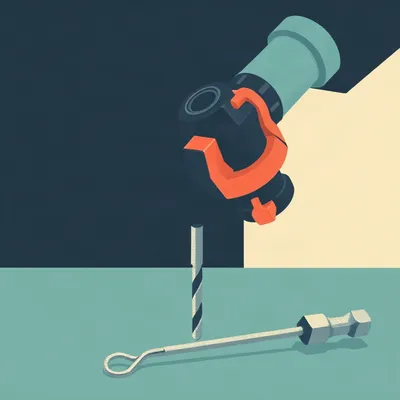
Daniel's been staring at his drill bits again. The question this week is about footprints, the quarter-inch hex system specifically, and whether the convenience of a quick-swap shank is actually costing you precision when the bit gets small. He's also asking about the opposite end, reduced shank bits and adapters that let a small driver spin a big bit, and whether they're as sketchy as people say. So we've got two failure modes to pull apart, one where the shank is too fat for the bit and one where the shank is too thin for the hole.

The sound of a chuck key clattering onto a concrete floor is the sound of a previous century. It's holding the bit against rotational slip, it's setting the depth, and in an impact driver it's the thing that lets the bit slide axially while the anvil hammers. But the click is also lying to you a little.
Lying how?
It tells you the bit is seated properly, so your brain files it under precision. But the quarter-inch hex was never designed for precision. It's a screwdriving standard that got borrowed for drilling because it was convenient. The hex geometry is there to transmit torque without a jaw crushing the flats, and the quarter-inch diameter, six point three five millimeters, is the sweet spot for the torque band of typical twelve and eighteen volt drivers. It's a driver footprint. Calling it a drill bit standard is like calling a trailer hitch a suspension component.
So the first thing to get straight is that Daniel's question about small bits with the fat hex shank is really a question about what happens when you force a driver standard into a drilling job. The bit tapers down from a quarter inch to maybe an eighth or three thirty-seconds, and suddenly the shank is thicker than the thing doing the cutting.
And that's the geometric problem in one sentence. The shank is the lever arm. The cutting torque is applied at the hex, six point three five millimeters across, and then it has to travel down through a necked-down flute section that might be three millimeters. The failure point is always at that transition, right where the flute meets the shank. It's not that the bit is weak, it's that you've built a stress concentration into the tool before it ever touches wood.
So the bit snaps at the shoulder.
Usually, yes. Or it flexes. A three millimeter bit with a quarter-inch shank has a long unsupported section, and the bending moment on that thin section is amplified by the shank length. You get a bit that whips. It walks across the surface, the hole goes oval, and then it grabs and snaps. The hex system didn't cause that, but it made it worse by giving you a fat, rigid handle on a thin, flexible cutter.
There's another factor here, and it's the one nobody mentions when they're selling you a fifty-piece hex bit set. Runout.
Right. Runout is the wobble. A ground round shank in a three-jaw chuck seats on three points of contact, and a decent keyed chuck will hold it to maybe four to eight thousandths of an inch of runout. A hex collet has to leave clearance for the hex to slide in and out, so the ball bearings seat into the detents, but the shank isn't gripped the way a round shank is. You're typically looking at ten thousandths or more of runout. For a quarter-inch bit, that's negligible. For a sixteenth-inch bit, that wobble is larger than the cutting edge's tolerance. The bit walks, the hole goes oversize, and the bit snaps.
So the convenience of the hex system is a trap for precision work. It's optimized for speed and torque, not for concentricity. The moment you're drilling a one-sixteenth pilot hole for a model hinge, the hex shank is actively working against you. You'd be better off with a round shank in a keyed chuck, even a cheap one, because the chuck's job is to hold the bit on center.
And here's the thing about Daniel's specific setup. He's asking about a chuckless drill with a ten millimeter shank. A ten millimeter collet is designed for larger shafts, ten millimeters is just under three-eighths of an inch. If he's using a quarter-inch hex adapter in that collet, he's adding a layer. The collet grips the adapter, the adapter grips the hex shank, and the hex shank tapers to the small bit. That's three interfaces, each with its own clearance, each adding a little more wobble. By the time you're at the cutting edge, the runout has compounded.
So the answer to his first question, would you recommend the tapering hex bits above very narrow diameters, is no. Not in that setup. For anything under an eighth of an inch, you want a round shank bit in a proper three-jaw chuck. The hex system is for driving screws, and it's fine for drilling holes that don't care about precision, but the moment the bit gets small, the system's strengths become liabilities.
And that's the counterintuitive part. The hex quick-change is sold as the thing that makes you faster, and it does. One-handed bit swaps, no chuck key, no fumbling. But the speed is a feature of the driving workflow. When you're drilling a pilot hole for a hinge, the thing you want is a bit that stays on center, and the quick-change mechanism is the wrong tool for that. It's not that the hex system is bad. It's that it's being asked to do a job it wasn't built for.
Let's flip to the other end of Daniel's question, because it's the same tension in reverse. Reduced shank bits. These are the big-diameter bits, half-inch, five-eighths, that have the shank milled down to a quarter or three-eighths so they'll fit in a standard chuck. And the pitch is always the same: run a big bit in a small drill.
The physics of failure here is actually cleaner than the small-bit problem. Cutting torque scales with the cube of the bit diameter. A half-inch bit doesn't need twice the torque of a quarter-inch bit, it needs eight times the torque. So when you mill the shank of a half-inch bit down to a quarter inch, you're asking a quarter-inch shank to transmit eight times the torque it was designed for. And the transition point, the shoulder where the shank steps up to the full diameter, is a stress riser. All the twisting force concentrates right there.
So the bit doesn't snap. It twists.
It twists, or the motor stalls, or the bit grabs. And the grab is the dangerous one. A reduced shank bit in a twelve volt driver is a wrist injury waiting to happen. The motor doesn't have the torque to spin the bit cleanly, so the bit binds, the drill body rotates, and your wrist takes the reaction force. The bit doesn't break, which is what people expect, it transfers the failure to the tool and the user.
So the verdict on reduced shank bits isn't that they don't work. It's that they're a workaround for a tool that's underpowered for the job. You're asking a twelve volt driver to do the work of an eighteen volt drill, and the reduced shank is the symptom, not the solution.
The right answer is to use a bigger drill with a proper half-inch chuck. The reduced shank is a hack, and it's a hack that puts the stress in the worst possible place. If you need to drill a half-inch hole in steel, you need a drill with the torque to spin a half-inch bit, not an adapter that lets a small drill pretend.
And then there are the adapters. The ones that let a quarter-inch hex driver hold a round-shank bit, like a Jacob's chuck with a hex shank on it. Daniel asked about those too, and they're their own special category of compromise.
The problem with adapters is that they add length and weight. Every millimeter of adapter increases the lever arm, which reduces the effective torque at the bit. And they introduce runout. The hex shank seats in the collet with clearance, the adapter body adds its own tolerances, and the round-shank bit seats in the adapter's chuck with more tolerance. By the time you're at the cutting edge, you've got three sources of wobble stacked on top of each other. It's fine for rough work, but for precision drilling it's useless.
The market has actually responded to this confusion with hybrid tools. The Bosch FlexiClick system is the one that comes to mind, a drill body that can take a three-jaw chuck, a hex collet, an offset driver, all on the same motor. The fact that toolmakers are building swappable heads is an admission that no single footprint is ideal for everything.
It's a quiet admission, but it's there. The three-jaw chuck is for drilling. The hex collet is for driving. The SDS system is for hammering through concrete. Each one is optimized for a specific load case, and the minute you try to make one do another's job, you get the failure pattern we've been describing. The quarter-inch hex is a brilliant system for what it is, but what it is is a screwdriving standard.
The thing I keep coming back to is that the convenience of the hex system has trained a generation of users to think of it as universal. And it's not. It's one ecosystem. The round shank in a three-jaw chuck is another. SDS is a third. They coexist because they solve different problems.
And the coexistence is stable because the physics doesn't compromise. You can't make a hex shank as concentric as a ground round shank without giving up the quick-change geometry. You can't make a reduced shank as strong as a full shank without giving up the small-drill compatibility. The trade-offs are baked into the shapes.
So for Daniel's practical question, the recommendation is clear. For very narrow bits, under an eighth of an inch, use a round shank bit in a three-jaw chuck, even a keyed one. The hex shank tapered bits are fine for larger holes where runout doesn't matter, but they're a liability for precision work. And for reduced shank bits and adapters, treat them as a last resort. If you need a big hole, get a big drill.
And the thing about Daniel's drill, the Bosch GSB one twenty, is that it's a twelve volt hammer drill. It's a good tool for its class, but it's not a half-inch drill. The reduced shank bit is asking it to be something it isn't. The tool is fine. The bit is the wrong tool for the tool.
Which is a sentence that sounds like a riddle but is actually just accurate.
It's the whole episode in one line. The bit has to match the tool, and the tool has to match the job. The footprint is the interface where those two things meet, and when they don't meet properly, the failure happens at the interface.
Let's talk about the quick-change mechanism itself for a minute, because Daniel asked about the mechanisms for swapping bits, and there's actually more than one thing going on under that phrase.
Right. The classic quick-change chuck is the spring-loaded locking collar with ball bearings. You pull the collar back, the balls retract, the bit slides in, you release the collar, and the balls seat into the detents on the hex shank. It's a one-handed operation, and it's fast. The balls are doing two things at once: they're holding the bit against axial pull-out, and they're transmitting the rotational force through the detents.
And that's different from a three-jaw chuck.
Completely different. A three-jaw chuck uses friction. The jaws tighten around the round shank, and the grip is proportional to how hard you tighten the key. It's a clamping force, not a positive engagement. The hex collet is a positive engagement. The balls sit in the detents, and the bit can't rotate relative to the collet unless something shears.
And then there's the impact driver collet.
The impact driver collet is a variation on the hex quick-change. It's a cam-lock mechanism. You push the bit in, it clicks past a cam, and the cam holds it. The difference is that the impact driver collet is designed to allow axial movement. The bit slides forward and back a few millimeters with each hammer blow, which is what lets the impact mechanism work. A standard drill chuck doesn't allow that movement, which is one reason you don't use an impact driver for precision drilling.
So the mechanism is matched to the tool's power delivery. The drill delivers constant rotation, the impact driver delivers rotational hammer blows, and the chuck is designed accordingly.
And the quick-change hex collet sits in between. It's used on both drills and impact drivers, but it's really an impact driver standard that got adopted by drills because it was convenient. The axial play that's essential in an impact driver becomes a source of runout in a drill.
Which brings us back to Daniel's small-bit question. The axial play in the hex collet is part of why the small bits wander. The bit isn't just rotating, it's moving forward and back a few hundredths of an inch with every revolution, and that movement is enough to ruin a precision hole.
The clearance is the price of the quick change. If you made the hex collet tight enough to eliminate the axial play, you couldn't get the bit in and out with one hand. The convenience and the precision are in direct tension, and the hex system chose convenience.
That's a useful way to think about it. The hex system chose convenience. The three-jaw chuck chose precision. The SDS system chose impact resistance. Each choice has consequences.
And the consequences show up in the failure pattern. A hex bit in a precision hole wanders. A reduced shank bit twists. An adapter stacks runout. The failure pattern are different, but they all trace back to the same root cause: asking a tool to do a job its geometry wasn't designed for.
Let me push on the reduced shank thing for a second, because I want to make sure we're being fair. Are there any legitimate use cases for a reduced shank bit?
There are a few. The most common is when you have a small drill press with a three-eighths chuck and you need to drill a half-inch hole in wood. The drill press has the torque, the bit is held rigidly, and the reduced shank lets you use the smaller chuck. In that case, the reduced shank is a reasonable compromise because the tool is rigid and the material is soft.
So it's not always a bad idea.
It's not always a bad idea. The bad idea is using a reduced shank bit in a handheld drill that's underpowered for the job. The drill press case is fine. The handheld case is where the wrist injuries happen.
And the adapter case?
Adapters are fine for rough work. If you're drilling a hole for a cable through a stud and you don't care about the hole being perfectly round, a hex shank adapter with a spade bit works. It's ugly, but it works. The problem is when people try to use adapters for precision work, like drilling a hinge mortise or a dowel hole. The runout makes that a losing game.
So the adapter is a convenience tool, not a precision tool.
And that's the whole taxonomy. Convenience tools for convenience work, precision tools for precision work. The trouble starts when you try to cross the streams.
The industry's answer to the crossing-the-streams problem has been the hybrid drill driver. You mentioned the Bosch FlexiClick, but there are others. The idea is that you buy one motor and swap the head depending on the job.
It's a smart response, but it's also a compromise. The swappable heads add cost and complexity, and each head has its own tolerances. The three-jaw chuck head on a FlexiClick is good, but it's not as rigid as a dedicated drill's chuck because it has to mount to the swappable interface. The hex collet head is convenient, but it has the same runout issues as any hex collet.
So the hybrid solves the convenience problem but not the precision problem.
It narrows the gap, but it doesn't close it. The fundamental trade-off is still there. You can't have a chuck that's both quick-change and precise, because the quick-change requires clearance and the precision requires rigidity.
Which is why the multi-ecosystem world persists. The SDS system for hammer drilling, the three-jaw for precision, the hex for driving. Each one is a local optimum, and the global optimum doesn't exist.
That's the thing about tool standards. They're not chosen by committee, they're chosen by physics. The shapes persist because they work for their specific load case, and trying to unify them means accepting a compromise that makes every job worse.
Daniel's question about the tapering hex bits is really a question about whether the compromise is worth it for small bits. And the answer is that it depends on what you mean by small. For an eighth-inch bit, the runout is annoying but manageable. For a sixteenth-inch bit, it's catastrophic.
The threshold is somewhere around an eighth of an inch. Above that, the hex shank's runout is a small fraction of the bit diameter, and the convenience is worth it. Below that, the runout is a significant fraction of the bit diameter, and the bit can't hold center.
And the ten millimeter chuckless drill Daniel's asking about makes it worse, because the adapter layer adds more runout on top of the hex collet's runout.
If he's using a ten millimeter collet with a quarter-inch hex adapter, he's got the collet's clearance, the adapter's clearance, and the hex collet's clearance all stacked. For a three millimeter bit, that's death. The bit is wandering before it ever touches the work.
So the practical advice for Daniel's setup is to keep a small keyed chuck drill around for the narrow bits. It doesn't have to be expensive. A cheap keyed chuck will hold a sixteenth-inch bit more truly than a premium hex collet.
And that's the counterintuitive thing that drives people crazy. The cheap keyed chuck drill, the one that looks like it's from nineteen eighty, is actually the better tool for precision work than the modern quick-change driver. The old tech is better at this specific job.
It's the same dynamic as hand planes. The old Stanley planes are still the standard because the geometry was solved a century ago. The new stuff is lighter and faster, but it's not more precise.
The chuck key is a pain, but the pain buys you concentricity. The three-jaw chuck tightens evenly around the round shank, and the bit runs true. That's worth the thirty seconds of fumbling.
Let's talk about the cube law for a second, because it's the thing that makes reduced shank bits so dangerous, and I want to make sure it lands.
Cutting torque scales with the cube of the diameter. Double the diameter, eight times the torque. A half-inch bit needs eight times the torque of a quarter-inch bit. That's why the reduced shank is a stress riser. The quarter-inch shank is transmitting eight times the torque it was designed for, and the shoulder where it steps up to half-inch is where all that stress concentrates.
So the bit doesn't break at the cutting edge. It twists at the shoulder.
Or it stalls the motor. A twelve volt drill doesn't have the torque to spin a half-inch bit through anything harder than softwood. The motor stalls, the bit grabs, and the drill body rotates. If you're holding it with one hand, your wrist takes the reaction.
That's the injury mechanism. It's not the bit snapping and flying off. It's the drill twisting out of your hand.
The drill becomes a lever, and your wrist is the pivot. A reduced shank bit in an underpowered drill is a wrist sprain waiting to happen. The bit doesn't fail, the user fails.
The bad reputation is earned, but for the wrong reason. People think the bits break. They don't. They twist, and the twist transfers to the user.
The twist is worse than a break. A broken bit is a clean failure. A twisted bit is a stored energy failure. The bit winds up like a spring, and when it releases, it releases into your wrist.
The reduced shank is a spring, and the spring is wound by the motor.
The motor is winding the spring, and the spring is your wrist. It's a bad combination.
For Daniel's second question, the reduced shank bits and adapters, the verdict is that they're a workaround for the wrong tool. If you need a half-inch hole, get a half-inch drill. The reduced shank is a hack, and the adapter is a hack on top of a hack.
The legitimate use case is the drill press with the small chuck. That's it. In a handheld drill, the reduced shank is a liability.
The adapter is a convenience tool for rough work. Use it to drill a cable hole, not a hinge mortise.
The hinge mortise is the test. If your setup can drill a clean hinge mortise, it's precise enough. If it can't, you're using the wrong tool for the job.
The hinge mortise is the test. I like that. It's the precision benchmark for the home workshop.
It's the thing that shows whether your runout is under control. A hinge mortise needs a clean, straight hole, and if your bit wanders, the hinge doesn't sit flush.
The practical takeaway for the home workshop is to have two tools. A quick-change driver for screws and rough holes, and a keyed chuck drill for precision holes. Trying to make one tool do both is where the trouble starts.
That's the answer to Daniel's question about the tapering hex bits. They're fine for rough holes, but for precision work, get a round shank bit and a keyed chuck. The hex system is a driver standard, not a drill standard.
The hex system is a driver standard. That's the line that ties the whole thing together.
It's the line I wish more people understood. The quarter-inch hex is brilliant for driving screws. It's fast, it's secure, it's one-handed. But it's not a drilling standard. It's a driving standard that got borrowed for drilling because it was convenient.
The borrowing created the confusion that Daniel's asking about. The small bits with the fat shanks are the result of that confusion. They exist because the hex system is so dominant that bit makers felt they had to offer everything in that footprint.
The market responds to what people buy. If people buy hex shank bits, the makers make hex shank bits, even if the geometry is wrong for the small sizes.
The makers know the geometry is wrong. That's why the small hex shank bits are always sold in sets with a disclaimer about precision work.
The disclaimer is usually in the fine print, but it's there. Use these for rough work, use round shank bits for precision.
The fine print is the honest part. The marketing is the part that says universal.
Universal is a marketing word. Nothing is universal. Everything is a trade-off.
The trade-off is the show. The hex system traded precision for convenience. The three-jaw chuck traded convenience for precision. The SDS system traded both for impact resistance. Each one is a local optimum.
The local optima are stable because the physics doesn't change. The cube law doesn't change. The runout geometry doesn't change. The trade-offs are baked in.
Where does that leave the future? Are we stuck with the multi-ecosystem world, or is there a path to something better?
I think we're stuck with the multi-ecosystem world for the foreseeable future. The forces that created the standards are still there. The hex system is dominant in driving, the three-jaw in drilling, SDS in hammering. Each one has a huge installed base, and the switching costs are enormous.
But there's a wrinkle. The rise of brushless motors and electronic torque control. Could a smart chuck detect the bit size and adjust the speed and runout automatically?
That's the interesting question. A smart chuck could measure the runout and compensate, or it could detect the bit diameter and limit the torque to prevent the reduced shank failure. The electronics are getting cheap enough that it's plausible.
But the mechanical interface is still the bottleneck. The electronic compensation can't fix the clearance in the hex collet. It can't make the ball bearings seat tighter.
Unless the chuck itself becomes active. A chuck with a motorized collet that tightens around the shank and eliminates the clearance. That's the holy grail, but it's expensive and complex.
It would be a new standard, which means it would have to overcome the network effects of the existing standards.
The network effects are brutal. That's the lesson of the screw drive history. No new standard has broken through since Torx, and Torx took decades.
The multi-ecosystem world is stable. The best tool is the one that matches the job, not the one that matches the marketing.
Know your footprint, know your torque, and don't force a square peg into a round hole. Literally.
That's the closing line, isn't it?
It's the closing line.
Before we wrap, I want to circle back to one thing Daniel asked that we haven't fully addressed. He asked about the mechanisms for quickly swapping out driving bits and drilling bits, and we covered the quick-change collar and the impact collet, but there's also the magnetic bit holder.
Right. The magnetic bit holder is the simplest mechanism. It's just a hex socket with a magnet in the bottom. The bit slides in, the magnet holds it, and the hex walls transmit the torque. It's fast, but it has no positive lock. The bit can pull out under axial load, and the runout is entirely dependent on the fit between the bit and the socket.
It's the least precise of the quick-change mechanisms.
It's the least precise and the least secure. The magnetic holder is fine for driving screws where the axial load is low, but it's useless for drilling. The bit wobbles, and it can pull out mid-hole.
The locking bit holder is the upgrade.
The locking bit holder adds a spring-loaded collar that captures the bit's detent, so it's a hybrid between the magnetic holder and the quick-change chuck. It's more secure than the magnetic holder, but it still has the clearance issue.
The hierarchy is magnetic holder, locking bit holder, quick-change chuck, three-jaw chuck. Each step up adds precision and security, and each step costs convenience.
The impact collet sits somewhere between the locking bit holder and the quick-change chuck. It's secure, but the axial play makes it unsuitable for precision.
The axial play is the thing. It's the trade-off that makes the impact driver work, and it's the thing that ruins precision.
The impact mechanism needs the bit to slide. The hammer hits the anvil, the anvil drives the bit forward, the bit rebounds. If the bit couldn't slide, the impact energy would go into the chuck and destroy it.
The axial play is a feature, not a bug. It's just a feature that's incompatible with precision drilling.
Which is why you don't drill precision holes with an impact driver. The tool is optimized for driving, and the bit is optimized for driving, and the result is a hole that's roughly in the right place.
Roughly in the right place is the phrase. That's the hex system's precision ceiling.
It's a fine ceiling for most home projects. Most holes don't need to be within a thousandth of an inch. The problem is when people don't know the ceiling is there.
Daniel knows the ceiling is there. That's why he's asking the question.
The answer is what we've been saying. For narrow bits, use a round shank in a three-jaw chuck. For big holes, use a big drill. The hex system is for driving.

The intern who lost the chuck key was named Mikey. This was ninety-four, ninety-five, I was building stage sets in a shop in Bridgeport. We had a half-inch drill that was older than I was, solid steel body, and the chuck key was on a chain. Mikey lost the key, and instead of telling anyone, he used a pair of pliers to tighten the chuck. Stripped the threads on the jaws. The drill still worked, but the chuck never held true after that. Every bit wobbled.
The thing about the reduced shank hole saw, the one that sent me off the ladder, is that it wasn't a reduced shank bit. It was a hole saw with a quarter-inch arbor in a half-inch drill. The arbor twisted, the saw grabbed, and the drill came out of my hands and spun me off the ladder. I landed on a pile of plywood, which was lucky. The smell of burning wood was the first thing I noticed, because the saw had friction-burned the two-by-four before it grabbed.
The point isn't the bit. The point is that I thought I could hold the drill. I thought my grip was stronger than the torque. It wasn't. The drill taught me that in about half a second.
Mikey's an orthopedic surgeon now. I saw him at a reunion a few years back. He said the pliers thing was the moment he learned to respect tools. I told him the ladder thing was the moment I learned to respect gravity. We both laughed, but neither of us was joking.
The thing about Mikey's story is that the stripped chuck was a precision failure. The drill still spun, but it couldn't hold a bit on center anymore. The pliers didn't just damage the threads, they changed the tool's geometry. Every hole after that was roughly in the right place.
The ladder story is the torque failure. The drill was powerful enough to spin him off the ladder, but the arbor wasn't strong enough to transmit that torque cleanly. The failure happened at the interface, just like the reduced shank bits.
The arbor twisted. I found it later, bent about fifteen degrees. I kept it for a while, then threw it out. Should have kept it as a reminder.
The reminder being that the tool's power has to go somewhere. If the bit can't take it, the user takes it.
That's the lesson. The bit doesn't care about your wrist.
The bit doesn't care about your wrist. That's the whole episode.
The whole episode is that the bit doesn't care. The chuck doesn't care. The motor doesn't care. They're all just doing what the physics says.
The physics says the hex system is for driving, the three-jaw is for drilling, and the reduced shank is a spring waiting to unwind.
The spring is the part people don't think about. They think the bit breaks. It doesn't. It winds up.
The winding is the stored energy. When it releases, it releases into whatever is holding the drill.
Which is usually a wrist.
Which is usually a wrist.
The practical advice is to respect the interface. Match the bit to the tool, and the tool to the job. Don't force a square peg into a round hole.
Literally.
The misconception I want to land before we close is the one about the quarter-inch hex being a universal standard. It's not. It's a driver standard that got borrowed for drilling. The hex geometry is optimized for torque and speed, not for concentricity. The runout is higher than a three-jaw chuck, and the axial play is a feature of the impact driver, not a precision tool.
The correction is that for small bits, under an eighth of an inch, a round shank in a keyed chuck is the better tool. The cheap old drill is more precise than the modern quick-change driver for that specific job. It's not about the tool being old or new, it's about the geometry matching the task.
The future question is whether a smart chuck could close the gap. Electronic torque control could limit the reduced shank failure, and active collets could eliminate the runout. But the network effects of the existing standards are brutal, and the multi-ecosystem world is probably stable.
The best tool is the one that fits the job, not the one that fits the marketing. Know your footprint, know your torque, and don't force a square peg into a round hole.
This has been My Weird Prompts. Thanks to our producer, Hilbert Flumingtop, for keeping the show on the rails.
If you have a weird prompt about tools, torque, or the physics of your workshop, send it to us at my weird prompts dot com.
We'll be back soon.