Hannah sent us something this week, and it starts with an apple. Not just any apple — the ancestor of every apple you've ever eaten.

Kazakhstan. The wild apple forests of the Tian Shan.
That's where this began for her. She read Michael Pollan's The Botany of Desire, got hooked on the idea of Kazakhstan as the birthplace of the apple — wild forests, thousands of varieties, fruit the size of your fist. That led her to a book called Apples Are from Kazakhstan, and from there to a much bigger curiosity about the whole country. So she's asking: what is Kazakhstan actually like, versus the mythic version? Are the apple forests real and can you visit them? Is apple hunting a thing? What do Almaty and Astana feel like architecturally — Astana especially, which seems to have this surreal, futuristic, almost Dubai-of-the-steppe quality. She wants to understand the culture: the Soviet legacy, the nomadic traditions, the food, the horse culture, the oil economy, the vast open landscape. And whether her instinct that Kazakhstan has a strange amount in common with Texas is remotely accurate. Plus the practical question — if someone keeps at least somewhat kosher and doesn't eat horse meat, how hard is it to travel there as a vegetarian?
That's a full briefing.
It is. So we're going to spend the next twenty-five minutes answering every one of those questions, starting with the apple forests, because that's where the whole thing began.
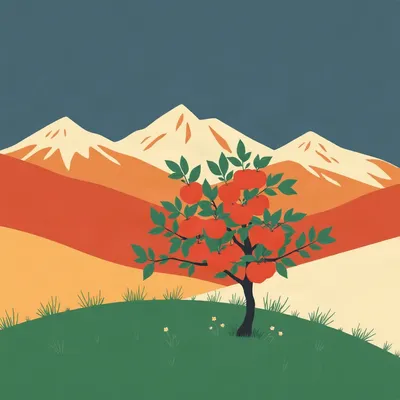
And they are absolutely real. Malus sieversii grows in the Tian Shan foothills of southeastern Kazakhstan, primarily in Ile-Alatau National Park, about twenty-five miles south of Almaty. Russian scientist Nikolai Vavilov identified it as the progenitor of the domestic apple in 1929. He wrote that thickets of wild apple trees make up entire forests there — and he wasn't exaggerating. Genetics confirmed it in 2017. The Boyce Thompson Institute sequenced a hundred and seventeen apple varieties and found that roughly forty-six percent of the domestic apple genome comes straight from Kazakhstan's Malus sieversii. Nearly half of every supermarket apple's DNA traces back to those mountains.
That's a wild fact. Every Red Delicious, every Granny Smith, every Honeycrisp — forty-six percent of its genetic code walked out of a forest in Kazakhstan. I'm trying to think of an equivalent. It's like if someone told you that forty-six percent of every dog breed's DNA traces back to one specific wolf pack in one specific valley in Mongolia. You'd say, wait, that one place? And we can still go there?
And the diversity in those forests is extraordinary. At monitoring sites in Ile-Alatau they've identified sixty distinct apple forms. Fruits ranging from eighteen grams to a hundred and twenty grams. Colors from green to yellow to deep red. Flavors from sour-bitter to sweet-honey. Some individual trees yield up to nine hundred kilograms of fruit. And they live — a single tree can survive more than a hundred and sixty years.
So the forest is a living library. Every tree is a volume nobody's read yet. And when you say sixty distinct apple forms — I want to pause on that. Most of us have eaten maybe six or seven apple varieties in our entire lives. Granny Smith, Fuji, Gala, Honeycrisp, Red Delicious, Golden Delicious, maybe Pink Lady if you're fancy. That's the range most supermarkets offer. Sixty forms in one forest system means there are apples in those mountains that taste like nothing you've ever experienced, with textures and aromas that never made it into commercial cultivation.
And some of those traits could be critically important. Disease resistance. Drought tolerance. Cold hardiness. The commercial apple industry relies on an extremely narrow genetic base — a handful of cultivars grafted onto a handful of rootstocks. That makes the entire global crop vulnerable. The wild forests of Kazakhstan are the backup drive for one of the world's most important fruit crops.
And it's threatened. You mentioned the logging.
Logging in the nineteen-twenties and thirties was brutal — the Almaty brewery and the Talgar distillery were heated with apple wood until 1932. The Talgar winery alone prepared sixteen thousand cubic meters of apple wood in 1926. Between that, development, livestock grazing, and grafting of cultivated varieties onto wild rootstocks, the forests have been reduced by an estimated eighty percent. Malus sieversii is listed as vulnerable on the IUCN Red List.
Eighty percent gone and we still don't know exactly how many trees remain. The monitoring is limited to five permanent sites.
Five. In a forest system that once covered the foothills.
That's the kind of number that keeps conservation biologists up at night. Five monitoring sites for the genetic origin of every apple on Earth. Imagine if we had five monitoring sites for the Amazon and called it a day. So Hannah's first question — can you visit them? The answer is yes. Multiple tour operators run excursions. Caravanistan offers one- and four-day wild apple forest tours from April through October. Steppe and Sky Travel does daylong tours from May through September. The best months are May for blossom and September for fruit. Ile-Alatau National Park is accessible year-round with guided hikes, weather-dependent from November through March.
And is apple hunting a thing? Not as a named tourist activity like truffle hunting in Italy — there's no industry around it. But the guided tours include foraging and tasting components. You walk through the forest, you pick apples off trees whose genetic lineage goes back millennia, and you eat them. The sellers at the Green Bazaar in Almaty will tell you which mountain valley each apple came from. It's like a wine tasting, but for apples.
Which brings us to Almaty itself. The city's former name, Alma-Ata, literally means father of apples. It sits at the foot of the Zailiysky Alatau mountains — this stunning natural backdrop of snow-capped peaks. Described as leafy, with broad tree-lined boulevards, parks, and the mountains looming over everything. Imagine you're sitting at a café, you look up from your espresso, and there's a fourteen-thousand-foot wall of rock and ice just hanging there above the city.
Architecturally it's a layered city. You've got nineteenth-century neo-Russian buildings — Zenkov Cathedral in Panfilov Park is the fourth-tallest wooden building in the world, built without a single nail. You've got Soviet-era Khrushchyovka and Stalinka apartment blocks. And a strong collection of nineteen-sixties through eighties Soviet modernism. It's called the Garden City for its green plantations. The Green Bazaar is the sensory heart — apples sold in precarious towers, fastidiously organized according to hue, size, and shape. The city has a thriving cafe culture, a contemporary art scene, the Abai Opera House.
And then there's Astana.
Astana is the opposite of everything I just said.
Built from scratch starting in 1997, when President Nazarbayev moved the capital from Almaty. Designed by Japanese architect Kisho Kurokawa. It sits isolated on the northern steppe, and the contrast with the surrounding emptiness is so jarring that one photographer described it as a L-EGO city — a lot of empty spaces in between, people appearing displaced among the large-scale buildings. I've seen photographs where you can literally see the steppe just... stopping, and then a Norman Foster pyramid rising out of the grass. No transition. No suburbs gradually thinning out. Just emptiness, then city.
The signature buildings are surreal. The Baiterek Tower — a golden egg cradled by a stylized poplar tree, conceptualized by Nazarbayev himself. The Palace of Peace and Reconciliation — a sixty-two-meter glass pyramid by Norman Foster. The Khan Shatyr — a giant transparent tent. And the spherical Kazakhstan Pavilion from EXPO 2017, which everyone compares to the Death Star, to the government's displeasure.
The phrase that keeps appearing is as if a far-flung migrating civilization got its coordinates wrong. And there's this specific detail I can't get out of my head — the average salary is about four hundred and fifty dollars a month. So you've got Foster-designed landmarks and a giant transparent tent, and the person cleaning that tent is making four hundred and fifty dollars a month. The gap between the glitzy exterior and everyday life is impossible to ignore.
Nazarbayev planted a million trees starting in 1997 to insulate the city from brutal winds and cold — winters can stretch from November to May. The ambition is staggering, but the emptiness between the landmark buildings tells a more complicated story about who the city was built for. It's a capital designed to be seen from a helicopter, or photographed for a brochure. The pedestrian experience is secondary.
That's the built environment. But to understand Kazakhstan, you have to understand the culture that shaped it — and that starts with the horse.
For roughly three thousand years, Kazakhs were mobile pastoralists following a precise seasonal circuit. That shaped everything. The yurt — a portable felt home, UNESO-listed in 2014. The horse-centered diet and sport. The oral tradition of dombra music and aitys — improvised poetry duels, UNESO-listed in 2015. The principle of jeti ata — knowing your seven male ancestors. And hospitality — qonaqjaılyq — which is a sacred obligation. There's a proverb that a guest brings happiness with them, and people mean it. The guest is almost holy.
Let me ask about that — how does that actually work in practice? If I show up at someone's door in rural Kazakhstan, what happens?
You're fed. You're given tea. You're offered the best they have, even if they have very little. There are accounts of travelers in the steppe being taken in by strangers, given a place to sleep, fed a full meal, and sent off with provisions, all without any expectation of payment. The obligation is on the host, not the guest. Refusing hospitality is a breach of social code. And the guest has obligations too — you accept what's offered, you show gratitude, you don't overstay. It's a reciprocal system built on centuries of nomads understanding that anyone traveling the steppe might one day need shelter.
And then the Soviet Union happened.
Forced collectivization in the nineteen-thirties ended large-scale nomadism in a famine that remains a national trauma. Russian remains widely spoken. The shift from Cyrillic to a Latin-based alphabet for Kazakh is underway, targeted toward 2031. The capital's original site, Akmola, was known for housing a gulag for wives of convicted traitors. A 2026 study in Frontiers in Communication examines how Kazakhstan has been reconstructing national identity through a hybrid model — blending Soviet-era figures with revived nomadic traditions.
So you've got this tension between the nomadic past and the Soviet scar tissue, and the country is still working out how to hold both. Do you celebrate the pre-Soviet warrior poets? Do you keep the Soviet war memorials? The answer seems to be: yes, both, and we'll figure out the contradictions later.
And the horse sits at the center of it all. Transport, sport, status symbol, and dinner. Kazy — horse meat sausage — is a delicacy. Kokpar is a mounted game with a goat carcass, like buzkashi, and it has a professional league. Kumis — fermented mare's milk, two to three percent alcohol — is the national drink. Children are sometimes said to ride before they walk.
The national dish is beshbarmak — five fingers. Boiled horse meat or lamb over flat noodles, eaten by hand. The most honored guest may be presented with a boiled sheep's head and must carve and distribute it by rank. And this isn't just dinner — it's a ritual. Different parts of the head go to different people based on age, status, and relationship to the host. The ears might go to the youngest person so they'll listen to their elders. The eyes to someone who needs to see more clearly. If you get it wrong, you've committed a social error. If you refuse, you've committed a much bigger one.
Bread is sacred. Never placed upside down or on the floor. Thirteen Kazakh traditions are on UNESCO's Intangible Cultural Heritage list. This is not a culture that forgot itself.
The food tells the story. Kazakh cuisine is not meat-heavy by accident — it's a direct expression of nomadic survival on the steppe, where every part of the animal was used and nothing was wasted. The difficulty of finding a meat-free meal is itself a cultural lesson. You're not just dealing with a menu preference; you're brushing up against a three-thousand-year-old survival strategy.
Which brings us to the oil economy. Kazakhstan has about thirty billion barrels of proven oil reserves. Oil drove five percent GDP growth in 2024, accelerating to six-point-five percent in 2025. Total oil output reached ninety-nine-point-four million tons last year.
But oil's share of exports fell to a historic low of forty-four-point-four percent in the first quarter of 2026. Copper, silver, sulfur — the non-oil sectors are growing.
The Tengiz field's Future Growth Project is a major driver, but pipeline politics with Russia remain a vulnerability. Caspian Pipeline Consortium disruptions this summer forced production cuts. KazMunayGas reported first-half 2026 production of twelve-point-four million tonnes, down from thirteen million the year before. The economy is diversifying, but it's still tethered to hydrocarbons.
And this is where it gets interesting from a policy perspective. You've got an economy growing at six and a half percent, but oil's share of exports is dropping. That's actually the dream scenario for a petrostate — grow the rest of the economy faster than the oil sector so you're not caught flat-footed when the oil runs out or demand drops. The question is whether the diversification is real structural change or just commodity price shifts.
The copper and silver numbers suggest it might be real. But the pipeline vulnerability with Russia is a reminder that geography doesn't diversify. You can change what you export, but you can't change where the pipelines run.
So the country is at a crossroads — oil wealth is still flowing, but the share is shrinking, and the economy is broadening out. Which is probably the right place to talk about Texas.
The Kazakhstan-Texas comparison is real, and it's weirder than it first appears. Shymkent, the third-largest city, has been called the Texas of Kazakhstan since Soviet times. The reasons: geography — south-central part of the country. Cattle — lots of them. And a Wild West independent spirit.
A 1985 Los Angeles Times article quotes a Soviet official saying the republic is something like Texas — both places where cowboys and cattle played an important historical role and both retain a lot of the independent frontier spirit.
And Kazakhs themselves use it. Scholars Natalie Koch and Kristopher White documented that Shymkent — eto nash Texas — Shymkent is our Texas — is a cultural trope repeated countless times. One Kazakh student wrote in an essay, in Shymkent people are very fond of meat and it unites us with the Texans.
I love that. The comparison isn't something outsiders imposed — it's something Shymkenters embraced. The Soviet-era origin is that Westerns were popular in the USSR, and South Kazakhstan was seen as ruleless and tough, so the cowboy archetype mapped neatly onto the local self-image. There's something almost touching about it — Soviet citizens watching John Wayne movies and thinking, yeah, that's us.
Kazakhstan is about four times the size of Texas — two-point-seven million square kilometers versus six hundred seventy-eight thousand — but has a smaller population. Nineteen-point-four million versus twenty-five-point-one million. Both are major oil producers. Both have a frontier self-image. The comparison holds up better than most people would expect.
The Texas thing is real. Which leaves Hannah's practical question: can you actually travel there as a vegetarian who keeps somewhat kosher and doesn't eat horse meat?
The short answer is challenging but manageable. Vegetarian availability is medium in big cities and tourist areas. Salads, vegetable stews, bread dishes are easy to find. Pumpkin manti — steamed dumplings — and chickpea plov are increasingly available as vegetarian versions. Cities now carry more vegetarian versions of the staples than they did even five years ago.
But traditional Kazakh cuisine leans hard on meat. And when you say bez myasa — without meat — in Russian, you still have to watch for broths. Many vegetable dishes are cooked in meat-based stock. This is the thing that catches people out. You order what looks like a simple vegetable soup, and it's been simmering with lamb bones for six hours. The vegetables are vegetarian. The soup is not.
Kosher food is very low availability. The Jewish community is small — eighteen to thirty thousand people, mostly Ashkenazi, in Almaty and Astana. Soviet-era suppression gutted religious infrastructure. There are no kosher restaurants or butchers outside Chabad facilities. Chabad Kazakhstan operates in Almaty and may offer Shabbat meals with advance notice.
Horse meat is central. Kazy, beshbarmak with horse — it's not an occasional thing, it's the cultural cornerstone. Horse meat is not kosher. Dairy and meat are not kept separate in Kazakh cooking. So the overlap between keeping kosher and eating local is essentially zero. You're not going to find a kosher beshbarmak. It doesn't exist.
The best strategy: contact Chabad before traveling, bring kosher supplies, and lean on fresh produce from the Green Bazaar. The fruit and vegetable markets in Almaty are extraordinary — you can eat well without touching meat if you're cooking for yourself. But in restaurants, you're going to be navigating carefully.
Lamb and beef versions of most dishes exist. You need to be explicit. The biggest risk is cross-contamination and the fact that the broth in what looks like a vegetable soup is probably meat-based. And there's the social dimension too. If someone invites you to their home and serves beshbarmak, which is the highest expression of hospitality, and you say no — that's not just a dietary choice. That's a cultural rejection. You need to navigate that with real sensitivity.
It's not impossible. People do it. But it requires planning, and it means accepting that you're going to miss a significant part of the culture — which is built around shared meat dishes and the ritual of hospitality that comes with them.
The boiled sheep's head is not going to work for a vegetarian who keeps kosher.
No. It is not.
Before we wrap up, I want to sit with something. The apple forests are a metaphor for the whole country. They're tough, diverse, threatened, and globally significant. Forty-six percent of every apple in your grocery store traces its DNA to those mountains — and the forests have been reduced by eighty percent, and we don't even know exactly how many trees are left. The thing that gave the world its apples is fighting to survive, and most people have no idea it exists.
You can still go there. You can walk into Ile-Alatau National Park in September and pick an apple off a tree whose ancestors were feeding bears and wild horses ten thousand years ago. That's not a myth. That's a plane ticket.

I was in Atyrau in 2019. Three months, consulting for an oil services company — supply chain optimization for the Tengiz expansion. Not glamorous. But I got a weekend in Almaty and went to the Green Bazaar.
Everyone talks about the Baiterek Tower and the Death Star building. The thing that got me was the apples. I saw apples I didn't know existed. Purple ones. Ones that looked like pears. Ones that tasted like honey and cinnamon. The sellers were so proud of them — they'd tell you which mountain valley each one came from. It was like a wine tasting but for apples. And I thought, this is the real Kazakhstan. Not the oil, not the futuristic capital. This ancient, diverse, stubborn thing that's been here for millennia and is fighting to survive.
I brought back a bag of dried apple slices from a variety called Almaty Gold. They're still in my pantry. They're probably seven years old now. I'm afraid to eat them because they're the last ones I'll ever have from that specific tree.
The fragility of the whole thing, compressed into a bag of dried fruit in a cupboard.
The monitoring sites cover five locations. Five. In a forest system that once stretched across the foothills. We don't know how many trees are left, and every one of them is a genetic repository that took millennia to build and could be gone in an afternoon.
The man who sold them to me said the tree was older than his grandfather's grandfather. He said it like it was just a fact about the weather.
I keep thinking if I eat them, that's it. That connection is gone. So they sit there.
You know what strikes me about that? You're doing exactly what the forest does. Preserving genetic material. Holding onto something irreplaceable because you understand, on some level, that once it's gone, it's gone. Your pantry is a miniature seed bank.
I hadn't thought of it that way. But yeah. Maybe I should plant them.
They probably wouldn't germinate after seven years. But the impulse is correct.
Kazakhstan is at a real crossroads. Oil wealth is diversifying, the economy is growing at six and a half percent, the country is reconstructing its identity after the Soviet era. The apple forests are a symbol of all of it — ancient, resilient, irreplaceable, and not guaranteed to survive the next century. Whether they do depends on conservation efforts, tourism pressure, and climate change.
If you ever find yourself in Almaty, go to the Green Bazaar. Buy an apple you've never seen before. Eat it. And remember that you're tasting forty-six percent of every apple that's ever been grown.
Thanks to our producer Hilbert Flumingtop. This has been My Weird Prompts. Email us at show at my weird prompts dot com.
We'll be back soon.