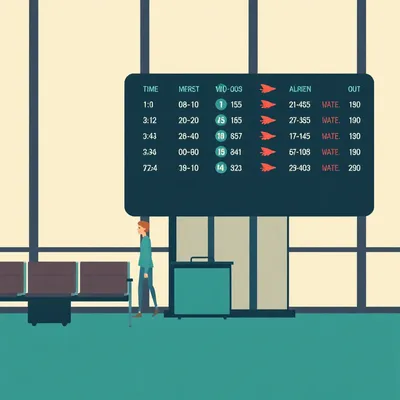
Daniel sent us this one — he's noticed something odd about himself and apparently a bunch of his friends. When he's in transit, like at an airport or on a long bus ride, he feels strangely relaxed. Not at the destination. And then he noticed the same thing during the Iran war last year in Israel — that month of national emergency, regular life upended, and people around him were reporting this almost perverse sense of calm. He's asking what this phenomenon is called, and whether we all experience it. Which is a deceptively simple question that opens up about six different fields of research.

It really does. And the short answer is — yes, it's been studied, quite extensively actually, and it has a name. The experience of being relaxed in transit or in between states is called liminality, or more specifically, what some psychologists call the liminal relaxation effect. The term liminality itself comes from the Latin word limen, meaning threshold. And the anthropologist Arnold van Gennep first wrote about it in nineteen-oh-nine in his work on rites of passage.
Nineteen-oh-nine. So we've been thinking about this for over a century and we still can't figure out why the airport departure lounge feels better than the office.
Van Gennep wasn't looking at airports. He was studying tribal rituals. He noticed that rites of passage have three phases — separation, transition, and incorporation. The middle phase, the transition, is the liminal period. You're no longer who you were, but you're not yet who you're going to be. And he observed that during this phase, normal social rules get suspended. Then in nineteen sixty-nine, an anthropologist named Victor Turner took this further and coined the term communitas — this feeling of shared equality and connection that emerges when people are in a liminal state together, stripped of their usual social hierarchies.
So the business traveler and the backpacker sitting next to each other at gate C fourteen, both equally powerless against the departure board — that's not just a design quirk of the airport. That's a deep anthropological pattern.
And here's where it gets interesting from a neuroscience perspective. There was a twenty twenty-one fMRI study out of Stanford that looked at what happens in the brain during passive transit, specifically train rides. They found that activity in the default mode network — the DMN — drops by about twenty to thirty percent compared to when you're at rest at home or in an office.
The default mode network being the part of the brain that's active when you're... Thinking about yourself?
The DMN is associated with self-referential thought, planning, worrying about the future, replaying social interactions. It's the brain's background noise of selfhood. And when you're in passive transit, that network quiets down. You're not rehearsing your next meeting. You're not mentally updating your to-do list. You're just watching the landscape scroll past.
The brain literally downshifts. It's not that you're doing something relaxing. It's that you're not doing the thing that's usually exhausting you — which is being yourself in a social context with responsibilities.
This connects to something called the liminality hypothesis in environmental psychology. The idea is that liminal spaces reduce cognitive load because you're not responsible for outcomes. At the airport, you've already handed over control. You can't make the plane leave faster. You can't speed up the security line. You're in a system that's going to process you on its own timeline, and your only job is to wait.
Which sounds like it should be stressful. And for some people it is. But for others, there's a kind of surrender that's almost pleasant.
There's a twenty twenty-three study in the Journal of Environmental Psychology that quantified this. They measured cortisol levels in airport departure lounges and compared them to office environments. They found about a fifteen percent reduction in cortisol in the airport setting. And these weren't people on vacation yet — they were just in the departure lounge, waiting.
Fifteen percent lower cortisol before the holiday has even started. The relaxation isn't the destination. It's the threshold.
And the researchers controlled for anticipation of the trip. The effect held even when people were traveling for business or for family obligations they weren't particularly looking forward to. The airport itself was doing something.
What's the mechanism? If it's not just excitement about the beach, what's actually happening?
This is where Stephen Kaplan's Attention Restoration Theory comes in. Kaplan, in nineteen ninety-five, identified something he called soft fascination. It's a mode of attention that's engaged but effortless. Think of watching waves, or a fire, or in this case, watching the airport activity — the planes taxiing, the people moving, the light changing through the terminal windows. Your attention is held, but it's not demanded. Unlike directed attention, which is what you use for work — focused, effortful, depletable — soft fascination actually restores your mental energy.
The airport as a screensaver for the brain.
actually not a bad analogy. The screensaver kicks in when the computer isn't being actively used, and it prevents burnout. The soft fascination of transit spaces does something similar for attention.
The airport is a giant, expensive, security-heavy attention restoration device that we accidentally built while trying to move people around.
It's not just airports. There was a twenty twenty-two University of Tokyo study of five hundred travelers that looked at this across different transit modes. They found the effect was strongest in what they called passively navigated transit — trains, buses, flights — where someone else is driving and you're just a passenger. The effect was weaker but still present in self-navigated transit like driving your own car.
That makes intuitive sense. When you're driving, you're still making decisions. When you're in seat twenty-three A, your biggest decision is whether to have the chicken or the pasta.
The study also found something I thought was fascinating. The relaxation effect was independent of trip duration. A forty-five minute train commute produced a measurable drop in self-reported stress, even though the person was heading to work.
Commuters are getting a mini liminal reset twice a day and probably not even noticing it.
Which might explain why the shift to remote work has been disorienting for some people beyond just the social isolation. They lost those liminal buffers between home and work. The threshold vanished.
The commute as a psychological airlock. You enter one identity, you exit another. And without it, the two identities bleed into each other.
There's a term for that in the literature — role blurring. And it's associated with higher burnout rates. The liminal commute, even an unpleasant one, serves a boundary function.
We've built a case for transit spaces. But the prompt also raised something that feels very different — national emergencies. That's not soft fascination with a departure board. That's sirens and uncertainty and real danger. And yet people report feeling calm.
This is what I think is the most counterintuitive part of the whole phenomenon. And the research backs it up. During the twenty twenty-three to twenty twenty-four Israel-Hamas war, which I lived through here in Jerusalem, and which I know many listeners experienced firsthand, there were surveys done on civilian psychological responses. And one survey about a month into the conflict found that thirty-four percent of Israelis reported feeling what the researchers called unexpectedly calm.
Over a third. During a war.
This isn't unique to that conflict. There's a twenty twenty-four study in the Journal of Traumatic Stress that looked at civilian responses to prolonged national emergencies across multiple countries and multiple types of crisis. They found a consistent subset of the population — somewhere between twenty-five and forty percent depending on the crisis — who reported reduced anxiety once the emergency phase actually began, compared to the anticipatory phase before it.
The dread before the crisis was worse than the crisis itself.
For those people, yes. And the researchers point to a few mechanisms. The first is what they call decision simplification. During a national emergency, your choice set collapses. You're not deciding between seventeen brands of yogurt or which email to answer first or whether to go to the gym. The non-essential decisions just... And decision fatigue is a real cognitive drain. When it lifts, there's a sense of relief, even if the remaining decisions are about things like shelter and safety.
It's almost like the brain experiences the reduced decision load as a net positive, even though the stakes of the remaining decisions are objectively higher.
Because the high-stakes decisions are usually clear. There's a protocol. There's a directive from the Home Front Command. You follow it. The ambiguity that normally exhausts you — should I switch careers, should I have that difficult conversation, am I spending my time well — that all goes quiet.
Which connects to what we said about the DMN dropping during train rides. The self-referential worry engine shuts off because the questions it normally chews on have become irrelevant.
And there's a second mechanism that's even more interesting. Terror management theory — which comes out of the work of Sheldon Solomon, Jeff Greenberg, and Tom Pyszczynski — suggests that when people are reminded of their mortality, they often respond by clinging more tightly to their cultural worldview and their close relationships. But there's a corollary to that. When the threat is shared, when everyone around you is in the same situation, you get what researchers call shared reality. And shared reality is profoundly calming.
Turner's term from nineteen sixty-nine shows up in a war zone.
And it's not just a nice feeling. Shared reality has measurable effects on stress physiology. When you're going through something difficult but you're going through it with everyone else, your cortisol response is actually attenuated compared to going through it alone.
The national emergency creates a kind of involuntary communitas. Everyone's social status gets flattened. The CEO and the janitor are both in the stairwell. The pretenses drop. And that flattening, which in peacetime we might find humiliating or destabilizing, in wartime feels like...
Part of that is because social hierarchy maintenance is cognitively expensive. Performing your status, managing your image, keeping up with the comparisons — it's exhausting. When the emergency suspends all of that, you get your mental bandwidth back. You're just a person in a building with other people.
There's a line from the prompt about friends describing a perverse sense of relaxation. And I think the word perverse is telling. People feel guilty about it. They think there's something wrong with them for feeling calm while rockets are falling.
This is one of the misconceptions I really want to address. Feeling relaxed during an emergency is not pathological. It's not denial. It's not dissociation — at least, not necessarily. It's a normal psychological response to a sudden reduction in cognitive load and an increase in social cohesion. The guilt people feel about it is often more distressing than the relaxation itself.
You're calm, and then you feel bad about being calm, and that's what actually stresses you out.
The meta-stress is the problem. And the twenty twenty-four Journal of Traumatic Stress study I mentioned makes this point explicitly. They found that people who experienced the emergency relaxation effect and accepted it as normal had better long-term mental health outcomes than people who experienced it but interpreted it as a sign that something was wrong with them.
Which suggests that just knowing this phenomenon exists and has a name could be therapeutic.
Psychoeducation — just teaching people what normal responses look like — is one of the most effective early interventions for preventing post-traumatic stress. If you know that feeling calm during a crisis is a documented, normal thing, you're less likely to spiral into self-judgment about it.
We've got two apparently different situations — the airport and the war zone — that produce the same psychological signature. Reduced cognitive load, suspended social hierarchy, shared experience, quieting of the self-referential brain. But are we all experiencing this? That was the second part of the prompt. Is this universal?
It's definitely not universal. And this is where personality psychology comes in. The experience of liminal spaces is strongly moderated by personality traits, particularly openness to experience and neuroticism.
Walk me through that.
People high in openness tend to find liminal spaces energizing rather than just relaxing. The novelty, the ambiguity, the break from routine — that's intrinsically rewarding for them. They're the ones who love airports even when they're not going anywhere interesting. They just like being in the flow.
People high in neuroticism?
For them, the same ambiguity that feels freeing to someone high in openness feels threatening. The lack of control, the unpredictability, the absence of familiar anchors — that triggers anxiety. They're the ones white-knuckling it through the terminal, checking the departure board every thirty seconds, unable to relax until they're at the gate and even then not really.
The same physical space produces opposite psychological experiences depending on who walks into it.
It's not just personality. There's also a cultural dimension. The twenty twenty-two University of Tokyo study I mentioned earlier found that the airport relaxation effect was stronger in cultures with higher uncertainty avoidance — which sounds counterintuitive, but the researchers suggested that in those cultures, the airport represents a rare socially sanctioned space where uncertainty is acceptable and even expected. It's a release valve.
If you come from a culture where ambiguity is normally stressful, the airport gives you permission to stop fighting it.
Whereas in cultures that are already comfortable with ambiguity, the airport might not feel like much of a psychological shift. It's just another Tuesday.
What about the dark side of this? You mentioned earlier that liminal relaxation isn't necessarily dissociation, but it can be. Where's the line?
This is important. The healthy version of liminal relaxation is temporary and context-appropriate. You feel calm at the airport, but you're still aware of your surroundings. You can still respond if your gate changes or if there's an announcement. You're relaxed, not checked out.
The unhealthy version?
It becomes a problem when liminal spaces become a form of avoidance. If someone is constantly seeking out transit experiences or manufactured crises because they can't tolerate the cognitive load of normal life, that's not restoration — that's escape. And if the relaxation during an emergency tips into emotional numbing, where you're not just calm but disconnected from your own experience and from other people, that can be a precursor to more serious trauma responses.
The same phenomenon that helps some people cope can become a trap for others.
The difference often comes down to whether the person has a stable baseline to return to. Liminality is defined by having a before and an after. The transition makes sense because you know where you came from and where you're going. If someone's whole life becomes liminal — if they're permanently in between, without a stable identity or community on either side — that's not freedom. That's drift.
Which makes me think about the COVID pandemic lockdowns. That was a global liminal period. Everyone's routines were suspended. Normal life was on hold. And some people thrived — they started baking bread, they felt strangely peaceful. Others fell apart.
The lockdowns were a massive natural experiment in liminality. And the research that came out of it confirms exactly what we're saying. People high in openness and low in neuroticism tended to report unexpected benefits — more creativity, more reflection, a sense of reset. People high in neuroticism and low in openness tended to experience it as pure distress. And people in the middle had mixed experiences that shifted over time.
We're not all having the same pandemic. We're not all having the same airport experience. We're not all having the same war experience. The liminal space is objective. The psychological response to it is deeply personal.
That's why the question of whether we all experience this is so important. The answer is no. But for those who do experience it, understanding why can change how they relate to it.
Which brings us to the practical side. If someone is listening and they recognize themselves in this — they're the person who feels weirdly good in airports or during disruptions — what do they do with that information?
There are a few things. The first is just what we said earlier — normalize it. You're not broken. You're experiencing a documented psychological phenomenon. The second is to recognize that your brain is telling you something about your normal cognitive load. If you feel dramatically better when your routines are suspended, that might be a sign that your routines are too demanding or too rigid.
The liminal relaxation is diagnostic. It's a signal about what normal life is costing you.
And the third thing — and this is where it gets actionable — is that you can intentionally build liminal moments into your daily life. You don't need a war or a flight to experience this. You can create what some psychologists call transit rituals.
Give me an example.
Take a bus or a train somewhere you don't need to go, with no agenda, just to be in transit. Go to a hotel lobby and sit there for an hour with a book. Find a bench in a busy train station and just watch. These are all ways to access the same soft fascination and reduced cognitive load without waiting for a crisis or a trip.
The liminal reset. A deliberate, low-stakes dose of in-between-ness.
There's actually a technique some therapists are experimenting with called the liminal reset for burnout. The idea is to schedule a block of time — it could be two hours, could be a full day — where you enter a transit-like state. You go somewhere, but the destination doesn't matter. You have no productive goals. You're just moving through spaces, watching, letting your DMN quiet down. The key is that you're not at home and not at work. You're in a third space.
The critical ingredient is that you've surrendered control. You're not optimizing. You're not trying to make the experience productive. The non-productivity is the point.
Which is hard for a lot of people. The temptation is to turn the liminal reset into a task — I'm going to do my liminal reset now, and then I'll check it off my list. That completely defeats the purpose.
The quantified-self approach to unstructured time. My resting DMN activity is down fourteen percent, Herman. I'm crushing it.
You joke, but there are probably apps for that.
Of course there are.
The other practical takeaway is about how we design spaces and schedules. If liminality is restorative for a significant portion of the population, then we should be protecting it rather than eliminating it. Airports that turn every square foot into retail space are actually degrading the liminal experience. Open-plan offices that eliminate transitional spaces between departments do the same thing.
The remote work trend you mentioned earlier — if we lose the commute entirely, we lose one of the few reliable liminal buffers in daily life. Companies that care about burnout should be thinking about how to recreate that boundary, not just celebrating that nobody has to sit in traffic anymore.
Some organizations are actually doing this. There are companies experimenting with virtual commutes — a fifteen-minute block at the beginning and end of the remote workday where you're explicitly not working, you're just transitioning. You might go for a walk, or sit with coffee and do nothing, or listen to music. The content doesn't matter as much as the boundary.
A fake commute to preserve the psychological airlock.
It sounds silly until you look at the burnout data. The companies that have implemented something like this are reporting measurable improvements in work-life separation and reductions in after-hours rumination.
The liminal space doesn't have to be physical. It can be temporal. A scheduled gap. A deliberate pause between identities.
That's the deeper point van Gennep was making in nineteen-oh-nine. Liminality is fundamentally about transition, not location. The airport is just a convenient physical container for a psychological state that can exist anywhere, anytime, if you create the conditions for it.
Which loops back to the emergency case. A national crisis isn't a physical space either. It's a temporal rupture. Normal time stops. Emergency time begins. And when emergency time ends, there's another liminal period before normal time resumes. The transition itself, in both directions, is the liminal experience.
People often report that the transition out — the return to normal — is actually harder than the crisis itself. During the crisis, you had clarity. Your role was defined. The social cohesion was strong. And then suddenly the sirens stop and you're supposed to go back to checking email and deciding what to have for lunch, and none of it makes sense.
The post-crisis identity hangover. You're back in your old life but you're not the same person who left it, and the old routines feel absurd.
Which is another form of liminality, by the way. The reintegration phase. Van Gennep's third stage — incorporation back into society — is itself a transition, and it's often the most psychologically difficult one. The warrior returning from battle, the traveler returning from a long journey, the civilian emerging from a month of emergency. You're at the threshold again, but facing the other direction.
Nobody builds a nice departure lounge for that direction. There's no soft fascination in the arrivals hall. land, and then you're supposed to be fine.
This is actually a critique some urban theorists have made. Arrivals spaces are designed for efficiency, not restoration. Get your bags, get through customs, get out. There's no space to process the transition you just underwent. And for people who've been through something significant — a long journey, a crisis, a life change — that absence can be disorienting.
We design the threshold for departure but not for return.
Maybe we should. Maybe airports need arrival lounges that aren't just for business class travelers but for anyone who needs ten minutes to sit and be nobody before they become somebody again.
The liminal decompression chamber. I'd use that.
I think a lot of people would. And it's not just airports. Hospitals have this problem. You're discharged from a major medical event and suddenly you're in the parking lot with a sheaf of papers and the expectation that you'll just resume normal life. There's no threshold. No transition ritual.
Van Gennep would be horrified. We've stripped the rites of passage out of modern life and then we're surprised when people feel unmoored.
Then we medicalize the unmoored feeling. We call it anxiety or adjustment disorder and we treat the symptom rather than recognizing that the person is having a normal response to an abnormal absence of transition.
What's the takeaway for someone listening who wants to apply this? You mentioned the liminal reset.
The first thing is to notice. Pay attention to how you feel the next time you're in an airport or on a long bus ride or even just waiting in a lobby. If you feel a sense of relief or lightness, notice it. That's liminal relaxation. And then ask yourself what it's telling you about your normal cognitive load.
Step one is awareness.
Step two is to protect the liminal spaces you already have. Don't fill your commute with podcasts and calls and productivity. Let some of it be empty. Don't rush through transitions. Linger in the hotel lobby. Sit in the train station for ten minutes after you arrive. Guard the gaps.
The gaps are where the restoration happens, and we fill them with scrolling.
The smartphone is the enemy of liminality. It pulls you out of the physical threshold and into a completely different psychological space — one that's full of social comparison and information overload and all the cognitive demands you were trying to escape.
The person scrolling Instagram in the departure lounge is sitting in a liminal space but not experiencing it. They're mentally back in the office, back in the social hierarchy, back in the DMN hamster wheel.
And step three is to intentionally create liminal moments. You don't need to book a flight. You can go to a bus station and take a bus to a town you've never been to and come back. You can sit in a hotel lobby. You can find a bench in a busy public atrium and just watch. The key ingredients are: you're not at home, you're not at work, you have no productive goal, and someone else is in charge of the environment.
The four ingredients of the intentional liminal moment.
Step four — and this might be the most important — is to share it. Tell someone about this phenomenon. If you have a friend who felt guilty about being calm during a crisis, tell them it's normal. Tell them it has a name. The guilt about the calm is often worse than the crisis itself, and just knowing that can be a gift.
The psychoeducation piece. Name it to tame it.
There's actually a term for that in trauma-informed care. You tell someone their response is normal, and you can see the relief on their face. It's one of the most powerful interventions we have, and it costs nothing.
We've gone from van Gennep's tribal rituals in nineteen-oh-nine to fMRI studies at Stanford to the departure lounge at Ben Gurion to a friend in Jerusalem feeling weirdly okay during a war. And the thread that connects all of it is this: being in between is not a defect in the human experience. It's a feature. We're built to navigate thresholds, and sometimes the threshold is where we feel most alive.
Or most at peace, which isn't quite the same thing. Alive is stimulating. Peace is quiet. And I think the liminal relaxation effect is more about peace. The absence of noise. The quieting of the self. The temporary suspension of all the roles you normally have to play.
The freedom of being nobody for a little while.
Which is why the phrase in the prompt — freed from the daily grind of life — is so precise. It's not freedom to do something. It's freedom from being someone.
For some people, that's the only real freedom they ever get.
Which is a sobering thought. But also a useful one. If you know that's what you're getting in the airport or during the disruption, you can appreciate it instead of rushing past it. You can let the threshold do its work.
The next time I'm stuck at a gate waiting for a delayed flight, I'm not being inconvenienced. I'm participating in a century-old anthropological tradition of threshold-dwelling, my default mode network is taking a well-earned nap, and my cortisol is down fifteen percent.
You're experiencing communitas with the other delayed passengers, all of you equally powerless and equally free.
The communitas of gate C fourteen. Someone should write a paper.
Someone probably already has.
And now: Hilbert's daily fun fact.

In eighteen fourteen, a German mining engineer named Carl Ludwig von Reichenbach designed a mechanical calculating machine that used interlocking brass gears to compute mineral yields from ore samples, and the only surviving prototype was discovered in eighteen ninety-seven buried under three feet of sand in an abandoned Namib Desert mining outpost, still partially functional despite decades of exposure.
...right.
The next time you're in an airport, or on a long bus ride, or sitting through some strange disruption to normal life, and you feel that odd sense of calm creeping in — don't fight it. Don't feel guilty about it. You're not broken. You're just standing on a threshold. And for some of us, the threshold is the best part of the journey.
This has been My Weird Prompts, with me, Herman Poppleberry, and my brother Corn. Produced by the endlessly patient Hilbert Flumingtop. If you enjoyed this episode, leave us a review wherever you listen — it genuinely helps other people find the show. And if you want to read more about the research we discussed, we'll put links in the show notes at myweirdprompts.
Go find a threshold this week. Preferably one with soft fascination and no departure announcements. We'll be here when you get back.