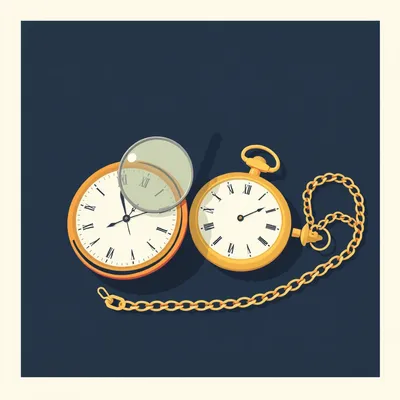
So Daniel sent us this one — and honestly, I think he's finally lost his mind in the most delightful way. He wants to acquire two props for what he calls social trolling directed at in-laws: a prescription monocle and a mechanical pocket watch. Not the cheap costume versions. The real thing. Something that would pass the sniff test if he ran into a similarly-minded medieval enthusiast on the street. The question is where to get them, what they actually cost, and whether you can pull this off without looking like you raided a Halloween store.

This is the natural endpoint of the flute-and-tunic arc and I am here for it. But there's a genuine tension here that makes this more interesting than just a shopping list. A monocle or pocket watch that actually passes muster with someone who knows what they're looking at requires real craftsmanship. We're talking about bespoke optical work and vintage mechanical movements. But the entire premise is absurdist performance. So how do you balance authenticity with the joke?
That's the thing. If you spend fifty dollars on Amazon you look like a fool. If you spend two thousand dollars you're the fool, just a different kind. There's a sweet spot where the props are good enough to be convincing but you haven't mortgaged your dignity to own them.
And the two props have fundamentally different manufacturing realities. Monocles are a bespoke optical niche — there are maybe three or four serious makers worldwide who will grind your prescription into a single lens and fit it into a proper frame. Pocket watches are a revived industry with vintage, Chinese, Swiss, and Japanese options at wildly different price points. So the sourcing strategies are completely different.
Let's start with the monocle, because that's the harder problem. Daniel wears standard spectacles. He needs a monocle ground to his actual prescription. Can you even get that in twenty twenty-six?
You can, but you're not walking into LensCrafters. The major optical chains don't offer monocles. Warby Parker will not save you here. You're dealing with independent opticians who will probably think you're joking when you first contact them. The two primary makers I've found are The Monocle Shop in the UK and Eyemetric in Germany. Both will take your prescription, grind it into a single optical glass lens, and fit it into a frame. Lead time is four to eight weeks. Price range is three hundred fifty to six hundred dollars depending on the frame material and your prescription complexity.
So you're paying what you'd pay for a decent pair of glasses, but for one lens.
And the frame matters enormously. This is where the cheap stuff fails in ways that are immediately obvious. A two dollar theatrical monocle is a single piece of acrylic with no prescription and no optical correction. It's a plastic disc on a wire. A fifty dollar steampunk monocle from Amazon might have a glass lens, but there's zero optical grinding — it's essentially a magnifier, not a corrective lens. Anyone who looks closely will see that the lens isn't doing anything for your vision.
What about the frame itself? I assume that's where the sniff test really happens.
The frame is everything. A proper monocle frame is called a gallery — it's the metal rim that holds the lens — and it's usually made of nickel-silver, brass, sterling silver, or gold-filled metal. The bridge design determines whether the thing stays on your face or drops into your soup. You've got the C-bridge, which is the classic shape that hooks around the eye socket. You've got wire bridges that are lighter but less secure. And then there's the pince-nez style, which uses a spring mechanism to grip the nose, but that's technically a different category of eyewear.
The C-bridge sounds like what Daniel's imagining. The classic aristocrat-squinting-at-a-menu look.
Right. And here's the thing — a proper C-bridge monocle is actually fitted to your face. The Monocle Shop will send you a kit to make a plaster cast of your eye socket. They shape the bridge to match the contour of your orbital bone. That's why it stays in place when you squint. A costume monocle has a generic curve that pinches and falls out constantly. That's the difference between looking eccentric and looking like you're fighting with your own face.
So we're at four hundred seventy five dollars for a sterling silver C-bridge monocle from The Monocle Shop with a prescription lens, six week lead time, hand-fitted. That's the benchmark.
That's the case study, yes. And that's before we talk about the vision tradeoff, which is not trivial. Wearing a monocle means deliberately operating with monocular vision. Your depth perception degrades by roughly forty percent in the first hour of adaptation. Your brain is used to combining input from both eyes to judge distance. When you cut off one eye, even if the monocle corrects the vision in that eye, you're still getting different visual information from each eye and your brain has to reconcile that.
So Daniel's bit about staring inquisitively at a menu with one eye — he's actually going to struggle to read the menu. That's the commitment.
That's the commitment. And he can't easily swap between his spectacles and the monocle. He'd need to carry a case, and the monocle has to be fitted to his dominant eye. You can't just pop it onto either eye depending on your mood. You need to know which eye is dominant — there's a simple test where you make a triangle with your hands and center a distant object, then close each eye alternately. The eye that keeps the object centered is your dominant eye. That's the eye that gets the monocle.
I feel like knowing your dominant eye is exactly the kind of detail a medieval reenactor would ask about. "Ah, but have you had your ocular dominance assessed?"
They absolutely would. And they'd also check whether the lens is actually ground or just polished flat. A ground prescription lens has a specific curvature — you can see it if you hold it at an angle to the light. A flat piece of glass or acrylic doesn't. That's a thirty-second sniff test that separates the four hundred dollar monocle from the four dollar one.
So the monocle is a bespoke optical instrument with a four to eight week lead time, a four hundred to six hundred dollar price tag, and a forty percent depth perception penalty. That's the reality. What about the pocket watch? That market seems completely different.
Completely different. The pocket watch market is bifurcated — actually, trifurcated. You've got vintage mechanical watches from before nineteen sixty, mostly American and Swiss makers. You've got modern Chinese mechanicals from companies like Seagull and the Shanghai Watch Factory. And you've got luxury Swiss — Patek Philippe, Vacheron Constantin — which are five figures and completely out of budget for a social trolling operation.
So the sweet spot is vintage American.
The sweet spot is a vintage American railroad-grade pocket watch from roughly nineteen hundred to nineteen fifty. Waltham, Elgin, Hamilton — these were the workhorses of American railroading. They're mechanical, they're robust, they were built to be serviced, and they're available in working condition for a hundred fifty to four hundred dollars on eBay from specialized dealers.
What makes a watch railroad-grade?
Railroad-grade means it met the standards set by the American railroad companies for accuracy and reliability. After a catastrophic train collision in eighteen ninety-one caused by a slow pocket watch, the railroads established strict requirements. The watch had to be accurate to within thirty seconds per week. It had to have a certain number of jewels in the movement — usually seventeen or more. It had to have a lever-set mechanism, meaning you had to unscrew the crystal and pull out a lever to set the time, which prevented accidental time changes. And it had to have a white enamel dial with bold Arabic numerals for legibility.
"Why yes, this is a railroad-grade Elgin. Did you know about the eighteen ninety-one Kipton disaster?"
That's exactly the kind of detail that makes the performance work. But let me get to the real sniff test, because this is where most people fail. There are three things a medieval enthusiast or any watch person will check immediately. One: is the movement mechanical? A quartz pocket watch fails instantly because there's no sweeping second hand and no winding ritual. Two: is the case solid metal, not plated brass? You can tell plated brass because the gold color wears off at the edges, revealing the brass underneath. Three: does the chain have a proper T-bar or dog clip?
The chain. Daniel mentioned the characteristic chain mail. That's actually called something specific?
It's called a fob chain or an Albert chain. Named after Prince Albert, who popularized wearing a watch chain through a waistcoat buttonhole. The chain matters more than the watch in some ways, because it's what people see first. A twenty dollar watch on a five dollar chain looks like a costume. A two hundred dollar watch on a hundred dollar sterling silver chain with a T-bar looks like a gentleman's accessory. The chain should be twelve to fourteen inches long, enough to reach a waistcoat pocket, and the T-bar or dog clip should be visible hanging from the buttonhole.
So you're saying Daniel needs a waistcoat now too. The prop list expands.
The waistcoat is non-negotiable if you're doing the pocket watch bit properly. The watch goes in the waistcoat pocket, the chain drapes across the front. Without the waistcoat, you're putting a pocket watch in your trousers and it looks like you've got a stopwatch for timing your jog.
Daniel's going to be wearing a tunic and a waistcoat and a monocle. He's going to look like a time-traveling haberdasher.
And that's the point. But let me give you a concrete comparison, because this is where the budget decisions get made. A nineteen twenties Elgin Grade three-oh-five, seventeen jewels, gold-filled case — that's about two hundred seventy five dollars on eBay from a dealer with ninety-eight percent positive feedback, serviced and running. It has a sweeping second hand, it ticks quietly, and when you press the crown the lid snaps open with a satisfying click. Compare that to a vintage-style quartz pocket watch from Amazon for thirty-five dollars. Loud tick, no sweep, the second hand jumps once per second, and the case is plated brass that'll show wear within a month. The Elgin passes every test. The Amazon watch fails all of them before you've even opened the lid.
The sweeping second hand is the giveaway?
It's the easiest giveaway. A mechanical watch movement beats at a certain frequency — typically eighteen thousand vibrations per hour for vintage pocket watches — which means the second hand moves in a smooth sweep, ticking multiple times per second. A quartz movement ticks once per second. It's a visible stutter. Anyone who's ever looked at a mechanical watch can spot it from across a table.
And the winding ritual is part of the performance.
That's the other half of the bit. When someone asks you for the time, you don't just pull out the watch. You pause. You unbutton your waistcoat pocket — deliberately, slowly. You draw the watch by the chain, feeling the weight of it. You press the crown to open the lid — or if it's an open-face watch, you just raise it. You read the dial with a slight squint. Then you announce the time with a small pause before the number, like you're delivering a verdict. You close the lid with a snap, return the watch to the pocket, and re-button. The ritual is the performance. The time is almost incidental.
"Almost" doing heavy lifting there. If someone asks for the time and you do a forty-five second ritual, they're going to regret asking.
That's the social trolling element. You're making the simple act of checking the time into an event. The person who asked has to stand there and participate in your little theater piece. And if they're an in-law, they can't walk away without being rude.
So let's get practical. Daniel's total budget. What's the minimum viable spend for both props at a level that passes the sniff test?
For under eight hundred dollars total, he can own both at a quality level that won't embarrass him in front of a medieval reenactor. Four hundred fifty for a prescription monocle from The Monocle Shop or Eyemetric. Two hundred seventy five for a vintage Elgin or Waltham pocket watch from a reputable eBay dealer. Seventy five for a sterling silver Albert chain, twelve to fourteen inches, with a T-bar. That's eight hundred even.
And that's before the waistcoat.
The waistcoat is a separate line item. But you can find decent wool waistcoats at thrift stores for twenty dollars. This doesn't have to be bespoke.
What about maintenance? These aren't buy-once items.
The pocket watch will need servicing every three to five years. A mechanical movement has oil that degrades, pivots that wear, and if you don't service it, accuracy drifts and eventually it stops. A basic service on a vintage pocket watch runs a hundred to two hundred dollars from a watchmaker who knows what they're doing. Not a mall kiosk battery-changer — an actual horologist.
And the monocle?
The monocle is more durable. It's a piece of ground glass in a metal frame. But Daniel will lose it within six months. I'm calling that now. A monocle is a small, slippery object that you're constantly taking on and off. It's going to fall out of a pocket, roll under a car, get left on a restaurant table. He should budget for a spare.
So the true cost of this bit is closer to twelve hundred dollars when you factor in the spare monocle and the first watch service.
And that's assuming he doesn't escalate further. Once you have the monocle and the pocket watch, the gravitational pull toward a walking cane, a top hat, and a cravat is very strong. The props multiply.
The monocle is a gateway drug to full Victorian cosplay.
That's the risk. But let me address something Daniel mentioned that I think is worth taking seriously. He said he'd be deliberately leaving half his workable vision on the table. That's not an exaggeration. If he normally wears spectacles, his uncorrected vision is presumably not great. The monocle corrects one eye. The other eye is getting whatever blurry input it naturally gets. His brain has to fuse a sharp image from one eye with a blurry image from the other. That causes eye strain and headaches after about thirty to sixty minutes.
So the monocle isn't a wear-all-day accessory.
It's not. It's an occasional prop. You deploy it when you need to examine something — the menu, the wine list, a receipt, a document someone hands you. You put it on, you squint, you read, you remove it, you polish it with a cloth, you put it away. The intermittent use is what makes it a character choice rather than a vision aid. If you wear it constantly, you're just a person with one corrected eye and a headache.
The polishing ritual is important. That's a whole secondary performance.
You need a small microfiber cloth, ideally kept in a different pocket from the monocle. You draw the cloth, you breathe on the lens — the breath fog is crucial — you polish in small circular motions, you hold it up to the light to inspect, you nod slightly as if satisfied, then you place it on your eye. That's fifteen seconds of wordless theater before you've even read the menu.
Daniel's in-laws are going to lose their minds.
That's the goal. But here's where I want to circle back to something important about the sourcing. The pocket watch market on eBay is full of traps. You see listings for antique style pocket watches that are actually new quartz watches made to look old. You see listings for vintage watches that haven't been serviced in forty years and won't run. You see listings with blurry photos that hide the fact that the dial is cracked or the case is dented.
How do you avoid the traps?
First, only buy from dealers with ninety-eight percent positive feedback or higher, and read the negative reviews to see what went wrong. Second, look for listings that say serviced and running — those three words mean a watchmaker has opened the case, cleaned the movement, oiled the pivots, and verified that it keeps time. Third, look for clear photos of the movement. A dealer who opens the case and photographs the gears is a dealer who knows what they're selling. Fourth, avoid anything described as antique style, vintage look, or retro — those are code words for new quartz watches made to look old.
What about the Chinese mechanical watches? The Seagulls?
Seagull makes a legitimate mechanical pocket watch movement, the ST thirty-six hundred, which is a clone of an old Swiss design. You can buy a new Seagull pocket watch with a mechanical movement for about a hundred to a hundred fifty dollars. It's not vintage, it doesn't have the history, but it passes the mechanical test — sweeping second hand, winding ritual, satisfying weight. The downside is that the finishing isn't as refined as a vintage American watch, and a medieval reenactor might notice that the case is stainless steel rather than gold-filled or silver.
So it's the budget option that passes most but not all of the sniff test.
It's the entry-level option. If Daniel wants to test the waters before committing to a vintage Elgin, a Seagull mechanical is a reasonable starting point. But he should still spend money on the chain. A good chain elevates a mediocre watch. A bad chain ruins a great watch.
The chain is the frame of the pocket watch world.
And the chain has its own sniff test criteria. The T-bar should be solid, not hollow. The links should be soldered, not just pressed together. The clasp should engage with a positive click. A sterling silver chain will have a hallmark — a small stamp indicating silver purity, usually nine twenty-five or the lion passant mark if it's British. A plated chain won't have a hallmark, or it'll have a vague silver or gold tone stamp that means nothing.
So Daniel needs to become a part-time metallurgist now.
He needs to become a part-time horologist, a part-time optician, and a part-time silversmith. This is the hidden cost of the bit. You don't just buy the props. You have to learn enough about each domain to make an informed purchase, or you'll get fleeced.
Which brings us to the performance itself. We've talked about the hardware. But the real question is whether Daniel can pull off the bit without looking like he's trying too hard.
The key is understatement. The biggest mistake people make with anachronistic props is over-deploying them. They wear the monocle constantly. They check the pocket watch every thirty seconds. They draw attention to the props instead of letting the props draw attention naturally. The correct approach is to use them sparingly, as if they're completely normal to you, and let other people's curiosity do the work.
The monocle should come out maybe three times in an evening. The pocket watch, maybe twice. The rest of the time, you're just a person in a waistcoat.
And when someone finally asks about the monocle — because someone will — your response should be genuinely puzzled. "What do you mean?" As if you've forgotten you're wearing it. That's the advanced technique. You're not performing eccentricity. You're inhabiting a character for whom the monocle is unremarkable.
The method acting approach to trolling your in-laws.
It's the only approach that works. If you wink at the audience, the bit collapses. You have to commit completely. The monocle is just how you read menus. The pocket watch is just how you tell time. You don't explain, you don't justify, you don't acknowledge the absurdity. That's what separates a memorable eccentric from someone doing a bit.
I want to talk about one more practical thing before we wrap up. The monocle deployment. Daniel mentioned rocking up to a cafe and staring inquisitively at the menu. How does that actually work logistically?
He walks in wearing his regular spectacles. He sits down. The server hands him the menu. He removes his spectacles — slowly, deliberately — and places them on the table. He reaches into his waistcoat pocket and produces the monocle. He brings it to his eye, squints to seat it, and then reads the menu with one eye while the other eye is unfocused. If he's doing it right, the server is already off-balance. The spectacles-to-monocle transition is inherently strange. It's a deliberate downgrade of your visual capabilities for no apparent reason.
And then when the server comes back to take the order, does he keep the monocle in?
He removes it, polishes it with the cloth, returns it to the pocket, and puts his spectacles back on. The server has now witnessed the full ritual and has no idea what just happened. That's the moment. They might ask about it. They might not. Either way, Daniel has successfully made a cafe interaction slightly surreal for everyone involved.
The bit scales too. He can do this at family dinners. Business lunches. First dates, if he's feeling bold.
I would not recommend the monocle on a first date. That's advanced trolling.
Fair. So let's land this. If Daniel's actually going to do this, here's the checklist. One: get your prescription from your optometrist and determine your dominant eye. Two: contact The Monocle Shop or Eyemetric, order a C-bridge monocle in sterling silver with your prescription, budget four hundred fifty dollars and six weeks. Three: find a vintage Elgin or Waltham pocket watch on eBay from a reputable dealer, serviced and running, budget two hundred seventy five dollars. Four: buy a sterling silver Albert chain, twelve to fourteen inches, with a T-bar, budget seventy five dollars. Five: acquire a waistcoat from a thrift store. Six: practice the rituals until they're muscle memory. Seven: deploy sparingly and never break character.
And eight: budget for the spare monocle and the watch service. This is not a one-time purchase. The bit has ongoing costs.
The bit is a subscription service.
The bit is absolutely a subscription service. But I think it's worth asking the deeper question here. Is the monocle worth the vision sacrifice? Daniel is deliberately reducing his functional eyesight for a performance. At what point does the bit become the identity? When does he stop being Daniel-who-wears-a-monocle-as-a-joke and become Daniel-who-just-wears-a-monocle?
That's the event horizon of social trolling. You start doing something ironically and eventually it's just something you do. The monocle stops being a prop and becomes an accessory. The pocket watch stops being a bit and becomes how you tell time. You've trolled yourself into a new personality.
And the in-laws might actually prefer the new personality. That's the real risk. You show up to Thanksgiving with your monocle and your pocket watch and your tunic and your flute, and your mother-in-law says "oh, Daniel's going through his Victorian phase" with genuine affection. The bit has been neutralized by acceptance.
The ultimate failure mode of social trolling is being embraced.
It's the paradox at the heart of the whole enterprise. You want to unsettle people, but if you do it well enough, you become charmingly eccentric instead of unsettling. You've created a character that people enjoy.
Which might actually be the better outcome. But that's a philosophical question for another episode. For now, Daniel has his shopping list and his performance notes. We want to hear from listeners who attempt this. How long until someone calls you out? How many people ask "is that a real pocket watch" before someone just assumes you're eccentric? Send us your field reports.
And if anyone has successfully deployed a prescription monocle at a family gathering, we especially want to hear about the moment someone finally asked what was wrong with your other eye.
And now: Hilbert's daily fun fact.

Tardigrades exhibit a property called birefringence — when viewed under polarized light, their tissues split light into two separate rays, creating a faint rainbow shimmer effect. This optical property was first documented in eighteen eighty-eight by a German zoologist studying specimens collected from a tide pool in Tuvalu.
A shimmering microscopic bear from a Tuvalu tide pool. Alright.
Thanks Hilbert. That's going to sit with me.
This has been My Weird Prompts. Send your monocle deployment stories and pocket watch acquisition triumphs to show at my weird prompts dot com. We'll be back soon.