Daniel's prompt this week centers on the capture of Moain al-Arabid, Hamas's internal security chief, in Gaza City on Tuesday. The footage that came out shows a large Israeli SUV moving fast through the streets with a special forces team. Anyone who's seen Fauda knows the look. Daniel's question is essentially this: if the vehicle is conspicuous enough that a TV viewer can spot it, how does it not blow the whole operation? And beyond the vehicle choice, what goes into the full camouflage picture — driving style, music, stickers, the condition of the car, even the specific tradecraft of blending into an urban space when the people who live there know every detail of what belongs and what doesn't.

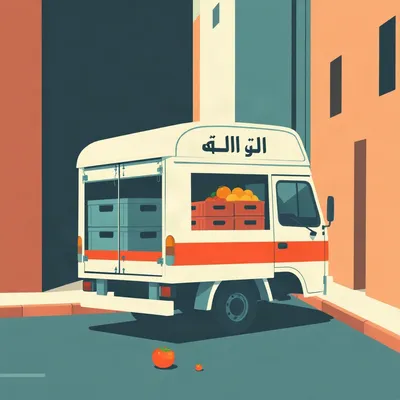
The first thing to understand about the al-Arabid operation is that the conspicuous SUV people saw in the footage was almost certainly not the vehicle that did the initial infiltration. According to the reconstruction in Asharq Al-Awsat, the force entered the area using a white van and a separate vehicle carrying vegetables. An Israeli vehicle had also been prepositioned in the neighborhood at least two days before the raid, just sitting there, becoming part of the scenery.
Two days. Parked.
Parked. In the Al-Katiba district, which is the Villas neighborhood, two hundred and fifty meters from the headquarters of Gaza's Internal Security Service. So the vehicle that looks like an undercover vehicle to us — the big SUV that screams special forces — that was probably the assault or extraction platform that only rolled in once the perimeter was already compromised and the element of surprise was gone. The vegetable truck did the quiet work.
So the conspicuous thing is the last thing to arrive. By the time anyone sees it, the operation is already in its loud phase.
Exactly the pattern. And this is what Shir Peled, a former Yamas officer, described when she said vehicles are like costumes — it's not enough to find the right vehicle, you need to disguise it so it will work in this specific territory. The vegetable truck works in a dense residential area in Gaza City in a way it wouldn't work in, say, the industrial zone of Nablus or the outskirts of Jenin. The disguise is hyper-local. You're matching the normal traffic of that specific street at that specific time of day.
A vegetable truck also gives you cover for behavior that would be suspicious in any other vehicle. You can drive slowly. You can stop. You can have people in the back. Nobody looks twice at a produce truck idling at a curb.
And nobody looks too closely at the produce itself. The thing I keep coming back to is how fragile this all is. If one person decides to buy a tomato off the back of that truck, the whole operation is over.
And yet they don't. Because the truck isn't interesting. That's the whole point. The disguise works not because it's perfect but because it's boring.
The boringness is the armor. Shir Peled talked about this — she said the job is to blend in like a set of a movie, be very quiet, be very chill, and then drop the costumes and become soldiers. The behavioral camouflage is as important as the physical. You're playing local music at the right volume, you're appearing to chat on a phone, you're matching the rhythm of how people move through that space. A vehicle that drives like a civilian drives — not too fast, not too slow, not too precise — is doing half the work.
Driving technique as camouflage. Daniel flagged this and he's right. There's no formal published doctrine on it, but every practitioner talks about it. The way you take a corner, the way you brake, whether you signal or don't. In some places, signaling marks you as an outsider immediately.
In the West Bank, Palestinian drivers tend to be more aggressive through certain roundabouts than Israeli drivers are. An undercover unit that doesn't match that aggression pattern stands out. It's the kind of thing you can't learn from a manual — you learn it by spending time in the specific area you're going to operate in. Which is why Duvdevan, the IDF's elite undercover unit, does part of its training in Tel Aviv's Carmel Market and in Jaffa. They're learning to read the behavioral texture of a place.
Duvdevan's whole origin story is about this. Ehud Barak founded the unit in nineteen eighty-six and his instruction was, I want people who will look like Arabs, speak like Arabs, and ride bicycles in the marketplace of Nablus as if they were on Dizengoff Street. The unit's sixteen-month training course includes basic Arabic, disguise and makeup, covert movement in crowds, and they use the costume department of a professional theater.
The theater connection is not a joke. They literally work with a theater's costume department. The gray platoon is the Arab infiltration unit — these are soldiers whose entire job is to become indistinguishable from the population. The doctrine is sometimes called purity of deception. Every detail matters. The way the collar sits. The brand of the sunglasses. Whether the shoes are scuffed in the right way.
Which brings us to vehicle condition. Daniel mentioned this and it's one of those things that seems obvious once you say it but isn't written down anywhere. A vehicle that's too clean in a conflict zone is wrong. A vehicle that's too damaged looks abandoned and attracts attention for a different reason. The dirt has to be the right kind of dirt — local dust, not mud from somewhere else. The stickers have to be local stickers.
Commercial logos, taxi markings, the specific kind of grime that accumulates on a vehicle that's been driving in that city. The al-Arabid vegetable truck presumably had appropriate commercial markings for a Gaza produce delivery vehicle. If it had a Ramallah phone number on the side, someone would notice. The detail goes that deep.
And then there's the question of what happens to the disguise after the operation. In the al-Arabid raid, the Israeli vehicle that had been prepositioned for two days was destroyed by missiles during the withdrawal. They blew up their own car to prevent intelligence or equipment from falling into Hamas hands. The camouflage has to be erased.
That's a layer of operational security most people don't think about. The vehicle isn't just a costume you wear — it's a costume you have to dispose of without leaving evidence. In some operations, the vehicles are stolen locally and abandoned. In others, they're brought in and destroyed. The choice depends on what you're willing to leave behind and what the enemy might learn from it.
Let's pull back to the broader principle here. Daniel mentioned the NYPD undercover taxis, the Trump catering truck in Turkey, the Italian police who arrested a mafia boss by posing as pizza delivery guys. These all work on the same logic. The disguise isn't about being invisible. It's about being the thing nobody looks at.
The pizza delivery arrest is the cleanest example. Roberto Manganiello, a Camora boss in Naples, was watching a football match on a Sunday evening when police knocked on his door dressed as pizza delivery boys. He opened the door because on a Sunday evening, a pizza delivery is the most normal thing in the world. The disguise worked because it matched the expectation of that specific moment.
The UPS arrest in Costa Mesa is the same shape. Detective disguised as a delivery man, knocks on the door with a package, suspect opens it without a second thought. The uniform is a key that opens doors because it's invisible through familiarity.
The Trump catering truck is a different application of the same principle but at a completely different scale. July eighth of this year, credible Iranian assassination threat, Trump boards Air Force One in view of cameras, then exits via a catering truck to a military C-thirty-two-A. He was hidden in an airline catering container. The vehicle that moves food is the vehicle nobody watches.
It's the inverse of the conspicuous SUV. The SUV says look at me but only after the quiet vehicles have already done the work. The catering truck says don't look at me at all. Different phases of the operation, different camouflage requirements.
Taiwan takes this to an extreme that's almost comical. During their annual Combat Readiness Week exercises, they disguise armored vehicles as cranes, scrap heaps, and construction equipment. In August, they hid M-one-A-two-T Abrams tanks inside construction yards near the main airport. A Clouded Leopard eight-by-eight infantry fighting vehicle was adapted to look like a yellow civilian construction vehicle.
A tank dressed as a crane. There's something almost touching about it.
It works though. In a dense urban environment, construction equipment is everywhere and nobody looks at it. The same logic as the vegetable truck but scaled up to a seventy-ton armored vehicle.
The Fauda problem is real though. Daniel's right to flag it. The show that made Israeli undercover tactics famous to global audiences may have simultaneously made those tactics harder to execute. If every Fauda viewer can spot the SUV and the driving technique, then so can Hamas.
I think the al-Arabid operation suggests two things about this. First, that the conspicuous elements are only deployed at the last second, as we said. Second, that real operations still have surprises that television doesn't capture. Fauda is dramatized. The real thing involves layers of preparation — days of prepositioned vehicles, months of surveillance, a special operations room directing everything in real time — that a TV show compresses for narrative.
The surveillance piece is worth sitting with. The Shin Bet tracked al-Arabid for months. They studied his daily routine, his routes, the patterns of his security detail. The raid was planned over months and directed from the Shin Bet's special operations room. Israel considered killing him in an airstrike and chose a ground operation instead because they wanted him alive for questioning.
And the intelligence value is enormous. Al-Arabid was responsible for Hamas counterintelligence, handling of hostages, and rebuilding Hamas capabilities. Channel Twelve called the potential intelligence a trove. Haaretz noted his interrogation could reveal what Hamas knows about Israel's agent network in Gaza. Netanyahu visited troops at the Yellow Line inside Gaza the next day and said, we took Hamas's Shin Bet chief, we'll probably learn a few things.
The understatement of the year.
But the thing that really gets me about this operation is how close it came to failing. According to the Asharq Al-Awsat reconstruction, al-Arabid's wife spotted the raiders and opened fire. She was shot in the head and killed. Two sons and two bodyguards were seriously wounded. Al-Arabid himself was shot in the leg before being captured. Drones fired more than five missiles and dropped more than fourteen bombs just to create diversions and protect the force.
All the camouflage, all the planning, the vegetable truck, the prepositioned vehicle, the months of surveillance — and it nearly unraveled because one person looked out a window at the wrong moment and was armed. The margin between success and disaster in these operations is razor-thin.
And that's the thing about camouflage. It reduces probability of detection. It doesn't eliminate it. You're playing the odds. You make yourself boring enough that most people don't look, and you move fast enough that the ones who do look don't have time to react. The al-Arabid operation played both sides of that equation — the boring vegetable truck for the approach, and then an overwhelming amount of firepower for the moment the disguise failed.
There's a psychological dimension to this too. Israeli sources told Channel Twelve that the raid was intended not only for intelligence but to make senior Hamas leaders feel hunted — even during a period of relative calm. The choice to capture rather than kill sends a message that Israel can reach anyone, anywhere, alive. The camouflage is part of that message. We can park a car outside your headquarters for two days and you won't notice.
Two hundred and fifty meters from the Internal Security Service headquarters. That's not just operational success. That's a statement about capability.
The wife who fought back complicates the narrative though. The operation wasn't invisible. She saw them. The camouflage worked long enough to get the force into position, but it didn't work perfectly. And the fact that the family was armed and ready to fight tells you something about the environment these operations happen in. This isn't a training exercise where the disguise holds for the whole scenario. This is a place where people are prepared for exactly this kind of raid.
Which is why the layered approach matters. The vegetable truck gets you close. The prepositioned vehicle gives you eyes on target for days. The white van brings the assault element. The SUV does the extraction. The drones provide cover. No single layer has to be perfect because the next layer is already in motion.
Daniel asked about the full toolkit — stickers, music, driving style, vehicle condition. I think what emerges from all of this is that the toolkit isn't a checklist. It's a sensibility. The operative has to inhabit the disguise so completely that they stop thinking about it. The music isn't a prop — you're actually listening to it. The driving isn't a technique — you're actually driving like someone who lives there.
Shir Peled's phrase keeps coming back to me. Blend in like a set of a movie, and be very quiet, and be very chill. The chill is the part you can't fake. If you're tense, the vehicle moves tensely. If you're scanning for threats, your head moves in a pattern that's recognizably tactical. The disguise has to go all the way down to your nervous system.
Which is why Duvdevan trains in actual markets and uses a theater costume department. You can't learn to be chill from a PowerPoint. You have to do it until it's not acting.

Two hundred and fifty meters isn't right.
Say more.
The Asharq Al-Awsat piece says the villa was near the headquarters, not that the prepositioned vehicle was parked that close. The vehicle was in the area. The two hundred and fifty meters is the distance from the raid villa to the ISS building. Different things.
That's a fair correction. The prepositioned vehicle was in the neighborhood, not necessarily parked on the doorstep of Hamas internal security.
Doesn't change the point. Two days is still two days. I did something similar once, not in Gaza. Late eighties, working vehicle prep for a private security outfit in Beirut. We'd park a car near a target's building three, four days before anything was supposed to happen. Let the neighbors get used to it. The trick was always the same thing — you don't clean it. A clean car in West Beirut in nineteen eighty-eight was a rental or a government car. You wanted it to look like it belonged to someone who lived there and didn't care.
So the dirt is functional.
The dirt is the whole job. We'd rub dust into the door handles, put a crack in the windshield if the street had other cars with cracked windshields. One time we paid a kid to kick a football at the side panel so the dent would be the right shape. The dent from a football is different from the dent from a door. Nobody thinks about the shape of a dent except the person whose job is to think about the shape of a dent.
The local detail again. It goes all the way down.
The stickers were the hardest part. You need stickers that are current — the right political faction, the right football club, the right local business — but not so current that someone asks you about it. We had a guy whose whole job was photographing bumper stickers in different neighborhoods and sending them back so we could reproduce them. He got arrested twice. Neither time for the photography.
What was he arrested for?
Once for smuggling cigarettes, once because he looked like someone else. The second one wasn't even his fault.
The detail of reproducing local stickers is something I hadn't considered. But of course — if you put a sticker from a business that closed six months ago on your vehicle, you've just created a tell.
The business that closed is worse than no sticker at all. No sticker, you're forgettable. Wrong sticker, you're memorable. Memorable is the thing you cannot be.
How long did you do that work?
Four years. Then the company lost its contract and I spent a year installing car stereos in Nicosia. That's a different story. The point about the vegetable truck is the right one though. Vehicles that do a job are invisible. Nobody looks at a plumber's van. Nobody looks at a produce truck. The best disguise is an honest day's work. The problem is you have to know what an honest day's work looks like in that specific place. In Beirut, a vegetable truck in the Christian quarter had different markings from one in the Muslim quarter. Different produce, even. You put tomatoes on a truck in the wrong neighborhood and someone notices because that neighborhood gets its tomatoes from a different supplier.
The produce itself is part of the disguise.
Everything is part of the disguise. The way the tarp is tied down. Whether the driver smokes and what brand. The radio station. We had a guy who could do the call to prayer well enough that he once did it from a van outside a target building and nobody looked twice. That's not in any manual.
The call to prayer from a van.
He was Egyptian. It helped.
The thing I'm taking from this is that the sophistication of these operations is in the layers that never make it into the footage. The SUV is what gets filmed because it's dramatic. The vegetable truck, the two days of prepositioning, the guy whose job is photographing bumper stickers — that's the real operation.
And the operation nearly failed anyway. The wife saw them. She opened fire. All that preparation and it came down to one person looking out a window.
That's always how it goes. You do everything right and then something you couldn't plan for happens. The good teams plan for the thing they couldn't plan for. That's what the drones are for. That's what the fourteen bombs are for. You assume the disguise will fail at some point and you have the next thing ready.
The disguise isn't a shield. It's a timer. It buys you seconds or minutes, not permanent invisibility.
We used to say you're not hiding. You're just arriving before the questions start.
That's a good line.
It's not mine. It was stenciled on the wall of the garage in Beirut. I don't know who wrote it.
If you take one thing from this, it's that camouflage in these operations isn't about the vehicle — it's about the texture of normal life in a specific place at a specific moment. The vegetable truck worked because vegetables belong in that neighborhood at that hour. The prepositioned car worked because it had been there long enough to become furniture. The SUV worked because by the time it appeared, the operation was already in its loud phase and camouflage had stopped being the point.
And the detail that's going to stick with me is the shape of the dent. That someone's job was to make sure the dent in the car door looked like a football hit it and not a door. Because in that neighborhood, footballs hit cars. Doors don't.
This has been My Weird Prompts. Thanks to our producer Hilbert Flumingtop.
We'll be back soon. If you want to send us a question like Daniel did, email us at show at my weird prompts dot com.
Or find us at my weird prompts dot com.