Daniel's been reading travel forums again. This time he's not asking how to avoid the worst of air travel — he wants to know how to find it. Deliberately.

The man wants a misery tour.
He does. He's been watching the online travel community — Reddit, FlyerTalk, the seat map databases — and he's noticed something. These people don't just complain. They document. They measure. They know exactly which gate agents at which airports weigh carry-ons, which seats on which aircraft don't recline, which routes collapse on schedule the moment a cloud appears. And Daniel's question is: if you had unlimited money and wanted to test the absolute worst edge of commercial air travel — not accidentally, but on purpose — what routes, airlines, and airports would you string together to maximize suffering?
He wants the bottom.
He wants the bottom. Not the worst deal, not the worst value — the worst experience, full stop. And he wants it data-driven.
So we're going to answer that question. But to do it properly, we first need to understand what "worst" actually means in twenty twenty-six — and how the data lets us build a misery tour that's almost scientific in its precision.
Because worst isn't one thing. It's three layers stacked on top of each other.
The airline, the airport, and the route. The airline gives you the seat — twenty-eight inches of pitch, pre-reclined so it doesn't move, a gate agent who gets paid extra to catch your bag being an inch too tall. The airport gives you the terminal — fifty-three percent on-time performance, corridors packed body to body, immigration lines that run three hours because the EU's new biometric system just went live. And the route is where those two things compound — a small regional airport feeding a congested hub on a corridor where forty-six percent of flights are delayed.
And twenty twenty-six is a uniquely good year to be asking this question. The system itself is under strain in ways that go beyond any one airline's policies.
Jet fuel shortage — European stocks at a three-year low, IEA issued a red alert. Middle East airspace closures forcing hour-plus detours on routes that used to be straight shots. The EU's new Entry-Exit System creating immigration lines that make you nostalgic for the old chaos. This isn't just Spirit being Spirit. The whole machine is running hot.
Let's talk about that fuel shortage for a second, because it's the kind of thing that sounds abstract until you're on the plane. European jet fuel stocks hit their lowest level in three years. The IEA doesn't issue red alerts casually. When stocks are that low, airlines start making decisions — they tanker fuel, meaning they carry extra on inbound flights because it's cheaper to fly heavy than to refuel at the destination. But tankering means burning more fuel to carry the extra fuel, which raises costs, which means corners get cut somewhere else. Maybe it's the catering budget. Maybe it's the staffing at the gate. The passenger never sees the fuel spreadsheet, but they feel the knock-on effect.
And the airspace closures — people hear "Middle East airspace" and think it's far away, but if you're flying from Europe to Asia, those detours add ninety minutes to a route that was already twelve hours. That's not just time. That's an extra meal service, extra fuel, extra crew hours, all compressing the schedule so the turnaround at the destination is tighter and the delay cascade is more likely.
So let's start with the airlines themselves. The physical experience of being in a twenty-eight-inch seat on a carrier that's designed to treat you as an adversary.
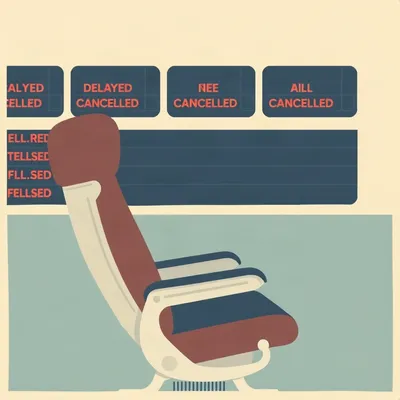
The twenty-eight-inch club. Spirit, Frontier, Wizz Air, WestJet. That's the tightest seat pitch in the industry — down from the thirty-one-inch standard that used to be normal. And pitch is just the number. What it actually means is your knees are in the seatback in front of you before you even recline. Except — these seats don't recline.
Spirit calls them pre-reclined. Which is a fascinating way to say they don't move.
It's honestly brilliant marketing of a missing feature. "Pre-reclined" sounds like a choice. It's not. They removed the mechanism and called it a philosophy. And Frontier's slimline seats — multiple travelers describe them as sitting on a plastic bench. Not like a plastic bench. As a plastic bench. There's a difference between a seat that resembles a plastic bench and a seat that has given up entirely on the pretense of padding.
There's a FlyerTalk thread I found where someone measured the actual padding thickness on a Frontier slimline seat with calipers. They brought calipers onto a plane. The padding was six millimeters. For reference, a standard yoga mat is about five millimeters. So you're basically sitting on a yoga mat stretched over a metal frame, and they're charging you for the privilege of picking where that yoga mat is located.
And that's someone who brought measurement tools onto an aircraft specifically to quantify their discomfort. That's the level of documentation we're dealing with in these communities. These aren't casual complaints. These are forensic investigations.
But seat pitch is just the baseline. The physical discomfort is almost the least interesting part of what makes an airline truly bad. The more interesting thing is the business model.
The adversarial airline. Spirit gate agents receive incentives to catch oversized personal items. This is documented — it's not a conspiracy theory. The agent at the gate has a financial reason to look at your backpack and decide it's too big. Frontier closed phone-based customer service entirely for certain fare classes. You can't call them. Chat or email only. Your flight's canceled at midnight and you're typing into a box.
How does that work in practice? Say you're at the gate, the agent flags your bag, and you want to dispute it. With a full-service carrier, you might escalate to a supervisor, make your case, maybe get somewhere. With Frontier, if you're on a fare class that doesn't include phone support, your only option is to type your complaint into a chat window. While you're standing at the gate. While the plane is boarding. The structural asymmetry is the point — you can't win because the system is designed to make disputing the charge harder than paying it.
Ryanair flies to Paris Beauvais. Which is in Paris the way Philadelphia is in New York — technically true if you're willing to drive eighty-five kilometers.
And the thing about Beauvais is that it's not even a secret. Ryanair's website lists it as Paris Beauvais. The airport's own website calls itself Paris-Beauvais. But if you book a ticket that says Paris and you don't check which Paris, you land in a field eighty-five kilometers from the city, and there's a bus that takes another hour and fifteen minutes, and that bus costs sixteen euros, and suddenly your twenty-euro flight to Paris is a thirty-six-euro flight to a bus ride to Paris.
And they're not hiding it. The business model is built on making the passenger the enemy in specific, measurable ways. The two-hundred-gram fee — a Reddit user earlier this year, Ryanair weighed their bag at boarding. Ten point two kilos on a ten-kilo limit. They charged fifty euros for two hundred grams. The passenger argued that their jacket was in the bag and if they wore it the bag would be under. The agent said once it's weighed it's final. So now you're standing at the gate in August wearing a jacket you don't need, having just paid fifty euros for the privilege of being two hundred grams over.
Two hundred grams is a paperback book. It's a small apple. It's the weight difference between having your phone in your pocket versus in your bag. And the agent's position — "once it's weighed it's final" — that's not a policy designed for fairness. That's a policy designed to close the loophole that might let you avoid the fee. The jacket argument is reasonable. The policy is built to be unreasonable.
That's not an accident. That's a revenue line.
And it's working. Which? ranked Ryanair worst short-haul airline in the UK this year — fifty-five percent satisfaction. EasyJet cancelled one in twenty-six departures from UK airports. Wizz Air, one in forty-six. The budget model isn't just uncomfortable — it's unreliable in ways that compound the discomfort.
But here's where it gets interesting. The budget carriers are at least honest about what they are. You pay fifty euros, you get fifty euros of misery. The real betrayal is the premium trap.
British Airways. American Airlines. You pay full-service money — sometimes a lot of it — and you get a Spirit-level experience. BA's aging premium cabins, last-minute cancellations, a long-haul product that Which? ranks as mid-tier at best. American's baggage handling complaint volumes are consistently high, and when a flight gets disrupted passengers report feeling stranded.
I'd rather fly Spirit knowingly than BA optimistically. At least with Spirit you know the deal. The betrayal premium — paying extra for the hope of competence and not getting it — that's a distinct category of misery. There's a psychological dimension here that's different from physical discomfort. When you pay fifty euros for a flight and the seat is terrible, you feel like you got what you paid for. When you pay two thousand euros for a premium cabin and the seat is broken and the meal is cold and the flight is cancelled, you feel like you were lied to. The gap between expectation and reality is its own form of suffering.
And that gap is measurable in a way. Which? does satisfaction surveys that capture exactly this — the ratio of price paid to satisfaction delivered. BA consistently underperforms its price point. You're paying for a premium product and receiving a mid-tier experience, and the difference between those two things is the betrayal premium. It's the cost of disappointed hope.
And then there's a third category that's different. The safety-concern carriers. Pakistan International Airlines — EU operational restrictions, aging fleet, maintenance concerns. Air Koryo — outdated Soviet-era aircraft, minimal entertainment, food described as unappetizing by the few people who've reviewed it. Lion Air — documented safety oversight history. These introduce a dimension that's not just discomfort or frustration. It's genuine uncertainty about whether you'll arrive.
The EU doesn't ban airlines lightly. When PIA got restricted from European airspace, that was after a series of findings that went beyond "the seats are uncomfortable" into "the maintenance logs don't match the aircraft." That's a different order of problem entirely.
So we've got three tiers of airline misery. The honest budget suffering — you paid nothing and you're getting nothing. The premium betrayal — you paid everything and you're still getting nothing. And the safety roulette — you might not get there at all.
Which tier is worst depends on what you're optimizing for. For pure physical discomfort, the twenty-eight-inch club wins. For psychological damage, the premium trap is hard to beat. For existential dread...
Lion Air.
Lion Air.
So those are the airlines. But an airline doesn't exist in a vacuum — it operates out of airports and along routes, and that's where the misery really compounds.
The airport layer. Tunis Carthage Airport finished dead last in AirHelp's ranking of two hundred seventy-nine airports for the third consecutive year. Score of five point five out of ten. Fifty-three percent on-time performance. Barely half the flights leave when they're supposed to. Gyro called it a hat-trick nobody in Tunis was hoping for.
Threepeat.
A threepeat of failure. Lahore Allama Iqbal, second worst. Ho Chi Minh City Tan Son Nhat, third. Vietnam placed three airports in the bottom ten — tourism boom outran the infrastructure. And here's the thing about infrastructure — it's slow. You can't add a terminal in a season. So when tourism spikes, the airport doesn't scale. You just get more people in the same space, and every metric gets worse simultaneously.
And then there's the stress ranking. Different metric entirely. iSelect measured something they call an airport stress index — delay rates, cancellation rates, security wait times, passenger volume, accessibility. Newark Liberty scored eighteen point four six out of a hundred. That's the worst in the world. Not the worst in the US — the worst in the world. And the stress index is interesting because it's not just measuring what happens. It's measuring how what happens feels. A delay at a spacious airport with good seating and clear announcements is annoying. A delay at Newark, where the corridors are narrow and the announcements are unintelligible and the air feels recycled for the fifth time — that's a different experience entirely.
The FAA calls Newark's airspace the most congested in the world. Twenty-six percent delay rate. It combines heavy passenger volumes with limited runway capacity, and sixty percent of its delays are weather-related — which means they're structural, not random. The weather happens in the same place every year and the airport still can't handle it.
Charlotte Douglas is the one that sticks with me. Gary Leff described it as where connections go to die. The airport wasn't built for the volume it gets. Corridors packed body to body. You're running between gates in a crush of people, and if your connection was tight to begin with...
You're not making it. And then there's Chicago O'Hare. Sixty-four percent on-time. Leads the US in total weather delays — forty-five percent of delays are weather-related. It's the hub that breaks itineraries. O'Hare's problem is that it's a massive connecting hub in a location where weather is reliably bad. You can't route around it easily because so many flights connect through it. When O'Hare sneezes, the entire domestic system catches a cold.
Which brings us to the route layer. This is where the data gets precise. AirAdvisor tracks something called the LD-one-eighty-plus metric — flights delayed three hours or more. And they've published the worst US routes.
Traverse City to Chicago O'Hare. Five point zero four percent rate of three-plus-hour delays — the highest in the country. Average delay when it happens: four hours thirty-eight minutes. Small regional airport feeding a massive congested hub. The delay rate is structural — it's the combination of a tiny airport and O'Hare's airspace that creates the problem, not random bad luck.
Traverse City is a fascinating case because it's not a busy airport by any normal measure. It's a small regional facility in northern Michigan. But it feeds directly into O'Hare, and O'Hare's delay problems cascade backward. The plane that's supposed to take you from Traverse City to Chicago is coming from Chicago, and if it can't get out of Chicago on time, you're sitting in Traverse City waiting. The delay didn't even happen at your airport — it happened somewhere else and landed on you.
Chicago O'Hare to New York JFK. The delay rate is lower — two point eight eight percent — but when a three-plus-hour delay happens, the average is seven hours and four minutes. That's the longest average delay of any US route in the top ten.
Seven hours. That's a full workday sitting in an airport terminal.
Austin to Dallas Fort Worth. Three point zero seven percent rate, average delay six hours twenty minutes. And that route is drivable in three hours. So you're sitting at the gate for six hours for a flight that takes less than an hour, on a route you could have driven in half the time you spent waiting. That's a special kind of frustration — the knowledge that you made the wrong choice and you have six hours to marinate in it.
The international long-haul data is just as grim. Simple Flying published the worst long-haul routes for punctuality this year. Chicago O'Hare to Frankfurt — forty-six percent of departures delayed. That's nearly half. Washington Dulles to Frankfurt, forty-three percent. Miami to São Paulo, forty percent. These aren't edge cases — these are major trunk routes between global hubs.
So let's build the tours. Daniel asked for routes, plural. Let's give him five.
Route one. The Transatlantic Misery Special. Start at Tunis Carthage — the world's worst airport, fifty-three percent on-time, third consecutive year at the bottom. Connect through Chicago O'Hare — the most delay-prone hub in America, forty-five percent weather delays, sixty-four percent on-time. Then fly O'Hare to Frankfurt — the most delayed long-haul route in the world, forty-six percent of departures late. You're stringing together the worst airport, the worst hub, and the worst long-haul route in a single itinerary.
And if you want to add a bonus leg, return through Newark — most stressful airport in the world, eighteen point four six out of a hundred stress score. Just to see if your spirit breaks on the final approach.
The Transatlantic Misery Special is almost elegant in its design. You start at the worst airport, connect through the worst hub, fly the worst long-haul route, and land at the most stressful airport. It's a symphony of failure. Each leg compounds the previous one, and by the time you reach Newark, you've been in the system for maybe twenty-four hours, you've experienced three different varieties of institutional incompetence, and you still have to clear immigration.
erman: Route two. The US Domestic Agony Tour. Traverse City to Chicago O'Hare — highest three-plus-hour delay rate in America, five percent. Then connect O'Hare to JFK — longest average delay when it happens, seven hours. Fly it on Spirit or Frontier. Twenty-eight-inch pitch, non-reclining seats, gate agents incentiized to catch your bag.
The gate agent at Traverse City probably knows the O'Hare flight is going to be delayed before you do. And they're still going to charge you for the bag. That's the part that gets me — the system knows it's failing and it's still extracting revenue from you while it fails.
Route three. The European Budget Gauntlet. London Gatwick — one in thirty flights cancelled. Fly Ryanair to Paris Beauais — the Paris airport that's eighty-five kilometers from Paris, on an airline with fifty-five percent customer satisfaction. Then connect to Lisborn — sixty-three percent on-time, Europe's worst-ranked major airport. You're stacking cancellations, fake destinations, and terminal chaos.
The Ryanair part is key here. You land at Beauais, you've got an eighty-five-kilometer bus ride to actually reach Paris, and then you have to do the whole thing in reverse to catch your connection. That's not a layover — that's a geography exam you didn't study for. And the timing is brutal. If your flight lands at Beauais at ten in the morning and your Lisborn flight leaves at four, you have just enough time to take the bus into Paris, realize you don't have time to see Paris, and take the bus back.
Route four. The Asia-Pacific Nightmare. Ho Chi Minh City — score six point four eight out of ten, third worst globally. Lahore — six point four zero, second worst. Tunis — five point five zero, the worst. Three of the world's four worst airports in a single itinerary. Fly it on AirAsia X — thirty-one-inch pitch on eight-plus-hour overnight sectors with minimal padding — or Lion Air, which adds the safety-oversight dimension.
That's a route where the airports are the point. You're not even flying anywhere you want to go. You're just connecting from one terrible terminal to another, each one slightly worse than the last, until you arrive at the global champion of failure. It's airport tourism in reverse — instead of visiting the best, you're visiting the worst, and the journey between them is just the miserable bridge from one disappointment to the next.
erman: Route five. The Premium Trap Special. British Airways long-haul through Heathrow — aging premium cabins, last-minute cancellations, mid-tier experience at full-service prices. Connect on American Airlines through Charlotte — where connections go to die, corridors packed body to body — to a small regional airport. You're paying premium money for a cascade of failures, and every step of the journey reminds you that you could have paid less for the same experience on Spirit.
That's the one that would actually make me angry. The other routes, you know what you signed up for. Route five, you paid for dignity and got cattle class anyway.
And this is the paradox of the unlimited-budget misery tour. The most miserable experiences come from choosing the cheapest options. An unlimited-budget traveler would normally fly private or first class. The deliberate pursuit of the worst — paying premium prices for Spirit, or choosing a seven-hour delay on O'Hare to JFK — is a perverse luxury.
Does knowing you could escape make it worse? I think it does. If you're stuck in a twenty-eight-inch seat on Frontier because it's all you could afford, there's a kind of grim acceptance. If you're there because you chose to be there, with a first-class ticket on another airline sitting in your email, every minute of knee pain is a decision you're actively reaffirming. You're not trapped — you're a volunteer. And that makes the suffering feel different. It's the difference between getting caught in the rain and going for a walk in the rain without an umbrella. Same wetness, completely different psychological texture.
The self-inflicted misery is the purest form.
But we've been talking about the passenger experience from the outside. The seat, the delay, the terminal. Hilbert, you actually worked in the belly of this beast. What are we missing?

The food.
The food.
You can survive a bad seat. You can wait out a delay if you know it's coming. What breaks a person is being served something inedible at thirty-five thousand feet when you're already four hours late and the cabin is eighty-five degrees.
You've got a specific meal in mind.
Air Koryo's beef soup. I worked for a catering company that had the contract for their Toront route — this was a while back, different era. The beef soup was hot water with beef flavoring powder and floating cabbage. Came with a plastic spoon. The spoon bent when you tried to use it. Not broke — bent. So you'd be fishing around in this brown water with a spoon that had become a question mark.
erman: How does a spoon bend in soup?
The soup wasn't hot enough to bend plastic, if that's what you're asking. The spoon came pre-bent. I think they were seconds from a factory that made something else. They arrived in the supply shipment already curved. And nobody questioned it. They just went into the meal trays. So somewhere there's a factory that produced a batch of spoons that were supposed to be something else — maybe a clip, maybe a handle for something — and they ended up in Air Koryo's catering supply chain, and now they're being handed to passengers with a straight face.
What else did your catering company handle?
We had contracts with several of the carriers on your list. Pakistan International, before the EU restrictions. A few of the European budget carriers — reheat-and-serve contracts. Meals cooked, frozen, shipped, microwaved on board. The real scandal wasn't the food. It was the temperature logs. They were falsified routinely. Oven set to sixty percent power to save fuel. Log said a hundred percent. If you ever wondered why the chicken is always dry and the rice is always crunchy — that's why. The oven was running cool and the paperwork said otherwise.
So the supply chain decisions that passengers never see — the fuel-saving measures, the falsified logs — those are producing the meal experience directly.
The facility that handled the PIA contract failed three consecutive health inspections. The airline never asked for the reports. We just kept sending the meals and they kept serving them. And I want to be clear — this wasn't a secret. The reports existed. They were filed with the relevant authorities. The airline simply never requested them. They had a right to know and they chose not to exercise it.
Did anyone ever get sick?
Not that I heard. But I wouldn't have heard. That's the point. The passenger gets the end of a long chain of decisions made by people who will never meet them, and if something goes wrong three steps back, the passenger is the last to know. They just think the chicken tastes off. They don't know the oven was at sixty percent. They don't know the health inspection was failed. They don't know the spoon was supposed to be a different object entirely. They just sit there at thirty-five thousand feet, eating their dry chicken with a bent spoon, thinking this meal isn't very good, having no idea they're at the end of a chain of failures that stretches back through multiple companies and multiple countries.
The hidden infrastructure of misery.
The seat pitch you can measure. The delay you can clock. The food is the thing that sits in your stomach for the next six hours reminding you what you paid for. I still remember that beef soup. It's been... a while. And I remember it.
The food is the hidden dimension. And that raises a bigger question — what else are we not measuring?
Cabin temperature, for one. Daniel mentioned overheated cabins and there's no standardized ranking for which airlines bake their passengers. Noise levels. Lavatory cleanliness at hour six of a long-haul. The things that don't show up in delay statistics or seat pitch databases but define whether you walk off the plane feeling human.
Those unmeasured variables might actually matter more than the measured ones. A seven-hour delay in a comfortable seat with edible food and a cool cabin is a very different experience from a seven-hour delay in a twenty-eight-inch seat with a cabin at eighty-five degrees and a meal you can't eat. The delay is the same. The experience is completely different. And we have no standardized way to capture that difference.
The misery tour we built is precise about the things we can measure. But the full experience is the measurable misery plus the unmeasurable — the spoon that bends, the cabin that's ten degrees too warm, the gate agent who's being paid to find a reason to charge you.
If you take one thing from this, it's that the worst travel experience isn't any one failure — it's the compounding of failures across layers that were designed independently but hit the passenger all at once. The twenty-eight-inch seat, the fifty-three-percent on-time airport, the forty-six-percent delayed route, and the meal that was cooked at sixty percent power to save fuel — those decisions were made by different people in different companies for different reasons, but they land on you simultaneously at thirty-five thousand feet.
The thing I keep thinking about is how narrow the gap is getting between the worst and the average. The twenty-eight-inch pitch that defines the bottom today used to be unthinkable. Now four carriers offer it. The adversarial boarding model — incentivizing gate agents to catch bags — that was Spirit's innovation, and now you see versions of it everywhere. The misery tour of twenty thirty might look a lot like the standard experience of twenty twenty-six.
The floor keeps dropping and the ceiling stays where it is. And that's the real warning in all of this. We built these routes as a thought experiment — a deliberately extreme tour of the worst the industry has to offer. But the gap between the deliberate misery tour and the average Tuesday flight is shrinking. The twenty-eight-inch seat was a punchline five years ago. Now it's a product offering. The adversarial gate agent was a Spirit novelty. Now it's an industry practice. The misery tour isn't just a tour. It's a preview.
This has been My Weird Prompts. Thanks to our producer Hilbert Flumingtop for keeping the show running — and for the beef soup memory none of us asked for.
If you enjoyed watching us build a scientifically precise tour of human suffering at altitude, leave us a review wherever you listen. Send your own weird prompts to show at my weird prompts dot com.
We'll be back soon.