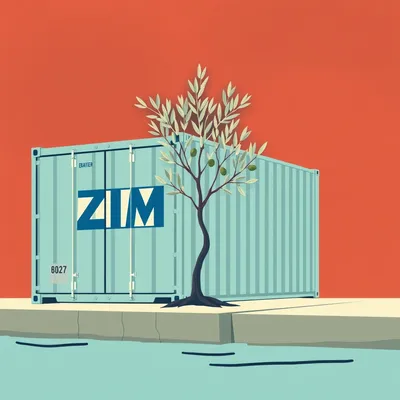
So Daniel sent us this one — and it hits close to home, literally. He wants to talk about ZIM, the Israeli shipping line. And the core observation is this: there are maybe a dozen global container carriers that actually matter, and one of them belongs to a country of nine million people that didn't even exist when the company was founded. That's weird. He's asking how that happened, what ZIM's role has been in Israel's history, and especially how it fits into Israel's doctrine of non-dependence — this idea that the country has to maintain its own lifelines and can't rely on outsiders for critical supply routes. And the timing on this is not academic.

Not at all. As of June, a German shipping company — Hapag-Lloyd, one of the top five globally — hired former IDF Chief of Staff Gadi Eizenkot to lead its effort to acquire ZIM. This is the first serious attempt by a foreign entity to buy Israel's national carrier, and it's triggered a national security review. We're watching a live stress test of whether the non-dependence doctrine can survive market forces.
So how does a country that didn't even exist when its shipping line was founded end up with a global carrier? The answer starts in 1945, before there was an Israel at all.
ZIM was founded in 1945 by the Jewish Agency and the Histadrut labor federation. This was not a business venture — it was a political project. The British had imposed a naval blockade to prevent Jewish immigration to Palestine, and the Zionist leadership understood that without ships they controlled, they had no way to bring Holocaust survivors to the land. The first ZIM vessels were essentially blockade runners. The name itself comes from the Book of Numbers, chapter twenty-four verse twenty-four — "ships shall come from the coast of Kittim" — and it was chosen by David Ben-Gurion personally.
Ben-Gurion naming a shipping line from a biblical verse is about as on-brand as it gets.
It really is. And it tells you everything about how he saw this project. This wasn't a commercial calculation — it was a strategic one, rooted in a doctrine he would formalize in the early statehood years. He called it "non-dependence," and the idea was brutally simple: Israel is a small country surrounded by hostile states, subject to boycotts and blockades. If you rely on foreign ships, foreign airlines, foreign suppliers for anything essential, you are one crisis away from being cut off. So you build your own.
And ZIM was the maritime pillar of that doctrine.
In those early years — 1948 through the 1960s — ZIM carried immigrants, food, weapons, and exports when no foreign line would reliably serve a country under Arab boycott. The Arab League boycott didn't just target Israel directly — it threatened secondary boycotts against any company that did business with Israel. Major shipping lines simply wouldn't call at Israeli ports because they didn't want to risk losing access to the entire Arab world. ZIM was the answer to that. By 1960, it was operating passenger lines and cargo routes to eighteen ports worldwide.
And this is the part that's easy to miss if you just look at a map. Israel sits at the eastern edge of the Mediterranean, far from the main east-west shipping lanes. It has a tiny coastline. There's no obvious commercial reason for a global carrier to be based there. ZIM exists because the market failed Israel, not because Israel was a natural shipping hub.
And it's the thread that runs through the entire story. ZIM was never supposed to be the most profitable shipping line. It was supposed to be the one that would show up when nobody else would. And that strategic logic shaped every major decision about the company for decades. To understand how ZIM survived — let alone thrived — you have to understand the specific bets it made that bigger competitors didn't.
Alright, walk me through those bets.
The first big one was containerization. ZIM was an early adopter — it ordered its first container ships in the early 1970s, right as the industry was shifting from break-bulk cargo to standardized containers. This was a forward-looking move, but the timing was terrible. The 1973 oil crisis hit, the Yom Kippur War followed immediately, and ZIM nearly went bankrupt. The Israeli government had to effectively re-nationalize it to prevent collapse.
Which established a pattern that's still relevant — ZIM would be allowed to operate commercially, but the state would step in when strategic necessity demanded it.
Right. And that pattern is awkward for a publicly traded company, which is exactly the tension we're seeing play out today. But the second big bet was the one that really defined ZIM's survival strategy. In the 1990s, ZIM pioneered something called the ZIM Container Service — a hub-and-spoke model using Kingston, Jamaica and Haifa as transshipment hubs.
Explain the hub-and-spoke model for people who don't live inside shipping logistics.
Imagine you're a small carrier. You can't compete with Maersk or MSC on the main east-west routes — the Asia to Northern Europe lane, the trans-Pacific. Those routes require massive ships, huge volumes, and the kind of capital that only the giants have. So instead, you position yourself as a connector. You pick up containers in Asia, bring them to a hub — Kingston, in ZIM's case — and then redistribute them on smaller feeder ships to destinations in the Caribbean, the US East Coast, the Mediterranean. You don't try to beat the giants at their own game. You build a niche where your smaller fleet is actually an advantage because you can be more flexible.
So ZIM's survival strategy was essentially: don't fight Maersk on the main highway. Own the side roads.
That's the best one-line summary I've heard. And it worked. The Kingston hub became so central to ZIM's identity that they named a ship after it — the ZIM Kingston, which was a 2000s-era vessel that exemplified the strategy. By the 2000s, ZIM was operating profitable niche routes while the giants slugged it out on the main lanes with razor-thin margins.
And this is where the comparison to Israel's arms industry is interesting. Both started as state-driven projects for self-sufficiency. Both were later privatized. But shipping is a commodity business in a way that defense contracting isn't — the margins are brutal, and the competitive dynamics are completely different.
That's a crucial distinction. The Israeli defense industry sells differentiated products — missile defense systems, drones, cyber capabilities — where technical superiority commands a premium. Container shipping sells a commodity: space on a ship. The only way to make money is through scale, efficiency, and route optimization. ZIM couldn't rely on being Israeli to charge higher rates. It had to compete on pure commercial terms against companies with five or ten times its fleet capacity.
So how did it actually do that? What does ZIM look like today?
As of 2026, ZIM operates roughly 130 vessels, and here's a key detail — most of those are chartered, not owned. It's what the industry calls an asset-light model. Rather than tying up billions in ship ownership, ZIM leases capacity and focuses on its route network and customer relationships. It ranks around tenth globally by capacity, which makes it a mid-tier player, but its influence in the Eastern Mediterranean is outsized. The main routes are the Asia-Mediterranean trade, the ZIM Pacific service to the US West Coast, and the ZIM Seven Stars service linking China to Israel directly.
Seven Stars — there's another biblical reference, I assume.
You assume correctly. The branding is consistent. But the asset-light model is a double-edged sword. It keeps capital costs down, but it also means ZIM doesn't control its own fleet in a crisis. When shipping rates spike — as they did during COVID — charter rates spike too, and ZIM's costs go up with them. The company had a spectacularly profitable 2021 and 2022, then gave a lot of it back when rates normalized.
Which brings us to the current moment and the sale. Before we get to the acquisition battle, explain the golden share — because that's the legal mechanism that makes this whole thing so fraught.
When ZIM was privatized in 2004 and later listed on the Tel Aviv Stock Exchange, and then on the New York Stock Exchange in 2021 under the ticker ZIM, the Israeli government retained what's called a golden share. This is a special class of share that gives the government veto power over three specific things: any change of control of the company, any sale of strategic assets, and any liquidation. It does not let the government dictate day-to-day operations, set prices, or choose routes. It's a narrow but powerful tool — a kill switch, essentially — designed to prevent ZIM from falling into hands that might not serve Israeli strategic interests.
And the golden share is the concrete legal expression of the non-dependence doctrine. It's Ben-Gurion's 1940s vision encoded in corporate law.
And now it's being tested. In June, Hapag-Lloyd hired Gadi Eizenkot, who was IDF Chief of Staff from 2015 to 2019, to lead its acquisition effort. That's a remarkable choice. You don't hire a former military chief to negotiate a commercial shipping deal unless you understand that this is not a normal commercial shipping deal. Hapag-Lloyd is signaling that they know the national security dimensions are the real obstacle.
And it's not just Hapag-Lloyd. Multiple carriers are reportedly interested — MSC, CMA CGM, COSCO. The Chinese interest is particularly sensitive, for obvious reasons.
Right. COSCO is a Chinese state-owned enterprise. The idea of China's state shipping arm owning Israel's strategic maritime lifeline is, let's say, politically complicated. But even the European bidders raise hard questions. The non-dependence doctrine assumes that in a crisis — war, blockade, sanctions — foreign carriers will stop serving Israeli ports. ZIM is the insurance policy. But ZIM today is a publicly traded company with fiduciary duties to shareholders. If a German owner acquires it, does the golden share actually guarantee that ZIM ships will keep running to Haifa and Ashdod during a war?
That's the question. And we have recent data points that make it more than theoretical.
We do. During the 2023-2024 Red Sea crisis, Houthi forces in Yemen explicitly named ZIM ships as targets. ZIM was one of the first carriers to reroute around the Cape of Good Hope — which adds about ten days and a million dollars in fuel per voyage. But here's the critical detail: ZIM maintained service to Israeli ports even as some foreign lines suspended calls or imposed massive war risk surcharges. During the 2014 Gaza war, the same pattern — ZIM kept operating normally while foreign lines either skipped Ashdod or charged a premium.
So the doctrine works in practice. ZIM actually does show up when others don't.
It does. But the question is whether a privately owned, potentially foreign-owned ZIM would do the same thing. The golden share can block a sale, but it can't force a private owner to lose money serving unprofitable routes during a crisis. It can't force a foreign parent company to prioritize Israeli national security over shareholder returns. That's the gap between the legal instrument and the strategic need.
And this is where the parallel with El Al is instructive. We're going to cover the air side in the next episode, but the basic dynamic is the same — El Al has been bailed out multiple times by the Israeli government because no foreign airline will fly to Israel during wartime. The government keeps paying because the alternative is being cut off entirely.
And that's the uncomfortable reality underneath the non-dependence doctrine. Strategic autonomy is expensive. ZIM has historically been less profitable than its peers because it maintains excess capacity and serves routes that don't make pure commercial sense. The state backstop — whether through direct ownership, bailouts, or the golden share — is the premium Israel pays for the insurance policy. The current sale debate is really a debate about whether the country still wants to pay that premium.
So what are the scenarios here? What happens if the government exercises the golden share and blocks the sale?
Then ZIM remains Israeli-controlled, and the non-dependence doctrine holds — at least on paper. But there's a cost. Blocking the sale signals to investors that Israeli companies come with political strings attached. If you buy shares in an Israeli firm, you might find that your exit is blocked by national security considerations. That risk gets priced in — lower valuations, higher cost of capital. And ZIM's ability to raise money for fleet renewal, which it desperately needs given that most of its ships are chartered, becomes more expensive.
And if the government allows the sale with conditions — keep the headquarters in Israel, maintain the ZIM brand, guarantee service during emergencies?
That's the middle path, and it's probably where this is heading. But the conditions are only as good as their enforcement. A German owner can promise to maintain service to Haifa during a crisis, but when the missiles are flying and the insurance underwriters are saying no, what does that promise actually mean? The golden share gives the government a veto, not a command authority. It can say no to a sale, but it can't say "you must sail into a war zone."
There's a deeper question here about whether the non-dependence doctrine itself is still viable. It was designed in the 1950s, when Israel was under comprehensive Arab boycott and the state owned the means of production directly. Today, Israel is a startup nation with a globalized economy, and ZIM is a publicly traded company. Can you really run a 1950s strategic doctrine through a 2020s corporate structure?
That's the core tension. And it's not unique to Israel. Singapore faces a version of this with PSA, its port operator. Taiwan has Evergreen and Yang Ming — both started as national carriers, both now publicly traded, both sitting in an incredibly awkward position given China's claims. Every small country that built strategic corporate assets in the mid-20th century is now wrestling with whether those assets still serve their purpose in a globalized market.
The ZIM sale is going to set a precedent. If Israel lets it go, it signals that the non-dependence doctrine is being quietly retired. If it blocks the sale, it signals that strategic autonomy still trumps market logic — and every investor in every Israeli company will adjust their models accordingly.
And there's a third dimension that makes this even more interesting. ZIM's fleet is mostly chartered. In a real crisis, the ships ZIM leases could be recalled by their owners — who are mostly Greek, Danish, and Chinese leasing companies with no stake in Israeli security. So even if ZIM remains Israeli-owned, its actual ability to maintain service during a war depends on whether those leasing companies are willing to let their assets sail into a conflict zone.
So the insurance policy has a deductible that nobody's quite sure about.
That's a very good way to put it. The golden share protects ownership, but ownership doesn't guarantee operational control when the ships belong to someone else. This is the gap between the legal structure and the physical reality.
Let's step back for a moment and put this in context for listeners who aren't following Israeli shipping news daily. We did an episode a while back on who really owns the world's container ships — the global oligopoly of about a dozen carriers that control essentially all containerized trade. If you haven't heard that one, the short version is that container shipping is one of the most concentrated industries on earth. The top five carriers control something like sixty-five percent of global capacity. In that landscape, a small country maintaining its own carrier is genuinely remarkable.
It's remarkable and it's expensive. And the expense is the point. The non-dependence doctrine is not an economic policy — it's a security policy implemented through economic means. The question the Israeli government is now asking is whether the security benefit justifies the economic cost in a world where the threats have changed. The Arab boycott is largely defunct. Israel has peace treaties with Egypt and Jordan, and normalization with several Gulf states. The strategic environment that created ZIM is not the strategic environment that exists today.
Although the Houthi attacks on shipping suggest that new threats can emerge faster than old ones fade. The Red Sea crisis wasn't on anyone's radar five years ago, and suddenly ZIM's strategic role was back in the headlines.
That's the counterargument, and it's a strong one. Strategic assets look expensive until you need them. The problem is that you don't know when you'll need them, and by the time you do, it's too late to build them. That's the logic that created ZIM in 1945, and it's the logic that's keeping the golden share relevant in 2026.
So what should someone watching this from the outside pay attention to? What's the framework for understanding what happens next?
Three things. First, watch the golden share decision itself — whether the government blocks the sale, allows it with conditions, or allows it outright. That's the headline. Second, watch the conditions if there are any — specifically whether they include enforceable guarantees about fleet capacity and port service during emergencies, or whether they're just vague commitments. Third, watch the market reaction. If investors start pricing political risk into other Israeli companies — if the "ZIM discount" becomes the "Israel discount" — that's a much bigger story than who owns a shipping line.
And for anyone who's not following Israeli corporate law, the next time you see a ZIM container — bright orange with the blue ZIM logo — recognize that what you're looking at is a physical manifestation of a 1940s bet that a small country surrounded by enemies would need its own lifeline. That bet is now being stress-tested in real time.
It's also worth noting that ZIM's orange containers are distinctive. In an industry where most boxes are some shade of blue, gray, or white, ZIM's bright orange stands out. It's a small thing, but it's consistent with the broader identity — this is a company that has always known it's different from the giants, and it leans into that rather than trying to blend in.
Alright, so to land this: ZIM is a case study in how small states use strategic corporate assets to maintain autonomy in critical infrastructure. The model works only as long as the state is willing to pay the premium. The current sale battle is a referendum on whether Israel still wants to pay it. And the outcome will set a precedent that goes far beyond shipping — it will signal whether the non-dependence doctrine that has shaped Israeli strategy since 1948 is being reinforced or retired.
And in our next episode, we're going to look at the air side of this same story — Israel's cargo airline, which most people have never heard of, and which has an even more dramatic history of bailouts and strategic necessity. Same doctrine, different industry, equally uncomfortable questions.
Looking forward to that one. For now, the open question we'll leave you with: can a 21st-century startup nation still justify owning a shipping line, or is the non-dependence doctrine a relic of the 1950s that should be retired? The answer is being written right now in a corporate boardroom in Haifa.
And now: Hilbert's daily fun fact.

The earliest known written description of a cave-dwelling animal comes from a Babylonian clay tablet dated to roughly 400 BCE, which describes a pale, eyeless fish found in a spring near the Aral Sea basin. The scribe noted it as a "fish that has forgotten the sun" and classified it as a bad omen for travelers.
A fish that has forgotten the sun. That's unexpectedly poetic for a bad omen.
Thanks, Hilbert.
This has been My Weird Prompts. Thanks to our producer Hilbert Flumingtop. If you enjoyed this, the best way to support the show is to tell someone about it — or leave a review wherever you're listening. We'll be back soon.