The best home organization system isn't sold at IKEA. It's designed for factory floors, it costs less over a decade of use, and almost nobody has heard of it. Daniel's been deep in this rabbit hole for months, and he sent us a question that's basically: industrial Euroboxes are better in every measurable way — more durable, cheaper long-term, fully modular — so why does IKEA still own the closet, and who's trying to bridge that gap?

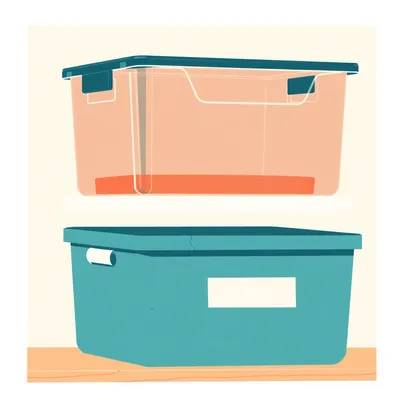
And he's not wrong about the specs. I've been reading the technical sheets on this stuff, and the gap between what industrial storage delivers and what consumers accept is genuinely wild. A Eurobox built to the VDA 4500 standard is designed to survive a decade of forklift abuse in a just-in-time logistics loop. A Samla bin from IKEA cracks if you look at it wrong during a move.
I've seen Daniel's Samla graveyard. It's not small.
And that's the thing — the graveyard is the business model. But let's start with what these systems actually are, because most people walking through a home goods aisle have never heard the word Eurobox, and they should.
So what exactly are these industrial systems, and why should anyone who doesn't work in a warehouse care? Let's start with the standard that makes it all work.
The VDA 4500 standard. VDA stands for Verband der Automobilindustrie — the German Association of the Automotive Industry. Back when German auto manufacturers were building out just-in-time manufacturing, they needed containers that could move between suppliers, assembly lines, and warehouses without anyone ever repacking them. So they standardized the footprint: six hundred by four hundred millimeters. That's the base. Every VDA 4500 compliant box shares that footprint. The height variants go up in seventy-five millimeter increments — so you get a one-twenty, a one-ninety-five, a two-seventy, and so on. Stack any height on any other height, from any manufacturer, and they interlock.
So it's a universal standard. Like shipping containers, but for boxes you can carry.
Exactly like shipping containers. And that's the insight that should make a consumer sit up. When Maersk puts a container on a ship, they don't care whether it was built by CIMC or Singamas — the corner castings are in the same place. VDA 4500 does the same thing at the closet scale. A Eurobox from Raaco stacks perfectly on a Eurobox from Schoeller Allibert. You're not locked into any brand's ecosystem. You can start with one box and add different brands over a decade, and everything still fits.
Compare that to IKEA's Samla line. A Samla bin stacks on another Samla of the same size. It does not stack on a Kuggis. It does not stack on anything from another brand. It barely stacks on last year's Samla if they tweaked the mold.
Which they do. IKEA changes suppliers and tooling constantly. And there's no published standard — the compatibility is accidental and temporary. That's not a flaw in their design, it's the point. Lock-in sells more bins.
So the standard itself is the moat, or the lack of one. IKEA builds a walled garden. VDA 4500 is open-source storage. Anyone can manufacture to it.
And the material science is where this gets embarrassing for consumer storage. Samla bins are made of polypropylene, which is a perfectly good polymer. But IKEA uses thinner wall sections — typically around one to one-point-five millimeters — and minimal UV stabilizers. Polypropylene degrades under UV exposure. It gets brittle. In a home that gets sunlight through a window, or in a move where the bin gets flexed, that thin unstabilized wall cracks. Typical lifespan in active use: two to three years before something breaks.
I've watched a Samla lid shatter in cold weather. It was indoors. It was just a cold room.
An industrial Eurobox from a supplier like Schoeller Allibert or Raaco uses the same base polymer — polypropylene — but with thicker walls, often two to three millimeters, and industrial-grade UV and impact stabilizers. These boxes are rated for closed-loop logistics systems where they get thrown onto trucks, run through automated sorters, and sit in unshaded outdoor yards for years. Design life is ten to fifteen years minimum. Some of these boxes have been circulating in automotive supply chains since the nineteen nineties and they're still in spec.
So the upfront cost difference — let's put numbers on that. A Samla twenty-two liter bin is about eight dollars. A comparable Eurobox?
Fifteen to twenty-five dollars, depending on the height and the supplier. So yes, the Eurobox costs two to three times as much upfront. But here's the total cost of ownership math Daniel's getting at. You move apartments three times over a decade. Each move, a Samla bin gets stressed, and a certain percentage crack — lids snap, corners split. You replace them. Three Samlas over ten years at eight dollars each is twenty-four dollars. One Eurobox at twenty dollars survives all three moves and is still fine. You're ahead by the second move.
And that's before you factor in the annoyance cost of discovering your winter clothes are sitting in a bin whose bottom just gave out on the staircase.
The annoyance cost is real but hard to amortize. The environmental math is easier. Every Samla that cracks and goes to landfill is polypropylene that took energy to mold and ship. The Eurobox stays in service. Polypropylene is technically recyclable, but thin consumer bins often don't make it into recycling streams — they get tossed because they're cheap to replace. The industrial box is built to never need replacing, which is the most efficient form of waste reduction.
So that's the deep storage layer — the Eurobox stack in the closet with seasonal stuff, spare cables, the things you need twice a year. But Daniel mentioned a second category that I think is the more interesting discovery: quick-pick boxes.
This is where Sortimo and Festool come in. Euroboxes are for deep storage — you stack them, you label them, you forget about them until you need the Christmas decorations. Quick-pick is the stuff you reach for constantly. Velcro strips, VHB tape, screwdrivers, batteries. In an industrial setting, this is the workstation layer. And the systems built for it are remarkably clever.
Sortimo's L-Boxx. What makes it different from just a smaller bin?
Two design features that map almost perfectly onto what someone with ADHD needs from a storage system. First, the transparent lid. You can see the contents without opening the box. That sounds trivial, but for a brain that struggles with object permanence — if I close the lid, the thing ceases to exist — a transparent lid is functionally a prosthetic for working memory. Second, the removable tray. The L-Boxx typically has a lift-out tray on top and deeper storage below. You put the high-frequency items in the tray, the less-used items underneath. You're not digging. You lift the tray, grab what you need, put it back. The system imposes structure without requiring you to maintain it through willpower.
That's the part that clicked for Daniel. It's not just a box. It's a workflow. The box does the remembering for you.
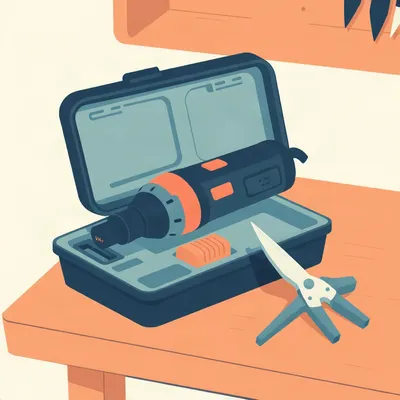
And Festool's Systainer takes a different approach to the same problem. The T-Loc system uses a single-handed latch — you turn one knob and the box opens, turn it back and it locks. The top surface has interlocking feet so stacked Systainers don't slide. These are designed for professionals who might open and close a box fifty times a day. Every friction point has been engineered out. The latch mechanism alone is a small marvel — it's a cam-action closure that pulls the lid down evenly, so you get a dust and water seal without fighting with four separate clips.
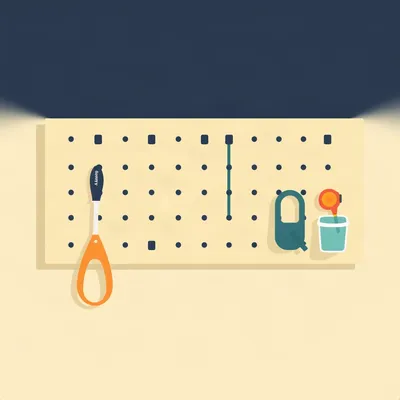
IKEA's equivalent for small-item storage is... what? A SKÅDIS pegboard with plastic cups that don't seal, don't stack, and don't travel.
There is no IKEA equivalent to a Systainer. They don't make anything in that category. Their tool storage solutions are pegboard accessories and fabric bins. Neither seals. Neither stacks securely. Neither survives being carried to a job site. The closest consumer product is probably a Plano tackle box, which is a fishing product that happens to work for screws.
And a tackle box doesn't have a transparent lid with a removable tray system designed for rapid access. It has a bunch of little compartments with snap-shut lids that eventually break off.
To understand why industrial storage beats consumer storage, you have to look at the spec sheet — and the material science. But I think we've established that part. The tech is better and cheaper over time. The real question Daniel's asking is: why isn't everyone using it?
That's where the story gets interesting. And where there might be an actual business opportunity sitting in plain sight.
Let's look at who's currently trying to bridge this gap, because the answer is: almost nobody, and the people who are trying aren't doing it well. Sortimo has a direct-to-consumer site — MySortimo dot com. You can buy L-Boxx systems and accessories there. But the site is clearly designed for tradespeople. The product photography shows workshops and vans. The navigation assumes you already know what an L-Boxx is and which configuration you need. There's no "getting started" guide for someone who wants to organize a home office. There's no "apartment closet starter kit."
It's like they're selling to an existing customer who already speaks the language, and anyone else who wanders in is just confusing the analytics.
Festool is even more extreme. Their Systainer ecosystem is beloved by woodworkers and finish carpenters, but their marketing is entirely professional. You won't find a Festool ad in a lifestyle magazine. Their retail partners are tool distributors, not home goods stores. The consumer who might benefit from a Systainer for craft supplies or electronics components has no natural path to discovering it unless they also happen to be a woodworker.
And then there's the community layer. Reddit has these pockets — r slash Workbenches, r slash Tools, r slash Organization — where enthusiasts post photos of their Eurobox and Systainer setups. The comments are always the same pattern: "What are those boxes?" "Where do you get them?" "Can I use these in an apartment?" The demand signals are right there, public, for years. Nobody's harvesting them.
Adam Savage's Tested channel on YouTube is probably the single best piece of evidence for latent demand. His workshop tours routinely feature walls of Systainers and Euroboxes. Millions of views. The comment sections are full of people asking for identification of the storage systems — not the tools inside, the boxes themselves. Millions of people have seen these products and wanted them, and there's still no consumer brand saying "here's what they are, here's how to buy them for your home."
So the demand is real, it's visible, and it's been visible for years. The supply side is a bunch of German industrial manufacturers who don't seem to know or care that apartment dwellers exist. What's stopping someone from just... filling that gap?
A few things. First, the industrial manufacturers don't need the consumer market. The automotive logistics sector alone is enormous. VDA 4500 boxes move through every major car plant in the world. Sortimo's core business is van racking and mobile workshop systems for service technicians — that's a multi-billion dollar market by itself. Consumer home organization is a rounding error to them. They're not ignoring it out of stupidity; they're ignoring it because their sales reps are busy with fleet contracts for ten thousand units.
So it's the classic innovator's dilemma in reverse. The established players have no incentive to serve a small, uncertain market when their existing market is massive and predictable.
Second, IKEA's business model is structurally opposed to this. IKEA sells furniture that needs replacement. A Eurobox that lasts twenty years is bad for repeat sales. But more importantly, IKEA benefits from non-standard sizing. Once you buy a Samla, you're in the Samla ecosystem. When you need more bins, you buy more Samlas. When IKEA changes the design, you might need to replace your whole set. VDA 4500 is an open standard — anyone can make compatible boxes. That destroys the lock-in that makes consumer storage profitable.
IKEA's not going to adopt a standard that lets you buy next year's bins from a competitor.
They'd be insane to. Their entire home organization strategy is built on proprietary ecosystems — SAMLA, KUGGIS, SKÅDIS, TROFAST. None of them interoperate. Each one is a little walled garden you have to keep buying into.
There's one consumer brand that comes close to the industrial model, and it's worth mentioning as a counterexample: The Container Store's Elfa system. It uses a standardized rail and bracket system. It's modular, it's durable, it's marketed to consumers. But it's shelving, not containers. And it doesn't follow VDA 4500 or any industrial container standard. It's a parallel universe — consumer storage that figured out modularity for shelves but never connected to the box ecosystem underneath.
Elfa proves consumers will pay a premium for modular, durable storage. A basic Elfa closet system can run five hundred to a thousand dollars. People buy it because it lasts and it adapts. The same consumer psychology should work for boxes — but nobody's made the offer yet.
So who could bridge this? Daniel floated the idea that maybe he could. Let's take that seriously for a minute. What would a bridging business actually look like?
I see three models. The first is a direct-to-consumer brand that curates industrial storage for home use. Think of it as the Muji of storage — clean, minimal, high-quality boxes with clear guides and starter kits. You'd source Euroboxes and L-Boxx units from existing manufacturers, possibly with custom colors or branding, and sell them through a Shopify store with apartment-friendly photography and use-case guides. "The Closet Kit," "The Craft Station Kit," "The Under-Bed Kit." The value-add isn't manufacturing — it's translation and curation.
The hard part there isn't product, it's education. You're teaching consumers a vocabulary they don't have. Most people don't know what a Eurobox is. They don't know the VDA 4500 standard exists. They've never heard of Sortimo. The marketing has to do double duty: explain the system and sell the product.
Which is why the second model might be a prerequisite. A content-first approach — YouTube channel, newsletter, social media — that teaches people the vocabulary and shows apartment-friendly setups before trying to sell anything. Build the audience around the concept, then launch the store. Adam Savage's comments section is basically a waiting list. Someone just needs to show up and say "here's how to do this in a six hundred square foot apartment."
The third model is lower-friction: a retailer that imports and resells existing industrial boxes with consumer-friendly branding. No custom manufacturing, just a well-organized storefront that takes the friction out of sourcing. Right now, if you want a Eurobox as a consumer, you're probably buying from a logistics supply site with a nineteen nineties web design and minimum order quantities. A clean storefront with single-unit sales and clear descriptions would be a genuine improvement.
And the economics could work. If a Eurobox wholesales for eight to twelve dollars and retails for twenty to twenty-five, there's margin. Shipping is the challenge — these are bulky items — but flat-rate shipping on curated kits would help. The bigger question is whether the market is large enough to sustain a business, or whether this is a niche within a niche.
I think Daniel's ADHD angle suggests it's bigger than it looks. The Sortimo L-Boxx's transparent lid and removable tray aren't just nice features — for someone with ADHD, they solve a genuine disability-related problem. Object permanence issues, executive function challenges around organizing, the "out of sight, out of mind" problem that makes deep storage unusable for some brains. A system designed for logistics efficiency happens to also be a system designed for neurodivergent accessibility.
That's the product-market fit story. It's not just "nice boxes." It's "boxes that compensate for the exact cognitive challenges that make organization hard for a significant portion of the population." ADHD prevalence in adults is estimated at around four to five percent. That's millions of people in the US alone who might find that a transparent-lidded, tray-based quick-pick system changes their relationship to their stuff. And nobody is marketing to them.
The industrial systems were designed for speed and efficiency on a factory floor — the worker needs to see the part and grab it without thinking. That's the same thing a brain with executive dysfunction needs. The use case converges from completely different directions.
And the deep storage versus quick-pick distinction is useful even if you never buy a single Eurobox. The concept is free. You can implement it today with whatever bins you already own. Designate a picking zone — the stuff you touch daily or weekly, at arm's reach, visible, easy to access and return. Designate a deep storage zone — the seasonal items, the backups, the rarely-used tools, stacked and labeled, tucked away. Just making that distinction transforms how a closet functions.
Most home organization advice is aesthetic. "Make it look nice." This is functional. "Make it work for how your brain actually operates." The deep storage versus quick-pick framework is an operational concept, not a decorating tip.
And IKEA's organization products are almost entirely in the aesthetic camp. They look good in catalog photos. They don't survive use. They don't interoperate. They don't accommodate different access patterns. They're designed to be bought, not to be used.
The Samla bin is the fast fashion of storage. It looks fine on the shelf, it costs little, and it falls apart before you've gotten your money's worth. And because it's cheap, you don't question replacing it. You just buy another one and throw the cracked one away.
The environmental cost of that cycle is invisible to the consumer but enormous in aggregate. Polypropylene production emits about one-point-seven kilograms of CO2 per kilogram of plastic. A Samla twenty-two liter bin weighs about four hundred grams. Multiply that by the millions sold annually, then multiply again by the replacement rate — and you've got a significant waste stream that's entirely avoidable if the bins were built to last in the first place.
Okay, so the gap is real, the demand is latent, the environmental case is strong, and nobody is filling it well. What can someone actually do about it, starting today?
Three concrete steps. First, start with one Eurobox. Don't overhaul your whole closet. Buy a single VDA 4500 compatible box from a supplier — Raaco, Schoeller Allibert, or even a used one from a logistics surplus site. A used Eurobox costs about the same as a new Samla and it's already proven it can survive industrial use. See if the system clicks for you. See if the six hundred by four hundred millimeter footprint works in your space. One box is a twenty dollar experiment.
Second, implement the deep storage versus quick-pick distinction right now, with whatever bins you already have. You don't need new boxes to do this. Walk over to your closet or your workbench. Separate everything into two categories: stuff you reach for at least weekly, and stuff you don't. The weekly stuff goes where you can see it and grab it without moving anything else. The seasonal stuff gets stacked and labeled. That alone will change how the space works, and it costs nothing.
Third, if you want to go deeper, search for "VDA 4500" or "Eurobox" on YouTube and Reddit. Don't search "home organization" — you'll get IKEA hacks and Marie Kondo. Use the industrial vocabulary. Search "Systainer" and "Sortimo" for the quick-pick layer. The community is small but passionate, and you'll find setups that range from garage workshops to apartment closets. The information is out there, it's just not packaged for consumers yet.
And for the entrepreneurially inclined — Daniel, I know you're listening — the gap is real. A Shopify store selling curated Eurobox starter kits with apartment-use guides and a "which box for what" quiz could be a viable niche business. The hard part is education, not product. The boxes exist. They're excellent. Someone just needs to translate them for people who don't speak logistics.
The Container Store built a billion-dollar business selling modular shelving to consumers. The box layer underneath those shelves is still waiting for its Container Store moment.
So whether you buy one box or build a business around them, the core idea is the same: the best tools for your home might come from a factory, not a furniture store. That's not weird. It's just overlooked.

If these Euroboxes are so much better and cheaper over time, why hasn't a single big retailer picked them up? Is there something about the supply chain or the business model that makes them impossible to sell at consumer scale?
It's not impossible — it's just uninteresting to the people who currently make them. The industrial manufacturers are capacity-constrained serving their existing B2B customers. Tool distributors don't want to stock bulky, low-turnover items for a consumer audience they don't understand. And big retailers like IKEA or Target would have to abandon their proprietary ecosystems to adopt an open standard, which cannibalizes their lock-in. The boxes aren't the bottleneck. The business model is.
What Herman's saying is that the boxes are a commodity — the value would be in the curation, the education, and the brand. And that's not a supply chain problem. That's a marketing problem. Someone just has to do it.
Thanks, Hilbert — good question.
So here's the open question we'll leave you with. Will a major consumer brand ever adopt the VDA 4500 standard, or will this bridge be built by a thousand small enthusiasts — someone in an apartment with a laptop, a Shopify account, and a really good idea about how to explain Euroboxes to people who've never set foot in a warehouse?
If you've tried Euroboxes or Systainers in your home, we want to hear about it. Email the show at show at my weird prompts dot com. Daniel's been building out his system for months and he's convinced there's a community of people who've discovered this independently. We'd love to know if you're one of them.
This has been My Weird Prompts. Thanks to our producer Hilbert Flumingtop. We'll be back soon.
Check out the website at my weird prompts dot com for every episode. See you tomorrow.