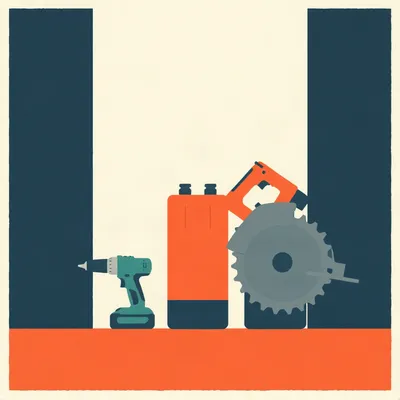
I bought a drill and now I apparently have a marriage.

That's the whole thing in six words, honestly. Daniel's prompt this week starts with a twelve volt Bosch drill that he says is the best DIY purchase he's made, right for the job. Then he went looking for a cordless heat gun, and discovered that at twelve volts, the category basically doesn't exist. Not a gap in the range, a physical wall. And his questions are: why does voltage divide tool families? What does each tier actually buy you? What's the naming trap? What actually shares a battery footprint? And how should you choose?
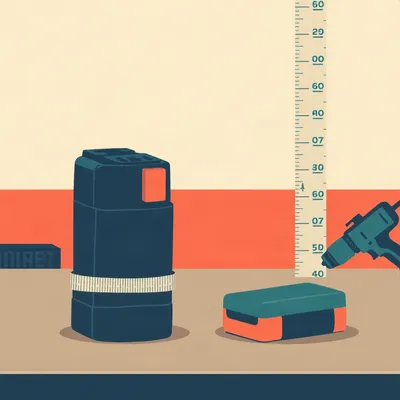
Which is five questions, and they all collapse into one insight, which is that you are not buying a tool. You are buying a battery mount with a tool attached to it. The tool is the cheap part. The platform is the decision.
And the platform is a decade-long commitment whether you know you're making it or not. The drill costs less than the batteries, the charger, the next bare tool, the one after that. So let's start with the wall Daniel hit, because the wall is not marketing. It's physics. Power equals voltage times current. A twelve volt pack has fewer cells in series than an eighteen volt pack. To deliver the same wattage, the twelve volt pack has to push proportionally more current. For the same power, roughly one and a half times the current of an eighteen volt system.
And current is the enemy.
Current is the enemy. More current means more resistive heating. The losses go up with the square of the current, so it's not linear. It's worse than linear. More current means more heat in the cells, more heat in the interconnects, more heat in the tool's electronics. And it means voltage sag. Under load, the pack's voltage droops. So the tool loses power exactly when you're asking the most from it.
So the question isn't whether twelve volts can do the work. It's whether it can do the work for long enough without cooking itself.
Right. A drill is an intermittent, bursty load. Seconds on, seconds off. You sink a screw, you reposition, you sink another screw. The pack gets a rest between bursts. A heat gun, a circular saw, an angle grinder, those are sustained high-draw loads. Minutes of continuous current. And at twelve volts, the currents you'd need are absurd.
Let's put a number on the heat gun. A useful heat gun needs roughly a thousand watts or more. At twelve volts, that's over eighty amps. Eighty amps through a handheld pack, through the contacts, through the wiring. That's not a battery, that's a welding rig.
At eighteen volts it's still over fifty-five amps, which is why even eighteen volt heat guns are rare and often underwhelming. They exist, but they're compromised. The runtime is short, the packs get hot, and they don't match a corded heat gun. So the catalogues break where they break because the physics breaks there first.
I want to pause on that eighty amp number for a second, because I think it's easy to hear "eighty amps" and not have a reference point. A typical household circuit breaker in the UK is thirty-two amps for a ring main. A car battery cranking an engine in winter might push a few hundred amps for a few seconds. So eighty amps continuous through something you're holding in your hand, through contacts that are maybe a few millimetres across... that's not a tool. That's a fault condition.
That's a really helpful comparison. The breaker in your wall is rated lower than what the twelve volt heat gun would need to draw continuously. So the wall would protect itself, but the battery pack has no breaker. It just has chemistry and resistance.
And chemistry doesn't negotiate.
Chemistry doesn't negotiate. The cells get hot, the electrolyte degrades, and eventually the pack either shuts down or fails. Best case, you get a tool that works for ninety seconds and then takes a nap. Worst case, you get a thermal event.
Which is a euphemism for a fire in your hand.
It's a euphemism for exactly that. So once you see that, you can predict the boundary yourself. You don't need to memorise which tools live at which voltage. You just ask: is this a bursty tool or a sustained tool? If it's sustained and it needs real wattage, it's going to live higher up the voltage ladder or it's not going to exist cordless at all.
And that's the listener takeaway from the first half. The boundary isn't arbitrary. It's the point where sustained wattage demand meets what a given pack voltage can deliver without melting. Once you grasp that, the catalogue becomes a map instead of a list.
So let's read the map. What are the tiers?
Before you do, can I just say something about the map metaphor? Because I think it's more literal than people realise. A map shows you where the rivers are, where the mountains are, where you physically cannot walk. The tool catalogue is the same. You look at it and you think someone in marketing decided which tools go where. But actually, the physics decided, and marketing just drew the lines on top.
And once you know the terrain, the lines become predictable. So let's walk the map. Twelve volt class. Drills, drivers, impact drivers, small ratchets, inspection cameras, detail tools. One-handed, compact, intermittent. This is the class Daniel's Bosch lives in, and for drilling and driving it's the right choice. A good twelve volt impact driver will sink screws all day because it's bursty. The limitation is sustained draw, not capability.
I've got a twelve volt driver that I use for almost everything around the house. It's light enough to hold above my head for an hour, and I'm not fighting the tool. But the moment I try to do anything that's continuous — sanding, cutting, grinding — it's the wrong tool. Not because it's a bad tool, but because I'm asking it to be something it isn't.
And that's the thing. The twelve volt class isn't a compromise. It's a specialisation. It's the right answer for a specific set of jobs, and the wrong answer for others. The problem is when people buy it expecting it to be a universal answer.
So what's the universal answer?
Eighteen volt is the universal middle. By far the broadest catalogue. Everything from drills and drivers up through circular saws, reciprocating saws, angle grinders, some miter saws, rotary hammers, nailers, lights, vacuums. This is the platform where most people should live, because it covers the most ground. It can do the light work, and it can reach up into the sustained work, though sometimes with compromises.
And the compromise is usually runtime and heat, right? An eighteen volt circular saw can absolutely cut plywood, but it's working hard. The pack gets warm. You're not going to frame a house with it.
Correct. It will do the job, but the duty cycle is shorter than a corded equivalent. You'll stop to let the pack cool, or you'll swap batteries. That's the compromise. It's not that the tool can't do it. It's that you're managing the energy budget.
Then above that, thirty-six volt, or paired eighteen volt packs, and higher. That's sustained draw and mains-replacement work. Big miter saws, table saws, high-demand grinders, tools that are replacing a corded tool on a job site.
And then there's the separate high-voltage outdoor and garden tier. Thirty-six volt, forty volt, fifty-four volt, sixty volt, seventy-two volt. Mowers, chainsaws, blowers, trimmers. And here's the thing that catches people: these are usually a distinct platform even inside the same brand. Your eighteen volt drill batteries will not run your fifty-four volt mower. Different mount, different cells, different everything.
So the voltage tiers are not a ladder you climb one rung at a time. They're more like separate buildings with different addresses.
And once you've picked your voltage, the real traps start, because the number on the box is not the whole story.
This is the naming trap. And it's one of the oldest tricks in the book.
A lithium-ion cell is nominally three point six volts, but it peaks at four point zero to four point two volts when fully charged. Five cells in series: eighteen volts nominal, or twenty volts max. Same pack, counted two ways. DeWalt's twenty volt max platform is eighteen volts nominal. It's not more powerful because the box says twenty. It's the same five cells.
I remember when the twenty volt max branding first appeared. It was a masterclass in marketing. Every other brand was selling eighteen volt tools, and suddenly DeWalt had twenty. And the implication was obvious: twenty is more than eighteen, so this must be more powerful. Except it wasn't. It was the same pack with a different number printed on it.
And it worked. People believe their twenty volt tool is a step up from an eighteen volt tool. They'll argue about it on forums. It's the same five cells in series. The only difference is whether you're counting the nominal voltage or the peak voltage.
And the same thing happens at the bottom. Ten point eight volts and twelve volts are the same three-cell pack counted two ways. Three cells at three point six nominal is ten point eight. Three cells at four volts peak is twelve.
Anyone comparing brands on the headline number is comparing marketing conventions, not capability. A twenty volt max tool and an eighteen volt tool are the same voltage class. A ten point eight and a twelve are the same class. The number is not the spec.
What should you compare instead?
The physical platform. The battery mount shape, the cell count, and the ecosystem. The real spec is what tools share a footprint. Because here's the trap that costs real money: same brand and same voltage does not guarantee the same platform.
This is where Bosch is the classic example, and it's almost unfair to pick on them because everyone does it, but Bosch is the cleanest illustration.
Bosch runs a twelve volt and an eighteen volt Professional line, the blue tools. And a separate Home and Garden line, the green tools. Both eighteen volt, same brand, same nominal voltage, and historically physically incompatible mounts. You cannot put a green battery on a blue tool. The mount is different. So a buyer who assumes the number is the compatibility buys a tool their battery won't fit.
That's a hundred dollar mistake if you buy a bare tool. You get home, you open the box, you go to click your battery in, and it doesn't click.
The lines have been converging in some markets, I should say, but the historical situation is exactly the trap. So how do you check compatibility properly? You look at the specific platform name, not the voltage. Bosch Professional eighteen volt, Bosch Home and Garden eighteen volt, Milwaukee M twelve versus M eighteen, DeWalt twenty volt max versus FlexVolt. Those are the real identifiers. Check the physical mount shape. Look for the platform's logo or naming convention on the tool and the battery.
FlexVolt is its own whole thing. DeWalt's FlexVolt system can switch between eighteen and fifty-four volts depending on the tool. So a FlexVolt battery will run on an eighteen volt tool, and then the same battery slides into a fifty-four volt saw and delivers three times the voltage. That's a clever piece of engineering, but it also means you have to know which platform you're holding.
Then there are the cross-brand alliances. Bosch's AmpShare alliance is the notable one. Bosch, Gardena, Wagner, and others sharing the eighteen volt platform. You buy a Bosch battery, it runs a Gardena tool. The industry is moving toward openness, slowly, in patches.
Then there are third-party adapters. Milwaukee to DeWalt, that kind of thing. They exist, they're cheap, and they're a workaround with caveats. No official support, potential performance loss, and they don't solve the underlying commitment. They're a bridge, not a platform.
The underlying commitment is the thing. Platform-retirement risk. When a manufacturer sunsets a line, your batteries become paperweights. You can't buy new ones, you can't repair the old ones, and the tools you own are suddenly orphans. This is the real cost. It's why the platform decision matters more than the tool decision.
I think platform retirement is the part nobody thinks about when they're standing in the aisle holding a drill. You're thinking about the hole you need to drill this weekend. You're not thinking about whether you'll be able to buy a battery for this thing in eight years. But that's actually the question that matters most.
It's not hypothetical. Every major brand has sunsetted a platform at some point. NiCad lines got retired. Older lithium lines got replaced by newer mounts. If you were on the wrong side of that, your tools still work mechanically, but the batteries are dead and you can't get new ones. Or if you can, they're third-party rebuilds of questionable quality.
Given all that, how do you actually choose? Daniel asked for a heuristic.
Buy the platform sized to the largest tool you can plausibly imagine owning. You can always run a small tool on a big platform, but never the reverse. If there's any chance you'll want a circular saw or a reciprocating saw, get the eighteen volt platform, even if your first purchase is a drill. The drill will be slightly bigger and heavier than a twelve volt, but it will run on the same batteries as everything else you buy later.
The reassurance Daniel probably needs to hear: ending up with two platforms is normal and sensible. A light twelve volt platform for precision and drilling, a bigger eighteen volt platform for sustained work. That's not a failed first purchase. That's a tool collection that matches the jobs.
I think that's the thing most people get wrong. They think they're supposed to find one platform that does everything, and then they feel like they failed when they end up with two. But two platforms is the natural endpoint for most people. The twelve volt lives in the kitchen drawer, the eighteen volt lives in the workshop.
The twelve volt drill Daniel bought is still the right purchase. It's the right tool for the job he does most. The mistake would have been assuming it could scale up to a heat gun.
Which brings us back to the physics. The heat gun doesn't exist at twelve volts because it can't exist at twelve volts. Not without a battery the size of a car battery and a duty cycle measured in seconds.
That's the thing I keep coming back to. The catalogue is a physical document. It's not a marketing document, not really. The marketing lives on top of it, but the shape of the catalogue is dictated by what a pack of cells can physically do.
Once you see that, you can look at any cordless tool and work out what committing to it implies. You look at the voltage, you look at the mount, you look at the platform name, and you ask: what's the biggest tool this system can run? And is that big enough for what I'll want in five years?
If the answer is no, you're not buying a drill. You're buying a regret.

I sold cordless tools one summer in the late nineties. Hardware chain that's been gone for twenty years now. The platform trap was exactly the same then, except it was nickel cadmium packs and every brand had its own shape. You were just as locked in. What's changed is the voltages got higher and the marketing got louder.
I still have the first cordless drill I ever bought. Seven point two volt Black and Decker. Nickel cadmium. The battery takes three days to charge and lasts about eleven minutes. But it still works. I charged it last month just to see. Eleven minutes.
Here's the thing I've been waiting to say. The reason people end up with three different brands in their garage isn't bad planning. It's that each platform was bought for one specific tool that no other platform offered at the time. You buy the drill because it's on sale. Then you need a caulking gun, and only one brand makes a cordless caulking gun. So now you have a second platform. Then you need a little inspection camera, and someone else makes the good one. Third platform.
I own tools on four different platforms right now. One of them I bought solely because it was the only cordless caulking gun I could find. I have used the caulking gun exactly once. But I keep the platform alive. You never know.
The caulking gun is the perfect illustration of what we're saying. It's not that you made a bad decision. It's that the platform decision was made for you by the one tool that only existed in one place.
Now you're carrying four chargers and four sets of batteries to keep one caulking gun available in case you ever caulk again.
The charger is in a box with the other three. I know which one goes with which. There's a system.
The thing about Hilbert's four platforms is that each one was rational at the moment. That's what makes platform lock-in so insidious. It's not one big mistake. It's four small correct decisions that add up to a garage full of incompatible batteries.
The caulking gun is the extreme case, but the logic is the same as Daniel's heat gun. He wanted a tool that didn't exist on his platform. The difference is he found out before he bought a second platform.
The heat gun doesn't exist at twelve volts because it can't. I could have told him that in the store in ninety-eight. Same reason we didn't sell a twelve volt circular saw. The pack would sag so hard the saw would stall halfway through the cut.
That's the predictive power we were talking about. You don't need to know every tool in every catalogue. You just need to know whether the tool is bursty or sustained, and how much wattage it needs.
The one thing I'd want a listener to take from this is the heuristic. Buy the platform sized to the largest tool you can plausibly imagine owning. You can always run a small tool on a big platform, never the reverse. That single sentence would have saved Hilbert at least two chargers.
It would have saved me three, if I'm being honest. The caulking gun platform has a charger, the inspection camera platform has a charger, and there's one more I don't remember buying.
That third charger is the ghost of a decision you don't remember making. Which is kind of the whole point. Platform lock-in doesn't announce itself. It accumulates.
The open question worth sitting with: with AmpShare-style alliances growing and third-party adapters improving, will the platform lock-in of the next decade look different from the last? Or is the mount itself the new battleground?
I suspect the mount is the battleground. The battery is a commodity now. The mount is the moat.
Which is a grim thought for anyone who just wants to buy a drill and drill some holes.
The drill was never the product. The drill was the gateway.
Now you know what you're actually buying.
Thanks to our producer Hilbert Flumingtop for keeping the show running, and for the caulking gun.
This has been My Weird Prompts, the human-AI collaboration podcast.
If you enjoyed this, leave us a review, or send your own weird prompt to show at my weird prompts dot com.
We'll be back soon.
Bring a battery.