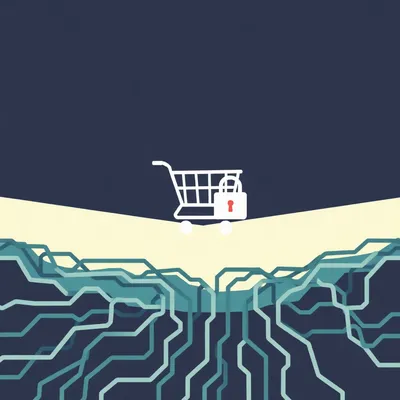
I was six euros short of free shipping last night and genuinely stared at my screen for ten minutes trying to decide whether paying the shipping was worse than finding something I'd use eventually. I bought cable clips I didn't need. Daniel's been thinking about exactly this, and he sent us something long.

How long?
Long enough that I'm going to read it properly. Here's what he wrote.
Over the past few episodes we've talked about how my wife and I buy a surprising number of small parts from AliExpress. We're currently setting up a new rental apartment, so there's a constant stream of little purchases: wall mounts, concrete screws, drill bit holders, cable clips, adapters, storage bins. AliExpress has become remarkably good at consolidating shipments and making these kinds of purchases economical, and living in a relatively small market like Israel, it's often the only practical way to find niche hardware.
But I've always disliked the psychology of online shopping. I hate feeling pressured to complete an order because I'm five pounds or ten dollars short of a free shipping threshold or some temporary promotion. It occurred to me that this feels like an ideal job for an AI agent. Rather than placing orders immediately, it could maintain a shared household wishlist, wait until we've reached a sensible threshold, optimize the basket, and then suggest it's a good time to place an order.
When I mentioned this to my wife, she suggested extending the idea with package tracking. There are already services like 17TRACK that aggregate shipments across carriers, but that's only one piece of the puzzle. The more I thought about it, the more it seemed the real opportunity is a unified household purchasing platform — a single place where a couple or family manages everything they buy online, regardless of vendor.
He then lists what it should do: shared wishlists across multiple marketplaces, price comparison between AliExpress, Amazon, local retailers, show purchases within a monthly household budget, keep receipts and warranties in one searchable archive, aggregate tracking across all carriers, recommend when to combine purchases, coordinate between household members to avoid duplicates, and potentially use AI to recommend alternatives or suggest delaying purchases based on historical pricing.
That's basically a procurement department.
That's exactly where he goes next. He asks whether this problem has already been solved inside businesses — what kinds of enterprise software handle collaborative purchasing, approvals, supplier management, purchase orders, budgeting, invoice management, and shipment tracking. How much of that could sensibly be adapted for a household? And he wants to understand the boundaries between personal finance software, procurement platforms, spend management systems, inventory management, procurement orchestration, and e-commerce automation. Which existing categories provide the best architectural inspiration?
Then the final question: Looking ahead, does this feel like the sort of application AI agents could transform? Could an AI become the household's purchasing coordinator — tracking needs over time, consolidating orders, negotiating between cost, urgency, and budget, and quietly handling the logistics? Or are there barriers that make this much harder than it first appears?
Okay. So the question underneath all of this is: can the boring machinery of corporate procurement be reinvented for the household, and is AI the missing piece that makes it possible?
And the fact that nobody's built it yet is either a market failure or a signal that the economics are terrible. Let's figure out which one.
Let's start with why the problem feels so bad in the first place. Daniel's six-euro gap to free shipping — that's not an accident. That's a mechanism designed to exploit something very specific in how humans process loss.
Prospect theory.
Kahneman and Tversky, nineteen seventy-nine. The core finding is that losses hurt roughly twice as much as equivalent gains feel good. Losing a hundred dollars is psychologically about twice as powerful as winning a hundred dollars. Applied to a shipping threshold: when you're six euros short of free shipping, your brain doesn't process that as "I could save six euros by adding something." It processes it as "I am about to lose the free shipping I already feel entitled to." The threshold creates an endowment effect — you mentally take ownership of the free shipping before you've qualified for it, and paying six euros to ship feels like a loss, not a cost.
So the store hasn't offered me a discount. It's manufactured a sense of loss and then offered to sell me relief.
That's the entire business model. And the numbers back it up. Consumers consistently add unplanned items to reach free shipping thresholds, and the kicker is they often spend more on the filler items than the shipping would have cost in the first place. You end up with fourteen euros of cable clips to avoid an eight-euro shipping charge, and you tell yourself you won.
I absolutely told myself I won. The cable clips are still in the drawer.
And that's just the threshold. The broader category here is dark patterns — interface designs that manipulate users into doing things they wouldn't otherwise do. The taxonomy is fairly well mapped at this point. Urgency: countdown timers, "offer ends in fourteen minutes." Scarcity: "only three left in stock," which on AliExpress is often completely fabricated. Social proof: "one thousand two hundred people bought this in the last week." Forced action: making you create an account before you can see the price. The FTC published a major report on this in twenty twenty-two documenting how widespread these patterns are across e-commerce.
And the EU actually regulated it.
The Digital Services Act, also twenty twenty-two, explicitly bans dark patterns that distort or impair users' ability to make free and informed decisions. The problem is enforcement. It's been slow, it's uneven across member states, and most of the enforcement actions target the big platforms — Amazon, Meta, Google. Marketplaces like AliExpress operate in a regulatory gray zone where the seller is technically in Shenzhen, the platform is technically in Singapore, and the buyer is in Jerusalem. Who enforces what?
So the pressure is designed, it's documented, it's partially illegal, and it's still everywhere. Daniel's six-euro gap is a textbook case of what the FTC report describes. And the specific AliExpress dynamic makes it worse because of the consolidation model.
Right. AliExpress consolidates shipments — multiple sellers, one package, one tracking number. To make that work, they set a "choice" shipping threshold. You need to hit a minimum spend across eligible items to qualify for consolidated shipping. If you're six euros short, you're not just paying for shipping — you're losing the entire consolidation benefit. The pressure to add something, anything, is constant and low-grade. It's not one big decision. It's fifty small ones a week.
Which is exactly what makes Daniel's idea interesting. The wishlist-plus-agent approach doesn't solve the dark patterns at the platform level. It solves them at the decision level. It converts "buy now under pressure" into "buy later when the basket is ready." The temporal pressure is the thing being eliminated.
And the mechanism is clever because it exploits the one thing an AI agent has that a human doesn't: infinite patience with zero emotional cost. The agent doesn't feel loss aversion. It doesn't get a little dopamine hit from clicking "place order." It can wait three weeks for the basket to naturally fill to the threshold, and it experiences exactly zero frustration during that wait. The human sets the rules — budget, urgency, acceptable price ranges — and the agent executes without the emotional interference that dark patterns are designed to exploit.
This is the part where I want to push on something. The agent still needs rules. "Wait until the threshold is met" sounds simple, but what's the actual rule? What if the threshold is never met? What if one item is urgent and the rest are not? The psychology of impulse buying doesn't disappear — it gets delegated, and the delegation itself requires discipline.
And it's the first major design challenge. The agent needs a policy, and the policy has to encode trade-offs that the humans may not have fully thought through. Urgency versus cost. Quality versus speed. One spouse's priority versus the other's. The agent becomes a negotiation platform, not just a purchasing tool.
And that's where the enterprise software world has already solved a lot of the architecture. Let's go there.
So the enterprise procurement landscape has a few major categories, and they map surprisingly well onto what Daniel described. First, procurement platforms — Coupa, SAP Ariba. These handle the full lifecycle: supplier management, purchase orders, approvals, receipt, and invoice matching. The core pattern is that they separate the request from the approval from the fulfillment from the reconciliation. Four distinct stages, different people involved at each stage, audit trails throughout.
And in a household, all four stages collapse into one person clicking "buy now" at eleven at night.
That's the structural problem. Daniel's vision is essentially asking for a consumer-grade version of that separation. You add an item to the wishlist — that's the request. The agent or the other spouse reviews it — that's the approval. The agent places the order when conditions are met — fulfillment. The receipt and tracking are archived — reconciliation. It's the same four-stage model, just with a much smaller org chart.
So what's directly adaptable?
The approval workflow is the most transferable piece. In Coupa, a purchase request routes to a manager based on dollar amount and category. The household equivalent is a shared wishlist where either partner can see what's been added and either can veto or flag something for discussion. No hierarchy — peer to peer — but the routing logic is similar.
The budget envelope system is the second piece. Ramp and Brex, which are spend management platforms rather than full procurement suites, let you set category budgets and enforce them in real time. You allocate five hundred dollars a month to hardware and the card declines if you exceed it. The household equivalent would be monthly category budgets that the agent checks before approving a purchase.
Third, the receipt and archive function. Expensify uses OCR to match receipts to transactions automatically. The household equivalent is auto-archiving AliExpress order confirmations, Amazon invoices, and local retailer receipts, then matching them to bank statement lines. Searchable, sortable, warranties tracked. This is useful and not particularly hard to build.
And supplier consolidation?
That's the fourth piece. Enterprise procurement platforms maintain preferred supplier lists. If you need office supplies, the system routes you to the contracted supplier with negotiated pricing, not to whoever shows up first in a search. The household equivalent would be the agent knowing that for M4 concrete screws, the best source is a specific AliExpress seller, and for storage bins, the local hardware chain is actually cheaper when you factor in shipping time.
So a lot of the architecture transfers. What doesn't?
The authority structure. Enterprise procurement assumes a single legal entity with formal approval hierarchies. A manager approves a subordinate's request. That's not how households work. Households are peer-to-peer. There is no procurement manager. The AI agent has to negotiate between two or more humans with equal standing, and that's a different design problem. You can't just port Coupa's approval routing and call it done — you need consensus mechanisms, not command chains.
The agent becomes a mediator, not an enforcer.
And that's hard. If I add a drill bit holder to the wishlist and Hannah thinks it's unnecessary, what does the agent do? It can't approve over her objection. It can't just escalate to a higher authority. It has to surface the disagreement and wait for resolution. That's a social coordination problem, not a software problem.
Which might explain why nobody's built this. Let's talk about the commercial barrier, because I think that's the real answer to "why doesn't this exist."
The unit economics are brutal. Enterprise procurement software sells to companies that save millions of dollars a year through better supplier management and spend control. Coupa's customers are Fortune 500 companies. The contract values are in the hundreds of thousands or millions annually. A household procurement platform would monetize a family saving maybe two hundred pounds a year on shipping and duplicate purchases. What do you charge for that? Five pounds a month? That's sixty pounds a year, and you've just eaten thirty percent of the savings you're supposed to be creating.
And the household that's price-sensitive enough to care about shipping thresholds is also price-sensitive enough to balk at a subscription.
The commercial incentive is fundamentally misaligned. The people who would benefit most are the least willing to pay, and the savings per household are too small to support a venture-scale business. That's why existing tools are fragmented and shallow — each piece of the puzzle is a small feature in some other product, not a standalone platform.
Which brings us to the boundaries question Daniel asked. Where do the existing categories start and end?
Personal finance software — YNAB, Mint, whatever replaced Mint by now — tracks spending after the fact. It tells you what you already spent. Procurement platforms manage the before and during. They control what gets spent. Inventory management tracks what you have. E-commerce automation — browser extensions that auto-apply coupons, price trackers — optimizes the single transaction. Daniel's vision is the first to integrate all four into one loop: what you need, what you'll spend, what you bought, and what you have.
Four separate categories, none of which talk to each other for consumers.
Right. And the reason they don't talk to each other isn't technical — it's commercial. Each category monetizes differently. Personal finance apps sell subscription or use your data. Price trackers get affiliate commissions. Inventory apps are a tiny niche with no obvious business model. Nobody has an incentive to integrate them because the integrated product would cannibalize each individual revenue stream while being harder to monetize than any of them individually.
The commercial barrier is real. But that's exactly where AI agents change the calculus. Let's talk about the agentic orchestration pattern.
This is the part that excites me. The assumption Daniel's prompt seems to make — and it's a natural one — is that a household procurement platform would need to be a single monolithic application. One app that does everything. But that's not how enterprise systems are evolving, and it's probably not how a consumer version would work either.
The pattern that's emerging in enterprise is called agentic orchestration. Instead of building a monolithic platform that owns every function, you deploy an AI agent that coordinates across existing APIs. The agent doesn't own the supplier database — it queries Coupa's. It doesn't own the receipt matching — it calls Ramp's. It doesn't own the tracking — it pulls from 17TRACK. The agent is the integration layer, not the platform.
The agent is the conductor, not the orchestra.
That's the image. And for households, the architecture would be the same. The agent maintains the wishlist and the rules. When it's time to check prices, it queries AliExpress, Amazon, and local retailer APIs. When an order is placed, it pulls the tracking number into 17TRACK. When the charge hits the bank, it matches the transaction against the order confirmation. It doesn't need to own any of those functions — it just needs to orchestrate them.
Which means the barrier to building this isn't "build a massive platform." It's "build a thin agent layer that can talk to existing APIs." That's a much smaller problem.
It's the reason I think Daniel's instinct is right about AI agents being the missing piece. The technical challenge shifts from building a monolith to building a coordinator. The coordinator needs to understand natural language — "add concrete screws to the hardware list" — maintain state across weeks or months, make judgment calls about timing and pricing, and present recommendations in a way that two humans can discuss. Those are all things large language models are good at.
But the APIs have to exist and be accessible. AliExpress doesn't exactly have a friendly developer platform.
That's the real technical barrier. Marketplace APIs are designed for sellers, not buyers. Amazon's Product Advertising API exists but it's limited and heavily rate-limited. AliExpress has an affiliate API through their AliExpress Affiliate Program, but it's designed for driving traffic, not for programmatic purchasing. The agent would need to work with whatever partial access is available, plus probably some screen scraping for the parts that aren't API-accessible, which is fragile and breaks whenever the site redesigns.
The agentic orchestration pattern is the right architecture, but the APIs are hostile to it.
Hostile by design, in many cases. Marketplaces don't want an agent optimizing across platforms — they want you inside their ecosystem, feeling the pressure of their dark patterns, adding those cable clips. An agent that systematically defeats dark patterns is an adversary to the platform's revenue model.
Which loops back to the commercial barrier. The platforms have no incentive to support this, and the savings per household are too small to fund a workaround.
Unless the agent isn't a product at all. Unless it's just something your AI assistant does because it has access to your browser and your bank feed and your messages with your spouse. At that point it's not a business — it's a capability. And the commercial barrier dissolves because nobody's trying to sell it.
That's the "AI becomes the default interface for shopping" scenario. If you're already using an AI agent for everything else, household procurement is just another thing it handles in the background.
That's the timeline question. If AI agents become the default interface for online shopping by twenty twenty-seven or twenty twenty-eight, as some people are predicting, the household procurement platform might never emerge as a product. It'll emerge as a pattern — something the agent just does. The same way nobody built a "household email platform" because email clients just handled it.
Before we get too far into the future, let's get practical. What can someone actually do this week without waiting for a product that may never ship?
Three steps, and the first one costs nothing and requires zero software. Start with a shared wishlist — literally a shared note, a spreadsheet, whatever — and one rule: nothing gets ordered until the basket hits the threshold naturally. No topping up. If you're six euros short, you wait until there's something you need. That rule alone removes the psychological pressure because it eliminates the moment of decision. You're never standing in front of the screen at eleven at night trying to find something to add.
We did this with a shared Apple Note for a while. It worked until it didn't, which is its own lesson about process versus tools.
The process matters more than the tool, and that's the mindset shift Daniel's prompt is really about. Treat household purchasing like a mini procurement department. Separate request from approval from fulfillment. You add the concrete screws to the list. Your spouse sees them, maybe adds a note about quantity. When the list hits the threshold, someone places the order. That's three distinct steps spread across days or weeks instead of one impulse click.
Second step: use existing tools as building blocks. 17TRACK for aggregating tracking across carriers — it's free and it works. A price-tracking extension for AliExpress and Amazon — CamelCamelCamel for Amazon, AliExpress has its own tools. A shared budget app for the monthly envelope. And then let the "agent" be a weekly review ritual — ten minutes on Sunday where you both look at the wishlist and decide what to order.
The ritual is the agent. Low-tech but it works.
It builds the habits that a real AI agent would eventually automate. You're training yourselves to think in procurement terms before the software exists.
Third step, for the technically inclined: a simple automation can already watch a wishlist and alert when conditions are met. Something like n8n or a short Python script with a cron job — it checks prices once a day, compares against your thresholds, and sends a notification when the basket qualifies for free shipping or when a tracked item drops below a target price. The full AI agent is a future step, but the pattern is testable today with off-the-shelf tools.
None of those tools require you to be a developer. n8n is visual and self-hostable. The barrier is willingness, not skill.
The deeper point is that the process change matters more than the tool. You can have the world's most sophisticated procurement platform and still impulse-buy if you haven't internalized the separation of request and approval. And you can have a shared text file and a weekly review and get ninety percent of the benefit. The software is an accelerant, not the solution.
Let's steelman the objection to all of this. The strongest argument against the household procurement vision is that it over-engineers a problem that's fundamentally about self-control. If you can't resist adding cable clips to hit a shipping threshold, the solution isn't an AI agent — it's discipline. The agent is just a crutch, and crutches don't fix the underlying behavior.
That's fair, and there's truth in it. The agent doesn't eliminate the psychology — it delegates it. Someone still has to set the rules, and someone still has to resist the urge to override the agent when it says "wait." The discipline doesn't disappear, it just moves one level up.
But the counterargument is that the environment is deliberately rigged against discipline. These platforms employ teams of people whose entire job is to defeat your self-control. Prospect theory, dark patterns, A/B tested urgency timers — this is industrial-grade psychological manipulation. Expecting individual discipline to consistently defeat it is like expecting someone to swim upstream against a fire hose. The agent doesn't fix your character — it removes you from an environment that's been engineered to exploit it.
That's the better framing. The agent isn't a crutch for the weak — it's a shield against an adversarial system. And the fact that the system is adversarial isn't a metaphor. The platforms optimize for their revenue, not your budget. An agent that optimizes for your budget is a counterweight, not a shortcut.
One open question before we close. If an AI handles all the logistics and timing of purchasing — tracking needs, consolidating orders, optimizing for cost and urgency — what happens to the serendipity of browsing? The thing where you stumble across a tool you didn't know existed but turns out to be exactly what you needed?
That's the trade-off I keep coming back to. Frictionless optimization eliminates waste, but it also eliminates discovery. Some of the best purchases I've made were things I found while looking for something else. An agent that only buys what's on the list never surprises you.
Some of the worst purchases were also things you found while looking for something else.
That's the tension. I don't think there's a clean answer. The agent could be designed to allow browsing — a "discovery mode" that surfaces related items without the urgency pressure — but that's a design challenge, not something that emerges automatically. The risk is that in removing the dark patterns, you also remove the genuine serendipity, and the household becomes a little more efficient and a little less interesting.
Something to watch as these agents actually start appearing.
This has been My Weird Prompts, produced by the indefatigable Hilbert Flumingtop.
If this episode sparked an idea — or if you've built a janky version of this with a spreadsheet and a cron job — we want to hear about it. Email the show at show at my weird prompts dot com.
We'll be back soon.