Daniel's question this week comes from a hospital room, which is never where you want to be sending prompts from unless the prompt is this good. Little Ezra's in with a chest infection, and Daniel found himself watching the doctors move a stethoscope around his son's chest and thinking about the fact that this two-hundred-year-old tube is still the first thing any doctor reaches for. He wants to know when we figured out that listening to the body was diagnostically useful, how the tool itself has changed, and whether it's finally going to be replaced by something with a screen and a battery.

And before we get into any of it, the whole team's thinking about Ezra. Chest infections in a one-year-old are miserable for everyone in the room, and Daniel's the kind of parent who copes by asking interesting questions. That's a gift, honestly.
It's the most Daniel response to a hospital visit I can imagine. Most parents are googling "infant chest infection recovery time." Daniel's writing a three-part research prompt about the future of auscultation.
And the prompt is well-aimed, because the stethoscope is in this strange position right now. It's the single most recognizable symbol of medicine — more than the white coat, more than the reflex hammer — and yet the debate about whether it's obsolete has been running for a decade. You've got cardiologists saying it's dead, and you've got pediatricians saying it's never going away. Both of them are partly right.
Let's start with the origin story, because it's better than most people know. The standard version is that a French doctor named René Laennec was too embarrassed to put his ear directly on a young woman's chest, so he rolled up a sheet of paper into a tube, and the stethoscope was born. It's a lovely story about modesty and ingenuity.
And it's probably not the real reason. The modesty version gets repeated everywhere, but the more likely account is that ear-to-chest auscultation was simply inaccurate. Direct listening muffled the sounds, and Laennec was trying to solve an acoustic problem, not a social one. The paper tube gave him a narrower channel that conducted sound better. That's the actual insight.
So the stethoscope was never a politeness device. It was an acoustic instrument from day one.
Right. And the timing matters. This is 1816, at the Necker Hospital in Paris. Laennec was already correlating what he heard with what he found at autopsy — that's the part people forget. He didn't just invent a listening tube. He spent about three years experimenting with hollow tubes of cedar and ebony, and in 1819 he published a treatise called De l'auscultation médiate, where he connected specific sounds to specific diseases. That's the founding document of clinical auscultation.
So within three years he'd gone from rolled paper to a published diagnostic framework. That's a fast turnaround.
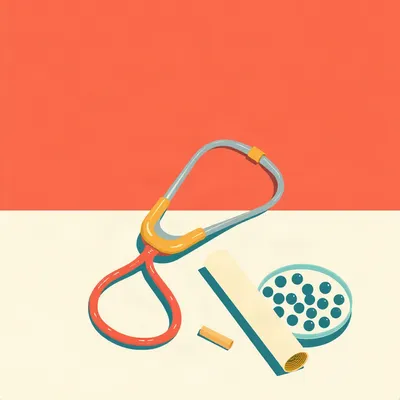
And the tool itself was a wooden cylinder about a foot long, an inch and a half in diameter, with a quarter-inch channel bored through it. Monaural — one ear. You pressed it to the chest and listened. It looks like a small flute, honestly.
Which means the name is wrong. Stethoscope means chest-looker. Stethos for chest, skopein for to look. It should have been stethophone — chest-listener.
That's the kind of thing that bothers you more than it bothers me.
It's a naming error that's survived two centuries. Of course it bothers me.
The binaural version — two earpieces, the thing we'd actually recognize today — doesn't show up until 1851. That's thirty-five years of doctors holding a wooden tube to one ear. And the binaural design wasn't one person's clean invention. There's a Cincinnati doctor named N.B. Marsh who gets credit in some accounts, an Irish doctor named Arthur Leared in others, and then a New York physician named George Cammann who refined it into the first commercially successful model.
And rubber enters the picture in 1853. Before that, the tubing was brass or wood or ivory. Once rubber becomes widely available, the whole design gets lighter and more flexible, and that's when it starts looking like the modern instrument.
There's an interesting detour here that connects to Daniel's situation. During the contagion panics — cholera, tuberculosis — stethoscopes got longer. Some were up to thirty-five centimeters, about thirteen and a half inches, specifically so the doctor could keep his face further from the patient's body. And there were shorter, smaller versions for children. So the pediatric stethoscope isn't a modern invention. Doctors in the nineteenth century were already sizing the instrument to the patient.
That's the detail Daniel would appreciate, watching someone auscultate a one-year-old. The positions on a toddler's chest aren't random. There's a whole geometry to it.
And that geometry was worked out by Laennec and his students. The standard positions — the four cardiac areas, the lung fields front and back, the bases where fluid pools — all of that comes from correlating where you hear what. A pediatric chest is smaller, so the landmarks compress, but the logic is identical.
The next big jump is the Littmann. That's the name most people actually know, even if they don't know why.
David Littmann was a Harvard cardiologist. In the early 1960s he patented a design that 3M bought, and the Littmann became the gold standard. The real innovation came in the late 1970s with the tunable diaphragm — one chest piece where light pressure gives you low-frequency sounds and firm pressure gives you high-frequency sounds. That's the thing doctors do when they seem to be pressing harder or softer. They're not just repositioning; they're changing the acoustic filter.
So the modern stethoscope is a two-hundred-year-old idea with a 1970s acoustic refinement. That's the whole physical evolution in one line. Paper tube, wooden cylinder, binaural rubber, tunable diaphragm.
And then the digital era starts in the late 1990s. A doctor named Richard Deslauriers developed a recording stethoscope with help from Bose engineers, specifically for noise-insulated tubing. That's the first time you could capture and store a heart sound as data rather than as a memory. And in 2015, the FDA cleared the Eko Core at about three hundred dollars, which transmits heart sounds to an iPhone app and can send them into an electronic medical record.
Three hundred dollars for a digital stethoscope in 2015. What does a Littmann cost these days?
A good Littmann Cardiology runs two hundred to two-fifty. The digital ones with amplification and recording run higher. But the point is, the price ceiling for a stethoscope has always been a few hundred dollars, and that's one of the reasons it's survived. A handheld ultrasound costs thousands. The Vscan was nearly eight thousand dollars in 2014.
That's the economic argument in one number. But the more interesting argument is diagnostic. What does the stethoscope actually tell you that an ultrasound doesn't?
This is where the debate gets real. The stethoscope is not just for hearts. It's for lungs — crackles, wheezes, diminished breath sounds. It's for bowels — the presence or absence of bowel sounds after surgery. It's for bruits — turbulent blood flow in arteries. A handheld ultrasound doesn't replace any of that. The ultrasound is better for structural heart disease, no question. But auscultation is a functional tool, not just an imaging tool.
And the numbers on auscultation are... not great, when you actually test them. The sensitivity of crackles for pneumonia is somewhere between nineteen and sixty-seven percent depending on the study. Specificity between thirty-six and ninety-six. That's a huge spread.
And inter-observer agreement is only about seventy-two percent. That's the dirty secret of auscultation — two competent doctors listening to the same chest will disagree about what they heard a quarter of the time. The kappa was point four one, which is moderate at best.
So the stethoscope is simultaneously indispensable and unreliable. That's the actual state of the tool.
And that's exactly why the AI version is the most interesting development in the field. The recent work isn't about replacing the doctor's ears. It's about making the ears better. There was a study published in February — three hundred fifty-seven patients over fifty, median age seventy — where an AI-enabled digital stethoscope was compared against a traditional stethoscope for detecting valvular heart disease. The AI version had a sensitivity of ninety-two point three percent. The traditional stethoscope was at forty-six point two percent.
It more than doubled the sensitivity. That's not a marginal improvement.
And valvular heart disease affects more than one in two adults over sixty-five. So this isn't a rare condition. We're talking about the majority of elderly patients, and the standard tool is missing more than half of the moderate-to-severe cases. The AI isn't just better — it's catching disease that would otherwise walk out the door undetected.
What's the catch?
Specificity. The AI had a minor reduction in specificity compared to the traditional stethoscope. It flags more true positives, but it also flags more false ones. So you get more early detection, and you also get more unnecessary echocardiograms and more anxious patients. That's the tension, and it's not going away.
The deep learning algorithm underneath these things was trained on over fifteen thousand heart sound recordings. Validated on over two thousand recordings from six hundred fifteen subjects. Sensitivity eighty-five point six, specificity eighty-four point four for murmurs. Average clinician accuracy was seventy-seven point nine percent. So the algorithm beats the average clinician, but not by an enormous margin.
And when you restrict to clearly audible adult murmurs, the algorithm hits ninety-seven point nine percent sensitivity. The gap is biggest where the signal is clearest. That makes sense — the algorithm is better at not getting tired, not getting distracted, not having a bad day.
The pediatric angle is even more relevant to Daniel's situation. There's an April preprint on automated detection of congenital heart disease from phonocardiograms in children — seven hundred fifty-one subjects, ninety-two percent accuracy, AUROC of ninety-six. And a Bangladesh study with nine hundred ninety children where non-physicians recorded usable heart sounds in eighty-seven point six percent of cases, most within five minutes.
That Bangladesh study is the one that should change how people think about this. You don't need a cardiologist to operate the device. You need someone who can place a stethoscope on four chest positions. The AI does the interpretation. In a country where echocardiography is scarce, that's a screening program that can actually run.
And Malawi — a hundred children hospitalized with pneumonia, median age twelve point six months. The AI interpreted lung sounds from digital stethoscope recordings. That's Ezra's age group. The tool that's being tested in low-resource pediatric wards is the same tool Daniel watched in a Jerusalem hospital.
The global health case is the strongest argument for the stethoscope's survival. People who say the stethoscope is dead are usually imagining a hospital with an ultrasound in every room and a cardiologist down the hall. Most of the world doesn't have that. The stethoscope costs a few hundred dollars, fits in a pocket, and now comes with an algorithm that outperforms the average clinician.
Let's talk about the "stethoscope is dead" side, because it's not a straw man. There's a Mount Sinai cardiologist named Jagat Narula who said it plainly in 2016: the stethoscope is dead and its time has gone. And there was a BMJ head-to-head in 2019 where the pro-ultrasound side argued that point-of-care ultrasound is a better diagnostic test than auscultation or chest radiography for acute respiratory failure.
And the counterargument from the other side was that the cost is hard to justify without evidence of improved outcomes. Which is the adult version of the argument. Ultrasound sees more, but does seeing more change what happens to the patient? That evidence is still thin.
The 2025 and 2026 literature has landed on a word: augmentation. Not replacement. The digital stethoscope aims to revitalize bedside medicine, not replace it. There's a quote from Rosalie McDonough at Eko Health — "technology is not taking over; use of this device requires doctors to use their own clinical judgement."
And here's the part that connects to what Daniel said about reassurance. The ESC study found that patients seemed more engaged when they could see and hear what the clinician was responding to. The AI stethoscope gave them a visual readout, and they could see the waveform, and that increased trust and engagement with follow-up treatment. Daniel's intuition — that there's something deeply reassuring about knowing the doctor is hearing something — now has evidence behind it.
That's the part of the prompt that stuck with me. He said as a patient you always wondered what the doctor was hearing. The digital stethoscope answers that question. It turns the private acoustic moment into a shared visual one.
And for parents, that's even more powerful. You're watching someone listen to your child's chest, and you're completely dependent on their interpretation. If the device shows you the waveform and the AI flags a possible murmur, you're not just trusting the doctor's ears. You're seeing the data.
There's a wearable angle too. A soft wearable stethoscope for continuous real-time auscultation was demonstrated in 2022 — a patch that listens continuously and runs automated diagnosis. And there's a foam pad with fourteen microphones that auscultates fourteen chest positions at once, though it took about twenty-eight minutes to do a full session.
Twenty-eight minutes is not a clinical tool. That's a research device. But the direction is clear — continuous monitoring, not spot checks. The stethoscope has always been a snapshot. You listen for thirty seconds and make a judgment. Continuous auscultation is a different data stream entirely.
The remote sensor question Daniel asked — will the stethoscope be replaced by some kind of remote sensor — the evidence points to no near-term replacement. But the stethoscope itself is becoming a remote sensor. The digital version records, transmits, stores. The physical exam is becoming a data capture event.
And that's the through-line of the whole two-hundred-year history. Laennec's insight was that body sounds carry diagnostic information. Every subsequent innovation has been about capturing that information more accurately, more reproducibly, more shareably. The paper tube was the first recording device. The AI stethoscope is just the latest one.
The tool has never been the point. The listening has always been the point.
The listening is still cheap, fast, and available everywhere. That's why it survives. The stethoscope is the only diagnostic instrument that works without electricity, without a screen, without a network connection. In a blackout, in a refugee camp, in a rural clinic with intermittent power, the stethoscope still works.
There's a phrase from a Dutch cardiologist, van der Wall, writing in 2016: after two hundred years it's time to celebrate the stethoscope — our most impressive necklace — and to provisionally postpone its cremation. That's the right tone. Celebrate it, keep using it, and don't be surprised when it turns out to have another century in it.
The "most impressive necklace" line is good. Every doctor wears it like jewelry. It's a status marker as much as a tool.
Which is part of why the "dead" argument never quite lands. You can't take away the thing that makes a doctor look like a doctor. The white coat went casual, the reflex hammer is a niche item, but the stethoscope around the neck is the universal uniform.
Now it's a uniform with a processor in it. The next generation of doctors will wear digital stethoscopes that feed into their phones, and the AI will be listening alongside them. The question isn't whether the stethoscope survives. It's whether the doctor's ear remains the primary interpreter, or whether the algorithm becomes the primary listener and the doctor becomes the validator.
That's the real shift, and it's subtle. Right now the AI is an assistive layer. The doctor listens, the AI suggests, the doctor decides. But if the AI consistently outperforms the human ear — which it already does for clearly audible murmurs — how long before the doctor's listening becomes the backup rather than the primary?
The Eko Health line is that technology is not taking over, and I think that's true for now. But the trajectory is the same as every other AI diagnostic story. The algorithm gets better, the human stays the same, and eventually the human's job is to interpret the algorithm's output in context. That's not a bad outcome. It's just different.
For the patient, the reassurance survives. If anything, it gets stronger. The doctor isn't just hearing something — the machine is hearing it too, and they agree. That's more reassuring, not less.
Daniel's prompt has a personal layer that I want to sit with for a second. He said he grew up with asthma, had chest infections, got steroids. He knows what it's like to be the kid on the table while someone listens to his chest. And now he's the parent on the other side. That's a very specific kind of full circle.
The stethoscope is the one instrument that's been there for all of it. The same tool that listened to his asthmatic lungs as a kid in Ireland is listening to his son's chest infection in Jerusalem. Two hundred years of design evolution, and the experience is functionally identical.
That continuity is part of the reassurance. The doctor isn't doing something new. They're doing the thing doctors have done since 1816, and they're doing it well. The stethoscope is a ritual object as much as a diagnostic tool.
The ritual is the part the AI can't replace. The cold disc on the chest, the instruction to breathe deeply, the small nod when the doctor hears something. That's a human moment. The algorithm can interpret the sound, but it can't do the ritual.
The ritual matters. Patients want to be examined, not just tested. The stethoscope is the examination. The ultrasound is the test. They're different experiences.
That's the answer to Daniel's third question, I think. The stethoscope won't be replaced by a remote sensor because the remote sensor doesn't do the ritual. It doesn't touch the patient. It doesn't create the moment of shared attention. What's happening instead is that the stethoscope is absorbing the remote sensor technology. The sensor is moving into the tube.
The tool becomes the sensor. It records, it transmits, it interprets. But it's still a tube with two earpieces and a chest piece. The form factor survives because the form factor is the ritual.
Let's talk about what the stethoscope can't do, because that's the honest counterpoint. It can't see structural abnormalities. It can't measure ejection fraction. It can't detect a small effusion. The ultrasound does all of that better. The stethoscope is a screening tool, not a diagnostic gold standard.
For pneumonia specifically, the crackles sign is unreliable. That nineteen to sixty-seven percent sensitivity range is a real problem. If you rely on auscultation alone, you'll miss pneumonias and you'll over-diagnose them. The stethoscope is a starting point, not an endpoint.
Which is why the AI augmentation matters so much. If the algorithm can push that sensitivity up — and the pediatric pneumonia work in Malawi suggests it can — then the stethoscope becomes a better screening tool without changing the form factor. The doctor still does the ritual. The algorithm improves the interpretation.
The Malawi study is small — a hundred children — but the direction is right. And the Bangladesh study with nine hundred ninety children shows the logistics work. You can train non-physicians to capture good recordings, and the AI does the rest. That's how you scale auscultation to places that have never had enough cardiologists.
The TB screening work is interesting too. Two hundred forty participants, sensitivity seventy-seven percent, specificity fifty percent. That's not a great test. But for TB screening in high-burden settings, a cheap stethoscope with AI might be better than no screening at all.
That's the pragmatic case. The stethoscope survives not because it's the best tool, but because it's the best tool that works everywhere. The ultrasound is better where it exists. The stethoscope exists everywhere.
Daniel asked about the history, and I want to make sure we've done justice to the pre-Laennec part. Listening to the body predates the stethoscope by millennia. The Ebers Papyrus from around 1500 BCE references listening to breath sounds. The Hindu Vedas from 1400 to 1200 BCE do too. Hippocrates wrote about it.
Laennec didn't invent auscultation. He invented mediated auscultation — listening through an instrument rather than directly. The word "mediate" is in the title of his treatise. De l'auscultation médiate. The mediation was the innovation.
The mediation solved a real acoustic problem. Direct ear-to-chest listening muffles the sounds because the ear doesn't form a good seal, and ambient noise leaks in. The tube creates a closed channel. That's the actual physics.
The modesty story is more charming, but the acoustic story is more true. And I think that's a better origin anyway. Laennec was solving a signal-to-noise problem, not a social convention. The stethoscope was born as an engineering solution.
Which makes it the oldest biomedical engineering device still in clinical use. Two hundred years of continuous service, with the basic principle unchanged.
The name is still wrong. Chest-looker. It's a chest-listener.
We're back to the name.
We never left the name. It's a two-hundred-year-old misnomer, and I find it funny that the most famous medical instrument in history is mislabeled.
The ultrasound is arguably more of a stethoscope than the stethoscope is. It actually looks at the chest.
Van der Wall made exactly that point. A handheld ultrasound is a stethoscope in the literal sense. The stethoscope is a stethophone. Language has been fighting this battle for two centuries and losing.
Let's bring it back to the hospital room for a minute. Daniel's watching doctors auscultate Ezra's chest. They're using a pediatric stethoscope, which is just a smaller diaphragm and shorter tubing. They're moving through the standard positions — upper lobes, middle, lower, front and back. They're listening for crackles, wheezes, diminished breath sounds. They're probably also listening to the heart to make sure there's no murmur that would change the picture.
They're doing it in about thirty seconds. That's the thing about auscultation — it's fast. The whole exam takes less than a minute, and it gives you a functional snapshot of the lungs and heart. No imaging modality is that fast.
For a chest infection in a one-year-old, the stethoscope is the right first tool. It tells you whether there's wheezing, whether the air entry is reduced, whether there's consolidation. The chest X-ray comes later if needed. The stethoscope comes first.
The positions matter. A pneumonia in the right lower lobe won't be heard at the left upper chest. The doctor moves the stethoscope because different pathologies live in different places. That's the geometry Laennec worked out, and it's still the geometry doctors use.
Daniel noticed the positions. That's the layperson's window into the expertise. The doctor isn't just moving the tube randomly. They're sampling a map.
The map is the same for a one-year-old as for a seventy-year-old. The anatomy is the same. The proportions are different, but the landmarks are identical. That's why pediatric auscultation is just auscultation with a smaller instrument.
The future question is the one Daniel actually asked, and I think we've circled it. The stethoscope will retain a central place. It will be digital, AI-augmented, and connected. But the form factor survives. The tube survives. The ritual survives.
The strongest evidence for survival is the global health deployment. The digital stethoscope is being tested in Malawi, Bangladesh, and TB screening programs precisely because it's cheap, portable, and now intelligent. That's not a tool that's dying. That's a tool that's finding new life.
The strongest evidence for transformation is the AI valve study. Ninety-two percent sensitivity versus forty-six. The algorithm is not a gimmick. It's a real diagnostic improvement, and it's available now.
The stethoscope of 2030 will be a digital device with onboard AI that interprets heart and lung sounds in real time, flags abnormalities, and transmits the recording to the electronic record. It will still cost a few hundred dollars. It will still fit in a pocket. It will still be the thing around the doctor's neck.
It will still be a chest-listener, even if the name says chest-looker.
You're never letting that go.
Two hundred years of misnaming. Someone should fix it.
Hilbert: The Littmann tunable diaphragm was the last time I actually trusted one of those things. I worked a summer stocking shelves in a medical supply warehouse in Bridgeport, and we had a whole pallet of Littmann Cardiology Threes come in. I opened one to check the seal, and the diaphragm had two frequencies depending on how hard you pressed. Light pressure, low frequency. Firm pressure, high frequency. That's the whole trick, and most doctors never explain it to the patient.
That's the part that's invisible to the person on the table. The doctor looks like they're just repositioning, but they're actually changing the acoustic filter.
Hilbert: I sold a used one to a nursing student in New Haven a few years later. She asked me if it was the model that could hear a murmur. I told her it could hear whatever the heart was doing, but the murmur part was up to her.
That's the human factor the AI is now competing with. The algorithm doesn't need to learn what a murmur sounds like. It's heard fifteen thousand of them.
Hilbert: The algorithm doesn't get tired at three in the morning or distracted by a monitor alarm. I'm not saying it's better. I'm saying it's consistent.
The consistency is the thing. The inter-observer agreement for crackles is seventy-two percent. Two doctors disagree a quarter of the time. The algorithm disagrees with itself zero percent of the time.
Hilbert: I had a doctor in Bridgeport who used to say the stethoscope was the only instrument in medicine that made him feel like a doctor. Everything else was a machine. The stethoscope was his ear, extended. I thought about that when I read about the AI version. The machine is now inside the ear.
That's the tension. The stethoscope was the last tool that was purely the doctor's own perception. Now the algorithm is listening alongside.
Hilbert: The kid in the hospital room doesn't care about any of this. He just wants the cold disc off his chest. But the parent watching, the one who wrote the prompt — he's the one who's going to remember the sound of the doctor saying "I hear something." That's the reassurance. The machine doesn't change that.
The ESC study found exactly that. Patients were more engaged when they could see the waveform. The reassurance isn't just the doctor's word anymore. It's the data.
Hilbert: I don't have a waveform. I have a Littmann in a drawer that I haven't used since the warehouse. But I understand why the doctor still reaches for it. It's the one tool that makes the patient feel examined.
The ritual.
Hilbert: The ritual.
The one thing I'll take from this is that the stethoscope's survival isn't about the tool. It's about the moment. The cold disc, the instruction to breathe, the shared silence while someone listens. That moment has been the same since 1816, and no imaging technology has ever reproduced it. What's changing is what happens inside the tube — the AI is joining the doctor's ear, not replacing it. The ritual survives, and the listening gets better.
The listening getting better is the part that matters. Ninety-two percent sensitivity for valve disease versus forty-six. That's not incremental. That's the difference between catching a treatable condition early and missing it entirely. The stethoscope isn't dying. It's getting its first real upgrade in two hundred years.
Daniel, if you're listening from the hospital room, we're all thinking about Ezra. The doctors with their stethoscopes are doing exactly what Laennec would have done — listening carefully, moving through the positions, hearing what the body is saying. The only difference is that now the machine can hear it too.
This has been My Weird Prompts.
Our producer is Hilbert Flumingtop, who somehow always has a Littmann in a drawer. If you enjoyed this episode, leave us a review wherever you get your podcasts, or visit my weird prompts dot com for the full archive.
We'll be back soon.