Daniel sent us this one — he's been watching how ambulance bays restock, and it's got him thinking about the quick-reach nightmare we all know: you need a screwdriver, you know you own one, but it's buried somewhere in a drawer or a toolbox or possibly another dimension entirely. He spotted a vending machine system in a hospital ambulance bay where paramedics swipe an ID to self-service replenish things like needles and supplies, and he wants to know what other high-stakes environments use similar self-service restock mechanisms, and what design principles we can steal for a home workbench.

This is exactly the kind of question that gets me going, because most people walk past those machines every day and never think about the logic behind them. They just see a vending machine. But what's actually happening there is a complete inventory philosophy compressed into a box the size of a refrigerator.
A philosophy that dispenses needles.
The system Daniel's describing — it's almost certainly a variant of what hospitals call an automated dispensing cabinet, or ADC. The dominant player is the Pyxis MedStation system from Cardinal Health, introduced in the early nineties and now in over eighty percent of US hospitals. The core idea is deceptively simple: you swipe your ID, the drawer unlocks, you take what you need, the system logs who took what and when, and when stock drops below a certain threshold it generates a replenishment order. It's not a storage cabinet. It's an inventory enforcement mechanism.
The real innovation isn't the swipe card — it's that the machine refuses to let the system degrade. It tattles on you if you don't restock.
And that's the piece that most home organization systems completely miss. We have bins and labels and pegboards, but no automatic trigger that says "this is empty, fix it." The ambulance bay vending machine Daniel saw — those are typically smaller units, purpose-built for EMS. Enovate Medical makes one called the Supply Vault that holds about twenty to forty SKUs and runs somewhere in the eight to twelve thousand dollar range per unit. It's a slimmed-down version of the hospital ADC, designed specifically for that quick-turnaround paramedic workflow.
Twenty to forty SKUs. That's a deliberate constraint, isn't it? That's not "we couldn't fit more." That's "we chose not to.
And that's the first design principle worth stealing. The ambulance bay machine doesn't try to stock everything a paramedic might ever need. It stocks the twenty to forty items they need most urgently, most frequently, and most predictably — the things where running out has immediate consequences. A missing needle means a delayed IV start. A missing airway adjunct means a compromised airway. The machine says: these are the non-negotiables. Everything else lives somewhere else.
Already we've got a principle that runs completely counter to how most people set up a workbench. The instinct is to put everything within reach. Every screwdriver you own, every size of every bit, the specialized pliers you used once in 2019.
That instinct is what creates the failure mode. When everything is in the quick-reach zone, nothing is. Your brain still has to search. The visual field is cluttered, the retrieval cost goes up, and you end up spending thirty seconds finding the Phillips head you need among fifteen options. That's the "cost of a touch" problem — every time you handle an item to find what you actually need, you're burning cognitive calories and clock time.
Thirty seconds a day doesn't sound catastrophic, but if you're reaching for a screwdriver or scissors or tape three or four times a day, that's a couple of minutes. Over a year, that's hours of your life spent just... sorting through your own stuff.
There's an actual number from warehouse logistics — the cost of a single touch in a distribution center is estimated at somewhere between fifty cents and a dollar per item handled. That's labor, time, and opportunity cost. For home use, the dollar amount is negligible, but the cognitive cost is the real drain. Every unnecessary touch is a micro-interruption to your train of thought. You're in the middle of fixing something, you stop to hunt for the tool, and by the time you find it you've lost your mental place.
The junk drawer is the perfect counterexample here. It's the most accessible storage in most kitchens — one pull, everything's right there. But the organization is zero. So the accessibility doesn't help; it just means you can see all the things you don't need while you hunt for the one thing you do.
That's the tension the ambulance bay system resolves. High accessibility plus high organization, but only for a ruthlessly curated set of items. The paramedic isn't browsing. They walk up knowing exactly what they need, swipe, grab, and go. The machine's job is to make sure the thing is there, visible, and accounted for.
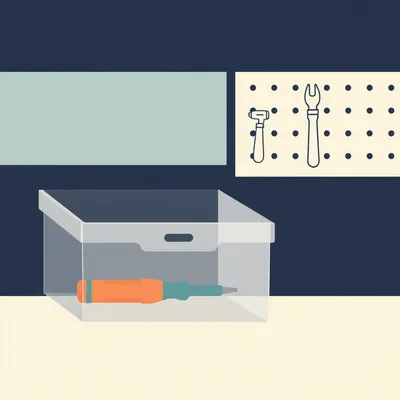
Let's talk about the visibility piece, because that's the second design principle that jumped out at me. Those ambulance bay machines — every model I've seen has transparent drawers or windows. You can see stock levels without opening anything.
That's standard across essentially all ADC systems. The Pyxis cabinets use clear drawer fronts and internal dividers with labels. The idea is that a visual stock check should take less than a second. You don't open a drawer to discover you're out of something — you see it from three feet away while you're walking toward the machine. That's not a convenience feature. It's a workflow design decision that eliminates an entire category of failure: the "open the drawer, realize it's empty, now what" moment.
Which in a home workshop translates to: you open the drawer, the screwdriver isn't there, you check another drawer, it's not there either, you eventually find it on the kitchen counter where you left it three days ago, and now you're annoyed and late.
The visual check principle is absurdly cheap to implement at home. Pegboard outlines — literally trace the tool with a marker on the pegboard so you can see at a glance that the hammer-shaped empty space means the hammer isn't home. It's the same logic as the ambulance machine, just without the polycarbonate and the twelve-thousand-dollar price tag.
The traced outline on a pegboard is the poor man's transparent drawer front.
There's a reason workshops have been doing it for decades. The silhouette is an instant visual inventory. You don't have to read a label, you don't have to remember what goes where — the missing shape tells you everything.
We've got curated SKU count, visual stock check. What's the third principle?
The replenishment trigger. In the ambulance bay system, when a drawer hits a low threshold, a restock order is generated automatically. In some systems, the paramedic also knows to report it — there's a protocol. The point is that replenishment isn't something you remember to do. It's something the system remembers for you.
That's the part where most home systems collapse. Even if you've got a beautifully organized pegboard, eventually the screwdriver breaks or goes missing, and the empty peg just... Because there's no trigger.
This is where the concept of "par level" comes in, which is straight out of hospital supply chain management. Par level is the minimum quantity of an item that must always be on hand. For a hospital floor, the par level for a specific syringe might be ten — if the count drops below ten, a restock is triggered. For a home workbench, the par level for a Phillips number two screwdriver is one. If it's not there, that's below par. The question is: what triggers the restock?
The trigger can be as simple as a visual cue. If the peg is empty, that's the trigger. Write it on a shopping list magnet on the fridge. Or better yet, have a backup in deep storage — we'll get to that.
That two-bin idea is essentially the Kanban system from Toyota manufacturing. You have two bins for each item. When the first bin is empty, you start using the second bin, and the empty bin itself becomes the signal to reorder. No inventory audit, no checklist, no remembering. The empty bin is the trigger. The ambulance vending machine is a high-tech Kanban — when the drawer hits the threshold, the empty space generates the order.
Which is elegant because it removes human memory from the equation entirely. The system doesn't rely on anyone being diligent. The empty bin does the remembering.
That's the meta-principle behind all of these systems. They don't trust people to be organized. They design the environment so that organization is the path of least resistance. The paramedic doesn't have to be a logistics expert. They just swipe, grab, and the system handles the rest.
Design for the tired, distracted, post-call version of yourself. Which is basically the paramedic version of me at ten PM trying to find packing tape.
So let's map these four principles: curated SKU count, visual stock check, replenishment trigger, and access tracking. The access tracking — the ID swipe — is the one piece that's hardest to replicate at home, but it's also the least essential for a personal workshop. You're not worried about theft or regulatory compliance. You're worried about stuff not being where you expect it.
Though there's an argument that the swipe card serves a psychological function too. It makes the transaction feel official. You're not just grabbing — you're checking out. There's a tiny moment of accountability.
That's an interesting point. The swipe creates a record, and the knowledge that there's a record changes behavior. Even if nobody ever reviews the log, the fact that the log exists makes people slightly more careful. It's the panopticon of inventory management.
The panopticon of Phillips head screws.
I'm not sure that's a book that would sell, but the principle holds. Now, this isn't unique to healthcare. Daniel asked about other contexts, and there are some fascinating parallels.
Let's hear them.
Aircraft galley carts are a beautiful example. Flight attendants are working in a space roughly the size of a bathroom, serving hundreds of people, and they need to access coffee pods, meal trays, medical kits, and oxygen bottles without wasting a single motion. The galley cart system solves this with pre-packed standardized drawers that are swapped out between flights. Every cart has the same layout. Coffee pods are always in the same position. Any crew member can walk onto any aircraft and know exactly where everything is without opening a single drawer.
Standardized layout across the entire fleet. That's the piece that makes it work for rotating crews.
And the home equivalent is: if you live with other people, everyone should know where the scissors live. Not "in the drawer somewhere." The exact spot. The galley cart principle says the spot should be so obvious and so consistent that nobody ever has to ask.
We had an episode that touched on this — the flight attendant galley cart system. The thing that stuck with me was that the cart isn't organized by category, it's organized by retrieval sequence. The stuff you need first is closest to where you stand. It's choreographed.
That's a crucial distinction. Category-based organization — all the screwdrivers together, all the pliers together — feels logical when you're setting up. But retrieval-sequence organization is what actually works in practice. The ambulance machine does this implicitly: the highest-frequency items go in the most accessible drawers. The paramedic doesn't have to think about it. Their hand just goes to the right place.
The question for a home workbench isn't "what goes with what," it's "what do I reach for most.
The answer to that question is almost always surprising. If you actually track your usage for a week, you'll probably find that eighty percent of your reaches are for maybe eight items. Two screwdrivers, a pair of scissors, tape, a utility knife, a tape measure, a pen, and whatever your personal equivalent of Ziploc bags is.
For me it's leaves. But I don't think those go on a pegboard.
They probably don't. But the principle holds. Speaking of other high-stakes environments — fire station turnout gear lockers are another great case study. Each firefighter has a personal locker with pre-set par levels for gloves, hoods, and SCBA components. After every call, the locker is checked and restocked. The key insight there is that the check happens immediately after use, not "sometime later." The system bakes restock into the workflow.
That's the difference between "I'll refill this later" and "refilling is part of the task." The firefighter doesn't go home and think "oh, I should check my gloves." It's built into the post-call procedure.
For a home workshop, that translates to: put it back when you're done. Sounds obvious, but the reason it fails is that "when you're done" is vague. The fire station system makes it specific — the check happens before you leave the bay. The home version might be: before you leave the workshop, scan the pegboard. Any empty outlines? Fix it now.
The visual scan takes five seconds. But it only works if the visual system is in place — if the empty peg is screaming at you.
There's one more industrial parallel worth mentioning, and it's the retail backroom "speed shelf" concept. In high-volume retail, the most frequently sold items are stored at waist height in clear bins near the sales floor, and they're restocked from pallets in the back only during off-hours. The speed shelf is essentially a quick-reach zone that buffers between the sales floor and deep storage. The items on the speed shelf are chosen purely by velocity — how fast they move.
Velocity-based organization. Not "what is this item" but "how often do I need it.
That's the organizing principle that almost nobody uses at home. We organize by category because it feels tidy. But tidy isn't the same as functional. A pegboard organized by velocity — the most-used tools at center, less-used at the edges — is more functional than a perfectly categorized drawer that requires a search every time.
If we're synthesizing all of this into something someone can actually build, what does the home quick-reach workbench look like?
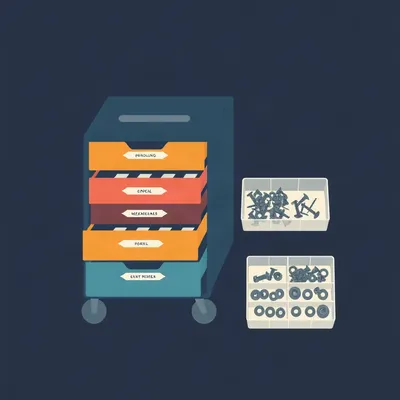
I think it's a three-zone system. Zone one is the quick-reach zone — this is your ambulance bay. It holds the ten to fifteen items you use multiple times a week. Wall-mounted pegboard or magnetic strip, within arm's reach of where you actually work. Every item has a fixed, visible home. Clear bins for small consumables like Ziploc bags, batteries, command strips. The par level for each item is one — if it's not there, there's a backup in zone two.
Zone two being the daily access drawer.
Zone two is a single drawer with dividers, holding the items you use regularly but not constantly — pliers, measuring tape, a few less-common screwdriver sizes, maybe a small level. This drawer gets opened maybe once a day, not once an hour. The dividers mean you can still see everything at a glance when you do open it.
Zone three is deep storage. Power tools, spare parts, seasonal items, the specialized tools you use twice a year. This can be a cabinet, a closet, a rolling cart under the desk. The key is that zone three is allowed to be less organized because you access it so rarely. You can stack boxes there. You can have a bin of miscellaneous cables. It doesn't matter, because it's not in your way.
The replenishment logic flows from zone three to zone two to zone one. When the screwdriver in zone one breaks or goes missing, you pull the backup from zone three, put it in zone one, and the empty spot in zone three goes on your shopping list. You're never hunting for a replacement because the system already has one staged.
It's a buffer. Zone three is the warehouse, zone two is the backroom speed shelf, zone one is the ambulance vending machine.
And the whole thing can fit in a surprisingly small footprint. A twenty-four by eighteen inch pegboard can hold eight to ten tools easily. A single clear bin underneath it handles the consumables. A small drawer unit or a rolling cart handles zones two and three. You don't need a garage. You can do this in an apartment.
There's a case study I wanted to mention — someone I know redesigned their apartment workbench around exactly this logic. Eight tools on a pegboard: two screwdrivers, a hammer, tape measure, scissors, box cutter, pliers, a small level. One clear bin for Ziploc bags, batteries, and command strips. Everything else lives in a rolling cart under the desk. The whole quick-reach system occupies about two square feet of wall space, and the time saved per retrieval is maybe ten seconds, but the cognitive relief is the real win. You never wonder where the scissors are.
That cognitive relief compounds. It's not just the ten seconds saved. It's the absence of the tiny frustration spike that comes with every search. Over a day, over a week, those micro-frustrations add up to a background hum of low-grade annoyance that you stop noticing because it's always there. Removing it feels like...
The ambient stress of disorganization. It's like living with a smoke detector that chirps every few minutes. You tune it out, but it's still costing you.
The fix is so cheap. A twenty-dollar pegboard, some clear bins, an hour of setup. The expensive part is the design thinking — deciding what actually belongs in zone one, tracking your usage honestly, setting up the visual triggers.
Let's talk about the honest tracking piece, because that's where most people go wrong. They set up a pegboard based on what they think they use most, not what they actually use.
The one-week audit. For seven days, every time you reach for a tool or a supply, make a tally mark. At the end of the week, anything with more than two tallies goes in zone one. Anything with one tally goes in zone two. Anything with zero tallies goes in zone three. It's brutally empirical, and it will almost certainly surprise you.
I did something like this a while back and discovered that my most-reached-for item was a pair of scissors that I didn't even think of as a "tool." It was just always in my hand. It wasn't on my mental list of workshop items at all.
Scissors are the stealth MVP of every workspace. They're never on the tool list, and they're always in demand. That's exactly why the audit matters. Your mental model of what you use is shaped by what feels important, not by what's actually frequent. The power drill feels important. The scissors are frequent.
The audit is step one. Step two is designating the zones. Step three is implementing the visual par level system.
On the visual par system, I want to emphasize something. The traced outline on a pegboard is a genuinely brilliant piece of low-tech design. It's a binary indicator — the tool is either there or it isn't. There's no ambiguity. You don't have to remember what goes on that peg. The empty outline is the signal. It's the same principle as the transparent drawer on the ambulance machine, but it costs nothing.
Binary indicators are underrated in home organization. We tend to over-complicate things with labels and categories and systems. But "is there a hammer-shaped hole on this board" is a question your brain answers in milliseconds.
It works for consumables too. A clear bin with a piece of colored tape at the halfway mark — when you can see the bottom of the bin above the tape line, it's time to restock. That's a par level indicator. No counting, no list, just a glance.
The tape line is your Kanban card.
And this connects to something I think is the real insight from the ambulance bay system. The vending machine isn't impressive because of the technology. It's impressive because of the design logic. The swipe card and the computerized tracking are just the implementation layer. The principles — curated selection, visual stock check, automatic replenishment trigger, standardized layout — those can be implemented with pegboard and clear bins and a Sharpie.
The twelve-thousand-dollar machine and the twenty-dollar pegboard are running the same software, just on different hardware.
That's the line of the episode right there.
I've been saving it up.
It's true. The software is the logic. The hardware is just how you instantiate it. A hospital needs the audit trail and the security and the regulatory compliance, so they pay for the machine. A home workshop doesn't need any of that, but it benefits enormously from the same underlying logic.
Let's get practical for a minute. If someone's listening and they want to do this, what's the weekend plan?
Day one: audit. Carry a notepad or use your phone, tally every tool and supply you reach for. Don't editorialize.
Day two morning: sort the tally. Top ten to fifteen items go in zone one. Everything with at least one tally goes in zone two. Everything else goes in zone three.
Day two afternoon: install zone one. Pegboard on the wall, magnetic strip, whatever works for your space. Trace the outlines. Set up the clear bins with tape-line par levels. Put the items in their homes.
Then the ongoing discipline: before you leave the workspace, scan the board. Bin below the tape line? Add it to the shopping list.
The shopping list itself should be as low-friction as possible. A magnet on the fridge, a shared note on your phone, whatever you'll actually use. The system fails if the trigger fires but the restock never happens.
The shopping list is the replenishment module of the software. If it's not running, the whole system degrades.
Degradation is the natural state of any organizational system. Entropy always wins in the long run. The question is whether your system has the resilience to bounce back. The ambulance bay machine has resilience built in — the automatic reorder, the low-stock alert. The home version needs the same. The visual trigger plus a shopping list habit is about as close as you can get without installing an RFID system.
Which, by the way, is where this is probably heading. Smart home tech is getting cheap enough that a simple RFID-based tool tracker isn't science fiction anymore. Tag each tool, a reader on the pegboard logs when something is removed and not returned, and your phone gets a notification. It's the ambulance machine for the home, minus the twelve grand.
There are actually some early products in this space — tool tracking systems for construction sites that use Bluetooth or RFID to monitor inventory. They're still expensive and aimed at commercial users, but the trajectory is clear. Give it five years and there'll be a consumer version that costs less than a nice toolbox.
The panopticon of Phillips head screws, coming to a workshop near you.
I still don't think that book sells. But the technology is real. And honestly, even without the tech, the principles we've been discussing are enough to transform a workspace. The key is that you're not trying to organize everything. You're organizing the high-frequency slice and letting the rest be messy.
Permission to let zone three be a disaster is maybe the most liberating part of this whole framework.
It really is. The pressure to have a perfectly organized workshop is what stops people from having a functional one. If you accept that deep storage can be chaotic as long as zone one is pristine, you've just eliminated ninety percent of the psychological barrier.
The ambulance bay doesn't try to organize the whole hospital supply chain. It handles twenty to forty SKUs. The rest of the hospital's inventory lives in central supply, which is a completely different system with different rules.
Central supply is allowed to be a warehouse. Forklifts, pallet racks, boxes stacked to the ceiling. Nobody expects it to be as tight as the ADC on the nursing floor. Different zones, different standards.
I think that's the part that most home organization advice misses. It treats the entire home like it should be the nursing floor. Everything visible, everything labeled, everything perfect. But that's exhausting and unnecessary. You just need the nursing floor where it matters.
The quick-reach zone is your nursing floor. The garage shelving is your central supply. Let central supply be central supply.
To circle back to the original question — Daniel asked about self-service restock mechanisms in high-stakes environments beyond ambulance bays, and what we can learn from them. We've got healthcare ADCs, aircraft galley carts, fire station turnout lockers, retail speed shelves, and the Toyota Kanban system. All of them converge on the same principles: limit the SKUs, make stock levels visible, automate the replenishment trigger, and separate high-frequency from low-frequency storage.
The home implementation is shockingly cheap. A pegboard, clear bins, a Sharpie, and a week of honest usage tracking. The expensive part isn't the hardware. It's the discipline to do the audit and set up the zones correctly.
The discipline and the willingness to admit that you don't need fifteen screwdrivers within arm's reach. You need two.
The rest can live in zone three, where they will wait patiently for the one time a year you need a Torx T-15.
When that day comes, you'll know exactly where it isn't — which is almost as good as knowing where it is.
Progress, not perfection.
Alright, before we wrap up, we should probably address the question of what other environments might have these systems that we haven't thought of. Submarine galleys come to mind — constrained space, critical supplies, rotating crews. Space station tool lockers are the ultimate expression of this — every gram of mass is accounted for, every tool has a specific home, and the cost of losing something is astronomical in every sense.
Film set tool carts are another one. A grip truck is essentially a mobile quick-reach system for a rotating crew of technicians who need to grab and go under time pressure. The layout is standardized across the industry so a grip can walk onto any set and find the C-47s — that's clothespins to civilians — in the same drawer every time.
Of course there are.
And they're always in the same place.
The principle scales from a paramedic grabbing a needle to a grip grabbing a clothespin to you grabbing a screwdriver. Same logic, same benefits, wildly different price tags.
That's the beauty of it. The design thinking is free. The implementation can cost whatever you want it to cost.
Alright, let's land this. Three things you can do this weekend. One: audit your quick-reach items for a full week. Actually track what you use. Two: set up a visual par level system — pegboard outlines, clear bins with tape lines, whatever makes empty visible. Three: separate your zones. Quick-reach, daily access, deep storage. Let zone three be messy. Your only job is to keep zone one pristine.
If you've built something like this — if you've designed a quick-reach system for your workshop or apartment — send us a photo or a description. We might feature it in a future episode. We're curious what people come up with.
Especially the weird ones. The ambulance bay vending machine of the soul.
not a category I was expecting, but I'm here for it.
Now: Hilbert's daily fun fact.

Platypuses use electrolocation to hunt underwater, detecting the tiny electrical fields generated by the muscle contractions of their prey. A single platypus can process up to forty thousand electrical signals per second through specialized receptors in its bill, making it one of the most electrically sensitive animals on Earth.
Forty thousand signals a second. That's a lot of data for a creature that also lays eggs and produces venom.
The platypus is just a collection of features that don't belong together, and I respect that.
Nature's junk drawer.
Somehow it works. This has been My Weird Prompts. Thanks to our producer Hilbert Flumingtop for the fact, and thanks to everyone listening. If you enjoyed this episode, leave us a review wherever you get your podcasts — it helps. We'll be back soon with more weird prompts and the conversations they spark.
Until then, keep your zone one pristine and your zone three as chaotic as you need it to be.