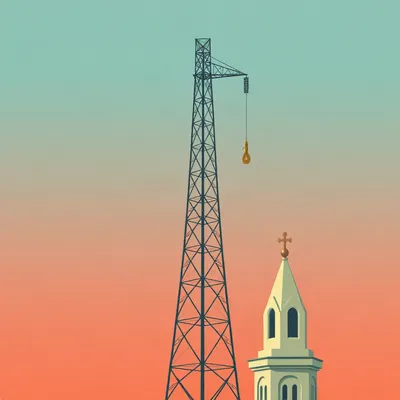
Daniel's been thinking about approach lighting — the massive light arrays that stretch out from runways and guide pilots home in bad weather. It started for him back in high school, plane spotting at Cork Airport with a friend. They'd camp out in this strange uninhabited house just outside the perimeter fence — a couple of horses grazing in the backyard, and right there, towering over everything, the approach lights. He says most people have never stood beneath one. If you have, you know — they're enormous. High-powered, redundant power systems, visible for miles through fog and rain. They extend hundreds of meters beyond the runway threshold. And then there are airports like JFK, where the runway just... ends at the ocean, and they've had to build literal jetties out into the water to hold the lights. Daniel wants to know who builds these things, who maintains them, what they cost, and how we got here.

The rotating beacon is a good place to start — because it's still up there. Every air traffic control tower still has one, and most people assume it's decorative. It's not. It's a direct descendant of the first thing that made night flying possible at all.
The beacon came first.
The earliest attempts at night aviation — we're talking the nineteen twenties — pilots were navigating by city lights, by bonfires, by hope. The first rotating beacons were adapted from maritime lighthouses. The Army Air Corps installed a rotating beacon system along the transcontinental airmail route in the mid nineteen twenties, and suddenly you could fly at night and actually know where you were going. They were spaced about ten miles apart, each one flashing a Morse code identifier so pilots could confirm their position.
So you'd see a sequence of flashes and know which beacon you were looking at.
You'd see the flash pattern and cross-reference it with your chart. By the nineteen thirties, there were more than fifteen hundred of these beacons across the United States. And they're still in use. The technology hasn't changed much — a high-intensity lamp with a rotating parabolic reflector — but they're now mounted on top of control towers rather than on standalone towers in fields.
And the beacon is what got us thinking about lighting the approach path specifically.
Right. The beacon tells you where the airport is. But knowing where the airport is and being able to land at it in the dark are two completely different problems. The first runway lights were basically car headlights. Literally. Airports would line up automobile headlights along the runway edges. The real breakthrough came after World War Two, when the military had poured enormous resources into instrument landing research and the technology started filtering into civilian aviation.
So let's pin down what we're actually talking about when we say approach lighting. I think most people picture runway edge lights and assume that's the whole story.
Approach lighting is the system that extends outward from the runway threshold along the extended centerline. For a major international airport with precision approaches, we're talking about a light array that stretches nine hundred meters, about three thousand feet, beyond the threshold. Its whole job is to give the pilot a visual reference during the transition from instrument flying to visual landing.
The most critical few seconds of any flight.
The most critical few seconds, and also the moment when you're lowest and slowest and have the fewest options. The pilot is flying the instrument landing system — the ILS gives them vertical and horizontal guidance — but at some point they have to look up and actually see the runway environment. The approach lights bridge that gap. They're the first thing you see, and their configuration tells you instantly where you are relative to the centerline.
And if you don't see them by a certain altitude, you're going around.
Every precision approach has a decision height — if you haven't acquired the required visual references by that altitude, you execute the missed approach. The approach lighting system is one of those required visual references. So if the lights fail while you're on final, that's a missed approach. Which is why the redundancy matters so much.
So what's the actual configuration? What am I looking at if I'm in the cockpit?
The standard at major US airports is something called ALSF-2 — Approach Lighting System with Sequenced Flashing Lights, configuration two. Imagine a long line of high-intensity white lights running straight down the extended centerline. Then, at regular intervals, you've got crossbars — horizontal rows of lights that give you roll guidance. The crossbars get wider as you get closer to the runway, which creates a perspective effect that helps the pilot judge their alignment.
And the sequenced flashing lights?
Those are sometimes called the "rabbit" — a series of bright white strobe-like lights that fire in sequence, rolling toward the runway threshold at about two flashes per second. It looks like a ball of light traveling down the approach path. It's incredibly effective at drawing your attention to the runway, especially in low visibility. The human visual system is wired to notice motion. In fog or rain, a static light can get lost in the noise, but a sequenced flash cuts through. The ALSF-2 also includes red terminating bars at the threshold and a decision bar at the one-thousand-foot point. The whole thing is designed to give the pilot an unambiguous visual picture in the few seconds they have to make the landing decision.
And the positioning tolerances on these things...
Inches. The FAA specifies that approach lights must be positioned within plus or minus one foot of their surveyed locations, and the tolerance gets tighter the closer you get to the runway. The centerline lights have to be within six inches of the extended centerline. If they're off, the visual picture is distorted, and a distorted visual picture at two hundred feet in fog is not where you want to be.
So how do you actually build something with that kind of precision, in a field, in the mud, potentially in water?
That's where the engineering gets interesting — and expensive. But before we get to construction, let me finish the technical picture. A typical ALSF-2 approach light produces something on the order of twenty thousand candela in steady-burning mode. The flashing lights can peak much higher. And they have to be adjustable. Pilots can request intensity settings — typically five steps — because a light that's perfect for thick fog is blinding on a clear night. It's done through the radio. The pilot clicks the microphone a certain number of times on the approach frequency, and the system steps the intensity up or down. It's called pilot-controlled lighting. Simple, reliable, no extra equipment needed in the cockpit.
That's elegant.
And the power requirements are substantial. An ALSF-2 system can draw fifty to seventy-five kilowatts. You've got a primary power feed, a backup feed from a different source, and in many cases, a diesel generator on site. The FAA requires that if the primary power fails, the backup must be online within one second for the highest-category approaches. One second. Because if you're thirty seconds from touchdown and the lights go dark, one second already feels like an eternity.
And the system has to know it failed.
Constant monitoring. Every circuit is monitored for current draw. If a lamp burns out, the system logs it. If a whole segment goes dark, alarms go off in the control tower. The system also monitors intensity output — if the lights are dimming because of a voltage drop, it flags that too. This is not a set of light bulbs on a switch. It's an engineered system with fault detection, redundant power paths, and fail-safe modes.
So let's go back to the history. You mentioned World War Two. What actually happened in that transition from beacons and car headlights to the ALSF-2?
The war accelerated everything. The Navy and Army Air Forces needed to land aircraft at night and in bad weather, on carriers and on improvised airfields. They developed the first standardized approach lighting configurations — the Navy had a system with a centerline and crossbars that looked a lot like what we use today. After the war, the Civil Aeronautics Administration, the predecessor to the FAA, started standardizing approach lighting for civilian airports. The first major system was the Standard Approach Lighting System, or SALS, in the nineteen fifties. Then came the Medium Intensity Approach Lighting System for smaller airports. And then the ALSF-1 and ALSF-2 for the big precision approaches.
And the international standards came through ICAO.
Right. ICAO set the global standards so a pilot flying into Tokyo or Frankfurt or Cork sees essentially the same visual picture they'd see at JFK. The configurations differ slightly — Europe tends to use a system called Calvert, which has a different crossbar layout — but the principle is identical. Centerline, crossbars, sequenced flashing lights, threshold identification.
So who actually builds these things? Daniel's question — who installs them, who maintains them?
It's a specialized industry. The FAA sets the standards and specifications — the Advisory Circulars that define every dimension, every photometric requirement, every electrical specification. But the actual installation is done by a handful of specialized airfield lighting contractors — companies like ADB Safegate, atg airports, Airfield Lighting Systems. They design the specific installation for each runway, manufacture or source the light fixtures, and deploy crews to build it.
And the cost?
A full ALSF-2 installation at a major airport runs into the millions. A single high-intensity approach light fixture can cost several thousand dollars. Then you've got the towers, the concrete foundations, the power cables, the backup generators, the control systems, the monitoring equipment. And that's before you deal with the site. If you're building in an open field, it's expensive. If you're building in water...
Which brings us to JFK.
JFK's Runway Thirteen Left / Thirty-One Right. The approach end for Runway Thirteen Left is water. There's no land to put the lights on. So the approach lighting system is built on a series of jetties and piers — elevated structures on piles driven into the bay floor, extending nine hundred meters out over the water.
And this is the Canarsie approach.
One of the most famous visual approaches in the world. You're flying in over Jamaica Bay, the Manhattan skyline off to your left, following this string of lights on jetties leading you straight to the runway. It's beautiful. But from an engineering standpoint, it's a nightmare.
Salt water, storms, corrosion.
Salt water is brutal on everything. The steel piles have to be protected with sacrificial anodes, specialized coatings, and regular inspection. The electrical systems have to be sealed against moisture and salt spray. And these lights have to work in the worst possible conditions — the exact moment when a nor'easter is blowing through and visibility is near zero is also the moment when the system is under maximum physical stress.
And the maintenance crews have to go out there.
By boat, or by walking the jetties if they're accessible. In winter. In the dark. To change a lamp or troubleshoot a circuit. The inspection cycles are rigorous — daily visual checks, monthly detailed inspections, annual certification tests. Every lamp has a rated life, and they're replaced on a schedule before they burn out. You don't wait for a failure.
What's the actual lamp life?
Traditional incandescent approach lamps have a rated life of about one thousand to fifteen hundred hours. At a busy airport, you might be replacing lamps every few months. The newer LED systems change that equation entirely — rated lives of fifty thousand hours or more, lower power consumption, better reliability. The FAA has been gradually certifying LED approach lighting systems, and many airports are transitioning.
So the JFK jetties probably got LEDs by now.
I believe they've been upgraded, yes. But the structural challenge remains. The piles are driven deep into the bay floor — fifty to a hundred feet to reach stable substrate. Each light platform is essentially a small marine structure, with its own electrical feed, its own lightning protection, and its own access ladder for maintenance crews.
And JFK isn't the only one.
Not by a long shot. San Diego International — Runway Twenty-Seven. The approach lights extend into San Diego Bay on piers. San Francisco International has approach lights on fill extending into the bay. LaGuardia has approach lights over water. And then you've got airports in mountainous terrain where the approach lights have to be built on towers of varying heights to follow the terrain slope while maintaining the correct visual plane.
That's the thing Daniel mentioned about Cork — this house with horses, right outside the perimeter fence, with approach lights in the backyard. The infrastructure just lands where it lands.
And that creates these strange pockets. The approach lighting easement extends well beyond the airport property line. The airport doesn't necessarily own that land — they have an easement, a legal right to install and maintain the lights. So you get these situations where someone's backyard, or a farm field, or a stretch of marsh has these massive light towers running through it. The FAA requires that the approach path be kept clear of obstacles, so there are height restrictions on anything built nearby. But the land itself can be privately owned.
I'm trying to imagine buying a house and discovering that the backyard comes with a three-thousand-foot approach lighting array.
You'd know before you bought it. It's on the charts. But yes, it's a strange thing to live with. The lights are only on during approaches, so it's not constant. But when they're on, they're noticeable.
So let's talk about the rotating beacon for a moment, because Daniel mentioned it and it's worth giving it its due.
The rotating beacon is one of those technologies that's so simple and so effective that it's never been replaced. A high-intensity lamp with a parabolic reflector rotates at a constant speed, producing a flashing effect. The standard for civilian airports is alternating white and green flashes. Military airports use white and green with an additional white flash between. Heliports use white, green, and yellow. Seaplane bases use white and yellow. The color pattern tells the pilot what kind of facility they're looking at, even from twenty miles away on a clear night.
So the beacon says "airport," the approach lights say "here's the runway," the runway lights say "here's where you land." A layered system.
The beacon is still required equipment for any airport that operates at night. The FAA's regulations specify the photometric requirements — intensity, beam pattern, rotation speed. It's still maintained, still inspected, still essential.
What did all of this cost to develop and deploy across the entire US aviation system?
It's hard to put a single number on it because it was deployed incrementally over decades. But a new ALSF-2 system at a major airport — just the approach lighting — typically costs between two and five million dollars for a land-based installation. The JFK jetty installation cost considerably more because of the marine construction. Annual maintenance — lamp replacement, electrical repairs, corrosion control, inspection — can run into the hundreds of thousands per year per runway.
Who pays for it?
It's a mix. The FAA's Airport Improvement Program provides grants for infrastructure projects. Large hub airports like JFK typically fund their own projects through airport revenue bonds and passenger facility charges, with some federal contribution. Smaller airports rely more heavily on federal grants. Maintenance is handled by the airport operator — the Port Authority in the case of JFK — with FAA oversight and certification.
When I'm flying into JFK at night in the rain and I see those sequenced flashers rolling toward the runway, I'm looking at a system that cost millions to build, costs hundreds of thousands a year to maintain, and has a crew of people who go out in boats in January to change light bulbs.
The crew probably knows every bolt on those jetties by name. There's a strange intimacy to maintaining infrastructure like this. You're responsible for something that pilots and passengers trust with their lives, and almost nobody knows you exist.
Which brings me to something Daniel said that I keep coming back to — standing beneath one of these lights and being amazed by the scale. Most people see approach lights from a plane window, if they notice them at all. But up close, they're massive. They have to be.
The light towers themselves are typically twenty to forty feet tall, depending on terrain. The fixtures are big — a high-intensity approach light fixture can be two or three feet across. And they're built to withstand everything: wind, ice, salt, vibration, and the constant thermal cycling of being on at full intensity and then off. The engineering is the kind of thing where every detail matters because the failure mode is not "the light goes out." The failure pattern is "a pilot doesn't see the runway in time."
That's the thing about all of this infrastructure. It's designed around failure. Redundant power, redundant lamps, fault detection, missed approach procedures. Everything assumes something will go wrong eventually.
That's aviation in a nutshell. The entire system is built on the assumption that components will fail, and the job of engineering is to make sure no single failure leads to a catastrophe. If the primary power fails, the backup kicks in. If the backup fails, the generator starts. If a lamp burns out, the next inspection catches it. If the whole system goes dark, the pilot executes the missed approach and goes somewhere else. Every layer is a safety net.
The people who maintain it — are they FAA employees? Contractors?
It varies. At large hub airports, the airport operator typically has an in-house electrical maintenance team for day-to-day work, supplemented by specialized contractors for major repairs or upgrades. The FAA provides oversight and conducts periodic inspections. At smaller airports, it might be a county maintenance crew that handles the airfield lighting along with everything else. But the certification requirements are the same regardless of who turns the wrench.
I want to go back to the JFK jetties for a moment, because I think there's something almost poetic about them. You've got this massive piece of aviation infrastructure — millions of dollars, cutting-edge engineering — sitting out in Jamaica Bay on piles driven into the mud. And for most of the day, they're just there. Unlit. Waiting.
When they light up, it's because the weather is terrible and a plane full of people needs them. There's something almost noble about infrastructure that only does its real job when conditions are at their worst.
I was also thinking about the ecosystem around these things. The JFK jetties are in a bay. There are birds, fish, marine life. The approach lights at Cork are in a field with horses. These massive engineered systems exist inside living ecosystems, and they create their own micro-environments. The lights are warm, they attract insects, which attract birds. The structures provide perches. The grass around the towers doesn't get mowed as often because it's in a restricted area. You get this strange little pocket of semi-wild land right next to the runway.
The approach lighting easement creates a de facto wildlife corridor in a lot of places. Which is ironic, because wildlife near runways is a hazard. But the approach lighting area is often the least disturbed land anywhere near the airport.
You've got maintenance crews who know the local hawk, the fox that dens near the crossbar foundation, the particular patch of marsh grass that always floods in spring. It's infrastructure, but it's also a place.
A place that almost nobody visits. Which is part of what makes Daniel's experience so unusual. He stood under one. He was in that strange backyard with the horses, looking up at this thing that most people only see from thirty thousand feet. And it stuck with him.
The awe of it. The sheer physical scale.
The realization that someone built it, someone maintains it, and someone's job is to make sure it works perfectly every single time.
Hilbert.
Hilbert: Nineteen ninety-seven.
I'm sorry?
Hilbert: Summer of ninety-seven. I worked for a lighting contractor out of Ohio — Aero-Glo Systems, they were called. We had a contract with a regional airport, maybe two hundred thousand operations a year. I spent three months hauling lamps up towers and cleaning fixtures on the approach lighting.
What was the physical reality of that?
Hilbert: Hot. The towers were metal, and in July they'd bake. You'd burn your hand if you grabbed one without gloves. The lamps were heavy — the big incandescent ones, before LED — and you'd carry them up a ladder one-handed because you needed the other hand to hold on. We worked at night mostly, between the last arrival and the first departure. Quiet. Strange quiet. You'd hear a plane coming from miles away, then it'd pass over and the sound would just swallow everything for a minute. Then quiet again. The lights would cycle through their intensity steps — you'd see them brighten and dim as the tower ran tests. We had a hawk.
A hawk.
Hilbert: Lived on the number four crossbar tower. Big red-tail. The crew called him Frank. He'd sit up there and watch us work. The rodents liked the grass around the tower foundations, so Frank had a steady food supply. The supervisor would check on him during the shift — make a note in the log if he wasn't on his usual perch. "Frank absent. Possibly hunting." He was part of the routine.
Frank the hawk, official approach lighting quality assurance.
Hilbert: He never complained about the intensity settings.
Did you ever have to work on a water installation?
Hilbert: No. Ours was all land. Cornfields on one side, a drainage ditch on the other. But I knew a guy who worked the LaGuardia approach lights — he said the worst part was the gulls. They'd nest on the platforms and get aggressive during breeding season. He carried a broom.
Of course he did.
Hilbert: The thing about approach lighting that nobody tells you — it's not the engineering that's hard. The engineering is solved. It's the keeping-it-working that never ends. Corrosion, birds, lightning strikes, drunk drivers taking out a tower on a perimeter road, cables getting chewed by rodents, ice building up on the fixtures and distorting the beam pattern. The system is designed to be perfect. The world is not. The maintenance crew fights the world every day so the pilot never sees the difference.
That's the gap between the specification and the reality.
Hilbert: The spec says the light must produce twenty thousand candela at a specific beam angle. The spec doesn't mention the seagull nesting on the fixture. You deal with the seagull.
How long did you do it?
Hilbert: One summer. I was nineteen. But I still think about it every time I fly at night and see those sequenced flashers rolling toward the runway. I know exactly what it took to make that happen. Most people see lights. I see Frank the hawk, sitting on his tower, watching the world go by.
That hawk is going to stay with me.
It's a good reminder that these massive systems exist in real places, with real ecosystems around them, and real people who know the local hawk by name. The next time I'm on approach at night, I'm going to look out the window and think about Frank.
The guy with the broom at LaGuardia.
The guy with the broom. The invisible infrastructure that keeps the whole thing running, and the even more invisible people who maintain it. That's the thing Daniel was getting at — the awe isn't just about the engineering. It's about the fact that someone cares enough to get it right, every single day, in the dark, in the cold, with a hawk watching.
I wonder how much of that infrastructure is going to change as LED technology keeps improving. If a lamp lasts fifty thousand hours instead of fifteen hundred, the maintenance equation shifts completely. You're not sending crews out nearly as often. But you also lose something — that regular human contact with the system. The guy who checks on Frank the hawk isn't going out there every week anymore.
That's the tradeoff, isn't it? Reliability versus presence. The more perfect the system, the less anyone touches it. And the less anyone touches it, the less anyone knows it.
Until something breaks that the automated monitoring didn't catch.
Then you really need someone who knows the system inside and out. But if nobody's been climbing those towers for years...
It's a real concern. The FAA's been thinking about this — the shift to LED and automated monitoring changes the maintenance model. You need different skills, different inspection protocols. The old hands who knew every quirk of the incandescent systems are retiring, and the new systems require less hands-on work but more diagnostic expertise. It's a different kind of knowledge.
The approach lights at JFK will still need someone to boat out there and check for storm damage, no matter how good the LEDs are. The salt water doesn't care about your solid-state reliability.
No, it does not. The marine installations will always be high-maintenance, just because of the environment. But for land-based systems, the future is probably fewer people, less frequent visits, and more data from remote monitoring. Which is efficient. But it also means fewer people have the experience of standing under one of those lights at two in the morning, in the quiet, watching the sequenced flashers roll toward the runway.
Fewer people who know the hawk by name.
Fewer Franks.
We've been talking about approach lighting for half an hour and somehow ended up at the existential question of whether automation makes us care less about the things we build.
That's the show, really. Start with light bulbs, end with the human condition.
Thanks to our producer Hilbert Flumingtop for keeping us on track, and for Frank the hawk, who I now cannot stop thinking about.
This has been My Weird Prompts. If you enjoyed this episode, tell someone about it — especially someone who flies. They'll never look at those lights the same way again.
You can find us at my weird prompts dot com. We'll be back soon.
See you tomorrow.