So Daniel was talking to a friend about Ezra, who is fourteen months old, and she asked the usual question, is he talking yet. Daniel's answer was that the vocabulary remains limited to ma, da, and baba, and they still have not figured out who or what baba refers to. His read is that it is a term of affection. Then the friend dropped a line that Daniel says made him do a double take. Babies are constantly communicating with us. And Daniel's point is that as the parent of a wonderful little boy who is not yet verbal, he feels that Ezra communicates volumes through his energy, his facial expressions, his whole way of being. He wants to reframe communication as a continuum, an array of tools that mature differently, rather than a race to words. And he has two questions for us. First, has anyone actually done research on interpreting nonverbal communication in children. Second, is there any validity to his observation that within developmentally normal children, some may be more advanced in nonverbal communication than verbal communication before speech emerges, or vice versa. And whether treating verbality as the endpoint is just us condensing a whole toolkit into a very narrow window.

That friend earned her keep in that conversation. Because the throwaway comment actually cuts straight through how most of us talk about babies and language. We divide childhood into pre-verbal and verbal, and we treat the first word as the milestone that matters. Everything before it is waiting. Everything after it is progress.
The first word is the one that gets written in the baby book. Nobody writes down the first time the kid pointed at a dog and then looked back to check if you saw it too.
Right, and that is exactly the thing the research has been quietly saying for decades. The first word is not the start of communication. It is more like the moment a channel opens up on a system that has been running since the kid was a couple of months old.
So Daniel's intuition is not just a nice way to think about it. It might actually be closer to what developmental scientists describe than the cultural story we tell ourselves.
The cultural story is the problem. We have this binary, pre-verbal and verbal, and the first word is the switch. But the data does not support a switch. It supports a gradient. And the gradient starts absurdly early.
How early.
Two to three months. Infants are already engaging in reciprocal exchanges through social smiling, mutual gaze regulation, emotional contagion. That is not passive. A two-month-old who smiles in response to your face and then looks away to regulate the intensity of the interaction is doing something that has the structure of conversation. Turn, pause, turn, pause. The infrastructure is there long before any words are.
So the baby is having a conversation and we just do not notice because no words are coming out.
We notice, but we do not credit it. Parents feel like they are having a conversation with a babbling baby, and then they second-guess themselves. Oh, it is just noise. It is not just noise. Babbling is practice with the rhythm and turn-taking structure of conversation. Infants babble in conversational patterns. They pause as if waiting for a response. They match the intonation contours of the language they hear around them. A baby babbling in a Jerusalem apartment is already shaping the sounds toward Hebrew and English patterns, whichever is dominant in the room.
So baba might be a word, might be a sound, might be a term of affection, might be none of those. But it is doing something.
It is doing a lot. And Daniel's uncertainty about what baba refers to is the most normal thing in the world. Infant vocalizations often function as all-purpose social placeholders. They are not necessarily referential in the adult sense. They are a way of participating in the exchange, holding up one end of the conversation. The content matters less than the fact of participation.
That is a reassuring thing to hear as a parent. The kid is not failing to communicate because baba does not map cleanly to a person or an object. He is communicating by using baba as a social tool.
And that brings us to the first of Daniel's questions, which is whether there is research on interpreting nonverbal communication in children. The answer is yes, and it is one of the richest areas in developmental psychology. The centerpiece is joint attention.
Explain joint attention.
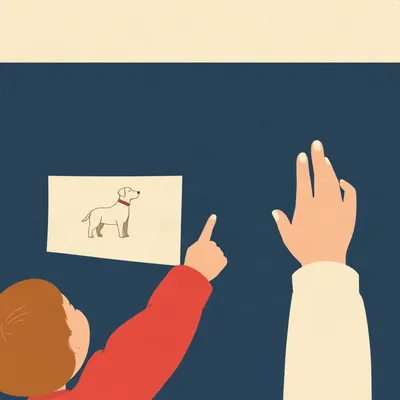
Joint attention is when two people are both attending to the same thing, and both know the other is attending to it. So a twelve-month-old points at a dog across the street, then looks back at your face to check that you are looking at the dog, then looks back at the dog. That sequence, point, check, confirm, is a fully intentional communicative act. No words. But the child is doing something extraordinarily sophisticated. They are triangulating attention between themselves, you, and the object. They are treating you as a mind that can share an experience.
That is not just communication. That is theory of mind.
The early scaffolding of it, yes. And the key distinction in the research is between proto-imperative pointing and proto-declarative pointing. Proto-imperative is pointing to get something. Point at the cup because I want the cup. That is instrumental. Proto-declarative is pointing to share attention. Point at the dog because I want you to look at the dog with me. That is communication for its own sake. And proto-declarative pointing emerges around twelve months. It shows the infant understands communication as a two-way exchange, not just a way to get needs met.
So the twelve-month-old pointing at a dog and checking back is not just requesting. He is saying, are you seeing what I am seeing. That is a profound thing to do without words.
It is the root of everything that comes later. And here is the part that answers Daniel's second question directly. The receptive-expressive gap. At twelve months, a typical infant comprehends roughly fifty to a hundred words while producing only one to ten. Comprehension consistently outpaces production through the first eighteen to twenty-four months. That gap is one of the most robust findings in the field. It is not a delay signal. It is a normal feature of development.
So the kid understands far more than he can say. Which means the nonverbal communication is running ahead of the verbal production by a wide margin.
By an enormous margin. At twelve months, the ratio can be ten to one or more. A child who says three words may understand sixty. And that gap persists. It is not a bug. It is the architecture of language development. Receptive language builds first, then expressive language follows. The comprehension system is laying track that the production system will eventually run on.
So Daniel's observation that a child can be more advanced in nonverbal communication than verbal communication is not a musing. It is the typical state of affairs for the first two years.
It is the default. And it flips the usual framing. We treat the first word as the milestone, but the milestone is really the first time the child demonstrates understanding through a channel other than speech. That happens much earlier. The kid who looks at the door when you say, where is the dog, at ten months, is demonstrating receptive vocabulary. He is communicating that he understands. He is just not saying dog.
That is the thing that gets missed. The communication is happening constantly. We are just only counting the channel we have decided matters.
And that is where Daniel's continuum reframing is not just a nice way for a parent to feel better. It is actually how developmental scientists increasingly describe it. Communication is not a single skill that turns on. It is a toolkit of capacities maturing on different timelines. Gesture, gaze, vocalization, facial expression, body orientation, and later lexical development. Each stream follows its own trajectory. Each one influences the others continuously.
So it is not that the kid is in a pre-verbal phase and then enters a verbal phase. It is that the verbal channel is one tool among several, and it happens to mature later than the others.
And the streams do not run in parallel isolation. They cross-feed. The gesture-language link is one of the best-documented examples. Early gesture use at fourteen months predicts vocabulary size at forty-two months. Children who gesture more earlier tend to have larger vocabularies later. The nonverbal channel is not a separate track that gets replaced by speech. It is a foundation that verbal language builds on.
So the kid who points at everything at fourteen months is not just filling time until words arrive. He is building the infrastructure for the words.
He is doing something even more specific. He is signaling to the adults around him that he is ready to learn words. When a child points at an object and you name it, the pointing creates the opportunity for the label. The gesture recruits the adult's language. The child is essentially asking for vocabulary. So the gesture is not a substitute for speech. It is a mechanism for acquiring speech.
That is a lovely loop. The kid points, the parent names, the kid files the word away, and eventually the kid can say the word. The pointing was the tool that got the word in the door.
And the research bears that out longitudinally. The fourteen-month gesture measure predicting forty-two-month vocabulary is not a small effect. It holds up across studies. Which means the parent who responds to a child's pointing by naming the object is doing exactly the right thing. The parent who ignores the pointing and waits for the child to talk is missing the invitation.
So Daniel's instinct to not stress about when Ezra becomes verbal is well-supported. The thing that matters is whether the adults in the room are reading and responding to the nonverbal communication.
That is the intervention that actually moves the needle. Attending to and responding to a child's nonverbal communication builds the foundation for later language. Drilling vocabulary does not. The responsive parent is a language environment. The pushy parent is a language test.
And there is wide variation within developmentally normal children. Some kids are early talkers with average nonverbal skills. Some are late talkers with highly developed gestural communication. Both trajectories fall within normal range.
The normal range is enormous. A child at sixteen months might produce five words or twenty words and both are unremarkable. But the child with five words might be leading you by the hand to the kitchen, pointing at the shelf, making a specific vocalization, and you know exactly what he wants. He is functionally communicating far more than his five-word vocabulary suggests. The verbal channel is lagging, but the communicative system is fully operational.
That is the key insight. The system is operational before the words arrive. The words are a new channel opening on top of an existing system, not the system starting.
And that reframes the so-called language explosion around eighteen to twenty-four months. We call it an explosion because the word count suddenly takes off. But it is not that communication suddenly starts. It is that the lexical channel finally catches up to the rest of the system. The comprehension was there. The gesture was there. The turn-taking was there. The child just finally has the motor control and the phonological encoding to produce words at scale.
So the explosion is not the beginning of communication. It is the moment one channel becomes dominant.
And then we retroactively decide that channel was the whole story all along. That is the condensing Daniel is talking about. We take a toolkit that has been maturing across multiple streams for two years and we compress it into a single milestone. First word. As if the other streams were just prologue.
The first word is a great moment. It is not nothing. But it is a moment in a process, not the start of the process.
The process starts with the kid looking at your face and smiling back at two months. That is communication. It is not symbolic. It is not referential. But it is reciprocal. It is the seed.
Let me make sure I am tracking Daniel's two questions. First, is there research on interpreting nonverbal communication in children. Answer, yes, and it is extensive. Joint attention, pointing, gaze-following, gesture studies, the works. Second, is there validity to the observation that nonverbal can be more advanced than verbal before speech emerges. Answer, yes, and the receptive-expressive gap is the quantitative backbone of that claim.
That is the episode in two sentences. But the more interesting part is what the reframing does to how we think about children who are slow to talk.
Because the cultural anxiety is real. Parents hear that a friend's kid is saying twenty words at sixteen months and their kid is saying five, and they panic. The comparison is the poison.
The comparison is the poison, and it is based on a single channel. The kid with five words might be communicating circles around the kid with twenty. But the parent only has a scorecard for one channel. So they miss what is actually happening.
That is a failure of measurement, not a failure of the child.
The measurement problem cuts both ways. The early talker with a big vocabulary might have relatively weak joint attention. The parent is thrilled because the word count is high, but the underlying communicative system might be less robust than the quiet kid who points at everything and checks your gaze constantly. The word count is a terrible proxy for communicative competence.
What should a parent actually be looking at.
The quality of the exchange. Does the child initiate communication through any channel. Does the child respond to your bids. Does the child use gaze to check in. Does the child persist when you do not understand. Does the child repair a failed communication attempt. Those are the markers of a healthy communicative system. The word count is downstream of all of it.
That is a much more humane scorecard.
It is the one that predicts later language. The gesture measure at fourteen months predicting vocabulary at forty-two months is exactly this. It is not the word count at fourteen months that predicts later vocabulary. It is the gesture use. The nonverbal channel is the leading indicator.
Wait, that is worth pausing on. The word count at fourteen months does not predict later vocabulary, but the gesture use does.
In the longitudinal studies, the gesture measure is the stronger predictor. I am not saying early word count is irrelevant, but the gesture finding is the one that keeps replicating. The child who communicates through multiple channels early is building a system that will eventually support rich verbal language. The child who has a few words early but weak gestural communication might be running a thinner system.
The kid who points at everything is not behind. He is ahead in the channel that matters most.
He is ahead in the channel that scaffolds everything else. And that is the thing Daniel's friend was pointing at. Babies are constantly communicating. The parent who sees that is seeing the system. The parent who only hears words is seeing one output.
This also matters for how we think about the kid who is delayed. Because the misconception is that a language delay in production necessarily indicates a communication delay. But the receptive-expressive gap means comprehension can be on track or even advanced when production is slower.
That is a critical clinical point. When a pediatrician evaluates a child for language delay, the first question is not how many words does the child say. It is how much does the child understand. Receptive language is the more fundamental system. A child with strong comprehension and slow production is in a very different category from a child with weak comprehension and slow production. The first is often a normal variant. The second warrants closer attention.
The parent who is worried about a slow talker should be asking, does the kid understand, does the kid point, does the kid follow a point, does the kid check in with gaze. Not just, how many words.
Most of the time, when parents actually inventory what the child is doing nonverbally, they realize the system is humming. The child is communicating constantly. They just were not counting it.
That is the reframe in practice. Stop counting words, start noticing exchanges.
The research supports that as more than a feel-good exercise. The responsive parent who notices the pointing and names the object is doing the work that builds vocabulary. The parent who ignores the pointing and says, use your words, is adding friction to a system that is already working.
Use your words is a strange demand to make of a fourteen-month-old who is already communicating through the tools he has.
It is a demand that the child abandon a working channel for one that is not ready yet. The pointing is the communication. The word will come. But the word will come faster if the pointing is honored.
Daniel's reframing is not just scientifically supported. It is practically useful. It tells him what to do. Read the nonverbal, respond to it, and stop worrying about the word count.
The word count will take care of itself on its own timeline. The variation is wide. Ezra at fourteen months with ma, da, and baba is completely within normal range. The fact that Daniel can read baba as a term of affection means he is already doing the work of interpretation. He is treating the vocalization as meaningful. That is the responsive parent. That is the language environment.
The friend's throwaway comment was not throwaway at all. It was the thesis of the episode.
It was the thesis of the last forty years of developmental research, compressed into one sentence by a friend in conversation. Babies are constantly communicating. The science says exactly that.
The first word is not the endpoint. It is one channel opening on a system that has been running since the kid was two months old.
The system is the story. The word is a headline.
What does the continuum reframing buy us beyond the toddler years. Because Daniel's point was about early childhood, but the implication is bigger.
The implication is that we do the same condensing at every stage. We treat verbal fluency as the marker of communicative competence across the lifespan. But adults are also communicating through tone, gesture, facial expression, body orientation, and a dozen other channels. The person who is verbally fluent but interpersonally tone-deaf is not a better communicator than the person who is verbally slower but reads the room perfectly.
The person who is nonverbal, whether through neurodivergence or disability, is not necessarily communication-poor. They may be running a rich system through other channels.
That is the thing the continuum reframing opens up. If communication is a toolkit, then verbality is one tool. Some people have more access to that tool than others. But the toolkit can be rich or poor independently of the verbal channel. A nonverbal child with strong joint attention and gesture use is communicating. A verbal adult with no ability to read facial expression is impaired in a way that a word count will never capture.
The reframing is not just about babies. It is about how we assess communication in everyone.
It is about what we value. We value the word because it is countable. We can write it in the baby book. We can compare it to the neighbor's kid. The gesture, the gaze, the smile, the point, those are harder to count. So we pretend they count less. But they are the system.
The countable thing is not always the important thing.
The countable thing is rarely the important thing. That is true in developmental psychology and it is true in most of life.
I taught baby sign language for about six months back in the early two thousands. Franchise operation. The owner had a line she used at every pitch meeting. Your baby has something to say before they can say it. She would trot out her own kid, maybe three years old, who had been signed to since birth. The kid was a perfectly average talker. But the owner would present him as proof the method worked. What I noticed was the kid was just communicative. He would have found a way to connect with or without the signs. The signs were incidental. The drive to communicate was the thing.
The franchise was selling a channel, but the product was the underlying system.
The franchise was selling anxiety relief. The parents who signed up were worried their kid was falling behind. The pitch was that signing would unlock communication and reduce tantrums. What happened instead was the parents started comparing sign counts. How many signs does your fourteen-month-old know. Same anxiety, new scorecard.
That is the dark side of the reframing. You move the milestone from words to signs and the comparison just follows you.
The comparison is the thing. The channel does not matter. If you tell parents that gesture count predicts vocabulary, they will start drilling gesture count. I watched it happen. The method was fine. The kids liked it. But the parents who were anxious about words became anxious about signs. The anxiety was not about language. It was about whether their kid was winning.
The continuum reframing is useful, but it can be co-opted by the same parental anxiety it is meant to relieve.
That is what I took from the job. The owner's kid was not proof that signing works. He was proof that a communicative kid will find a channel. The parents who got that did fine. The parents who wanted a new milestone to obsess over found one.
That is a sobering addendum. The science says the system matters more than the channel. But the culture will always find a channel to count.
The fix is not to stop counting. It is to notice what you are counting and ask whether it is the system or just the output.
The owner used to say the signing baby was happier because he could express himself. I think he was happier because his parents were paying attention to him. The signs were just the excuse.
Attention is the active ingredient. The responsive parent who notices the pointing, the gaze, the babbling, the sign, whatever the channel is, that parent is building the system. The channel is almost incidental.
The research and the lived experience converge on the same point. Read the child, respond to the child, and let the words arrive on their own schedule.
The words will arrive. Most of them do. And the ones who do not will still be communicating, if anyone is paying attention.
That is the open question, I think. If communication is a continuum of tools maturing differently, what happens when we apply that lens beyond early childhood. To adults, to neurodivergent communication, to cross-cultural interaction. The word is not the whole story at any age.
The gesture predicting vocabulary finding is the thing I keep thinking about. It suggests that how we attend to pre-verbal children shapes their communicative development more than when they start talking. The longitudinal studies are still running. But the direction is clear. The responsive parent is an intervention. The word count is an outcome. And the outcome is downstream of the attention.
Daniel's friend was right. Babies are constantly communicating. And the science suggests the real milestone is not the first word. It is the first time you realize you have been having a conversation all along.
That is the moment the reframing lands. You stop waiting for the kid to start talking and you notice he never stopped.
Thanks to our producer, Hilbert Flumingtop, for keeping the show running and for the franchise war stories.
This has been My Weird Prompts, the human-AI collaboration podcast.
If you have a story about a kid who communicated something profound without words, we would love to hear it. Email us at show at my weird prompts dot com.
We will be back soon.