Daniel sent us this one — and it's basically a real-time field report. He just discovered modular belt carry systems yesterday, immediately ordered a pile of MOLLE pouches from AliExpress, and is currently walking around with an electrician's pouch strapped to a tactical belt while pushing a stroller and charging his phone. He forgot he was wearing it at the playground. His question is: what are the actual pros and cons of the different attachment systems out there — ClipTech, MOLLE, magnetic — and how do people actually use these when they're swapping between parenting, DIY, and renovation throughout the day?

This is one of those discoveries where you realize an entire product category has been hiding in plain sight your whole adult life. And Daniel's absolutely right — he said even before Ezra was born, if he'd known these existed, they'd have been game changers. The core thing he's latched onto is that the belt stays on all day and the pouches swap on and off as contexts change. That's the insight.
Which is the exact opposite of a traditional tool belt. You don't put the whole thing on and take it off as a unit. The belt is the constant, the pouches are the variables. For someone with ADHD who's already managing working memory on fumes, that distinction matters enormously.
And what we're actually talking about here is the convergence of three product categories that usually don't talk to each other. First, tactical slash EDC belts — standardized on one point five or two inch webbing, usually with a ratcheting buckle. Second, modular attachment systems — ClipTech, MOLLE, magnetic, clip-on. Third, the specific use case of someone who needs to swap between childcare and unpacking and renovation without re-gearing from scratch every time. That's not a niche. That's basically every parent who owns a drill.
Let's get into the mechanics of how these attachment systems actually work — because the differences matter a lot when you're swapping pouches on a playground bench.
Alright, three major ecosystems. Let's start with Toughbuilt's ClipTech because it's the most mechanically clever. It uses a rotating C-clip that locks into a proprietary rail on the belt. You push the pouch onto the rail, it clicks audibly, and it's locked. To remove, you press a release tab and lift. Completely tool-free, completely one-handed. The pouch can also rotate on the clip, so if you're crouching or climbing, the pouch stays vertical instead of digging into your leg.
The audible click is a bigger deal than it sounds like. For someone with ADHD, that's confirmation the thing is actually attached. You're not going to spend the next ten minutes wondering if your drill holder is going to drop off while you're carrying a toddler.
And the one-handed operation means you can swap a pouch while holding Ezra with the other arm. That's not a theoretical benefit — Daniel's literally doing that. The tradeoff is you're locked into Toughbuilt's ecosystem. The belt has a specialized rail sewn into it, and only Toughbuilt pouches work with that rail. They make a decent range — drill holsters, utility knife pouches, tape measure clips, fastener pouches — but you're not going to find a dedicated baby wipe holder in their catalog.
Which is where MOLLE comes in. Daniel went straight to AliExpress for MOLLE pouches. What's the actual attachment mechanism there?
MOLLE stands for Modular Lightweight Load-carrying Equipment. It's a military standard — the U.Army developed it in the late nineties to replace the older ALICE system. The attachment surface uses horizontal one-inch webbing strips spaced one inch apart, sewn onto the belt or vest or backpack. Pouches have corresponding straps on the back that weave through those strips and snap or Velcro at the bottom. It's completely universal — any MOLLE pouch works with any MOLLE platform, regardless of brand. AliExpress has literally thousands of options.
Universal doesn't mean fast.
No, it doesn't. Weaving a MOLLE strap through webbing takes maybe thirty to sixty seconds per pouch, and you usually need both hands. It's not difficult, but it's deliberate. You're threading straps through slots, pulling them tight, securing the snap. If you're swapping individual pouches multiple times a day, that friction adds up. The workaround — and this is what a lot of people do — is to pre-configure a set of pouches on a separate MOLLE panel or belt sleeve, and then swap the entire panel as one unit.
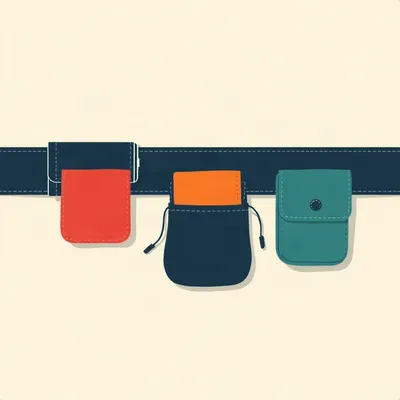
You'd have a parenting panel with your phone pouch and water bottle holder and snack pouch, and a tool panel with your drill holster and tape measure and utility knife, and you just swap panels instead of individual pouches.
That's the move. It turns a five-minute reconfiguration into a ten-second swap. And you can do it with a MOLLE-compatible belt sleeve that slides onto your tactical belt. The sleeve itself stays attached to the belt, and you Velcro or clip different panels onto it. It's not as elegant as ClipTech's click-and-go, but it's dramatically cheaper and infinitely more flexible in terms of pouch selection.
Daniel mentioned he ordered admin pouches, a water bottle holder, a torch holder, scissors holder, drill holder — all from AliExpress. What's the actual quality difference between those and name-brand MOLLE gear?
For non-trades use, the cheap stuff is probably fine. The main differences are stitch quality, fabric weight, and hardware. Military-spec MOLLE uses thousand-denier Cordura nylon with bartack stitching at stress points. AliExpress pouches typically use six-hundred-denier polyester or lighter nylon, single-stitched, with plastic buckles instead of metal. For carrying a power bank and snacks and a water bottle, that's perfectly adequate. You're not dragging it through a deployment. The webbing might fray after a year of daily use instead of five years. But at AliExpress prices, you can replace the whole set three times before you hit Toughbuilt money.
The lighter fabric is actually a pro for Daniel's use case. He specifically said he doesn't need the ultra-rugged heavy stuff intended for electricians. Lighter pouches mean less weight on the belt, which means less fatigue over a full day of parenting plus unpacking.
There's a third attachment ecosystem worth mentioning — magnetic systems. Some EDC brands like Krydex and a few smaller shops use rare-earth magnets with a mechanical lock backup. The pouch snaps onto a magnetic plate on the belt, and a small latch engages to prevent it from pulling off under load. They're extremely fast to attach — literally just bring it near the plate and it jumps into place. The downside is security under dynamic load. If you're running after a toddler and the latch isn't fully engaged, a heavy pouch could potentially detach. For light EDC items like a phone or keys, they work well. For a drill or hammer, I wouldn't trust them.
The landscape is basically: ClipTech for speed and security at the cost of ecosystem lock-in, MOLLE for flexibility and price at the cost of slower swaps, magnetic for light-duty speed at the cost of load security. But none of this matters if the belt itself isn't right. Daniel mentioned the ratcheting tactical belt specifically.
The belt is the foundation. If the belt is uncomfortable, you won't wear it, and the whole system collapses. A ratcheting tactical belt uses a micro-adjustable buckle — usually a track system with tiny teeth — that lets you tighten or loosen in quarter-inch increments. You just push the buckle lever and pull the strap through. No holes to line up, no fixed positions. This matters enormously when you're loading and unloading weight from the belt throughout the day. You can tighten it when you've got a full tool load, loosen it slightly when you're down to just a phone and keys, and do it one-handed without unbuckling.
It solves the sagging problem Daniel explicitly called out. He said a power bank alone would weigh his pants down and he'd feel ridiculous. The ratcheting belt keeps everything snug against your body, so the weight is distributed around your hips instead of pulling down at one point.
That's the biomechanics of it. A standard leather belt with holes has maybe five or six adjustment points, and none of them are likely to be exactly right when you've added or removed three pounds of gear. You're either too tight or too loose, and too loose means the belt rides down and the pouches flop around. The ratcheting mechanism eliminates that. You dial it to exactly the right tension every time.
Alright, so we know how the systems work. But what does it actually feel like to use them in the wild — and what do other people think when they see you?
Daniel's field report from yesterday is genuinely useful data here. He was at the playground, carrying Ezra, phone charging from a power bank in the electrician's pouch, belt ratcheted tight. And he forgot he was wearing it. That's the metric. That's the holy grail for any ADHD carry system. When the gear becomes invisible to you, it means the cognitive load of managing objects has been successfully offloaded to the physical system.
The "forgot I was wearing it" phenomenon. If you remember the system, it's still a cognitive burden. If you forget it, it's working.
And that's a clinical concept, actually — from my pediatrics days, we'd look at whether a child accommodated to an orthotic device or whether they were constantly aware of it. Accommodation means the brain has accepted it as part of the body schema. Daniel's brain apparently accepted a tactical belt with an electrician's pouch as part of his body within one day.
Which raises a question he might not have thought of yet. If you forget you're wearing it, do you also forget to swap pouches when you change contexts? You come home from the playground, you're still wearing the parenting loadout, and you start unpacking boxes — but your utility knife is on the tool panel sitting on the shelf.
That's exactly why the belt-as-constant model is better than a traditional tool belt you take off. If you take the belt off, you might forget to put it back on. If the belt stays on, you at least have the platform attached to your body. The worst case is you're wearing the wrong pouches, not no pouches. And the pre-configured panel approach solves the swap problem — you make it a deliberate ritual when you walk in the door. Parenting panel off, tool panel on. It becomes a physical transition cue, like taking off your shoes at the entrance.
The other thing Daniel brought up is the social dimension. He said he's probably overthinking it, or people might think he's a contractor or electrician. Then he landed on: I'm too tired to care. If I look like the mid-fifties building manager with a bunch of stuff on my waist, so be it.
That's a real barrier for a lot of people. The gear signals a role you don't occupy. A tool belt at the playground reads as "I'm working" in a space where the expected role is "I'm parenting." There's a category mismatch that makes people self-conscious. But Daniel hit on something important — most people don't notice or care. They're focused on their own kids, their own phones, their own day. And if they do notice, "contractor stopping by the playground with his kid" is a completely legible social category. Nobody's going to challenge it.
The social cost is almost entirely internal. And for someone with ADHD whose executive function is already depleted by constant context-switching, the internal cost of "I might look weird" gets weighed against the internal cost of "I can't find my keys and my phone is dead and my pants are falling down." At a certain point, function just wins.
There's another angle here too. As more people adopt modular belt carry for non-trade contexts, the social signal shifts. Ten years ago, wearing a backpack with MOLLE webbing at a coffee shop marked you as a certain kind of tactical enthusiast. Now it's just a backpack. The same normalization will happen with belt systems. Daniel's an early adopter of a category that's going to look completely unremarkable in five years.
Let's talk about the actual context-switching workflow. Daniel's day, based on what he described, probably looks something like: morning playground trip with Ezra — he needs phone, power bank, keys, water bottle, snacks, maybe a small toy or wipe pack. Then afternoon unpacking — drill, utility knife, tape measure, scissors, torch, maybe a marker for labeling boxes. Evening renovation — same tools plus a hammer, pry bar, whatever the specific task demands.
That's three distinct loadouts. The parenting pod and the tool pod might share a couple items — phone and keys are constant — but the bulk of the pouches are completely different. With ClipTech, you'd have three sets of pouches pre-loaded on their own clips, and you'd swap them in maybe fifteen seconds per pouch. Four pouches, one minute total. With MOLLE, if you're weaving individual pouches, you're looking at three to four minutes per full swap. That's not nothing when you're doing it three times a day.
Which is why the panel approach is so important for MOLLE users. You're not weaving six pouches. You're swapping one panel.
You can make those panels yourself. A MOLLE-compatible panel is basically a stiff piece of fabric with webbing on one side and some kind of attachment on the other — Velcro, clips, whatever. You can buy them, or you can make one with a cutting board and some webbing and a sewing machine if you're that kind of person. Daniel's probably not sewing anything right now given the apartment situation, but it's an option down the line.
The other thing worth comparing is how these systems handle specific items. A water bottle is a good test case. On a MOLLE system, you've got dedicated water bottle pouches with a drawstring top and a drainage grommet at the bottom. They work fine, but they add bulk — the pouch itself has volume even when empty. ClipTech doesn't really have a dedicated water bottle solution in their standard lineup. You'd be using a general-purpose pouch.
A drill holster is another interesting comparison. Toughbuilt's drill holster is purpose-built — it has a reinforced opening, a bit holder on the side, and it's shaped to let the drill sit at the right angle. A generic MOLLE drill holster from AliExpress is basically a fabric tube with a webbing strap. It holds the drill, but it might flop around more, and it probably doesn't have the bit storage. For occasional use, that's fine. For all-day renovation work, the purpose-built holster is worth the money.
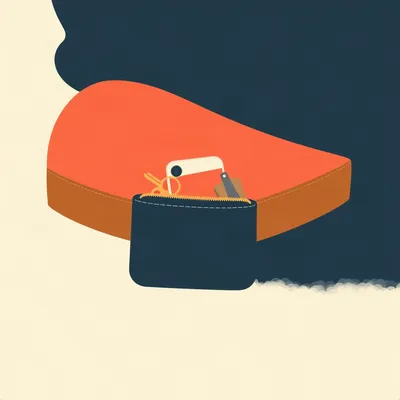
Daniel's current setup is interesting because it's neither ClipTech nor MOLLE — it's an electrician's pouch that presumably has a standard belt loop or clip. He's using it as a stopgap while waiting for the AliExpress order to arrive. And he reported that it worked well enough that he forgot about it. So even the janky temporary solution cleared the bar.
Which tells you the concept is sound even before you optimize the implementation. The electrician's pouch is probably a single large compartment with some internal dividers — not ideal for organization, but good enough to hold a power bank and phone and keys. The fact that it worked on day one, with no prior experience, in a high-stress context, is a strong signal that the modular belt approach is fundamentally right for his brain.
If you're sold on the idea, here's how to actually set this up without wasting money or ending up with a system that doesn't work for your specific context-switching needs.
Step one: start with the belt. Get a ratcheting tactical belt in one point five or two inch width. The width matters because it determines which pouches and panels will fit. One point five inch is more compatible with standard pants belt loops. Two inch is stiffer and supports more weight but might not fit through all your pants. For Daniel's use case — power bank, phone, tools — one point five inch is probably sufficient. Don't cheap out on the belt. It's what makes the whole system comfortable enough to forget you're wearing it. A good ratcheting belt runs thirty to fifty dollars. The buckle mechanism is the part that fails on cheap ones.
Step two: choose your attachment ecosystem based on your swap frequency. If you're swapping pouches multiple times a day — parenting to DIY to renovation and back — Toughbuilt ClipTech is worth the ecosystem lock-in for the speed. The audible click and one-handed operation matter when you're doing it constantly. If you swap once a day or less, MOLLE is cheaper and more flexible. If you want to experiment before committing, buy one ClipTech pouch and a few MOLLE pouches and compare them on your actual body in your actual day.
Step three: pre-configure context pods. This is the single biggest workflow upgrade. Take an hour one evening, lay out everything you need for each context, and build the pouch sets. Parenting pod: phone pouch, power bank pouch, water bottle holder, snack pouch, keys on a retractable tether. Tool pod: drill holster, utility knife pouch, tape measure clip, scissors holder, torch holder, marker sleeve. Renovation pod: same as tool pod plus hammer loop, pry bar sleeve, fastener pouch for screws and nails. Store them on hooks near the door. Swap the whole pod, not individual pouches.
Step four: ignore the social stigma. Daniel's day-one experience already proved this — nobody at the playground noticed or cared, and he forgot he was wearing it. The utility of having everything at hand and not sagging your pants down around your knees outweighs the self-consciousness. And honestly, if someone does ask, "I'm unpacking a new apartment while parenting a toddler" is a completely sympathetic answer that makes you look competent, not weird.
One more thing on setup: consider a retractable tether for your keys and phone. These are small reels with a kevlar cord that clip to your belt and let you pull the item out to use it, then it retracts back. You never set the item down, so you never lose it. For ADHD working memory, that's a huge deal. The "where did I put my keys" scan that burns five minutes and a bunch of cognitive energy just disappears.
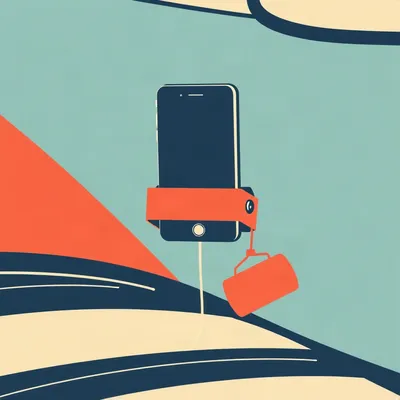
Daniel's actually doing a version of this with the phone charging cable tethered to the power bank in the pouch. He's already discovered that tethering things to your body eliminates the "set it down and lose it" problem.
The other thing I'd add is that pouch selection should follow a "slim when empty" principle. Bulky pouches that hold their shape even when empty add visual mass and make the belt more noticeable. Look for pouches that collapse flat when not in use. The admin pouches Daniel ordered are probably good for this — they're basically fabric envelopes with some internal organization. When they're not stuffed full, they sit relatively flat against the belt.
We've covered the mechanics, the social dynamics, and the practical setup. But there's one big open question we're watching in real time.
Will the MOLLE pouches from AliExpress hold up to daily use? Daniel's running the experiment right now. He ordered a full set — admin pouches, water bottle holder, torch holder, scissors holder, drill holder — all from the cheapest source available. In a month, we'll know if the stitching is failing, if the buckles are cracking, if the webbing is fraying. Or we'll know that the cheap stuff is perfectly adequate for non-trades use and the entire category is accessible for twenty or thirty dollars instead of a hundred and fifty.
My bet is on "good enough." The forces involved in carrying a power bank and a water bottle around a playground are not the same as the forces involved in carrying a full set of tools on a construction site eight hours a day. The AliExpress pouches don't need to be military-grade. They just need to not fall apart.
If they do fall apart, the experiment cost what, forty dollars total? That's a cheap lesson in what not to buy. Daniel can replace the failed pouches with name-brand equivalents one at a time, as needed, rather than paying the Toughbuilt premium up front for everything.
The other thing to watch is whether the category itself evolves. As more people discover modular belt carry for non-work contexts — parenting, ADHD, travel, events, photography — we're going to see more consumer-oriented designs. Slimmer pouches, faster attachment systems, better aesthetics, less tactical-looking fabric. The line between tactical gear and everyday carry is already blurring. Someone's going to launch a "parent belt" Kickstarter in the next two years and make a fortune.
The market is every parent who's ever tried to carry a phone, keys, snacks, wipes, a water bottle, and a toy while also pushing a stroller and holding a toddler's hand. That's not a niche. That's millions of people. And right now the solution is either a diaper bag that you have to dig through, or stuffing everything in pockets that sag and hurt. The modular belt is objectively better for a huge number of use cases that have nothing to do with construction or tactical operations.
If you've tried a modular belt system for parenting, ADHD, or just daily chaos, email us your setup. We want to hear your context-switching workflows — what's in your pods, how often you swap, what broke, what surprised you. Show at my weird prompts dot com.
Now: Hilbert's daily fun fact.
Hilbert: On the Chatham Islands, the volcano that formed the Pyramid emits hydrogen sulfide in concentrations that attract a specific species of red seaweed, which in turn supports a population of sea snails found nowhere else on Earth — a volcanic gas feeding a marine food chain that exists entirely because the vent keeps puffing.
The snails owe their entire existence to rotten-egg gas.
actually a pretty good metaphor for some of the gear we've been discussing. But I'm not going to make it.
This has been My Weird Prompts. I'm Corn.
I'm Herman Poppleberry. Produced by Hilbert Flumingtop. If you enjoyed this episode, leave us a review wherever you listen — it helps other people find the show. We'll be back with a new prompt soon.