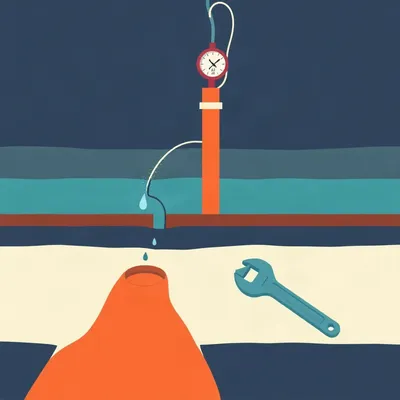
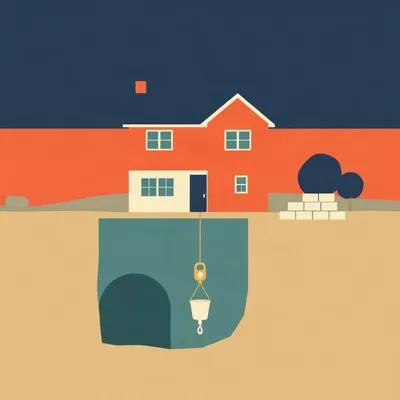
Imagine the Burj Khalifa — eight hundred twenty-eight meters of glass and steel, one hundred sixty-three floors. Now imagine it sitting on a slab of concrete the thickness of your driveway. That would be insane. And it's not what's happening. So Daniel sent us this prompt — what actually are foundations, the things that hold up buildings? Does every structure have one, or can you just drop a house on the dirt? And when you get to skyscrapers, how deep and extensive do these things need to be? There's a lot to unpack here.

What exactly is a foundation, and why does it matter more than most people realize?
That's the question. And it matters now more than ever — you've got cities pushing density mandates, permafrost thawing in the Arctic, water tables rising in coastal zones. Foundation design is becoming a first-order constraint on where and how we build. So let's get into it.
Let's start with what a foundation actually is from an engineering standpoint. It's not just the concrete at the bottom of a building. A foundation is the interface that transfers every structural load — dead load from the weight of the building itself, live load from people and furniture and snow, wind load, seismic load — all of it into the ground. And it has to do this without exceeding what's called the soil's bearing capacity and without causing unacceptable settlement.
It's a load-transfer mechanism. Not a slab.
And there are two fundamental categories. Shallow foundations — spread footings, mat slabs — and deep foundations — piles, caissons, drilled shafts. The choice between them depends entirely on the soil profile and how much load you're dealing with.
Just to clear up a misconception right at the start — a basement is not a foundation.
A basement is a habitable space that happens to be below grade. The foundation is the structural element that transfers load to the ground, and it's often located below the basement floor slab. Many buildings have basements that are structurally independent of the foundation system. They're different things.
Does every building have a foundation? Even a garden shed?
Even a garden shed. You need something between the structure and the dirt. For a shed it might just be a gravel pad or some concrete blocks, but you need it. Otherwise frost heave will twist the thing apart in a season or two. The question isn't whether you have a foundation — it's what kind and how deep.
I want to pause on frost heave for a second, because I think a lot of people have seen it without knowing what it's called. You know that sidewalk slab that's tilted up at a weird angle after winter?
Classic frost heave. Water in the soil freezes and expands — about nine percent volume increase — and if that expansion is constrained from above by a structure, it lifts whatever's on top. The key detail is that it's rarely uniform. One corner of your shed goes up an inch, the other corner stays put, and now your door doesn't close and the framing is twisted. That differential movement is what destroys structures. A uniform lift of half an inch across the whole building? You might not even notice. But differential heave? That's the killer.
Even at the shed level, the foundation is solving the same fundamental problem as a skyscraper — differential movement.
Exactly the same problem, just at a completely different scale. The physics doesn't change. Only the numbers get bigger.
Let's start with the basics — shallow foundations and when they work, and then we'll go deep.
The most common type is a spread footing. Picture a concrete strip under a load-bearing wall, or a square pad under a column. The idea is simple — you take the point load coming down through the wall or column and spread it over a wider area so the pressure on the soil stays below what the soil can handle.
How much pressure are we talking about for a typical house?
For residential construction on competent soil, typical bearing pressure is fifteen hundred to three thousand pounds per square foot. For a two-story house, you're often looking at a continuous footing about twelve inches wide and eighteen inches deep, reinforced with number four rebar at sixteen inches on center.
That's surprisingly modest. A foot wide, a foot and a half deep.
It is modest, because the loads are modest. A two-story wood-frame house isn't that heavy. The soil can handle it. But here's where it gets interesting — when you have columns close together, their individual footings would overlap. At that point you just pour one continuous slab under the whole building. That's called a mat foundation, or a raft foundation.
Because the building is essentially floating on it.
That's the image, yeah. A big reinforced concrete slab that distributes the entire building load across the whole footprint. These are used for mid-rises up to about ten stories on good soil. The Marina Bay Sands hotel in Singapore — that massive structure with the sky park on top — sits on a mat foundation two and a half meters thick.
Two and a half meters of concrete. That's over eight feet.
That's still considered a shallow foundation, because it's sitting near the surface. It's just very thick and very heavily reinforced.
Wait — how do you even pour a slab that thick? Does it cure in layers? Because concrete generates heat as it cures, and eight feet of concrete is going to get really hot in the middle.
This is actually a major challenge with mass concrete pours. The hydration reaction that cures concrete is exothermic — it releases heat. In a slab two and a half meters thick, the core temperature can hit seventy or eighty degrees Celsius while the surface is cooling to ambient temperature. That thermal gradient creates internal stresses that can crack the concrete from the inside out.
You're fighting a battle against your own chemistry.
The solution is a combination of things. You use a concrete mix with a lower cement content or with supplementary cementitious materials like fly ash that reduce the heat of hydration. You might embed cooling pipes in the pour and circulate chilled water through them during curing — the same principle as a ground-source heat pump, but in reverse. And you do extensive thermal modeling before you pour a single liter of concrete. The Marina Bay Sands mat pour was a continuous operation that took something like forty-eight hours with multiple batch plants feeding it.
A forty-eight-hour concrete pour. That's a logistical operation on the scale of a military campaign. But when the soil near the surface can't handle the load, or when the building is so heavy that even spreading the load across the whole footprint isn't enough, you go deep.
This is where piles come in.
Piles, caissons, drilled shafts. Deep foundations transfer load through weak upper soils down to competent strata or bedrock. There are two main types. End-bearing piles are driven down until they hit something solid — they're literally driven to refusal on bedrock. Friction piles work differently — the load is transferred through skin friction along the entire length of the pile shaft. The surrounding soil grips the pile and holds it in place.
One is standing on something solid, the other is being held up by friction along the sides.
That's it. And for really tall buildings, you're often using both mechanisms. The world record for pile depth is under the Burj Khalifa — one hundred ninety-two piles, each one and a half meters in diameter, driven fifty meters deep and socketed into Dubai's sandstone. Each pile was tested to six thousand tons.
Six thousand tons per pile. And they have a hundred ninety-two of them.
Here's the thing that most people don't realize — the depth of those piles isn't primarily about bearing capacity. It's about settlement. Specifically, differential settlement.
When you load soil, it compresses. That's settlement. A certain amount of total settlement is fine — the whole building sinks a little bit, uniformly, nobody notices. The problem is differential settlement, where one column or one part of the foundation sinks more than another. That induces bending moments in the structure. It pulls the building apart.
The building doesn't just tilt — it tears itself.
For high-rises, the typical allowable limit is about one inch of total settlement and a quarter inch of differential settlement. That's incredibly tight. And hitting that target drives pile depth more than anything else. You go deep enough that the soil compression under load is uniform across the entire foundation footprint.
A quarter inch. That's less than the width of my pinky finger. How do you even measure that during construction?
You install settlement monitoring points — basically precision survey markers on the foundation — and you track them with optical levels or GPS over months and years. On a major project, you might have hundreds of monitoring points, and you're taking readings weekly during construction and then monthly for years afterward. If you see differential movement exceeding the predicted values, you stop work and investigate. It's one of those things where the instrumentation budget alone can run into six figures.
Which brings us to the cautionary tale.
The Leaning Tower of Pisa. Construction started in eleven seventy-three, and it started leaning almost immediately. The foundation is only three meters deep, sitting on about ten meters of soft marine clay. By the time they finished the third floor, it was already tilting. Today it leans five and a half degrees off vertical.
Three meters deep on soft clay. They basically built a tower on a sponge and were surprised when it squished.
The soil stratigraphy at Pisa is actually fascinating. You've got a layer of silty sand, then a thick layer of soft clay, then a layer of sand, then more clay. The tower's weight squeezed water out of the clay layer unevenly. The south side compressed more than the north side. And for eight hundred years, engineers have been trying to fix it.
They did stabilize it eventually, right?
In the nineteen nineties they removed soil from under the north side — the high side — to let it settle back. They reduced the lean from five and a half degrees to about four degrees. It's stable now, at least for the next few centuries. But it's the textbook example of what happens when you ignore soil mechanics.
What I find darkly amusing is that the tower's lean is the only reason anyone cares about it. If they'd built it properly, it would just be another medieval bell tower in a Italian town square. The failure is the attraction.
That's perversely true. The engineering disaster created a world heritage site. But compared to the Burj's fifty-meter piles, the difference is almost comical. Three meters versus fifty meters.
The Burj isn't even the deepest. The Shanghai Tower uses nine hundred forty-seven piles, each eighty-six meters long, going through three hundred meters of soft alluvial clay before hitting anything solid.
Nine hundred forty-seven piles. That's a forest of concrete underground.
The soil in Shanghai is incredibly challenging. It's the Yangtze River delta — centuries of sediment deposition. The standard penetration test blow counts at the surface are two to ten. For context, that means a standardized hammer driving a sampling tube into the soil only penetrates two to ten blows per foot. That's extremely soft. You need thirty to fifty blows per foot for what engineers consider competent bearing soil.
Two to ten is basically pudding.
It's very soft clay. And it goes down three hundred meters. So every high-rise in Shanghai sits on deep piles. There's no alternative.
Which brings up something I've always wondered about — Manhattan. You've got all these skyscrapers, some of them over a hundred stories, and they're clustered in Midtown and Downtown. What's going on underground there?
This is one of my favorite geology stories. Manhattan's bedrock is a metamorphic rock called schist — Manhattan schist, specifically. In Midtown, it's only five to fifteen meters below the surface. In the Financial District, it's similarly shallow. But in between, around Greenwich Village and SoHo, the bedrock drops to over sixty meters down.
The skyscrapers cluster where the rock is shallow.
The skyline is basically a map of the subsurface geology. Where the schist is near the surface, you can use shallow mat foundations or short piles socketed directly into rock. That's dramatically cheaper than driving deep piles through sixty meters of overburden. The geology literally shaped the city.
That's the best kind of engineering story — the invisible constraint that determines everything visible.
It's not just Manhattan. The reason downtown Chicago has so many skyscrapers is partly that the soil conditions are workable there. In other parts of the city, the costs don't pencil out.
What about a city like Mexico City? It's built on an ancient lakebed. That must be a foundation nightmare.
It's one of the most challenging foundation environments in the world. Mexico City sits on what was Lake Texcoco — hundreds of meters of highly compressible lacustrine clay. The clay has a water content of two hundred to four hundred percent. It's more water than solid. And the city has been pumping groundwater for decades, which has caused regional subsidence of up to nine meters in some areas.
The entire city has sunk thirty feet?
Parts of it, yes. The Metropolitan Cathedral is a famous case — it was sinking so unevenly that they installed a massive underpinning system in the nineteen nineties with hundreds of micropiles and hydraulic jacks to level it. And that's a four-hundred-year-old building. Imagine what modern high-rises are dealing with.
We've seen how foundations work for small and medium buildings. But when you scale up to a skyscraper, everything changes.
Everything changes, and the first thing that changes is the soil investigation. Before you design a foundation for a major structure, you need to know exactly what's down there. For a high-rise, you might drill ten to twenty boreholes to depths of a hundred meters or more. You're doing standard penetration tests, cone penetration tests, taking undisturbed soil samples, running laboratory tests on shear strength and compressibility.
What does that cost?
For a supertall site investigation, five hundred thousand to two million dollars. Just to figure out what's in the ground.
Before you've poured a single cubic meter of concrete.
Before you've done anything. And that money is non-negotiable. You cannot skip the geotechnical investigation. Every foundation failure in history traces back to either an inadequate site investigation or ignoring what the investigation told you.
Pisa being exhibit A.
Pisa, and more recently and tragically, the Surfside condominium collapse in Florida. June twenty-fourth, twenty twenty-one. Ninety-eight people died. The NIST investigation has identified multiple contributing factors, but one of them was corrosion of the foundation reinforcement due to saltwater intrusion. The building was on the coast, the water table was rising, and the rebar inside the concrete was corroding for decades.
That's a sobering example. And it connects directly to what we were saying about climate change rewriting foundation engineering.
And this is happening in multiple ways. In the Arctic, permafrost thaw is causing differential settlement in buildings designed for permanently frozen ground. Entire towns in Siberia and Alaska are seeing buildings crack and tilt as the soil underneath turns from ice to mud. In coastal cities, rising water tables reduce soil bearing capacity — saturated soil is weaker — and increase hydrostatic uplift forces on basements. You can literally have groundwater pushing your basement upward.
The ground itself is changing under buildings that were designed for different conditions.
Foundation design life is typically fifty to a hundred years for residential, a hundred to a hundred fifty years for major structures. Climate change is happening faster than that. We're seeing foundations face conditions they weren't designed for within their design life.
The permafrost one is particularly vivid to me. I've seen photos of buildings in Norilsk, Russia, where the corners have sunk so much that the entire structure looks like it's melting. Staircases pulling away from landings, windows shattering from the racking. And these are occupied buildings. People are living in them.
Norilsk is a case study in what happens when you design for a stable thermal regime that no longer exists. The city was built assuming permafrost would stay frozen. The foundations were typically driven piles with the building elevated above grade on a ventilated crawl space — the idea being that cold air circulates underneath and keeps the ground frozen year-round. But as average temperatures rise, that passive cooling isn't enough anymore. The permafrost is degrading from the edges inward, and the pile shafts are losing their grip.
The very design feature that was supposed to protect the foundation — the ventilated crawl space — is failing because the climate has shifted out from under it.
The fix isn't cheap. You're talking about installing active thermosyphons — essentially heat pipes that use phase-change refrigerant to pull heat out of the ground during winter. It's a retrofit that costs more than the original foundation in many cases.
Let's talk about what happens to foundation costs as you go taller. This seems to be the thing that determines whether a building pencils out financially.
The cost curve is superlinear. For buildings under ten stories, foundation cost is typically three to five percent of total construction cost. For fifty-plus stories, it jumps to ten to fifteen percent. For supertalls — three hundred meters and above — foundations can be twenty to twenty-five percent of the total budget.
A quarter of the cost of a supertall is just the part you never see.
Taipei 101 is a good example. The foundation cost eighty million dollars of the one point eight billion total. Three hundred eighty piles, one and a half meters in diameter, driven eighty meters deep and socketed into bedrock at sixty meters. And that's on competent ground — Taiwan has decent geology for tall buildings.
Shanghai Tower, with its nine hundred forty-seven piles in soft clay?
The foundation there was estimated at over a hundred million dollars. When you're driving piles eighty-six meters into soft alluvial clay, every pile is a major operation. You need specialized drilling equipment, you need to case the hole to prevent collapse, you need to pump concrete under pressure. It's slow and it's expensive.
There's a sweet spot for foundation efficiency.
On good soil, it's typically eight to fifteen stories. Below that, you're not getting enough building value for the land cost. Above that, the foundation cost curve starts to steepen. And beyond about forty or fifty stories on difficult soil, the foundation cost per square foot of building area starts to climb dramatically.
Which means the economics of skyscrapers are fundamentally geotechnical. It's not about architectural ambition — it's about what's under the dirt.
Every skyscraper you see is a negotiation between the architect and the geotechnical engineer. The architect says "I want a hundred stories." The geotechnical engineer says "that'll cost you a hundred million dollars in piles." And then they negotiate.
Covering the covers.
There's a whole field of innovation around this. One area that's getting real attention is geothermal piles — foundation piles that double as heat exchangers for the building's HVAC system. You embed pipes in the piles, circulate fluid through them, and use the stable temperature of the ground to heat and cool the building.
The foundation becomes part of the energy system.
Instead of drilling separate boreholes for a ground-source heat pump, you use the piles you're already installing. It's been done in Europe for about fifteen years now, and it's starting to catch on in North America and Asia. The foundation is doing double duty — structural support and thermal exchange.
That's genuinely clever. What's the efficiency gain like? Does it meaningfully offset the cost of the piles?
It depends on the building type and climate, but typical numbers show a twenty to thirty percent reduction in heating and cooling energy use compared to conventional HVAC systems. The payback period on the additional installation cost is usually five to ten years. For a building with a fifty-year design life, that's a solid return. And it's particularly attractive in Europe where energy costs are high and carbon pricing is coming into effect.
What about the self-healing concrete I've been reading about?
This is still experimental but really promising. Researchers at ETH Zurich have been running field trials since twenty twenty-three using bacteria that precipitate calcite — calcium carbonate — to seal cracks in concrete. You embed bacterial spores in the concrete mix. When a crack forms and water gets in, the bacteria activate, metabolize nutrients that are also embedded in the mix, and produce calcite that fills the crack.
The foundation heals itself.
The trials so far show that cracks up to about half a millimeter can be sealed autonomously within a few weeks. That's significant because those hairline cracks are where water gets in and starts corroding the rebar. If you can seal them early, you dramatically extend the foundation's service life.
That's the kind of thing that could have made a difference at Surfside.
Though the corrosion at Surfside was advanced and systemic — self-healing concrete would have needed to be part of the design from the start, and it wouldn't have addressed the drainage issues that were also contributing.
How do the bacteria survive being mixed into concrete? Concrete is highly alkaline — pH twelve or thirteen. That's hostile to most life.
That was the breakthrough, actually. The spores are encapsulated in a protective shell — typically a silica-based coating — that keeps them dormant and protected during mixing and curing. They only activate when the coating is breached by crack propagation and water ingress. It's a remarkably elegant system. The bacteria are essentially in suspended animation until the exact moment they're needed.
That's almost poetic. Sleeping bacteria waiting for decades to wake up and repair damage. Let's talk about where this is all heading. Are we approaching the practical limits of driven pile technology?
We're getting there. The Jeddah Tower in Saudi Arabia, which is designed to be the first kilometer-tall building, will require piles socketed over a hundred meters into the ground. That's pushing the limits of current drilling and driving equipment. Beyond a certain depth, you're dealing with immense lateral pressures on the pile during installation, you need larger and more powerful hammers, and the concrete placement becomes extremely challenging.
What comes after piles?
There are a few directions. One is barrettes — these are rectangular reinforced concrete elements installed using diaphragm wall techniques. They can go deeper than circular piles and provide more surface area for skin friction. Another direction is what's called a piled raft foundation, where you combine a mat foundation with piles that don't go all the way to bedrock. The piles reduce settlement in the critical areas, but the raft still carries a significant portion of the load.
It's a hybrid system.
Hybrid systems are becoming more common for supertalls because they're more efficient. You're not trying to take every pile to refusal — you're strategically placing piles where they'll do the most good for differential settlement control.
What about floating foundations? I've heard the term but I'm not sure I understand it.
A floating foundation, or a compensated foundation, is where you excavate enough soil that the weight of the building is roughly equal to the weight of the soil you removed. The net pressure on the soil below is close to zero. It's like the building is floating in the ground.
You dig a big hole, and the building weighs about the same as the dirt you took out.
This is used for very heavy buildings on soft soils. The classic example is the Albion Riverside building in London — a twelve-story residential building on Thames alluvium. They excavated a deep basement, so the building's weight was largely compensated by the soil removal. The piles underneath only need to handle the net additional load, which is much smaller than the total building weight.
That's an elegant solution. But doesn't it require a deep basement? And doesn't a deep basement in soft, wet soil create its own problems?
It absolutely does. You're fighting hydrostatic pressure the whole way. The basement walls become essentially a boat hull — they need to resist the lateral pressure of saturated soil and groundwater trying to push inward. You need a robust waterproofing system, and you often need a dewatering system that runs continuously. At Albion Riverside, they used a secant pile wall — interlocking reinforced concrete piles that form a watertight barrier — and then constructed the basement inside that protected envelope.
You're building a temporary dam, digging out the inside, and then building your permanent structure within the dry hole.
That's the basic sequence, yes. It's called top-down construction in many cases — you build the perimeter walls first, then excavate downward while simultaneously building the superstructure upward. It saves time but it's technically demanding.
This is making me think about the homeowner level. What should someone who's buying or building a house actually know about foundations?
The single most important thing is soil type. If you're on expansive clay — which is common in Texas, Colorado, parts of California — you need deeper footings and possibly soil stabilization. Expansive clay swells when it gets wet and shrinks when it dries. That seasonal movement will tear a shallow foundation apart.
How do you know if you're on expansive clay?
A geotechnical report. It costs about five hundred dollars for a residential site. That five hundred dollars can save you fifty thousand in foundation repairs ten years down the line. It's the best money you'll spend on a house you're building or buying.
That's a wildly good return on investment.
Yet most homeowners skip it. They'll spend weeks picking out countertops and never think about what's under the slab.
The countertop of countertops. What else should homeowners know?
Most residential foundation problems aren't from structural overload — they're from water. Poor drainage around the foundation saturates the soil, causes differential swelling or erosion, and can lead to hydrostatic pressure against basement walls. Gutters, downspouts, grading — the boring stuff matters enormously.
I've seen this play out in my own neighborhood. A house two doors down had to have its foundation underpinned — jackhammered out in sections and repoured deeper — because the previous owner had let the downspouts drain right against the foundation wall for twenty years. The repair cost more than the roof replacement, more than a kitchen remodel. And it was entirely preventable.
That's the thing about foundation failures — they're slow, they're invisible until they're advanced, and they're ruinously expensive to fix. Underpinning a residential foundation can run thirty to a hundred thousand dollars depending on the extent. And it's not covered by standard homeowners insurance because it's considered a maintenance issue, not a sudden event.
We've got three audiences here. Homeowners — get a geotechnical report and manage your drainage. Developers — the sweet spot for foundation efficiency is eight to fifteen stories on good soil, and the cost curve gets ugly above that. And for urban planners — foundation constraints are going to increasingly determine where and how we build as climate change alters ground conditions.
That's a good summary. And I'd add that for planners and policymakers, the foundation cost curve has implications for density mandates. If you require twenty-story buildings but the local soil conditions make foundations prohibitively expensive above ten stories, you're creating a regulatory environment that doesn't match the geotechnical reality.
Which means you get either no building at all, or you get buildings with compromised foundations.
Compromised foundations are a slow-motion disaster. You don't see the problem until decades later, when the settlement has accumulated and the cracking starts. By then, the fix is astronomically expensive.
All of this engineering complexity has real-world implications — for homeowners, for developers, and for cities. Let's pull it together.
The core takeaways. Every building has a foundation — even a garden shed needs something between it and the dirt to prevent frost heave. The question isn't whether you have one, it's what kind and how deep. For a house on good soil, you're talking about a concrete footing maybe a foot wide and eighteen inches deep. For a supertall on soft clay, you're looking at hundreds of piles going eighty meters or more into the ground.
The depth isn't just about holding the building up. It's about controlling differential settlement. A quarter inch of uneven sinking is enough to cause structural problems in a high-rise. That's the real driver.
The cost scaling is brutal. Three to five percent of total construction cost for low-rises, jumping to twenty to twenty-five percent for supertalls. The foundation for Taipei 101 cost eighty million dollars. The foundation for Shanghai Tower cost over a hundred million.
Climate change is rewriting the rules. Permafrost thaw, rising water tables, saltwater intrusion — foundations designed for conditions that no longer exist are failing within their design life. The Surfside collapse is the most tragic example, but it's part of a larger pattern.
On the innovation side, we're seeing foundations become multi-functional infrastructure. Geothermal piles turn the foundation into part of the energy system. Self-healing concrete could dramatically extend foundation life. Hybrid piled raft systems are making supertalls more efficient. The next decade is going to bring foundations that actively respond to ground conditions using embedded sensors and adaptive materials.
Where does foundation engineering go from here? Let's look at the open questions.
The big one is whether foundation engineering becomes the limiting factor in urban density. We're building taller on more marginal land. The Jeddah Tower, aiming for a kilometer, needs piles socketed over a hundred meters deep. We're approaching the practical limits of current pile technology.
What's beyond that? Is there a fundamentally different approach on the horizon?
There are ideas. Some researchers are looking at what's called bio-cementation — using microbial processes to actually strengthen the soil itself rather than just punching through it with piles. If you could turn soft clay into something with the bearing capacity of sandstone through bacterial action, you'd fundamentally change the economics of building on difficult soils.
Instead of going deeper, you make the shallow soil stronger.
That's the vision. It's early-stage research, but the implications are enormous. Imagine being able to build a fifty-story tower on Shanghai clay with a mat foundation because you've biologically stabilized the upper thirty meters of soil.
That's the kind of thing that sounds like science fiction until suddenly it's not. And it gets back to what I think is the central insight here — foundations are not boring concrete. They're the most critical, least visible part of any structure. Everything you see depends on what you can't see.
The invisible constraint that determines everything visible.
That's the show, really.
Now: Hilbert's daily fun fact.

In the nineteen-tens, a Russian expedition to Lake Baikal documented that the venom of the Transbaikal pit viper refracts ultraviolet light at a wavelength that creates a visible blue shimmer along the snake's fangs — an optical property not found in any other venom studied before or since.
A snake with bioluminescent venom fangs in Siberia.
This has been My Weird Prompts. Thanks to our producer Hilbert Flumingtop. If you enjoyed this episode, leave us a review wherever you listen — it helps other people find the show. I'm Corn.
I'm Herman Poppleberry. Until next time.