Here's the question that stopped me this week. If every carrier in the country is advertising a cutting-edge 5G network, and whether you actually get high-speed 5G or barely 4G depends on which patch of the city you happen to be standing in, what is the point of making the claim in the first place?

That's Daniel's question.
It's Daniel's question, and it came out of something that actually happened to him. He's been rejigging his whole telephony stack. He's moving his calls and messaging over to Twilio, and he wanted a basic local SIM as a placeholder, just something that can receive SMS and local calls without getting flagged as a virtual number.
Right, the virtual number flagging problem is real.
So he ports from his original network operator to a slightly cheaper one. Not expecting much. Maybe slightly worse data. What he got was a catastrophic loss of connectivity. He lives in central Jerusalem. He went from a decent, reliable data connection to a connection that worked now and again and mostly didn't. He couldn't even take a WhatsApp call.
That's the tell. A WhatsApp call is not a demanding application.
It is not. And he'd planned to sort out a data eSIM eventually, but the local SIM was supposed to be a placeholder, and it was so bad he had to stop and deal with it first. The network he left has famously bad customer service. He knew that. He ported back anyway, because a known working connection with terrible support beats a non-functioning one with the same terrible support. Data is fine again. Same handset. Same Android, supports every radio band every carrier in this country operates.
Same phone.
And the questions he's asking are these. When users hit this kind of crazy difference, what's actually going on at the technical level? Is it as simple as one operator not having physical antennas in a certain geography? Is it that they don't have enough infrastructure to keep up with demand, so quality of service gets throttled down to a minimum for everyone? And then the marketing question, have any geographies actually introduced restrictions on what carriers can advertise versus what they deliver?
And one more thing he said that I want to flag, because it's the emotional core of the prompt.
Go on.
He said he always assumed the people who track network performance and collate metrics were power users trying to eke out extra speed from the best network. And now he sees that crowdsourced data is a bit more practical than that.
Because it turns out it's consumer protection.
It's consumer protection.
So where do we start with this? Because there's a lot in here.
We start with the distinction that runs under the whole episode. Nominal coverage versus usable service. A carrier can truthfully say it covers your address and still hand you a connection that fails most of the time. Those two statements are not in conflict. That's the thing Daniel ran into.
And his framing gives us a false binary, which I want to break open early. He asks, is it no antennas, or is it throttling? And the honest answer is both, plus two more layers he hasn't named.
Two more layers, and honestly the second one is the one that explains the most and gets discussed the least.
So here's the shape of the episode. First the technical mechanisms, the four layers that produce a connection that works now and again and mostly doesn't. Then the marketing and regulatory question, what does 5G even mean as a claim. And then what crowdsourced data actually measures and why Daniel's reassessment of those people is correct.
And I want to say up front, his experience is not exotic. This is a textbook case of the gap between operator-reported coverage and measured user experience. The textbook case. If you wanted to design an experiment to demonstrate that gap, you'd design what happened to him.
So the question underneath all of it is, what's actually happening when a carrier sells you a subscription it has no realistic way to service?
Let's start with the physical layer. Because before we get anywhere near marketing or regulation, we need to understand why the radio itself fails.
The antennas question.
The antennas question, which is partly true and usually not the whole story. So, a cellular network divides geography into cells. Each cell is served by a fixed base station, a cell site, and that site connects back to the operator's core network over what's called backhaul. That's the spine of the whole thing.
And if the cell density is thin in a given patch?
You get coverage holes. And central Jerusalem is close to a worst case for this, because it's dense urban terrain. Buildings block and reflect signals. You get multipath, you get shadowing, you get streets that are effectively canyons. A cell site that covers a suburb beautifully can leave a hole three streets over in a neighborhood like his.
So the map says covered.
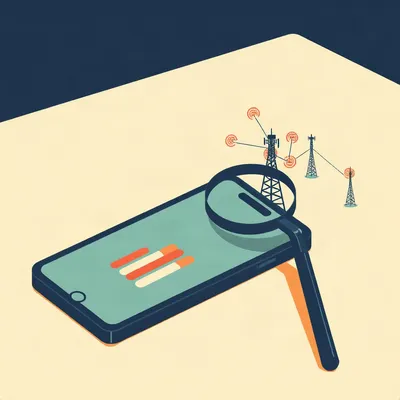
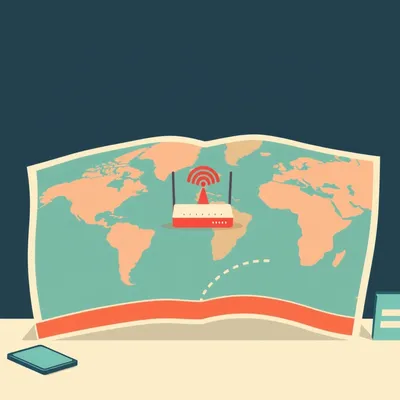
The map says covered, and the map is the problem. Coverage maps are modeled, not measured. There's a paper from this month, Koebe and others, on building a global mobile coverage raster at one kilometer resolution, and the thing they point out is that no globally consistent sub-national coverage record has existed. So what do you use as your tuning data when you build these maps? Operator-reported coverage.
The carriers' own claims.
The map is not ground truth. The map is the carrier telling you what the carrier believes, and the belief is generated from models, not from somebody standing in Daniel's apartment with a meter.
So that answers his last question before he even asks it. What's the point of the claim? The claim is the input to the map.
The claim is upstream of the evidence. That's the whole trick.
Layer two.
Layer two is spectrum band physics, and this is the most under-appreciated factor in the entire conversation. 5G is not one thing. It operates in three ranges. Low-band, which is wide coverage, on the order of five to two hundred fifty megabits per second. Mid-band, sub-six gigahertz, roughly ten to a thousand megabits. And high-band, millimeter wave, multi-gigabit, but it travels short distances and it's easily blocked by walls, windows, vegetation. High-band signals can lose over a hundred decibels passing through common building materials.
A hundred decibels is not a rounding error.
A hundred decibels is the difference between a signal and no signal. So two users on the same carrier, one block apart, can have wildly different experiences. One is on millimeter wave pulling a gigabit. The other has fallen back to LTE and is getting single-digit megabits if they're lucky.
So when Daniel says whether you get high-speed 5G or barely 4G depends on which patch of the city you're in, that's not marketing fluff alone.
That part is genuine radio physics. The physics is real. What's marketing is presenting all three bands under one label.
And there's a mechanism that makes the label even looser, right? The sharing thing.
Dynamic Spectrum Sharing. DSS. It lets 4G LTE and 5G New Radio share the same carrier. It's a common way for carriers to claim 5G coverage before they've deployed dedicated 5G spectrum, and in practice it often delivers only marginal gains over good 4G. So you'll see the 5G indicator on your phone, and you're essentially on a shared channel with the LTE traffic.
The indicator lights up and nothing happens.
The indicator lights up and you're on a slightly better version of what you had. That's a big part of the "5G that isn't" phenomenon.
Layer three. The congestion question, which is the one Daniel guessed at.
He guessed right on the mechanism. 5G was designed for up to a hundredfold projected capacity increase over 4G. That's a design target. It's not a guarantee, and it's not a promise about your cell site at seven in the evening. Where an operator has sold more subscriptions than its deployed capacity supports, everyone's quality of service degrades during peak load.
So it's not that they're throttling you deliberately.
It's not a conspiracy. It's oversubscription. It's the same arithmetic as an airline selling more seats than the plane has, except the plane is a radio channel and you can't bump anyone to a later flight.
And there's an operational gap underneath that, which I found interesting.
There is. There's a paper, Roy and others, on adaptive alarm thresholds in 4G networks. And the finding is that operators use fixed, manually-set alarm thresholds. They stay fixed regardless of time of day, traffic levels, or overall network conditions.
So the alarm that's supposed to catch a fault is calibrated for a quiet Tuesday morning.
And serious faults slip through during busy hours. Which is exactly when you'd notice them. So network degradation at peak isn't just physics, it's also a monitoring gap. The system isn't watching itself properly at the moment it most needs to.
That's a very specific kind of institutional failure. Nobody decided to degrade your service.
Nobody decided anything. That's what makes it so hard to complain about. There's no villain in the room.
Layer four.
Handover and mobility. 5G latency increases substantially during handovers, on the order of fifty to a hundred fifty milliseconds. And in a dense urban environment with lots of small cells, a user near a cell boundary can experience repeated, failed handovers.
Which feels like what?
It feels like the connection works now and again and mostly doesn't. It feels exactly like what Daniel described. And that's the synthesis here. His pattern, works intermittently, mostly doesn't, is the classic signature of congestion plus poor cell-edge signal plus handover failures. It's not a total outage. A total outage you could at least diagnose. This is a connection that keeps almost working.
Which is worse, in a way.
It's much worse, because it's intermittent. An intermittent fault defeats every diagnostic you have. You can't reproduce it, you can't prove it, and the support script doesn't have a branch for it.
So to answer his first question directly. Is it as simple as no antennas in a geography?
Partly. Thin cell density is real and it's the first layer. But it's compounded by spectrum band, by congestion, and by handover behavior. And his second guess, that they lack infrastructure and throttle everyone to a minimum, that's also partly right, except it's not throttling as a policy, it's oversubscription as a business decision.
Both of his hypotheses are correct and neither is complete.
Both correct, neither complete, and there are two more layers he didn't name. One of which is probably the one that explains his specific case.
So that's the mechanism. But Daniel asked a second question, and it's the one that takes us somewhere else. What's the point of the claim? And that takes us into marketing, regulation, and the strange economy of crowdsourced data.
Before we get to regulation, there's a layer we skipped, and I think for Daniel's specific experience it might be the most important one.
The wholesale layer.
If the slightly cheaper provider he moved to was an MVNO rather than a full mobile network operator, then it doesn't own spectrum or radio infrastructure at all. It buys wholesale capacity from a host network.
So it's a tenant.
It's a tenant, and the range of tenancy is wide. At one end you have a branded reseller that owns almost nothing, just a brand and a billing relationship. At the other end you have a full MVNO that owns its own core switching but still leases the radio access network from the host.
And a thin MVNO can't fix a radio problem.
It cannot fix a radio problem. It has no radio. All it can do is escalate to the host network, and the host network has no commercial incentive to prioritize a wholesale customer's traffic over its own retail subscribers. Why would it? Those are the customers paying it full price.
So Daniel's provider could have been doing everything right at its own layer and still delivering a terrible experience, because the thing that was broken was two layers below anything it controlled.
And this isn't a niche arrangement. As of August last year there were roughly two thousand one hundred and thirty-eight MVNOs globally against roughly eight hundred fifty to nine hundred fifty MNOs. That's about two point three eight MVNOs per MNO. The wholesale layer is a structural feature of the market, not an edge case.
Two and a half virtual operators for every real one.
And every one of them is selling you a subscription on infrastructure somebody else owns and somebody else maintains.
Now the marketing question. What actually constrains what a carrier can claim?
The canonical case is AT&T. In 2017 they introduced "5G Evolution," branded 5GE. And what it actually was, was upgraded LTE Advanced and LTE Pro. Carrier aggregation, four by four MIMO, two hundred fifty-six QAM. Theoretical speeds up to four hundred megabits per second, real-world around forty.
And it wasn't 5G.
It did not use 5G New Radio, which is the actual standardized 5G radio technology. It was LTE with a new name and a new icon in the corner of your screen.
So Sprint sued them.
Sprint sued in 2019, alleging the branding misled consumers into believing they were getting 5G. That dispute was settled. And then in 2020 the National Advertising Review Board, which is the US advertising industry's self-regulatory body, recommended that AT&T stop using "5G Evolution" and related claims, finding them misleading. AT&T disagreed with the finding but said it would comply with the self-regulatory process.
So the thing that stopped them was the industry policing itself.
The industry policing itself. Not a government regulator. A review board run by the advertising business. And that's the answer to Daniel's question, or at least the shape of it. In most geographies there is no hard legal rule preventing a carrier from claiming cutting-edge 5G while delivering patchy coverage. The claim is technically defensible because somewhere in the footprint, real 5G exists.
Somewhere in the footprint.
Somewhere. But somewhere, and that's enough to make the sentence true.
The claim survives because it's unfalsifiable at the level of the individual customer.
It's true in aggregate and meaningless in particular. And the only reason AT&T got any pushback at all was that they put a fake standard's name on the icon. If they'd just said "our best network yet," nobody could have touched them.
What about the EU?
The EU issued a recommendation back in 2003 pushing national regulators to open networks to MVNOs, which led to forced open-access rules in Ireland and France. But that's about competition, not about advertising truthfulness. It's a different regulatory axis entirely. Nobody in Europe has passed a rule saying you can't call your LTE network 5G.
And Israel specifically?
Israel specifically, I could not verify. I looked and I don't have a confident answer. The relevant bodies would be the Ministry of Communications and the Consumer Protection Authority, and I'd guess there's something on the books about misleading advertising in general, but I could not confirm a telecom-specific rule about network generation claims. So I'm flagging that as open rather than asserting it.
Fair. So the honest answer to Daniel is, some geographies have constraints, the US has a self-regulatory one, the EU has a competition one, and we don't know about here.
We don't know about here. That's the honest answer.
The claim is technically true and practically meaningless. Which brings us to the part of Daniel's prompt I actually find most interesting.
The crowdsourced data.
He said he always assumed those people were power users trying to eke out extra speed. And now he sees it's more practical than that. He's right, and I want to make the case for why.
Opensignal is the clearest example. Founded 2010, now Boston-based, acquired by Comlinkdata in 2021. And what they measure is real-world user experience, not theoretical coverage. Video Experience, Live Gaming, Voice App Experience, which explicitly includes WhatsApp, Skype, Facebook Messenger, download and upload speed, and Reliability. All of it from crowdsourced apps recording billions of measurements from real users globally.
Voice App Experience including WhatsApp.
Including WhatsApp. So there is a metric, published by an independent company, that measures precisely the thing Daniel couldn't do. Taking a WhatsApp call in his apartment. That metric exists. Somebody is measuring it.
The power user framing is completely backwards. Those people aren't hobbyists chasing speed. They're running the only measurement system that reflects what a customer actually experiences.
They're the only ones measuring the thing that matters. The carriers measure their own footprint and model it. Opensignal measures what happened to real people holding real phones.
Here's the part I love. Opensignal sells a product called Brand Licensing.
They do.
Which lets operators use Opensignal's independent data to validate their marketing claims.
The same crowdsourced data that exposes a bad network is also sold back to carriers to legitimize their marketing. That's the whole economy in one product.
The measurement that exists to protect consumers is also a marketing asset for the people being measured.
It's a beautiful arrangement. And it's not even cynical, necessarily. If you're a carrier and your network is good, buying the independent validation is rational. The problem is the incentive it creates for everyone else.
They launched a quarterly benchmark this year, right? The Global Network Excellence Index?
They did, 2026. A quarterly benchmark. Which is another step in the same direction, turning measured experience into a comparable, publishable thing.
Daniel's reassessment is correct and it's more correct than he maybe realizes. The crowdsourced community isn't a hobby. It's the closest thing the market has to an audit.
It's the audit function. And it exists because the official maps are built from the claims of the parties being audited.
Which brings us back to his practical situation. He ported back to a network with famously bad customer service because it worked.
That's the rational choice. Usable connectivity beats good support every time. Support is a thing you interact with occasionally. Connectivity is a thing you interact with constantly. If the choice is between a network that works and a support line that answers, and a network that doesn't and a support line that doesn't, you take the one that works.
The deferred eSIM plan is actually the right long-term answer for what he's trying to do.
It is. A data eSIM from a different provider decouples data quality from the local number. So the local SIM can be whatever is cheapest for receiving SMS and calls, and the data comes from whoever actually delivers at his address. A bad MNO can't take down the whole stack anymore, because it doesn't own the whole stack.
Which is the architectural lesson underneath all of this. Don't let one provider own the failure mode.
Test which network actually delivers at your specific address before you commit, because the map will not tell you.
There's one more layer to this, and Hilbert actually has something to say about it.
Hilbert: The routes were negotiated with marketing.
Say that again.
Hilbert: The drive-test routes. When I did a stint doing drive-testing for a regional carrier, you'd drive a prescribed loop with a laptop and an antenna on the roof, logging signal strength and dropped calls, and you'd hand the logs to an engineer who would nod and file them. And the routes were negotiated with the marketing department. Marketing.
The measurement was shaped by the people who wanted the measurement to look good.
Hilbert: They avoided the worst dead zones. Because those routes would have produced bad numbers. So the coverage map was built from a route that was chosen to look good. That's the whole thing. You drive where you're told to drive, you get the numbers you were always going to get, and the map comes out clean.
The map isn't just modeled from the carrier's claims. The claims themselves came from a route that was picked to flatter.
Hilbert: There was a name for the gap. They called it the last mile of the last mile. I always thought that was a meaningless phrase.
And now?
Hilbert: Now I think it meant the customer's actual apartment. The last mile of the last mile was the part nobody drove to.
The part nobody measured.
Hilbert: Anyway, I've got a delivery coming that needs a signature, and the window's nearly shut.
The route negotiation is the detail. That's the thing. It's not that the map is wrong because the model is bad. It's that the inputs to the model were selected by the department with an interest in the output.
The measurement was captured before it was ever taken.
Before it was ever taken. That's a much harder problem than a bad model.
Where does that leave us? If the measurement itself can be shaped by the people being measured, what would a truthful coverage claim even look like?
I don't have a clean answer. You'd need measurement that the carrier doesn't control, at a resolution fine enough to mean something at an address, and published in a form a customer can act on. Opensignal is the closest thing we have and it's still a company selling a product to both sides.
As carriers consolidate and the virtual operators keep multiplying, that gap between nominal and usable service probably widens rather than narrows. More resellers, same physical infrastructure, more subscriptions sold against capacity that isn't there.
The crowdsourced community Daniel once dismissed as power users may end up being the only reliable signal in the whole market.
Which is the one thing I'd take from this. The coverage map is not a measurement. It's a claim, and the claim is upstream of the evidence. Once you know that, the question stops being "why is my carrier bad" and becomes "who actually measured this."
The answer, almost always, is nobody the carrier didn't choose.
Daniel ported back to a network with terrible customer service because it worked. That's a rational choice in a market where the alternative is a connection that doesn't. And it tells you everything about what the market is actually optimizing for.
It's optimizing for the sale, not the service. The sale happens before the service does, and by the time you find out, you're in a contract.
Thanks as always to Hilbert Flumingtop for producing the show, and for the drive-test story.
This has been My Weird Prompts.
The human-AI collaboration podcast. If you want to send us something, email us at show at my weird prompts dot com. We read everything.
We'll be back soon.
See you then.