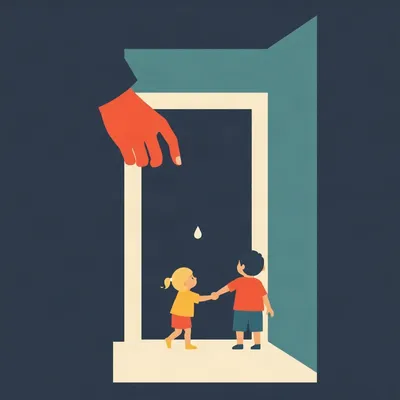
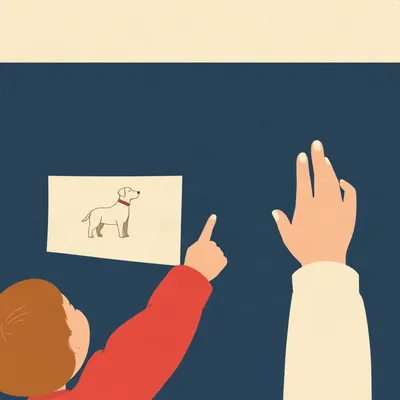
Before Ezra was born, I had never held a baby. I have one sister, no younger cousins, and the idea of holding someone else's infant felt like being handed a Fabergé egg made of anxiety. Then Ezra arrived, and suddenly I'm this baby guy. Hannah finds it hilarious. But here's the thing — I love it. I'm genuinely fascinated by watching this tiny person figure out the world. And I'm also completely flattened after about twenty minutes of solo care when the chaos kicks in and the screaming starts. I hit a wall.

That wall is real. I saw it plenty in practice. Parents would come in looking like they'd been through a spin cycle, and I'd think — you've been doing this for three hours. The professionals do it for eight, ten hours a day, with multiple children, and somehow they're still functioning.
That's exactly what I keep coming back to. I'm in awe of Ezra, but I'm also in awe of the people who do this professionally. And I don't mean in a sentimental, "angels among us" kind of way. I mean as a genuine puzzle. What kind of person chooses to spend their working life with infants and toddlers at scale? What psychological wiring does that take? And what kind of systemic support makes it sustainable — or fails to make it sustainable?
Daniel's prompt gets right at this. He sent us a really personal one — he's been reflecting on his first year as a dad, this transformation from someone who'd never held a baby to someone who finds them, in his words, "strangely amusing and endlessly curiosity-inspiring." But he also admits his capacity for chaos is finite. And he's asking, essentially, who are the people who do this for a living, and what makes them different?
There's a tension baked into that question. On one hand, Daniel's describing something beautiful — this genuine fascination with what's going on inside a baby's head. On the other hand, he's acknowledging that fascination alone isn't enough to sustain the work. Twenty minutes and he's done. So what bridges that gap? Is it character? All of it?
I'd say all of it, and the economics part is bleaker than most people realize. But before we get into the numbers, I want to name something Daniel's prompt surfaces really honestly. There's this cultural assumption that if you're a good person, you'll naturally love babies and be good with them. And if you don't, something's wrong with you. Daniel's picking at that — he notes that some people just don't want children, and a small percentage find them actively annoying. And he's not judging that. He's curious about it.
Which is a much more interesting place to start from. The question isn't "why are some people broken" — it's "what specific skills and dispositions make someone effective at this work, and are those things trainable?" Because if they're trainable, that changes the whole conversation about who we recruit into childcare and how we support them.
The research is starting to map this in really concrete ways. There's a study from last summer — Phys.org covered it in July twenty twenty-five — that looked at early childhood teachers and found something fascinating. The ones who score high on what psychologists call "emotional granularity" — the ability to make fine distinctions between emotional states — show about forty percent lower burnout scores.
Instead of looking at a crying nine-month-old and thinking "baby's upset," they're distinguishing between "baby's frustrated because the block tower fell" versus "baby's overstimulated because there's too much noise." That level of precision.
That's it. And it's not just a nice-to-have. It's a protective factor against burnout. When you can accurately label what's happening, you can respond more effectively, and the work feels less like chaos and more like a solvable puzzle. That's what keeps people in the field.
Which connects back to Daniel's experience. He's describing something that sounds a lot like the early stages of emotional granularity — this curiosity about what's going on inside Ezra. He finds babies "endlessly curiosity-inspiring." That's the raw material. But the professionals have trained that into a precise skill set, and they're applying it across multiple children simultaneously, for hours on end. That's a different order of magnitude.
They're doing it in a system that pays them poverty wages. The Berkeley Center for the Study of Child Care Employment released their Workforce Index in twenty twenty-four. Median wage for childcare workers is below fifteen dollars an hour. Forty-six percent rely on public benefits. One in five live in poverty.
One in five. While being responsible for the cognitive and emotional development of infants during the most neurologically sensitive period of human life.
The developmental stakes are enormous. New Scientist reported just last year that babies as young as six months show neural foundations for mathematical thinking — pattern recognition, quantity estimation, the ability to distinguish between four and eight objects. This isn't passive babysitting. This is active cognitive scaffolding during the period when brains are building their fundamental architecture.
We've got this wild disconnect. The science tells us the first two years are absolutely critical. Euronews just ran a major review last week — July second — recommending zero screen time in the first two years. Which means every moment of care requires a present, attuned adult. There's no technological substitute. And we're paying the people who provide that care less than fifteen dollars an hour.
The screen time recommendation is a bombshell. It puts enormous pressure on the quality of human interaction in childcare settings. If screens are off the table entirely for the under-twos, then every single interaction matters. There's no putting on a video to buy yourself ten minutes. The caregiver has to be on, attuned, and responsive, constantly.
Which makes the burnout numbers even more alarming. You mentioned the Berkeley data on poverty wages. What about the stress side?
There was a PRNewswire report earlier this year — a survey of childcare leaders and directors. Seventy-eight percent report high stress. Sixty-two percent work unpaid overtime every single week. That's the equivalent of an extra day of labor, uncompensated, week after week.
The people running these centers are burning out, the frontline workers are in poverty, and the developmental science keeps raising the bar for what quality care actually requires. That's not a workforce problem. That's a structural collapse.
Here's the mechanism that makes it so intractable. Parents can't pay more — childcare already rivals college tuition in most states. Workers can't earn less — they're already below the poverty line. The economic model is trapped. There's no slack in the system.
Which brings us back to Daniel's question with a sharper edge. Given all of that — the poverty wages, the burnout, the emotional demands, the zero-margin economics — who stays? What unites the people who are, as Daniel put it, truly and unusually committed to this work?
That's where the psychology gets really interesting. Because it's not just that they're more patient or more nurturing in some vague sense. The research is pointing to specific, measurable traits. Dispositional awe — the tendency to experience wonder and fascination in everyday situations. Emotional granularity — the precision labeling we talked about. And these aren't fixed personality traits you're born with. They're partially trainable skills.
That maps perfectly onto what Daniel's describing. He's experiencing awe at his own son — this genuine wonder at watching a tiny person figure out the world. The professionals have that same capacity, but they've developed it into a professional skill that works across children who aren't their own.
It protects them. org study found that teachers who can label "frustrated" versus "overstimulated" in a nine-month-old show forty percent lower burnout. That's a bigger effect than wage increases alone, which is a finding that should reshape how we think about professional development in this field.
The difference between Daniel hitting a wall at twenty minutes and a professional going eight hours isn't just stamina or saintliness. It's a trained skill set. Serve-and-return attunement.
Systemic support, or the lack of it. Even the most skilled professional can't sustain quality care indefinitely in a system that pays poverty wages and demands unpaid overtime. The skills protect against burnout, but they don't fix the economics.
So we've got two layers to this. The individual psychology — what makes someone good at this work and resilient in it. And the structural conditions — what makes the work sustainable or unsustainable regardless of individual traits. Daniel's question is about the people, but you can't answer it without looking at the system they're operating in.
There's a third layer worth exploring. The misconception layer. Because most people, if you ask them, would say childcare is unskilled work. It's just watching kids. Maybe changing some diapers. The reality is it requires high-level emotional cognition, constant pattern recognition, and the kind of attunement that most adults can't sustain for more than an hour.
The "just watching kids" thing drives me nuts. It's like saying a translator is "just listening to people talk." The skill is invisible to anyone who hasn't tried to do it.
That invisibility is part of why the wages are so low. We don't value what we can't see. The emotional labor of distinguishing "frustrated" from "overstimulated" in a pre-verbal infant, in real time, while also managing two other children, while also documenting everything for licensing requirements — that's cognitively demanding work. It just doesn't look like it from the outside.
Let me try to frame where we're going with this. Daniel's prompt gives us this personal window — new dad, never held a baby before, now fascinated, but aware of his own limits. From there, we want to understand the workforce that makes childcare possible. The burnout crisis. The psychological traits that predict who stays and who burns out. And what the developmental science tells us about why any of this matters — why the quality of infant care has stakes that go far beyond convenience for parents.
The Euronews screen time recommendation is the perfect framing device for why this is urgent right now. If the best evidence says zero screens before age two, then we have made a collective decision — whether we realize it or not — that human beings, not technology, will do the essential work of early cognitive development. And we are currently paying those human beings less than fifteen dollars an hour, with forty-six percent of them on public benefits.
That's the gap between what we know and what we fund. And that gap is where the burnout happens, where the turnover happens, and where the developmental consequences land — on the infants who lose consistent caregivers during the most sensitive period of their lives.
Let's get into the numbers, because the economic reality of childcare is stark, and it sets the stage for everything else.
The Berkeley Workforce Index breaks this down in a way that should make everyone uncomfortable. We're talking about nearly one point two million childcare workers in the U.Median hourly wage — thirteen seventy-one. For context, that's less than what most pet sitters charge.
These aren't teenagers doing summer work. These are adults, often with certifications and degrees, responsible for keeping tiny humans alive and developing during the most neurologically critical window of human life.
The Berkeley data shows that even among those with a bachelor's degree, the median wage only climbs to about sixteen dollars an hour. So education doesn't solve it. The wage ceiling is structural.
Which makes the forty-six percent on public benefits number almost inevitable. If you're making under fifteen dollars an hour, you qualify for SNAP, for Medicaid, for housing assistance. We're effectively subsidizing the childcare workforce through the social safety net while the industry itself can't pay a living wage.
That's the trap. Parents are already paying more than they can afford. Childcare costs rival in-state college tuition in most states — ten to fifteen thousand dollars a year per child. Families are making impossible choices. But the money isn't reaching the workers. It's going to rent, insurance, regulatory compliance, the fixed costs of running a licensed facility.
The economic model is a vise. Parents squeezed on one side, workers in poverty on the other. And in the middle, infants who need consistent, attuned, high-quality interaction — which the Euronews zero-screen recommendation just made non-negotiable. No screens means no shortcuts. Every moment of care is human labor.
Which brings us to the psychological puzzle. Given those economics, given the burnout numbers — seventy-eight percent high stress, sixty-two percent unpaid overtime — why do some people stay? And not just stay, but thrive? Daniel's question about what unites the truly committed ones — that's not just a nice thing to wonder about. It's a research question with real answers emerging.
The answers are surprising. The stereotype would be that the people who last in childcare are just more patient, or more nurturing, or more self-sacrificing. But the data points somewhere more specific. These are cognitive skills, not personality virtues.
That distinction matters enormously. If you think of childcare as requiring saintly patience, you're looking for saints. If you think of it as requiring trainable cognitive skills, you can build a workforce. You can teach people to notice the difference between a frustrated cry and an overstimulated cry. You can cultivate the habit of finding wonder in watching a six-month-old figure out that four objects and eight objects are different quantities — which, by the way, the New Scientist study confirms they can do. Someone has to be present enough to notice it and nurture it.
The episode we're about to build has three layers. The economic reality — brutal and structurally trapped. The psychological traits that predict who survives and thrives in that reality. And the developmental stakes — what the science says is actually happening inside baby brains that makes quality care so consequential.
The screen time recommendation ties all three together. If zero screens before age two is the evidence-based standard, then we've made human caregivers the only option. No technological cushion. No educational video loophole. Just people — underpaid, overstressed, and somehow still showing up with the emotional granularity to distinguish "frustrated" from "overwhelmed" in a pre-verbal infant.
That "somehow still showing up" part is the core of Daniel's question. What makes those people different? And can we replicate it, or are we just burning through a finite supply of unusually resilient humans?
Let's dig into the burnout piece, because it's worse than most people realize. The PRNewswire survey didn't just ask about general stress. Sixty-two percent of childcare directors are working unpaid overtime every single week. That's not occasional. That's structural. The equivalent of a six-day work week, every week, with no compensation for the sixth day.
Directors are the ones setting the tone. If leadership is running on fumes, that filters down to every teacher in the building. You can't fake attunement with an infant. They read your nervous system. A stressed caregiver produces a stressed baby.
That's the serve-and-return piece. The constant back-and-forth of reading an infant's cues and responding appropriately. You're tracking multiple children's states simultaneously, making micro-decisions about who needs what right now, while maintaining a calm exterior that regulates their nervous systems. Do that for eight hours without a break and you've done something most adults couldn't sustain for ninety minutes.
The Euronews review makes this non-negotiable. Zero screens before age two. That recommendation effectively says there is no acceptable substitute for human interaction in the first two years. Not educational content. Not video calls with grandma. So every single minute of care requires a present, attuned human being. You can't put on a video to reset the room. You can't use a tablet to buy yourself five minutes of documentation time.
Which means the emotional labor we're describing isn't optional and it isn't intermittent. It's continuous. And in a system where sixty-two percent of leaders are already working unpaid overtime, where do you find the capacity to be continuously present? You don't. Either the quality of interaction drops, or the worker burns out and leaves.
Turnover is its own crisis. Infants form attachment relationships with specific caregivers. When a teacher leaves, that attachment is disrupted. Do that repeatedly — which is what happens in centers with high turnover — and you're essentially training the infant's stress response system to expect inconsistency. That has long-term developmental consequences.
There's a direct line from the poverty wages to the turnover to the developmental outcomes. You can't separate them. The Berkeley data shows one in five childcare workers live below the poverty line. Those workers aren't staying in the field because the pay is good — they're leaving for better-paying jobs the moment they can. And the ones who stay are often subsidizing their own work through public benefits. We're asking people to be present, attuned, emotionally granular professionals while they're worrying about whether they can afford rent.
That's the structural trap in its purest form. Parents can't pay more. Workers can't earn less. And the Euronews recommendation just eliminated the only technological pressure-release valve anyone might have hoped for. No screens means no shortcuts. The labor is the labor.
Here's what makes it even more maddening. The developmental science keeps raising the stakes. The New Scientist piece from last summer — babies at six months can distinguish between four and eight objects. That's the neural foundation for mathematical reasoning. And it doesn't develop automatically. It requires interaction. Someone has to be there, counting objects, playing pattern games, responding to the baby's curiosity. That's cognitive scaffolding, and it happens in real time between a caregiver and an infant.
Reframe what a childcare worker is actually doing. They're not just keeping babies safe and fed. They're actively building the neural architecture for mathematical thinking, for language acquisition, for emotional regulation. And they're doing it for less than fourteen dollars an hour, with a forty-six percent chance of needing food stamps to feed their own families.
The term "unskilled labor" is offensive when you look at what the job actually requires. Serve-and-return attunement. Stress regulation for both self and infant. Simultaneous tracking of multiple children's developmental stages and emotional states. Communication with parents. And all of it performed continuously, with no screen breaks, for poverty wages.
Which brings us back to Daniel's question with the economic reality fully in view. Given all of this — the poverty, the burnout, the impossible economics, the rising developmental stakes — who stays? What unites the people who are, as Daniel put it, truly and unusually committed? Because it can't just be that they're nicer people. The system would have burned through nice people decades ago.
org study starts to answer that. Researchers looked at early childhood teachers and measured two things — dispositional awe, the tendency to experience wonder and fascination in everyday situations, and emotional granularity, the ability to make fine distinctions between emotional states. Teachers who scored high on both showed about forty percent lower burnout scores.
That's a bigger effect than most interventions we throw money at.
Here's the detail that reframes the whole conversation. The researchers weren't just measuring whether teachers could tell a happy baby from a sad baby. They were looking at precision. Can you distinguish "frustrated" from "overstimulated" in a nine-month-old? Those look similar on the surface — crying, fussing, pushing things away. But the causes are different, and the responses should be different. Frustration needs support to persist. Overstimulation needs quiet and reduced input.
If you misread overstimulation as frustration and try to engage more, you're making it worse. The baby escalates. You feel ineffective. Multiply that by eight hours and you've got a recipe for burnout.
The teachers with high emotional granularity don't make that mistake as often. They read the signals accurately, respond effectively, and the work feels coherent rather than chaotic. That coherence is protective.
Which means the difference between someone who finds babies annoying and someone who finds them fascinating might not be a character gap. It might be a skill gap. If you can't read what's actually happening, babies just seem like noisy chaos machines.
That's a really important reframe. Daniel mentioned in his prompt that a small percentage of the population just sees babies as an annoyance. The easy interpretation is that those people are cold or broken. But the emotional granularity research suggests something different — they may simply lack the perceptual skills to make sense of what they're seeing. It's like watching a sport you don't understand. It looks like random movement until you learn to read the patterns.
If it's a skill gap rather than a character flaw, that changes everything about how we think about recruiting and training childcare workers. We don't need to find saints. We need to find people with baseline curiosity and then train the granularity.
That's the practical implication that gets overlooked in policy conversations. Right now, the credentialing system for childcare workers is mostly about compliance — background checks, safety certifications, clocking professional development hours that are often generic and disconnected from the actual cognitive demands of the work. We reward paperwork over presence.
Paperwork over presence. That's exactly it. You can have every certification on the wall and still lack the emotional granularity to distinguish frustration from overstimulation in real time. And the infant doesn't care about your credentials. They care about whether you're reading them accurately.
org research points toward a different model. Emotional granularity is partially trainable. You can teach people to expand their emotional vocabulary, to notice subtle differences in facial expressions, body tension, vocal tone. These are perceptual skills that improve with practice and feedback.
A center that invests in that kind of training — teaching staff to name what they're seeing with precision — could theoretically cut burnout by forty percent without changing wages at all. That's not an argument against raising wages, to be clear. But it's a tool that's currently sitting on the table unused.
It connects directly to Daniel's experience. He described finding Ezra "strangely amusing and endlessly curiosity-inspiring." That's dispositional awe in its raw form. He's tapping into the same psychological resource that keeps professionals in the field. But without the trained emotional granularity and without systemic support, his capacity taps out at twenty minutes. The difference between him and a professional isn't character. It's skill and support.
That's humbling, actually. It means the awe I feel for Ezra — and the awe I feel for the people who do this professionally — are the same emotion. The professionals have just built an entire skillset on top of it, and they're applying it in a system that simultaneously demands everything from them and pays them less than a pet sitter.
The dispositional awe piece is worth sitting with, because it's not just about enjoying babies. It's a specific cognitive orientation — the tendency to notice and be moved by small moments of wonder. A six-month-old figuring out that four objects and eight objects are different quantities. An eleven-month-old discovering that a blanket can hide a toy but the toy still exists. These are astonishing events if you're paying attention. Most adults have forgotten how to see them.
The professionals who stay in the field haven't. They've retained or cultivated that capacity to find the work interesting at a cognitive level. It's not just warm feelings. It's intellectual engagement with what's happening inside a developing mind.
Which is why I think the "angels among us" framing that sometimes gets applied to childcare workers is actually counterproductive. It makes the work sound like a calling that requires supernatural patience. That's not what the research shows. It shows specific, trainable cognitive skills and a particular way of paying attention. Those are human capacities, not divine gifts.
If we treat them as trainable, we can build a workforce instead of just hoping enough unusually resilient people show up. That's the shift from "childcare is a vocation for special souls" to "childcare is a profession that requires specific skills we know how to teach.
What do we actually do with all of this? I've got three things that feel concrete, and they trace directly back to the research. First one's for parents — for Daniel, for anyone walking into a daycare tour trying to figure out if this place is actually good. Ask about staff turnover rates. But more importantly, watch whether the teachers narrate emotional states out loud. "You're feeling frustrated because the block fell." "You're overstimulated — let's find a quieter spot." That's emotional granularity in action. You're hearing it in real time. It's a proxy for quality and a predictor of whether the staff are burning out or staying.
That's a really practical heuristic. Most parents are looking at ratios and cleanliness and whether the art on the walls looks nice. Those things matter, but they don't tell you about the cognitive quality of the interactions. Listening for emotional labeling — that gets you closer to what actually predicts good outcomes.
Second takeaway is for policymakers, and it's uncomfortable because it complicates the obvious fix. Yes, raise wages. The Berkeley data makes that case overwhelmingly. But the Phys.org research shows that emotional granularity training cuts burnout by forty percent — which is a bigger effect than wage increases alone. If we're only throwing money at the problem without building professional development around these specific cognitive skills, we're leaving the most effective tool on the table.
The training isn't expensive in the way that wage subsidies are. It's about teaching people to expand their emotional vocabulary, to practice distinguishing subtle cues in infants. You can build that into existing professional development hours instead of the generic compliance modules most centers use. It's a high-leverage intervention.
Third one's more personal. For me, for Daniel, for anyone listening who's hit that twenty-minute wall and felt like they failed. Your finite capacity for chaos is normal. The professionals you admire have skills you can learn. Start by practicing the naming. When Ezra melts down, don't just think "he's upset.Is that frustration because he can't reach the toy? Is that overstimulation because there's too much happening? Is that genuine distress? The act of naming is the training. You're building emotional granularity in yourself, and you're modeling it for him.
Here's the open question I keep turning over. We now know what high-quality infant care actually requires. Professional development that builds real skills instead of checking compliance boxes. And the Euronews zero-screen recommendation removes any remaining fantasy of a technological shortcut. This is human work, period. So how do we scale it without burning through the very people who have what it takes?
That's the scaling problem in a nutshell. You can't automate attunement. You can't outsource serve-and-return to an iPad. And the people who are naturally good at this — the ones with high dispositional awe and trained emotional granularity — they're exactly the people most vulnerable to burning out in a system that exploits their commitment. The more you care, the more the unpaid overtime costs you.
We're currently losing them. The Berkeley data shows the turnover rate in this field is nearly double the national average for all occupations. Every time an experienced teacher leaves, an infant loses a consistent attachment figure. That's not just a staffing problem. That's a developmental event.
The gap between what we know and what we fund isn't abstract. It shows up in a nine-month-old's cortisol levels when their favorite teacher disappears and no one explains why. It shows up in the missed opportunity to build mathematical intuition because the new hire is overwhelmed and doesn't notice the baby counting objects. The science is clear about what infants need. The economics are clear about why they're not getting it. And the psychology is clear about what keeps the best people in the room. We're just not connecting those three things.
That's the final thought I want to land on. Daniel's awe for Ezra — and his awe for the professionals who do this work — those are the same emotion. It's curiosity about what's going on inside a tiny person. That curiosity, trained into emotional granularity and supported by a system that actually values the work, is the foundation of good care. The gap between what we know and what we fund — that's the real crisis.
Now: Hilbert's daily fun fact.
Hilbert: The Turkish oil wrestling festival known as Kırkpınar has been held annually since the 1930s, with the name "yagli güreş" literally translating to "oiled wrestling" — the olive oil coating is considered essential to the sport's technique, not just ceremonial.
I have so many questions, and I'm not sure I want any of them answered.
This has been My Weird Prompts. Our producer is Hilbert Flumingtop. If you enjoyed this episode, leave us a review wherever you listen — it helps. We'll be back soon.