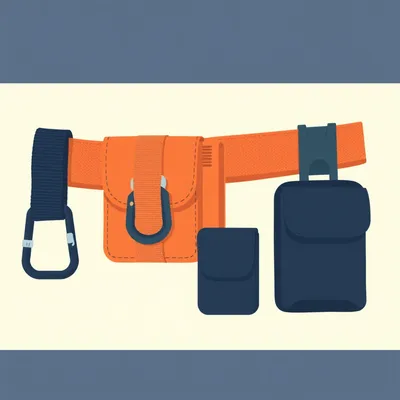
Daniel sent us this one — he's moving into a new apartment with his wife and their one-year-old son, and he's got this very specific problem. He's constantly fumbling around trying to find things: a power bank, his phone, a clip-on mic, scissors, multiple kinds of tape, an X-Acto knife, a headlamp with a spare battery, medications, a compact torch, and maybe a charger plug. He wants all of this on his waist, always within reach, and he wants to not look completely absurd. The question is: can you actually get all this onto a belt in some logical way?

Oh, this is a great prompt. And the timing is perfect — he's unpacking and setting up a new apartment, which is basically the ultimate stress test for any carry system. You're doing a hundred tiny tasks a day, you're constantly moving between rooms, and every time you set something down it vanishes into a box you haven't unpacked yet.
The box that ate the box cutter.
So the waist-level approach makes total sense here. And the spec is actually more interesting than a standard tool belt because it's this hybrid of DIY tools and everyday electronics. You've got a power bank and scissors living next to each other. That's not a normal pairing.
It's like a tradesperson who also runs a podcast.
Which, I mean, these days, that's not even unusual. But let me start with the core question: can you fit all this on a belt? The answer is yes, absolutely. But the way you do it matters enormously, because there's a real risk of ending up looking like you're cosplaying as a Home Depot employee at a tech conference.
The Batman utility belt for people whose villain is a missing roll of Velcro tape.
So let me break this down systematically. The items fall into roughly three categories. Category one: slim, flat, or pocketable things — your phone, the clip-on mic, medications, maybe the compact torch if it's a penlight. Category two: bulky cylinders and bricks — the power bank, the headlamp, the spare battery pack, the charger plug. Category three: long or awkward shapes — scissors, the X-Acto knife, rolls of tape.
Three different physical profiles. So you're probably not solving this with one pouch.
And that's actually a good thing. A single large pouch turns into a junk drawer on your hip. You're still fumbling, just at waist level instead of around the house. The key is modularity — separate homes for separate shapes, each instantly accessible without looking.
Which brings us to the actual product question. What's out there that can do this?
There are a few routes you can go. The first is a dedicated tool belt system — something like the Occidental Leather pouches, which are beautiful and indestructible but also very much read as "I am a finish carpenter." They're leather, they're heavy, they're expensive, and they're overkill for scissors and a power bank.
Also, wearing a full Occidental rig while unpacking boxes in your own living room is the sartorial equivalent of showing up to a potluck in a chef's jacket.
The second route is tactical-style MOLLE belts and pouches — think Maxpedition or similar. Very modular, lots of pouch options, but you run into the opposite aesthetic problem. You're not a carpenter anymore, you're a private military contractor who's been hired to assemble an IKEA bookshelf.
"Bravo team, we have contact with a Billy bookcase. Requesting Allen key support.
The third route, which I think is the sweet spot here, is what the everyday carry community calls an EDC belt pouch or a waist pack system — something designed for civilians who want their stuff organized and accessible but don't want to look like they're wearing a uniform. This is where brands like Alpaka, Aer, and even some of the smaller makers on Etsy really shine.
Walk me through a specific setup. If you were building this belt from scratch for this exact list of items, what are you actually buying?
Okay, let me build this piece by piece. First, the foundation: the belt itself. You want something stiff enough to support weight without sagging but not so tactical that it screams "range day." I'd look at something like a Grip6 belt — it's a nylon webbing belt with a low-profile buckle, no holes, infinitely adjustable. It's stiff enough to carry a load but it just looks like a belt. About forty bucks.
Here's where it gets interesting. For the power bank, which the prompt describes as pretty chunky, I'd actually recommend a dedicated phone-sized pouch that sits at about the four o'clock position on the belt. Something like the Alpaka Hub Pouch — it's designed to hold a phone plus a power bank, it's slim, it has internal organization, and it looks like a small tech accessory, not a tool pouch. That handles the power bank and probably the phone too if he wants it off his pocket.
The clip-on mic could slip in there as well.
Next, for the scissors and X-Acto knife — these need to be instantly accessible and also somewhat protected so you're not stabbing yourself when you bend over. I'd go with a small tool pouch designed for electricians. Electricians carry lots of small, pokey things. Klein Tools makes a leather utility pouch that's about four inches wide, has a couple of internal dividers, and it's designed to sit on a belt. It's not huge, it's not flashy, and it'll hold scissors, the X-Acto, and maybe even the compact torch.
What about the headlamp and the spare battery? Those are bulky but lightweight.
The headlamp is actually the trickiest item on this list. It's got an elastic strap, it's oddly shaped, and you don't want it getting tangled with everything else. My recommendation is a small dump pouch — something like the Maxpedition Rollypoly or a similar collapsible pouch. When it's empty or holding just the headlamp, it folds up flat against your belt. When you need to toss things in quickly, it expands. The headlamp lives in there, maybe with the spare battery pack.
A dump pouch for a headlamp. That's very specific.
It's the right tool for the job. And it solves a real problem — the headlamp is something you're taking on and off repeatedly. You don't want to be threading it through a tight loop every time. You want to drop it in and pull it out in half a second.
Like a holster for your forehead.
Now, the rolls of tape — Velcro tape and electrical tape — these are cylinders with holes in the middle. There's an entire category of product designed specifically for this: a tape thong or tape loop. It's basically a small nylon strap with a snap or clip that threads through the center of a tape roll and hangs from your belt. Or, if you want something more integrated, some tool pouches have a built-in tape loop on the side. Either way, your tape is riding externally where it's accessible but not taking up internal pouch space.
The medications and small bits — that's just a tiny zippered pouch, right?
Something like the size of a coin purse. You can get a small EDC organizer pouch from pretty much any brand — Alpaka makes one, but honestly, even a simple zippered pouch from Muji or a camping store will do. That clips onto the belt with a carabiner or a small loop, sits flat, and handles the meds, maybe a few cable ties, whatever small bits and pieces need a home.
We've got: a Grip6 belt, an Alpaka Hub Pouch for the power bank and phone and mic, a Klein electrician's pouch for scissors and the knife and torch, a Maxpedition Rollypoly for the headlamp and spare battery, a tape loop for the tape rolls, and a small zippered pouch for meds and bits. That's six items on the belt.
Six items, but several of them are very small. The Hub Pouch is maybe five inches wide. The Klein pouch is four inches. The Rollypoly folds down to almost nothing. The tape loop is just a strap. The meds pouch is the size of a golf ball. You're not wearing a hula hoop of gear. You're wearing a belt with some thoughtfully placed accessories.
The charger plug is the one thing we haven't placed.
The charger plug is small enough that it can drop into any of these pouches — probably the Hub Pouch with the power bank, since they're functionally related. Or the meds pouch if there's room. It doesn't need its own dedicated holster.
The system works on paper. But let me push on something. You're describing a belt with six attachments. Even if they're small, that's a lot of things clipped on. Is this actually comfortable to wear for hours while you're bending down, picking up boxes, chasing a one-year-old?
That's a fair question, and it gets at something important. The comfort of a belt system depends almost entirely on weight distribution and how the pouches sit against your body. If everything is hanging loosely and swinging around, it's miserable. If everything is snug and the weight is balanced, you forget it's there.
What makes it snug?
First, the belt itself needs to be stiff enough that it doesn't twist or roll under load. The Grip6 or something similar handles this. Second, the attachment method matters. A lot of pouches come with a simple belt loop, which is fine for something light like the tape loop, but for anything with weight — the power bank, the scissors — you want a pouch that either has a wide belt loop or uses a clip system that locks onto the belt securely. Some of the better EDC pouches use a webbing loop with a snap closure, so the pouch isn't sliding around.
The weight balance?
You don't want all the heavy items on one side. The power bank is probably the heaviest single item. Put that at four o'clock. The scissors and knife in the Klein pouch are next heaviest — put that at eight o'clock. The headlamp is light, the tape is light, the meds pouch is light. You spread the mass around your waist and you barely notice it.
The spec works. But there's a deeper question here that I think is worth pulling on. This prompt is asking for a tool belt, but it's really asking for something more fundamental: a way to stop losing things in your own home.
And that's actually a much more interesting problem. The tool belt is the solution to a specific version of it — the version where you're moving around a lot and need hands-free access. But the underlying issue is what I'd call working memory offloading.
Which is something we've talked about before in the context of ADHD and parenting.
When you're holding a one-year-old, your hands are occupied, your attention is fragmented, and your working memory — the mental scratchpad that keeps track of where you put things — is completely overwhelmed. You set the scissors down on a box, the box gets moved, and now you've lost the scissors. The belt solves this by making "where I put it" and "where it always lives" the same place.
The belt as externalized memory.
It's not just about convenience. It's about reducing cognitive load. Every time you don't have to think "where did I leave the tape," you've saved a little bit of mental energy that can go toward something else — like not tripping over a box or remembering that the baby needs a diaper change.
The ridiculousness threshold shifts. You might look a little silly with six pouches on your belt, but you look a lot sillier wandering around your own apartment muttering "where are the scissors" for the fourth time in an hour.
I think the prompt acknowledges this tension directly. The phrase is "preferably not look completely absurd." That's not asking for fashionable. That's asking for "not a complete spectacle." And I think the setup I described clears that bar. It's not a fashion statement, but it's not a Halloween costume either. It reads as "person who is getting things done" rather than "person who wandered off a construction site.
There's also something to be said for the psychology of wearing the belt. When you put on a tool belt, you're signaling to yourself that you're in work mode. It's a ritual. You clip it on, and suddenly you're not just wandering around the apartment — you're executing.
That's a real phenomenon. The same way putting on work clothes when you work from home changes your mental state, strapping on a tool belt puts you in a productive frame of mind. It's a physical commitment to the task.
Alright, so we've built the system, we've defended it against the absurdity charge, we've talked about the cognitive benefits. Let me ask a practical question: what does this whole setup cost?
Let me price it out roughly. The Grip6 belt is about forty dollars. The Alpaka Hub Pouch is around thirty-five. The Klein electrician's pouch — you can get a basic leather one for about twenty-five. The Maxpedition Rollypoly is around thirty. A tape loop is maybe eight dollars. A small zippered EDC pouch is fifteen to twenty. So we're looking at somewhere around a hundred and fifty to a hundred and seventy dollars total.
That's not nothing, but it's also not insane for what you're getting — which is essentially a personalized inventory system for your daily life.
Compared to the cost of replacing items you've lost because you set them down somewhere and forgot, it might actually pay for itself. A good power bank is forty bucks. A good headlamp is thirty. If the belt prevents you from losing either of those once, you're halfway to breaking even.
Plus the time savings. The time spent looking for things is real, and it adds up fast.
There was a study a few years back — I think it was a survey by a storage company — that found the average person spends something like ten minutes a day looking for misplaced items. That's over sixty hours a year. Sixty hours of just... where's my stuff.
That's a week and a half of waking life spent hunting for things you already own.
When you phrase it that way, a hundred and fifty dollars for a belt system that eliminates most of that seems like an incredible bargain.
Alright, so we've made the case for the belt. Let me play devil's advocate for a moment. Why not just use a small crossbody sling bag? Something like a Bellroy Lite Sling or an Aer Day Sling? You could fit all of this in there, it's one item instead of six, and it arguably looks more normal.
That's a strong counterargument, and honestly, for a lot of people, the sling is the better answer. But there are two reasons the belt wins for this specific use case. First, access speed. With a sling, you have to swing it around to your front, unzip it, find the item, zip it back, swing it back. With a belt system, each item has its own dedicated external home — you reach for the scissors and your hand knows exactly where they are. No zippers, no swinging, no looking.
The difference between half a second and three seconds.
Which doesn't sound like much until you're doing it fifty times in an afternoon while holding a baby. The second reason is body mechanics. A sling bag, even a small one, adds asymmetrical weight across your torso. When you're bending over repeatedly — which unpacking involves constantly — it swings forward and gets in the way. A belt system moves with your hips and stays out of your path.
The belt is the more ergonomic choice for this particular set of movements.
For unpacking and setting up a home, absolutely. If the prompt were about walking around a city or commuting, I'd say get the sling. But for this — bending, lifting, reaching, climbing step stools — the belt is the right tool.
There's one more item on the list I want to circle back to: the plug for charging the phone. It's such a small thing, but it's also the kind of item that's incredibly easy to lose because it's tiny and you only need it occasionally. Where does it actually live in this system?
I'd put it in the meds pouch, honestly. It's small enough, you don't need instant access to it, and the meds pouch is the catch-all for the tiny things. Alternatively, if the Hub Pouch has a small internal pocket — and most of them do — it could slip in there with the power bank cable.
The cable itself — was that on the list?
The prompt mentions a power bank and charging, so I'm assuming there's a cable in the mix somewhere. That's another small item that needs a home. I'd coil it and put it in the Hub Pouch with the power bank. Maybe secure it with a small Velcro strap so it doesn't tangle.
The cable management becomes part of the system too.
It has to be. Cables are the enemy of organization. They're the snakes in the garden.
"The snakes in the garden." That's almost poetic for a donkey talking about USB cables.
I have my moments.
Let's talk about the tape situation for a second. The prompt specifies Velcro tape and electrical tape. Those are very different use cases. Velcro tape is for cable management, mounting things, temporary fixes. Electrical tape is for... well, electrical things. But also it's just useful for labeling, temporary holds, all kinds of stuff. Are they both riding on the tape loop?
The tape loop can handle two rolls, but they'd be stacked, which makes accessing the bottom one annoying. A better solution might be two separate tape loops, or one tape loop and one roll just dropped into the dump pouch with the headlamp. The electrical tape is small enough that it could even live in the electrician's pouch — which is thematically appropriate.
Electrical tape in the electrician's pouch. We're building a little ecosystem here.
That's exactly what a good carry system is. It's not just a collection of pouches — it's an ecosystem where each item has a logical home based on how often you need it and what other items it relates to. The power bank and phone live together because they're functionally connected. The scissors and knife live together because they're both cutting tools. The headlamp lives in the dump pouch because it's bulky and you're taking it on and off. Everything has a reason for being where it is.
Once you've established that logic, you don't have to think about it anymore. Your hand just goes to the right place.
Muscle memory takes over. That's the goal. You want the system to become invisible. The best tool belt is the one you forget you're wearing until you need something, and then it's right there.
Which brings us back to the absurdity question. The most absurd thing isn't wearing a tool belt in your own home. The most absurd thing is spending ten minutes looking for the tape while your phone dies and your baby starts crying.
Alright, so we've got a solid recommendation. But let me ask a slightly different question: what if you don't want to buy six different products from six different brands? Is there an all-in-one solution that gets close?
There are a few contenders, but none of them nail the spec perfectly. Something like the Diamondback Tool Belt — the Niko pouch or the Grrande setup — is designed for finish carpenters and has multiple pockets and slots, but it's very much a tool belt aesthetically and it's built for construction tools, not power banks and clip-on mics. The Atlas 46 Yorktown vest or belt system is modular and well-made, but again, it reads as "I build houses.
The all-in-one solutions all lean too far into the tradesman look.
They do, because that's who they're designed for. The EDC community has filled the gap for people who want organization without the vocational aesthetic, but they've done it with individual pouches rather than integrated systems. It's a gap in the market, honestly. Someone should make a modular civilian tool belt that doesn't look like you're about to frame a wall.
"The dad belt.
I mean, unironically yes. There's a huge market of parents, hobbyists, and remote workers who need exactly this — a way to keep their daily tools organized and accessible without looking like they're cosplaying a trade. The success of brands like Alpaka and Aer in the sling and pouch space suggests the demand is there.
If you're building this system today, you're essentially MacGyvering it from existing products that weren't quite designed for this use case but happen to work well together.
Which, honestly, is how a lot of great carry setups come together. You start with the problem, not the product. You figure out what you need to carry, how you need to access it, and then you find the containers that fit those requirements. The result is always going to be more personalized — and more effective — than anything you could buy off the shelf.
There's one more angle I want to explore. The prompt mentions this is for the next few weeks — unpacking and setting up a new apartment. But reading between the lines, this feels like it might become a permanent system. The spec is too detailed, too considered, for a temporary solution.
I got the same impression. This is someone who's thought carefully about what they need within arm's reach at all times. The unpacking is the catalyst, but the underlying need — keeping these specific items organized and accessible — doesn't go away once the boxes are empty.
The question becomes: does this system work for daily life after the move, or is it purely a moving-day rig?
I think it transitions well, but you'd probably slim it down. Once you're not actively unpacking, you don't need the scissors and tape every hour. You might drop the tape loop and the electrician's pouch from the daily carry and keep just the Hub Pouch, the dump pouch for the headlamp, and the meds pouch. That's a much more subtle setup — three small pouches on a belt, barely noticeable under an untucked shirt.
A modular system that scales up and down depending on what you're doing that day. Heavy-duty unpacking mode versus everyday parent mode.
That scalability is another argument for the individual-pouch approach over the all-in-one solution. You can't easily remove half of an integrated tool belt. But you can unclip a pouch in two seconds.
Let's talk about one more specific item: the X-Acto knife. The prompt specifies "properly retractable," which is a safety consideration with a one-year-old in the house. Even on a belt, you want to be sure that thing isn't going to deploy accidentally.
That's an excellent point, and it's worth being specific about. A standard X-Acto knife with a cap is not safe for this kind of carry — the cap can come off in a pouch, and now you've got an exposed blade in there. What you want is a retractable utility knife with a positive locking mechanism. Something like the Olfa touch-knife or a retractable snap-off blade knife where the blade physically retracts into the handle and locks. Those are much safer for belt carry.
You can still get the precision of an X-Acto with a fresh snap-off blade.
The snap-off blades are actually sharper than a standard X-Acto because you're always working with a fresh edge. And when it's retracted and locked, it's completely safe — no cap to lose, no exposed edge.
We've just upgraded one item on the spec. The X-Acto becomes a retractable snap-off knife.
That's the kind of detail that matters when you're actually building this system. The spec is a starting point. The implementation requires making these small judgment calls based on safety and practicality.
Alright, let's zoom out for a moment. We've spent a lot of time on the specifics of pouches and belts. But I think there's a broader principle here that's worth naming: the right tool for the job includes the tool that holds the tools.
Say that again.
The right tool for the job includes the tool that holds the tools. We spend a lot of time thinking about which scissors to buy, which headlamp to buy, which power bank to buy. But we don't spend nearly enough time thinking about how those items live in our physical space. The container is part of the system. A great headlamp that you can never find when you need it is worse than a mediocre headlamp that's always on your belt.
That's the entire philosophy of organization in one sentence. The best tool is the one you can find.
The best finding system is one where the tool doesn't move.
Which is why the belt works. Every item has a fixed address. The headlamp lives at the eight o'clock position in the dump pouch. It never lives anywhere else. You never set it down on a shelf "just for a second." It goes back in the pouch every single time.
Discipline is part of the system. The belt only works if you actually use it.
Here's the thing — the belt makes the discipline easy. It's harder to set something down on a random surface than it is to drop it back into its pouch. The path of least resistance is the organized one. That's good design.
The path of least resistance leads to the dump pouch.
And that's the whole game. You're not fighting your own habits. You're designing an environment where your natural laziness works in your favor.
I feel like we've just described the entire field of user experience design in the context of waist-mounted pouches.
I'm not saying Don Norman should have written about tool belts, but I'm not not saying that.
Okay, so to bring this home: the recommendation is a modular belt system built from EDC and light trade components. Grip6 belt, Alpaka Hub Pouch, Klein electrician's pouch, Maxpedition Rollypoly dump pouch, tape loop, small zippered organizer. Total cost around a hundred and fifty to a hundred and seventy dollars. Swappable configuration depending on the day's needs. And the underlying philosophy is: give everything a fixed home on your body so you never have to think about where you put it.
That's the summary. And I'd add one more thing: start with fewer pouches than you think you need. It's easier to add than to subtract. Maybe begin with just the Hub Pouch and the electrician's pouch, see how it feels, then add the dump pouch and tape loop if you need them.
Iterative tool belt development.
Agile carry methodology.
We've officially been in the tech world too long.
We really have.
Now: Hilbert's daily fun fact.
Hilbert: In the nineteen seventies, researchers studying ancient quipu — the knotted-string recording devices of the Inca Empire — discovered that some of the cotton cords had been dyed with cochineal, a deep crimson pigment made from crushed insects. The same dye was also being exported from Peru to Chad in the same decade for use in traditional textile coloring, creating a bizarre historical loop where a five-hundred-year-old Andean pigment technology briefly re-entered central African supply chains through international aid craft programs.
The Inca and Chad were swapping bug-juice dye in the nineteen seventies.
History is just a series of incredibly specific events that nobody tells you about.
This has been My Weird Prompts. Thanks to our producer Hilbert Flumingtop, and thanks to all of you for listening. You can find more episodes at myweirdprompts.com or search for us on Spotify. If you enjoyed this, leave us a review — it genuinely helps. We'll be back soon.