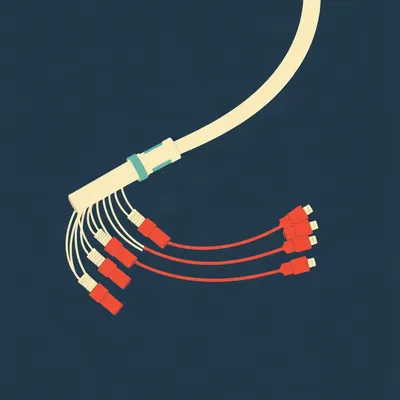
Daniel sent us this one — he wants to talk about dark fiber, which he rightly notes sounds way more glamorous and sketchy than it actually is. The core questions are straightforward but they open up a whole world. Are we literally talking about individual strands of glass inside a fiber conduit? And the bigger puzzle — why does dark fiber exist at all? You'd think if you lay a pipe for internet, it's just one big pipe that fills up with however much data is moving. We don't talk about dark water infrastructure. So what is it about how fiber optic cable is actually deployed that means multiple strands are put down, not used as one shared pipe, but as subdivided units?

I love this question because the very phrase "dark fiber" does all this heavy lifting — it sounds like something from a Gibson novel, like a shadowy underground network running beneath corporate arcologies. And the reality is, as Daniel flagged up front...
It's basically glass spaghetti sitting silently underground.
Individual strands of glass, thinner than a human hair, stretching for miles with no light running through them. Not a single pipe, not a shared trough — discrete, separate strands, each one its own potential channel. And the fact that the name sounds so cyberpunk when the reality is this mundane — it's the marketing victory of the telecom industry's entire century.
Dark water infrastructure would be deeply concerning as a phrase.
A reservoir with nothing in it is a crater. But dark fiber is a feature, not a failure state. That's the starting insight here.
Let's get to the first piece. Are we literally talking about individual strands?
A fiber optic cable going into a trench contains anywhere from a dozen to nearly three hundred individual glass fibers. Think of a cross-section: you've got an outer protective jacket, then layers of steel or Kevlar armoring, then little color-coded buffer tubes, and inside each tube, half a dozen or twelve glass fibers. Each one of those fibers is a completely separate waveguide. One tiny cylinder of ultra-pure glass, roughly a hundred twenty-five microns in diameter, a bit thicker than a sheet of paper.
Niche physical descriptor. Though now I'm picturing a cable cross-section like one of those fancy sushi rolls where every color on the inside means a different thing.
That's not a bad analogy, actually. The buffer tubes are color-coded precisely so technicians can identify which fiber is which when they're splicing at a junction box in some underground vault at two in the morning. Blue, orange, green, brown, slate, white, red, black, yellow, violet, rose, aqua. That's the standard twelve-color sequence, and they just repeat it with ring markings for higher-count cables.
There's a whole Rosetta Stone of glass spaghetti identification down there.
There really is. And when that strand goes dark, it's genuinely just glass sitting there with no photons moving through it. No laser at one end, no photodetector at the other. The physics still works — the strand could carry light tomorrow — but nobody's hooked it up yet.
Okay, so why not just make one big fat strand all the light goes through together? This feels like the obvious question, and I assume the answer is going to hurt my brain.
This is where the water pipe analogy collides with reality and explodes. Water is a continuous fluid. You push water into one end of a pipe, it just fills the cross-section more or less evenly. Greater demand means turning up the pressure or accepting a lower flow rate, but it's all in the same physical volume. Light doesn't work that way. A fiber optic strand works on total internal reflection. Light enters at one angle and bounces down the length of the glass, confined by the fact that the core has a slightly higher refractive index than the cladding around it. If you tried to just shove broad, unfocused light into a giant fiber, you'd get chaos — some angles would leak out immediately, others would take wildly different paths and arrive scrambled.
The fiber as a discrete narrow strand is not a choice. It's inherent to the physics.
The geometry of a single-mode fiber — the type that carries data over long distances — has a core only about nine microns across. That's specifically sized so that exactly one spatial mode of light propagates through it. The light is effectively a narrow coherent beam channeled down a very precise glass hallway. And one hallway carries one data stream per wavelength. You can't just pipe extra traffic into that same nine-micron core and have it sort itself out later. Each strand really is a discrete channel.
From the start, the entire premise is: fiber infrastructure is basically a bundle of dedicated private corridors, not a shared open highway. That's wildly different from anything in water or gas.
Yet the road analogy does land — not for the glass itself, but for the trench. Think about a highway. When you build a road, you don't just pave one lane and call it done. You build multiple lanes, even if traffic today only fills one. Because the asphalt is the cheap part compared to acquiring the land, grading the terrain, building the overpasses. Same logic applies underground, but more extreme.
Let's do the numbers. I know you have them.
The one number everyone in this industry memorizes: around eighty percent of the cost of deploying fiber is the trench. Civil engineering, permits, backhoes, traffic control, cutting through pavement, navigating existing utility corridors, restoring surfaces. That all costs somewhere between fifteen thousand and a hundred fifty thousand dollars per mile depending on whether you're in a rural grassy shoulder or downtown Manhattan. Meanwhile the fiber cable itself is about a dollar to two dollars per meter per strand.
Asphalt versus glass, basically.
So if you're already paying a hundred thousand dollars per mile to dig a trench and put conduit in the ground, and you're deciding what to stuff into that conduit, the incremental difference between running a cable with twelve strands and running a cable with one hundred forty-four strands is tiny. Maybe twenty-five percent more on materials cost for ten times the capacity. You put in the biggest bundle that makes economic sense.
Because the trench isn't getting dug again for decades. Concrete gets poured. Buildings go up. Nobody wants permits the second time. It's the platonic burial with no revival.
Which brings us to the 2025 Federal Communications Commission estimate that about twelve percent of installed fiber in the United States is actually lit. That number's been kicking around for a while, but the latest survey confirmed it. Eighty-eight percent is dark. Four out of every five glass highways somebody paid to install into that very expensive trench are just sitting there, silent.
Twelve percent sounds almost unbelievably low. Is that because it was always planned that way, or because of some miscalculation? I need to know whether this is strategic brilliance or the ghost of a mistake.
But the miscalculation piece — the ghost — is real and we'll get to it. The basic economics are: light what you need now, leave headroom for growth, and if someone else wants to lease the dark strands, do so under something called an indefeasible right of use. That's the legal instrument where a carrier gives a customer a permanent or multi-decade right to use a specific strand or set of strands.
Of course there are. There's a word that was definitely coined by a lawyer who wanted to sound like a wizard.
It's magnificent, isn't it? It means a right that cannot be defeated, annulled, or voided. You basically own that glass for the term of the agreement. I realize that sounds like abstract contract law, but it's the actual vehicle for the entire dark fiber leasing market. Google, when it builds a tie between two data centers, often doesn't trench its own fiber. It buys an IRU on dark strands from a Level 3 or a Lumen or a Zayo — effectively an exclusive or near-exclusive dedicated optical path between two locations.
Another company's speculative over-build becomes Google's private neural superhighway.
A carrier buried it twenty years ago in a moment of classic telecom hubris, sat on it through bankruptcy, and now it's a linchpin for AI training clusters. More on that later.
We still haven't pushed the water analogy until it bleeds out. Let's do that. I've heard people say "just push more internet through the pipe, we do it with water." Why does the physics make that a category error?
Take water: pressure at one end, you turn a valve, water moves. More demand means faster flow, higher pressure, or bigger pipe. The underlying medium is continuous. Water molecules take whatever path is available and there's no inherent separation except the pipe walls.
The plumbing has forgiven our failures.
Now take fiber: you fire a laser diode with a specific wavelength, say 1550 nanometers. That beam enters the nine-micron core of a single-mode strand. The glass confines it, and it travels potentially a hundred kilometers or more before it needs amplification. The total light capacity of that strand isn't a single bucket you pour data into. It's not about the intensity — you can't just turn up the pump laser brighter and double the data rate. Information is encoded by modulating the light's amplitude, phase, or polarization at the rate of billions of pulses per second.
You eventually hit a wall where the physics of the light itself won't cooperate.
The relevant ceilings are chromatic dispersion — different components of a light pulse spread out over distance — and nonlinear effects where too much optical power starts distorting the signal. If you crank the power high enough, the glass itself starts behaving in weird ways. You get something called four-wave mixing where two wavelengths spontaneously generate ghost wavelengths that interfere with everything else. It's like shouting so loud in a room that the air itself starts echoing back at you in distorted frequencies.
The medium pushes back. There's a physical ceiling, not just a logistical one.
There are solutions, of course. You can overlay multiple wavelengths on the same fiber using wavelength-division multiplexing. Think of this as different colors of light, perhaps eighty or a hundred of them, each carrying its own data stream independently. A single strand with WDM can carry something like ten to twenty terabits per second now. Way more than traditional water-through-a-straw thinking would suggest. But crucially, each wavelength in that WDM stream is still a logically separate channel. And the entire strand is a discrete physical entity. If you need a dedicated path to a different building entirely, you can't just split your one strand at the curb like splicing a water line. Each drop requires its own strand coming off the distribution cable.
The physics — single mode core is nine microns wide, it carries one coherent path per wavelength, and chaos ensues if you try to smash in anything undisciplined. The economics — digging a trench is a fortune. The optics remain cheap. That combination forces subdivision into strands by default. The big pipe is a myth. Do I have our setup?
You've got it.
All right, let's get into multiplexing properly. Wavelength-division multiplexing — give us the scale. How many colors are we actually talking about?
Right now the industry standard for dense WDM — DWDM — runs eighty to ninety-six wavelengths in the C-band, which is around 1530 to 1565 nanometers. That's the sweet spot where the glass has the lowest attenuation. A newer generation called super C-band pushes that into the 120 wavelength range, and if you also use the L-band — roughly 1565 to 1625 nanometers — you can double it. Each wavelength currently supports around 400 to 800 gigabits per second with the latest coherent optics from companies like Ciena and Nokia. So on a freshly lit strand using modern DWDM, you're talking twenty, thirty — soon forty terabits per second.
The per-strand ceiling alone is enormous. I'm trying to wrap my head around forty terabits on something the width of a hair.
Let me put that in concrete terms. Forty terabits per second is roughly the equivalent of streaming five million high-definition Netflix streams simultaneously. On one strand of glass. And you've got 144 of those in a single cable.
That's absurd. That's not infrastructure, that's a magic trick we've all agreed to treat as boring.
A cable with 144 strands, 40 terabits each strand, the theoretical ceiling is in the petabit-per-second range for the whole bundle. Yet most carriers light maybe twenty or thirty of those strands initially. Enough to power current residential demand plus business services and backhaul for cell towers. That leaves, as of that 2025 survey, roughly 115 to 125 strands in that hypothetical cable completely dark.
Petabit per second.
I'm just going to let that sit there.
No, I mean, a petabit per second bundle and still most of it is a door nobody's knocked on. That's not just cautious provisioning. That's fabric for something else. That's capacity waiting for a use case we haven't invented.
Which leads me directly to the historic miscalculation that inadvertently seeded the dark fiber ecosystem we're sitting on today.
Walk us through it. This is the ghost you mentioned.
The late nineties. The Telecom Act of 1996 breaks up the Bell monopolies. Suddenly there's a cornucopia of competitive carriers — the CLECs. Qwest, Global Crossing, Level 3, XO Communications, Williams Communications, Enron Broadband Services. And the logic went: internet traffic is doubling every three months. This is the dotcom mania era. Carriers borrowed enormous sums, I've seen estimates ranging around a trillion dollars collectively, to trench fiber everywhere: trans-continental, trans-Atlantic, intra-metro, you name it.
Billions spent on aspirational digging. I'm picturing boardrooms full of people pointing at hockey-stick graphs and nobody asking whether the stick might bend.
That's exactly what happened. And by two thousand one, the traffic growth predictions turned out to be absurdly inflated. Compounded annual growth rates ended up closer to fifty or sixty percent, which is still astonishing but nowhere near the hockey stick that justified forty thousand route miles from a single company. So the bubble pops. Global Crossing filed for bankruptcy in 2002 with twelve billion dollars in debt. WorldCom collapses — that one had eleven billion in accounting fraud on top of the market insanity. Level 3 survived but stockholders got absolutely hammered.
Sweeping away ungodly debt into the court system. But the glass was still in the ground.
The glass doesn't evaporate when the corporation does. Vultures bought the fiber assets for pennies on the dollar. Enter the new operator class.
Nobody's calling them the vanguard consortium this time.
These companies — Level 3 relaunched, later acquired by CenturyLink which became Lumen; Zayo, which went on a shopping spree cobbling together metro fiber networks; Crown Castle; Cogent — they paid fire-sale prices for fiber infrastructure where the massive construction costs had already been borne by idealistic or doomed investors.
Entire backbone goes in at a steep discount because the construction costs have been siphoned off into bankruptcy dust, and now you have unbelievable market supply at distressed asset prices. The original investors took the haircut, and the vultures got the scissors.
Then the growth did materialize. Broadband boomed, video streaming arrived, 3G became 4G became 5G, and then the hyperscale clouds — Amazon, Microsoft, Google — started running private global backbones on dark strands they were leasing from exactly these carriers. The glut soaked up over a number of years. What looked like catastrophic overbuild in 2002 turned out to be accidentally perfect provisioning for 2015.
The AI wave is next. That's the pattern continuing.
Which brings us to the second key historical pivot. Google, in late twenty twenty-four, publicly confirmed it had acquired a significant dark fiber network through the American Midwest interconnecting twelve of its data center campuses. It emerged in a half-secret regulatory filing and they finally discussed it on an earnings call — they're using fully controlled dark fiber for training workloads because they need both absurd throughput and deterministic latency.
This connects to one of the one-time-reference headlines — the SpaceX Cursor deal in June twenty twenty-six, the sixty-billion-dollar AI coding race contract requiring essentially fully controlled physical layers. I'd hazard a wild bet they're using dark fiber where possible.
And here's why. Dark fiber from on-ramp to off-ramp gives the operator complete freedom to choose the optical gear at both ends. They can change the DWDM configuration, migrate up to 800 gig or terabit coherent without asking anyone for permission. It is the purest form of what network architects call "fully deterministic performance isolation" — a fancy way of saying: I know my laser, my parameter, and my detector numbers with furious precision on a link I control from endcaps.
No contending with router competitions south of it with some leased capacity hit by an unwanted middle ground crew. Nobody else's traffic burst is suddenly your problem.
Pre-lit leased waves from a backhaul provider involve some element of statistical multiplexing hidden in the provider's photonic layer. It's usually not a real problem for general traffic. But for synchronous AI training datasets, retransmissions caused by microbursts, tiny instabilities in infrastructure co-running alongside other unexpected workloads, frustrate the orchestration layer measurably.
Eight seconds lost in every step over a month of repeated heavy pushes at scale would torch enormous accrued delay windows.
You just coined something weirdly vivid right then.
"Torch enormous accrued delay windows." I stand by it. It sounds like a sabotage tactic in a corporate espionage thriller.
[laughs softly] It absolutely does. Somebody in a server room muttering "delay windows torched, sir" into a lapel mic.
I regret nothing. That phrase is now canon.
Last I saw, dark fiber leases currently price out, roughly mid-2026 timeframe, in three segments: twenty-year IRUs pricing in the low four digits per strand per month, fully lit operations possibly doubling the bill, and then semi-dedicated waves with quarterly config adjustments sitting somewhere in between. Industry rags like Light Reading and Telegeography are signaling fierce downstream appetite at the moment. Some analysts are pointing at a sixty-three billion dollar range just for US-centric lit dedicated wavelength expansions through Q1 of 2027, with footprint forecasts stretching from data center clusters around Dulles and Columbus all the way out to the water-cooled server farms near Las Vegas — engineers marking pipeline routes in fuchsia ink on maps hung sideways as proprietary reference windows.
Wow, careful — I lost you somewhere around the fuchsia pipeline markers.
[eases grin, sheepishly] Fair. I got carried away on the imagery.
Okay, so — exclusive open stretches of dark fiber are being purchased alongside frantic new capital expenditure in the billions, and the whole thing has a slightly deranged excitement to it?
That's the cleaner sentence.
[glancing deadpan, not moving] Do they translate hot infrastructure gossip into something resembling haggis at these specialist periodicals, or is that just me?
[absolutely delighted, laughing ] Light Reading vertical — precisely. It's telecom sausage-making and it's beautiful.
[a beat drops, friendly, then resumes]
Let's zoom now fully into the policy side. Dark fiber is literally unlit public streets underneath multiple contiguous districts already owned yet gathering shadow value speculation — and varying municipal attitudes rule different competitor openness stances, which swing wildly depending on where you are.
Right, and there's a specific wonderful town that illustrates this, not just vague umbrella chatter: Ammon, Idaho. The city founders were fed ridiculous triple-bid price quotes from the incumbent provider — century-scale cost projections that essentially excluded any possibility of competitive entry, even when grant money was available to share the burden. The city brought it to a municipal vote on very rational grounds and the proposal to build a city-owned open-access network passed.
The little pragmatic marvel.
Ammon built a municipal fiber network where the city owns the physical infrastructure — the conduit, the fiber strands themselves — and then leases access to any ISP that wants to offer service. The result, and I'm pulling from USTelecom data and municipal reports here: as of the most recent numbers, five competitive ISPs are offering fiber products independently over the same physical plant. The incumbent, which had previously enjoyed a total local monopoly, suddenly had to compete on price and service quality. Local residents saw measurable drops in their monthly bills — some reporting reductions of thirty to forty percent — because the dark fiber model forced actual competition into a market that had been structurally closed.
The city didn't become an ISP. It just became a landlord for glass, and the market did the rest.
And this model is replicating. Cities like Chattanooga, Tennessee, and Lafayette, Louisiana, have run variations on it. Some with the municipal utility operating as the retail provider, some with the open-access wholesale model like Ammon. The common thread is that the dark fiber — the unlit capacity — is treated as public infrastructure, like a road or a water main, and the services riding on top are left to the private sector.
Which must drive incumbent telecoms absolutely up the wall.
It does, and they've lobbied extensively for state-level laws restricting municipal broadband. Something like seventeen states have passed legislation making it difficult or impossible for cities to do what Ammon did. The argument from the incumbents is that it's unfair for a taxpayer-funded entity to compete with private business. The counterargument is that the private business wasn't competing with anyone until the city showed up with a conduit.
"You weren't in the race, so we built the track ourselves." That's the counterargument in seven words.
Now that the track exists, suddenly everyone wants to run on it. That's the policy tension in a nutshell. Dark fiber as public infrastructure threatens the scarcity model that incumbent carriers depend on.
Which loops us back around to the net neutrality dimension. If you control the physical glass, you control the terms of access at the most fundamental layer. Not at the packet level, not at the peering level — at the photon level.
That's why the big content companies — the Googles and Microsofts and Amazons — are so eager to secure IRUs on dark fiber rather than just buying lit service. It's not just about performance. It's about removing a potential chokepoint from someone else's balance sheet. When you own the IRU on the strand, nobody can throttle you, nobody can deprioritize your traffic, nobody can suddenly change the pricing model. You've bought your way out of the entire net neutrality conversation by owning the layer below where it applies.
The ultimate end-run around regulatory uncertainty is to just own the glass.
Or lease it for twenty years with an indefeasible right. Same practical effect.
The home rhetorical reality here — the concept we keep circling — is that dark fiber makes visible something we usually ignore. The internet feels like a cloud, an abstraction, something that just arrives. But dark fiber is the physical residue of a deliberate build choice, a structural bet that capacity should be laid down in abundance even if it sits unused. And that bet has yielded sharing economies, competitive municipal models, private AI superhighways, and a whole secondary market in distressed telecom assets. It's infrastructure as option value.
The option keeps getting exercised in ways the original builders never imagined. The 1999 overbuild was a mistake by every metric of that era. But the glass stayed in the ground, and now it's the foundation for a computing paradigm that didn't exist when it was buried. There's something almost reassuring about that — that physical infrastructure can outlast the business models that created it, and find new purpose.
A happy accident at continental scale.
The happiest trillion-dollar accident in telecom history.
Now, Hilbert's daily fun fact.
Hilbert: The last reported sighting of an alive Yukon Emperor moth was in nineteen forty-one by a telegraph lineman who assumed it was already extinct, yet partial decayed wings matching the closest recognizable clade of blue-shaded specimens were reconsidered and re-posted in a faded British trust collection — rediscovered during a storage backlog audit among four strata of cross-shipment metal drawer sequences, missed due to a digit error in the original catalog maps, and only surfaced because a newly unsealed inventory lot was re-examined during a royal succession records re-reading, the tree of accession spanning a partial line that had been overlooked for eight decades.
[waiting a half-second, defaulting to a smile] Thank you. That is truly deep factual casualness, delivered with slight respectful pleased energy, and the bizarre abrupt transition is exactly exactly right.
[already crisp, framing warm and strong] Thanks as always, poet archivist Hilbert.
The tension linking this entire ride across dark fiber opens onto a lovely, strong micro-inference with a careful, much larger macro note. The final takeaway — and I mean this hopefully — is that infrastructure is never just about what it carries today. It's about what someone might need it to carry in thirty years. The architecture is sharp, yet not remotely tech-exclusive. Read good stories, welcome inside. We're home, slowly, always. Thank you for receiving this deeply. Check myweirdprompts dot com and sign up for the encouraging chain.
This has been My Weird Prompts.