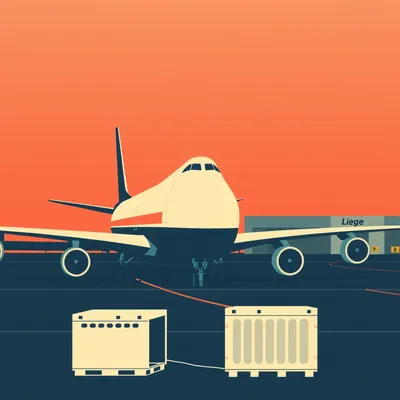
Daniel sent us this one — and it's a two-parter that connects in ways that aren't obvious at first glance. He's asking, what is the national carrier of Israel, and why are aquifers so important? On the surface, one's about aviation and the other's about groundwater. But the thread between them, and I think this is what he's really poking at, is sovereignty. A national airline isn't just a fleet of planes, and an aquifer isn't just a wet rock. Both of them are about a country's ability to function when nobody else is coming to help. So where do we start?

Let's start with the airline, because it's the one people think they know and mostly get wrong. Founded in nineteen forty-eight, same year as the state itself. Its first flight was bringing Chaim Weizmann back from Geneva, and the plane was a repurposed military transport painted with the Israeli flag. That detail alone tells you everything. This wasn't a commercial venture that happened to have a flag on the tail. It was a national project from day zero.
The name — El Al. It means "to the skies" or "upward," from the Book of Hosea. Not exactly subtle.
Not subtle at all. But here's the thing most people don't grasp. El Al isn't state-owned in the way people assume. It was fully government-owned until two thousand three, then privatized. Today it's publicly traded on the Tel Aviv Stock Exchange. The government doesn't run it. But, and this is a very heavy but, it operates under a legal framework that effectively makes it an instrument of national security. The airline has to maintain capabilities that no commercial carrier would ever choose to maintain.
Counter-man-portable-air-defense systems on their aircraft. El Al is the only commercial airline in the world that equips its planes with anti-missile defense. The system is called Sky Shield — it's Israeli-developed, originally by Elbit, and it detects incoming shoulder-launched missiles and deploys countermeasures. This isn't theoretical. In two thousand two, terrorists attempted to shoot down an El Al plane in Mombasa, Kenya, with two SA-7 missiles. They missed, barely. After that, the program went from "we should think about this" to "install it on everything.
You're flying from Tel Aviv to London and your 787 is packing countermeasures.
And the pilots are trained for evasive maneuvers that would make a fighter jock nod in approval. The cockpit doors are double-locked with a vestibule system that prevents anyone from rushing the flight deck. The security screening isn't just the standard airport stuff — El Al operates its own profiling and screening methodology, and they're famously thorough. Interview-based, behavior-focused. They'll ask you who packed your bag, who gave you gifts, why you're traveling. If your answers don't add up, you're not boarding. No amount of "but I paid for this ticket" changes it.
I've always appreciated that about them. Most airlines treat security as a compliance checkbox. El Al treats it like the product.
Because for them, it is the product. Or at least co-equal with getting you from A to B. And the fleet reflects this. As of mid two thousand twenty-six, their mainline fleet is about forty-seven aircraft — mostly Boeing 737s for short and medium haul, and 787 Dreamliners for long haul. They retired their last 747 in twenty nineteen, and the 767s are gone now too. The Dreamliner is the backbone of their long-haul network.
They're expanding, right? I remember reading they ordered more Dreamliners.
In early twenty twenty-four they placed an order for three additional 787-9s, with options for more. Delivery is staggered through twenty twenty-nine or so. But the bigger story is the smaller fleet — they've been adding 737 MAX aircraft, which is interesting because it's a plane that had, let's say, a complicated global reintroduction, and El Al was one of the earlier airlines to bring it back into service confidently.
The 737 MAX saga is the aviation equivalent of a product recall that became a diplomatic incident.
A regulatory turf war. But El Al's calculus was pragmatic. The MAX is fuel-efficient, the range works for their European and medium-haul routes, and Boeing gave them terms that made it hard to refuse. They're not making decisions based on vibes. Every route, every aircraft, is evaluated through a lens of "can we sustain this if half the world decides they don't want to refuel us.
Which has happened.
And that's where the fleet composition gets strategic. They fly routes that other airlines wouldn't touch, or would touch only with massive subsidies. They fly over the Saudi land bridge now — that's a relatively recent development, post-Abraham Accords, and it shaves hours off flights to India and East Asia. But before that, they were routing around the Arabian Peninsula, adding enormous fuel costs. They still can't overfly several countries. Their flight paths look like someone trying to parallel park a skyscraper.
Let's talk about those routes for a second. Where does El Al actually fly?
North America is the big one — Tel Aviv to New York, Newark, Miami, Los Angeles. Those are the prestige routes, the ones where they compete head-to-head with Delta, United, and American. Europe is the dense network: London, Paris, Amsterdam, Frankfurt, Rome, Barcelona, and a bunch of others seasonally. They've been adding routes into Central and Eastern Europe too — Prague, Budapest, Warsaw. Asia is where it gets interesting. Bangkok, Tokyo, Mumbai, Delhi. They used to fly to Beijing but that's been suspended for a while. And then there are the routes that only make sense if you understand the diaspora: Johannesburg, for instance.
Because there's a large South African Jewish community.
And they fly to destinations that align with Israeli business and tech travel patterns. The "Startup Nation" isn't just a slogan — El Al's premium cabins are packed with people doing deals in cybersecurity, agritech, pharma. The airline is effectively the corporate shuttle for an export economy that punches about ten weight classes above its size.
The premium cabin thing is worth pausing on. They've invested heavily in the business class product on the Dreamliners.
They had to. For decades, El Al's hard product was, charitably, functional. The seats were fine. The service was fine. But fine doesn't win when Emirates and Qatar are flying the same routes with suites and bars and showers. So they went big on the Dreamliner refit — lie-flat seats, direct aisle access, decent entertainment system, upgraded catering. It's not Emirates, but it's competitive. And they kept the thing that actually differentiates them, which is the security layer. You can't get that on any other carrier.
The business traveler who picks El Al over a Gulf carrier is making a calculation. The Gulf carrier gives you a nicer lounge in Dubai. El Al gives you the assurance that your plane isn't going to be the softest target in the sky.
That's not abstract. In twenty twenty-four, when Iran launched its massive drone and missile barrage at Israel, El Al was one of the few carriers that kept operating. Others suspended flights for days or weeks. El Al adjusted routes, flew around threat zones, and kept the country connected. That's the national carrier function in its purest form. It's not about profit maximization. It's about maintaining a lifeline.
Which brings us to the financial side. How does any of this pencil out?
It's been rough, historically. El Al has gone through multiple restructuring cycles. Labor costs are high — the pilots' union is powerful, the workforce is heavily tenured. Fuel costs are brutal when you're flying long-haul with security equipment adding weight. Competition from low-cost carriers in Europe has eaten into their short-haul margins. They posted losses for years. COVID was catastrophic — they grounded almost everything, took government-backed loans, went through a major restructuring in twenty twenty-one that involved layoffs and fleet simplification.
And post-COVID, the financial picture actually improved. Demand surged, they streamlined operations, and the cargo business turned out to be a quiet profit center. They fly a lot of high-value cargo — pharmaceuticals, electronics, perishables. The belly of a 787 full of Intel processors is a pretty good business model.
They're profitable now?
Twenty twenty-three was a record year — net profit of about two hundred fifty million dollars. Twenty twenty-four was strong too, though the war environment complicated things. Twenty twenty-five they were still in the black. It's not guaranteed to last — the airline industry is a machine for turning jet fuel into shareholder anxiety — but they're in better shape than they've been in decades.
The national carrier is a publicly traded company that loses money for years, posts record profits, flies with missile defenses, and keeps the country connected when everyone else bails. That's the short version.
That's the short version. And here's the thing — every country has an airline. But the number of countries where the airline is genuinely existential infrastructure, not just a flag on a plane, is very small. Israel is one of them. The geography dictates it. You can't drive to most of the world. You can't take a train. You fly, or you're isolated. And when you're isolated, you're vulnerable in ways that go far beyond tourism.
Which is the perfect segue to aquifers. Because if El Al is about not being isolated from the world, aquifers are about not being isolated from your own water supply. Same logic, different domain.
And this is where the conversation gets geological.
Let's talk about rocks full of water. Why are aquifers so important, specifically in this part of the world?
Because Israel sits on top of some of the most politically and hydrologically significant aquifers in the Middle East, and the water in those rocks has been a central factor in every negotiation, every conflict, and every agricultural decision for the last century. The two big ones are the Mountain Aquifer and the Coastal Aquifer. There's also the Western Galilee Aquifer, but the first two are the heavyweights.
Start with the Mountain Aquifer. That sounds dramatic already.
It is dramatic. The Mountain Aquifer runs beneath the central highlands — the West Bank and into Israel proper. It's a limestone aquifer, which means water flows through cracks and channels in the rock rather than sitting in a giant underground lake like people imagine. It's more like a sponge made of stone. The aquifer is divided into three basins: the Western Basin, which flows toward Israel's coastal plain; the Northeastern Basin, which flows toward the Jezreel Valley; and the Eastern Basin, which flows toward the Jordan Valley.
The water doesn't care about borders.
Water has never cared about borders. That's the entire problem. The Western Basin alone supplies something like twenty percent of Israel's total water consumption. And a significant portion of the recharge area — the land where rain falls and seeps into the aquifer — is in the West Bank. So you have a situation where the rain falls in one political jurisdiction and the water flows underground into another. You can't build a wall to stop groundwater.
You can't build a wall. What you can do is drill wells and pump.
That's exactly what both sides have done, which creates a classic commons problem. If you pump too much, you draw down the water table. If the water table drops too far, the aquifer near the coast starts pulling in seawater — saltwater intrusion. The Mountain Aquifer and the Coastal Aquifer are connected in ways that make over-extraction in one a problem for both.
Let's talk about the Coastal Aquifer.
The Coastal Aquifer runs along the Mediterranean shoreline from about Haifa down to Gaza. It's a sand and sandstone aquifer — different geology, shallower, more vulnerable to contamination. And it's been over-pumped for decades. Nitrate levels are high from agricultural runoff. In some areas, the water is brackish and needs desalination or blending before it's potable. Gaza's water situation is even worse — their portion of the Coastal Aquifer is severely depleted and contaminated. It's a humanitarian and environmental crisis that gets overshadowed by the political crisis but is arguably just as urgent.
Over-pumped, contaminated, and under-replenished. The trifecta of water mismanagement.
This is where the story takes a turn, because Israel's response to aquifer depletion has been one of the more remarkable infrastructure stories of the last twenty years. They built desalination plants. Five major ones along the coast: Ashkelon, Palmachim, Hadera, Sorek, and Ashdod. Sorek, when it opened in twenty thirteen, was the largest reverse-osmosis desalination plant in the world. They've since built Sorek Two, which is even larger.
Reverse osmosis — that's forcing seawater through membranes at high pressure to separate the salt.
And the energy cost used to be the limiting factor. But the technology has improved dramatically. The energy required to desalinate a cubic meter of seawater has dropped by more than half since the early two thousands. Israel now produces something like eighty percent of its domestic water from desalination. That's an almost unthinkable number if you go back to the nineteen nineties, when water scarcity was treated as an existential constraint on the country's growth.
The aquifers are still important, but they're no longer the only game in town.
They're still critically important, but their role has shifted. The aquifers are now part of a diversified water portfolio. Desalination provides the baseline. The aquifers act as storage and buffer — you can pump less when it rains, let them recharge, and draw more during dry periods. Treated wastewater is used for agriculture — Israel recycles something like eighty-five to ninety percent of its wastewater, which is the highest rate in the world by a wide margin. The next closest country, Spain, is at about twenty percent.
Eighty-five percent. That's not a typo?
Not a typo. The water you flush down the toilet in Tel Aviv gets treated and ends up irrigating crops in the Negev. It's a closed loop that took decades of investment in treatment plants, purple piping, and regulatory frameworks to make work. And it works so well that Israel is now a net water exporter in terms of technology and expertise. The same country that was rationing water in the nineteen sixties is now selling desalination technology to California and water management consulting to sub-Saharan Africa.
There's a deep irony there. The scarcity forced innovation, and the innovation created abundance.
Necessity is the mother of not dying of thirst. But here's the thing about the aquifers that still matters enormously — they're strategic reserves. If something happens to the desalination plants — a major power outage, a coordinated attack, an earthquake — the aquifers are the backup. You can't run a country on just-in-time water delivery. You need storage. And the best storage is the geology you're sitting on.
Which brings us back to the political dimension. The Mountain Aquifer crosses the Green Line. That makes it a negotiation item.
It's been a negotiation item since the Oslo Accords. The interim agreement in nineteen ninety-five, Oslo Two, established a Joint Water Committee between Israel and the Palestinian Authority. Water allocations were specified. Israel recognized Palestinian water rights in principle, and there were provisions for developing additional supply. But the agreement was supposed to be interim, and it's now been thirty years. The allocations haven't kept up with population growth on either side. The infrastructure in the West Bank is uneven — some areas have modern water systems, others rely on tanker trucks and rooftop cisterns.
The aquifer doesn't wait for a final-status agreement.
It doesn't. The water keeps flowing. The question is who gets to pump it, how much, and at what price. And underneath that is a deeper question about whether water should be treated as a shared resource managed cooperatively or as a sovereign asset to be controlled unilaterally. The track record is mixed. There has been cooperation — the Joint Water Committee still meets, technical coordination still happens. But there's also been conflict over well drilling, over pricing, over infrastructure access.
The phrase "water wars" gets thrown around a lot. Is that what this is?
It's less a war and more a slow-motion allocation dispute with periodic flare-ups. The real water wars, if they come, will be driven by climate change. The entire Levant is getting hotter and drier. The Jordan River is a shadow of what it was fifty years ago. Rainfall patterns are shifting. The aquifers recharge more slowly when there's less rain and more evaporation. Every climate model says this region is going to face more water stress, not less, over the next thirty years.
Desalination buys time, but it's not a permanent solution.
Desalination is energy-intensive. Right now Israel runs the plants mostly on natural gas from the offshore fields — Leviathan and Tamar. That's a fossil fuel, even if it's cleaner than coal. There's work on solar-powered desalination, but it's not at scale yet. And desalination produces brine — super-salty wastewater that gets discharged back into the Mediterranean. The environmental impact of that is still being studied, but it's not zero. So you're trading one set of problems for another.
The brine issue — is that something people are actively worried about, or is it more of a "we'll deal with it later" situation?
It's a known concern. The Mediterranean is a large body of water with good circulation, so the immediate impact is localized around the discharge points. But if you scale desalination across the entire region — Egypt, Jordan, Gaza, Lebanon all building plants — the cumulative effect on salinity and marine ecosystems becomes a real question. There are research projects looking at brine mining, extracting minerals from the waste stream, but that's still in the pilot phase.
The aquifers remain the foundation. Desalination is the supplement, the buffer, the thing that lets you stop over-pumping. But the rock water is the strategic reserve.
And the Coastal Aquifer, depleted as it is, is actually being used as a storage reservoir now. During winter months when desalination is running at full capacity and demand is lower, they pump desalinated water back into the aquifer. It's called managed aquifer recharge. You're essentially banking water underground for use during the dry summer months. The aquifer becomes a battery, but for water instead of electricity.
A water battery. That's a great image.
It's ancient, conceptually. The Nabateans were doing something similar in the Negev two thousand years ago — capturing flash flood water and directing it into underground cisterns. The technology is different, but the principle is identical. Store when you have surplus, draw when you have need.
The Nabateans also built Petra, so they knew a thing or two about engineering in a desert.
And the through-line from Nabatean water capture to modern managed aquifer recharge is one of those historical arcs that makes you realize how much of civilization is just figuring out where the water is and how to keep it.
Let's connect the two halves. El Al and aquifers. The prompt put them together, and I think the connection is sovereignty infrastructure. These are systems that a country can't outsource.
Can't outsource, and can't afford to lose. An airline is something you can theoretically replace with foreign carriers — lots of countries don't have a national airline. But if you're a small country in a geopolitically complicated neighborhood, relying entirely on foreign carriers means your connectivity is subject to someone else's risk assessment. When Lufthansa or British Airways decides it's too dangerous to fly to Tel Aviv, you need someone who can still get in and out. That's El Al.
Water — you can't exactly import water by air.
You can, but it's ruinously expensive and it doesn't scale. Water is heavy. A cubic meter weighs a metric ton. You're not flying that in. So you either have it in the ground, you make it from the sea, or you go without. Israel chose to do both — protect the groundwater and build the desalination capacity. That dual approach is what turned a water-scarce country into one that actually has a surplus.
Both of these are areas where the private sector and the state are deeply intertwined. El Al is a public company with a national security mandate. The water system is a mix of state-owned infrastructure — Mekorot, the national water company — and private technology firms doing desalination, irrigation, leak detection.
Mekorot is a fascinating entity. It was founded in nineteen thirty-seven, before the state existed. It built the National Water Carrier in the nineteen sixties, which moves water from the Sea of Galilee to the coastal plain and the Negev. It's one of the largest water utilities in the world, and it operates a network that would be impressive in any country, let alone one the size of New Jersey.
The National Water Carrier — that's the pipeline that basically moves water from the north, where it's relatively wet, to the south, where it's desert.
And it was a massive engineering project. Hundreds of kilometers of pipes, canals, tunnels, pumping stations. It reversed the flow of water in the country. Before the Carrier, the Jordan River flowed south into the Dead Sea and that was that. After the Carrier, water from the Jordan basin was being pumped west and south, irrigating the Negev and supplying the cities. It's one of those infrastructure projects that's so fundamental most people never think about it.
Like the aqueducts in Rome. Invisible until they break.
The Carrier has been supplemented and partially superseded by desalination, but it's still operational. It's now part of a more complex system where water flows in multiple directions depending on supply and demand. The fifth desalination plant, Ashdod, was built specifically to supply water to the south without having to pump it all the way from the north.
The system has evolved from "move water from where it is to where it isn't" to "make water where you need it and use the pipes for balancing.
That's the arc. And it's the same arc you see in energy grids. Distributed generation changes the topology of the network. You go from a few big sources and long transmission lines to many smaller sources and a more resilient mesh.
Resilient mesh — that's actually a good description of what we've been talking about across both topics. El Al's route network, the water system, they're both resilient meshes designed to survive single points of failure.
Because the cost of a single point of failure is existential. If your water supply fails, people start dying in days. If your air links are severed, you're cut off from medicine, from trade, from evacuation. These aren't luxuries. They're the preconditions for a modern state to function.
Both systems were built with the assumption that things will go wrong. The missile defenses on the planes, the desalination backup for the aquifers — these aren't optimistic bets on a peaceful future. They're hedges against a difficult one.
Which is a very Israeli approach to infrastructure. Plan for the worst, build for the worst, and then be pleasantly surprised if things are better than expected. It's not cheerful, but it works.
The other thread here is that both of these are areas where Israel has exported expertise. El Al's security methodology has been studied and partially adopted by other airlines and airports around the world. The profiling techniques, the layered security approach, the cockpit hardening — those are now standard in various forms globally.
The water technology is an even bigger export. Netafim, the drip irrigation company, was founded on a kibbutz in the nineteen sixties and is now a global operation. IDE Technologies, which built Sorek and Ashdod, has built desalination plants in China, India, Australia, and the United States. The Carlsbad plant in California, which supplies something like ten percent of San Diego's water, is an IDE project.
Drip irrigation — explain why that matters, for people who think irrigation is just "spray water on plants.
Drip irrigation delivers water directly to the root zone of each plant through a network of plastic tubing with emitters. You're not flooding a field. You're not spraying water into the air where half of it evaporates. You're putting exactly the amount of water the plant needs right where it needs it. The efficiency is something like ninety to ninety-five percent, compared to fifty or sixty percent for sprinklers and even less for flood irrigation. And because you're not wetting the whole field, you reduce weed growth and fungal diseases. It's precision agriculture before precision agriculture was a buzzword.
This was invented on a kibbutz because they were trying to farm in a desert.
Out of necessity. The story goes that a farmer noticed one tree was growing much better than the others, dug around it, and found a cracked pipe was dripping water directly onto its roots. That observation led to the development of the first drip emitters. It's apocryphal, possibly, but it captures the dynamic. Constraint drives observation, observation drives innovation.
The cracked pipe story is the sloth-pizza of water technology. Nobody believes it, but I'm choosing to.
But the broader point stands. Israel's water technology sector is now a multi-billion-dollar export industry. And it's not just hardware. It's software for leak detection, remote sensing for crop water stress, AI-driven irrigation scheduling. The same tech ecosystem that produces cybersecurity startups also produces water-tech startups. The skills transfer.
Because both are about monitoring complex systems in real time and detecting anomalies before they become failures.
A water network is a distributed system with sensors, actuators, and control logic. So is a computer network. The tools are different but the mindset is the same. Find the weak point. Fix it before it breaks. Assume adversaries — in water, the adversary is entropy and scarcity rather than a hacker, but the defensive posture is similar.
We've got El Al as the airborne expression of that defensive posture, and the water system as the subterranean one. The national carrier keeps the country connected to the world. The aquifers and desalination keep it connected to its own survival.
Both are stories of taking a vulnerability and turning it into a strength. The vulnerability of being a small country surrounded by hostility became the driver for building an airline that's harder to attack than anyone else's. The vulnerability of having almost no natural water became the driver for building the most sophisticated water management system on the planet.
The other side of that, though, is that both systems are expensive to maintain. The security on El Al adds cost. The desalination plants consume energy. These are premiums that the country pays for resilience. And not every country can afford those premiums.
That's the privilege of a developed economy. Israel can afford desalination because it has a high-tech export sector generating the foreign currency to pay for the energy. It can afford El Al's security because the cost is spread across an economy that values the connectivity. A poorer country with the same geography and the same threats would be in a much harder position.
Which is why the technology export matters. If you can drive down the cost of desalination, if you can make drip irrigation cheaper, you make resilience more accessible to places that need it.
The cost curves are moving in the right direction. Solar energy is getting cheaper, which makes solar-powered desalination more viable. Drip irrigation systems are becoming cheaper and simpler to install. The knowledge is spreading. It's not a solved problem — billions of people still face water insecurity — but the trajectory is better than it was twenty years ago.
One last thing on the aquifer side. You mentioned Gaza's water situation. Can you say more about that?
The Gaza Strip sits on top of the southern end of the Coastal Aquifer. The population is about two million people in a very small area. For decades, the primary water source has been groundwater from that aquifer. But the extraction rate has far exceeded the recharge rate for years. The water table has dropped, and seawater has intruded into the aquifer. Something like ninety-five percent of the water from the aquifer in Gaza is not safe to drink without treatment. Nitrate levels are sky-high from untreated sewage and agricultural runoff. Salinity is far above WHO guidelines.
There are desalination plants in Gaza — smaller ones, some funded by international donors. A larger plant was in development with European and other international funding. But the infrastructure challenges are enormous. Power supply is unreliable. Materials are hard to import. The water network has massive leakage rates — some estimates say forty percent or more of the water is lost before it reaches users. It's a compounding crisis where the technical problems and the political problems are completely entangled.
The same aquifer that Israel has learned to manage and supplement is, a few dozen kilometers away, in a state of collapse.
That contrast is not lost on anyone. It's a stark illustration of how water infrastructure is governance infrastructure. The technology exists to solve the problem. The barriers are political, logistical, and financial. And the people paying the price are the ones who can least afford it.
That's a sobering note to land on. But I think it underscores the whole theme. Water and air links — these are the systems that determine whether a place can function. Get them right, and you buy yourself a future. Get them wrong, and everything else becomes harder.
The prompt asked why aquifers are so important. I think the answer is that they're the original infrastructure. Before there were airlines, before there were pipelines, there was the water in the ground. And even in an age of desalination and Dreamliners, that groundwater is still the foundation. You can supplement it, you can manage it, you can bank it, but you can't ignore it.
The national carrier — El Al — is the modern expression of the same principle. A country that can't be reached is a country that can't trade, can't evacuate, can't project itself. The airline is the aquifer of connectivity.
That's a very Corn way to put it.
I've been practicing.
Now: Hilbert's daily fun fact.
Hilbert: In nineteen seventy-three, the French island of Réunion maintained roughly one kilometer of Roman-style paved road for every two point three residents — meaning a family of four was collectively responsible for about one point seven kilometers of imperial-grade road surface, a per-capita ratio that would have made a Roman provincial governor weep with envy.
...right.
Roman roads on a French island in the Indian Ocean, maintained at a rate that would embarrass an empire. That's where we're leaving it.
This has been My Weird Prompts. Thanks to our producer Hilbert Flumingtop. If you enjoyed this, leave us a review wherever you get your podcasts — it helps.
Find us at myweirdprompts dot com for every episode. We'll be back soon.