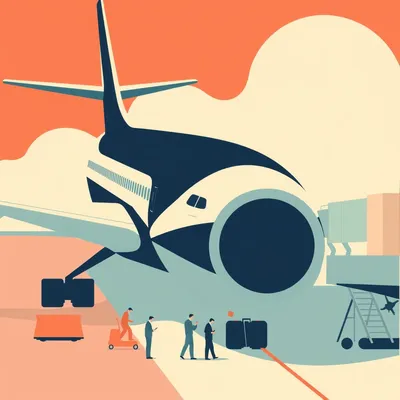
Daniel sent us this one — El Al just announced they're buying more Boeing 787 Dreamliners, up to twelve of them, in a deal worth around one point five billion dollars. Deliveries are slated for 2030 through 2032. And Daniel's asking two things: which airline actually has the largest fleet in the world right now, and when a fleet gets big enough that you've got multiple aircraft in the same region simultaneously, what does that do to the maintenance and parts logistics picture? Because El Al is sitting at just under fifty aircraft total, which puts this expansion in a certain kind of perspective.

Right, fifty aircraft is a boutique operation by global standards. I mean, El Al is a serious airline — Dreamliners, long-haul, they punch above their weight strategically — but the fleet size tells you something about the operating model.
Before we get into it — quick note, today's script is courtesy of Claude Sonnet four point six.
The friendly AI down the road. Doing its thing.
Doing its thing. Okay, so fleet size — why does it matter beyond just "more planes, more routes"?
It's actually a pretty good proxy for the complexity of the entire operation. The number of aircraft you operate determines how many maintenance cycles you're running in parallel, how many crew pairings you need to schedule, how much leverage you have with manufacturers and parts suppliers, how geographically dispersed your maintenance infrastructure has to be. A fleet of fifty is a fundamentally different organizational problem than a fleet of five hundred, and not just in a linear scaling sense. There are qualitative shifts that happen at certain thresholds.
El Al's announcement is interesting partly because of the timing. There was a piece on AeroTime covering this — the deal was announced April sixteenth — and the framing was explicitly around reduced competition in Israel's air travel market. Which, given what's happened over the past couple of years with other carriers pulling back from Israeli routes, makes a lot of sense as a strategic window.
They're moving while the runway is clear, so to speak. And the 787 is the right tool for what El Al does. Long thin routes — Tel Aviv to North America, Tel Aviv to the Far East — the Dreamliner is built for exactly that. High fuel efficiency on long hauls, passenger comfort that matters when you're flying thirteen hours. If they get to thirty-four Dreamliners by the mid-2030s, which is what the projections suggest if they exercise the full options including the larger 787-10 variant, that's a meaningful shift in their operational character.
Thirty-four Dreamliners out of what would presumably still be a fleet in the fifty to sixty range. That's a lot of eggs in one aircraft type's basket.
Which has its own maintenance implications, actually — fleet commonality is a double-edged thing. On one hand, your technicians only need to be certified on fewer airframe types, your parts inventory is more consolidated, your training programs are simpler. On the other hand, if Boeing has a supply chain disruption on a specific 787 component, and we've seen that happen, it hits you harder when you're more concentrated in that type.
Boeing's supply chain issues are basically their own podcast at this point.
They really are. But the commonality argument is generally considered a net positive. Southwest ran a single-type fleet for decades — all 737s — and the operational efficiency gains were real. El Al moving toward a Dreamliner-heavy long-haul fleet is following a similar logic at a smaller scale.
That's the strategic framing. Daniel's first question is the ranking one — who actually has the largest fleet? And I think a lot of people would guess American Airlines.
It's a reasonable guess. American is enormous. But as of right now, United Airlines is actually sitting at the top. The numbers I've seen put United at somewhere between one thousand fifty-eight and one thousand sixty-one mainline aircraft. American is right behind them — around one thousand five to one thousand thirteen. Delta is in the nine hundred eighty to nine hundred ninety-two range. So you've got three American carriers all clustered in that band, and then the gap to everyone else is substantial.
That's a remarkable concentration of the world's largest fleets in one country.
It is, and it reflects the geography. The continental United States is a massive domestic market with hundreds of city pairs that need service. No high-speed rail alternative worth mentioning. You can't serve that market without scale. European carriers — Lufthansa, Air France, British Airways — they're operating in a context where rail genuinely competes on shorter routes, and they're also dealing with slot constraints at major hubs that put a ceiling on how many movements they can make per day regardless of fleet size.
The American carriers are large partly because the American market demands it, not because they're better managed.
That's a fair way to put it. The market structure shapes the fleet structure. Though I'd add that the hub-and-spoke model the big American carriers run also incentivizes fleet growth in a specific way — you need enough aircraft to maintain frequency at your hubs, because frequency is what makes a hub attractive to connecting passengers, which is what makes the hub economically viable. It's a self-reinforcing system.
If you drop below a certain frequency threshold at a hub, the whole thing starts to unravel.
Which is why you saw carriers fight hard to protect their hub operations even during periods of financial distress. The fleet is infrastructure in a way that's not always obvious from the outside. You can't just park a hundred planes and expect to rebuild that network position later without enormous cost.
Daniel specifically flagged the maintenance angle as the thing he's most curious about — and I think that's where this gets interesting. Because the question isn't just "large fleet equals more maintenance work" in a proportional sense. There's something more complicated happening when you've got multiple aircraft from the same fleet in the same geographic area simultaneously.
This is where fleet management gets operationally fascinating. Let me set up why the geography piece matters specifically. When you have a small fleet like El Al's fifty aircraft, your maintenance footprint is relatively concentrated. You've got a main technical base — in El Al's case, that's Tel Aviv — and most of your heavy maintenance cycles rotate through there. You can plan around it. You know where your aircraft are going to be, roughly, because your network isn't that complex.
When you scale up?
When you scale up to United's thousand-plus aircraft, you've got planes spread across hundreds of airports at any given moment. And here's the wrinkle Daniel's asking about — when multiple aircraft from your fleet happen to be at the same station simultaneously, whether that's because of weather diversions, schedule clustering, or just the natural rhythms of a hub operation, you're competing with yourself for resources. Same pool of certified technicians. Same parts inventory at that station. Same ground support equipment.
The problem isn't just that you have more aircraft to maintain. It's that the demand for resources spikes in a locally correlated way.
And the systems you build to handle average demand get overwhelmed by the peaks. A station that's sized to handle, say, three aircraft turnarounds in an evening might suddenly have six because two flights diverted from a storm system. The technicians who were planning a routine inspection on one plane now have to triage across all six. Parts that were allocated for a scheduled job get cannibalized for an AOG — aircraft on ground — situation. And AOG is the worst place to be, because a grounded aircraft is losing revenue from the moment it stops flying.
What's the actual cost of poor planning in this space? Because I suspect people underestimate it.
There was a piece I came across from Power Aero Suites that put the figure at one hundred to two hundred million dollars annually for major airlines in lost revenue and passenger compensation. Just from poor maintenance planning. Not from catastrophic failures — from the routine friction of parts not being where they need to be, maintenance windows being missed, aircraft being unavailable when the schedule needs them.
A hundred to two hundred million dollars annually just from planning friction.
Just from planning friction. And that's before you get into the regulatory side. Every maintenance action on a commercial aircraft has to be documented, certified, traceable. If a technician at a station does a repair, that work has to be logged in a way that's accessible to the next technician who touches that aircraft, potentially at a different station, potentially in a different country. For a fleet of fifty aircraft, that's manageable with relatively straightforward systems. For a fleet of a thousand, the data management challenge alone is significant.
The workforce piece — because I imagine the technician shortage is real.
The figure I've seen is that sixty-two percent of airlines report workforce constraints as a significant factor in their maintenance operations. The underlying dynamic is a retiring workforce — a lot of the senior technicians who built their careers during the jet age expansion of the seventies and eighties are aging out, and the pipeline of new certified mechanics hasn't kept pace. And the certification requirements are not trivial. You can't train a new airframe and powerplant mechanic in six months. It takes years to get someone to the point where they can sign off on a line check independently.
New-generation engines are apparently making this worse?
The newer high-bypass turbofans — the CFM LEAP, the Pratt and Whitney GTF — they're more fuel efficient, but they're also more maintenance-intensive in certain respects. The intervals between shop visits are longer in theory, but when they do need heavy work, the work is more complex. So you have fewer experienced technicians available, and the aircraft they're working on require more specialized knowledge. It's not a great combination for the industry.
El Al's expansion into more 787s is happening in a labor market that's already strained.
Which is one of the reasons the delivery timeline of 2030 to 2032 is actually somewhat realistic — not just from Boeing's production schedule perspective, but from El Al's ability to actually staff and support those additional airframes. You need time to hire, train, certify. If they took delivery of twelve Dreamliners tomorrow, they'd struggle to absorb them operationally.
That's a point that gets lost in fleet announcement coverage. The headline is the number of planes and the dollar figure. Nobody writes about whether the airline can actually maintain them.
It matters enormously. The D check — the heaviest scheduled maintenance inspection, where you essentially take the aircraft apart and put it back together — can ground a plane for up to two months. For a small fleet, one aircraft in a D check is a significant operational constraint. You're running at reduced capacity. For a large carrier, you're running D checks on multiple aircraft simultaneously, essentially continuously, and the scheduling of those checks has to be integrated with your route planning, your revenue management, all of it.
It's a four-dimensional puzzle. Aircraft, time, geography, and regulatory compliance all at once.
The parts supply chain threading through all of it. Because parts don't just need to exist — they need to be at the right place at the right time with the right documentation. An aircraft part that's sitting in a warehouse in Cincinnati when you need it in Miami is operationally useless. The logistics of pre-positioning parts across a network of maintenance stations, anticipating where demand will spike, is sophisticated supply chain management. Delta has invested heavily in this — they've built a parts distribution infrastructure that's designed to minimize the time between a part being needed and a part being available at the station.
Delta's maintenance operation is interesting because they brought a lot of it in-house, right? Through their TechOps division.
TechOps is a good example of a certain philosophy of fleet management. The argument for vertical integration is that you have more control over quality, turnaround time, and cost. You're not dependent on third-party MRO providers whose capacity might be constrained by other customers. The argument against is that running a maintenance operation at scale requires capital and expertise that might not be your core competency as an airline. Most carriers land somewhere in the middle — they do some work in-house and contract out the rest, particularly for heavy checks which often go to specialized facilities.
The MRO market itself is growing substantially.
The global maintenance, repair, and overhaul market is projected to hit around one hundred twenty-five billion dollars by 2030. Which tells you something about the scale of the underlying demand. As fleets age, as new-generation aircraft enter service and require different maintenance profiles, that market is going to keep growing. And the airlines that have figured out how to manage their maintenance costs efficiently have a genuine competitive advantage — not just in terms of aircraft availability, but in terms of the cost per available seat mile that determines whether a route is profitable.
When El Al is thinking about this 787 purchase, they're not just thinking about the ticket revenue those planes will generate. They're thinking about a decade-long maintenance commitment.
A decade-plus. The 787 is a relatively young airframe in fleet terms — the first ones entered service in 2011 — so the maintenance history is still developing. There are aspects of the long-term maintenance profile that the industry is still learning. Which is another reason fleet commonality matters: the more operators there are of a given type, the richer the collective knowledge base about what wears, what fails, how to fix it efficiently.
El Al joining a larger community of 787 operators — there are quite a few of them globally — means they benefit from that accumulated knowledge.
The technical knowledge sharing in commercial aviation is actually quite good. There are working groups, there's data sharing through the manufacturers, there are airworthiness directives that propagate lessons learned across the entire operator community. When something goes wrong on a 787 operated by one airline, every other 787 operator gets informed. It's one of the things the industry does well from a safety perspective.
Which brings us to Daniel's core question on the logistics side: the specific maintenance challenges of concentration — when you've got multiple of your own aircraft in the same place at the same time.
Speaking of scale, El Al's position in all of this is worth sitting with for a moment. Fifty aircraft is small by the standards we're talking about. To put it in perspective, United's thousand-plus planes means El Al is operating at roughly one twentieth the scale of the world's largest fleet. That's not a criticism — it reflects the market. Israel has one major international gateway, Ben Gurion, and El Al is serving a network defined by that single hub.
The fleet composition tells you a lot about the strategy. El Al already operates some 787s, so this purchase isn't a pivot — it's a deepening of a commitment they've already made. The 787-9 and the potential upgrade to the 787-10 are long-haul workhorses. They're not buying narrowbodies to expand domestic routes, because there essentially aren't domestic routes worth expanding into. They're buying range. They're buying the ability to serve more long-haul destinations, or to serve existing ones with better economics.
The timing is interesting given the competitive landscape in Israeli aviation right now.
That's the strategic context that makes this more than just a routine fleet order. The disruption to Israeli air travel over the past couple of years has reduced competition on certain routes. El Al is in a position where adding capacity isn't just about growth for growth's sake — it's about capturing demand that exists and isn't being fully served. The 787 gives them the unit economics to do that profitably on thinner long-haul routes that wouldn't pencil out with a larger, less efficient widebody.
Fleet size, in El Al's case, isn't a vanity metric. It's a fairly direct expression of what markets they can physically reach and how often.
Which is true for any airline, but it's especially legible with a carrier this focused. When American Airlines adds fifty planes, it might mean marginal frequency increases across hundreds of routes. When El Al adds twelve Dreamliners, you can almost map each one to a specific strategic objective. More capacity to North America, new routes into Asia, redundancy on the European trunk routes. The fleet is small enough that individual aircraft decisions are strategic rather than just operational.
Right, at fifty aircraft you don't have the luxury of slack. Every plane is doing real work.
That constraint shapes everything downstream — maintenance scheduling, crew planning, the risk tolerance for having an aircraft in a heavy check. Which brings us to United's fleet: over a thousand planes, the largest in the world.
And that scale is crucial context for what we're comparing against. United's fleet isn't just the largest in the United States; it's the global benchmark right now.
United crossed the threshold to become the largest mainline fleet globally, sitting at somewhere between one thousand fifty-eight and one thousand sixty-one aircraft depending on how you count regional affiliates. American is close behind at around one thousand to one thousand thirteen, and Delta is in the high nine hundreds, roughly nine hundred eighty-nine to nine hundred ninety-two. So the top three American carriers are essentially running neck and neck in the nine hundred to eleven hundred range, and then there's a significant drop to the next tier.
Which raises the obvious question of why those three specifically. Why are the world's largest fleets all American?
Market structure, primarily. The United States domestic market is enormous — you have a continent-spanning network of cities connected almost entirely by air, because the distances make rail impractical for most of it. There's no high-speed rail alternative that's going to pull meaningful traffic away from Chicago to Los Angeles. So the underlying demand base for domestic air travel in the US is structurally larger than almost any other single-country market. And the deregulation of American aviation in 1978 created conditions where carriers could grow aggressively to capture that demand.
The fleet size is downstream of geography and policy more than it is of operational genius.
To a significant degree, yes. The European carriers that are large by global standards — Lufthansa, Ryanair, easyJet — are large partly because they're operating across a fragmented continental market with dozens of country pairs. Ryanair has a massive fleet, over five hundred aircraft, but it's built on a fundamentally different model: extremely high aircraft utilization, very short sectors, a single aircraft type for almost the entire fleet. That's a different kind of fleet discipline than what American or United is doing.
The single aircraft type thing is interesting. Ryanair flying almost exclusively 737s — that's a deliberate maintenance strategy, not just a purchasing preference.
It's one of the clearest examples of fleet commonality as competitive advantage. When you operate a single type, your pilot pool is entirely cross-qualified, your technician certifications are concentrated, your parts inventory is unified. You don't need to stock components for six different aircraft families. The per-unit economics of maintenance improve dramatically because your volume on any given part number is much higher. Ryanair can negotiate supplier contracts that a carrier with a fragmented fleet simply cannot.
American Airlines is the interesting contrast there, because they've historically had one of the more diverse fleets in the industry.
American has made significant moves toward simplification, but yes, historically they operated a wide range of types — various Airbus narrow-bodies, Boeing 737s in multiple variants, 777s, 787s, the 757 which they've been retiring. Each of those families has its own maintenance ecosystem. And when you're at a thousand-plus aircraft, even small inefficiencies in how you manage that diversity compound significantly. A parts stockout that costs you twelve hours on one aircraft type, multiplied across a fleet of that scale, is real money.
The hundred to two hundred million dollar annual figure from poor planning starts to feel more concrete when you think about it that way.
That number reflects the aggregate of what are individually manageable-seeming problems — a delayed part here, an unscheduled maintenance event there, an aircraft sitting on the ground when it should be flying. Each one is a rounding error in isolation. At scale they're not.
The advantages of being at that scale — what does a thousand-aircraft fleet actually buy you that a fleet of three hundred doesn't?
Supplier leverage is the most direct one. When American or United is buying replacement parts, consumables, tooling, they're doing it at a volume that gives them pricing power that smaller carriers cannot match. The same applies to Boeing and Airbus — when you're ordering at the scale of the American majors, you're negotiating differently than when you're El Al ordering twelve planes. You're also negotiating differently on financing, on delivery slots, on customization.
If a plane goes unserviceable at a hub, a large carrier has options a small carrier doesn't.
That's operationally significant. If a United aircraft goes mechanical at O'Hare, there are almost certainly other United aircraft at O'Hare or within short ferry range. You can substitute capacity, reprotect passengers, minimize the downstream disruption. For El Al at Ben Gurion, there's no equivalent cushion. Every aircraft is doing a specific job, and when one is unavailable the operational impact is immediate and visible.
Which is a genuine strategic vulnerability for a carrier that size, but also partly why the 787 purchase makes sense — adding even a few aircraft at that scale meaningfully increases your ability to absorb disruption.
Going from fifty to sixty-two Dreamliners by the mid-2030s doesn't sound dramatic, but in proportional terms it's a meaningful improvement in operational resilience. You have more redundancy built into the long-haul network specifically, which is where an unserviceable aircraft is most disruptive given the turnaround times involved.
And that’s where concentration really bites. A 787 sitting unserviceable for two days isn't just a two-day problem — it's the ripple through every rotation that aircraft was supposed to fly, across routes that might be twelve or fourteen hours each way.
That's where the maintenance logistics question gets complicated at the large-fleet end of the spectrum. Delta has built one of the more sophisticated in-house maintenance operations in the industry — their Technical Operations division at Atlanta is essentially a full-scale MRO facility, maintaining not just Delta's own fleet but doing contract work for other carriers. The reason they can do that is precisely because they have the volume to justify the infrastructure.
The fleet size enables the maintenance capability, which in turn reduces dependence on external providers.
It becomes a self-reinforcing advantage. Delta's Atlanta hub handles heavy maintenance checks — the most intensive kind, what the industry calls D checks, which can take an aircraft completely out of service for up to two months. At that scale, you can have aircraft cycling through the facility continuously, which means your technician workforce is fully utilized, your tooling is amortized across more labor hours, your parts inventory turns over regularly rather than sitting on the shelf. The fixed cost of running that facility is spread across a much larger fleet.
Two months is a long time to have a widebody out of service.
It's brutal from a revenue standpoint. A 787 on a productive long-haul route might generate several hundred thousand dollars in revenue per week. Two months offline is real money. And that's why the planning discipline around scheduling those checks matters so much — you want to minimize the number of aircraft in heavy maintenance at any given time, which means you need to stagger the checks carefully across your fleet. At Delta's scale, with nearly a thousand aircraft, that's a genuine scheduling optimization problem.
What does that look like for a carrier the size of El Al, though? Because they don't have the volume to justify a Delta-style in-house facility.
Smaller carriers typically outsource heavy maintenance to third-party MRO providers, and El Al does this for some of its work. The tradeoff is that you're now competing for slots at those facilities alongside every other airline that can't justify running its own. And when the industry is under maintenance pressure — which it is right now, given the technician shortage — those slots get scarce and expensive. I saw a piece from Logistics MRO noting that D checks can stretch well beyond the nominal two-month window when you factor in parts delays and labor constraints. For a carrier with fifty aircraft, an unexpected extension on a heavy check isn't an abstraction. It's a specific tail number that isn't flying routes it was supposed to fly.
The parts supply chain is its own layer of complexity on top of that.
This is where the concentration problem Daniel raised gets really interesting. Large carriers run regional parts distribution networks — essentially warehousing critical spares at multiple hub locations so that when a component fails, you're not waiting for it to ship from a central depot. United can pre-position parts at O'Hare, at Newark, at Houston, at San Francisco, because they have enough aircraft operating through each of those hubs to justify the inventory investment. The probability that you'll need a given part at O'Hare is high enough to make stocking it there economically rational.
For El Al, running everything through a single hub, the distribution question almost answers itself.
In one sense it simplifies things — all your aircraft are based at or returning to Ben Gurion, so your parts depot is essentially one location. But the flip side is that you have no geographic redundancy in your supply chain. If you have a parts stockout at Ben Gurion, there's no nearby Delta hub you can ferry a component from. You're waiting for an international shipment, which can mean forty-eight to seventy-two hours in a best-case scenario.
Which is an argument for carrying deeper inventory relative to fleet size than a geographically distributed carrier would need to.
And that's a capital cost that doesn't show up in the headline fleet economics. You're essentially paying an insurance premium in the form of excess inventory to protect against supply chain disruptions that a larger, more distributed carrier can hedge against through network density. The Power Aero Suites analysis put the cost of poor maintenance planning at somewhere between one hundred and two hundred million dollars annually for major airlines — but that number is skewed toward the large carriers simply because they have more aircraft to get wrong. The proportional impact on a smaller carrier can be just as severe.
The sixty-two percent of airlines reporting workforce constraints — that number cuts across fleet sizes pretty evenly, I'd imagine.
It does, and in some ways it hits smaller carriers harder. A large MRO operation like Delta's can offer training programs, career development, the kind of institutional infrastructure that makes it an attractive employer for technicians. A smaller carrier competing for the same limited pool of certified mechanics has fewer tools to offer. Wage competition helps at the margin, but it's not the only factor. And for the 787 specifically, the newer generation engines — the GEnx and the Trent one thousand — require specialized training that takes time to develop in-house. El Al is going to be building that capability as it grows its Dreamliner fleet, which is partly why the existing 787 operators in the network matter so much for knowledge transfer.
There's something almost counterintuitive about it — the airline buying newer, more efficient aircraft is also taking on a more complex maintenance burden.
That's one of the genuine tensions in fleet modernization. The 787 burns about twenty percent less fuel than the aircraft it typically replaces, which is a significant operating cost advantage. But the maintenance profile is different. The composite airframe requires different inspection techniques than a conventional aluminum structure. The electrical systems are more complex. The engines, while more efficient, have longer, more intensive maintenance intervals when they do come due. You're trading one set of costs for another, and you need the technical capability to handle what you've traded into.
For El Al, the Dreamliner expansion is a long-term organizational capability build, not just a purchasing decision.
That's a good way to frame it. By the time those twelve aircraft are delivered between 2030 and 2032, El Al needs to have the maintenance infrastructure, the trained workforce, and the parts supply chain to support a Dreamliner fleet that could reach thirty-four aircraft by the mid-2030s. That's a fundamentally different technical organization than the one they're running today. The purchase is an announcement about the kind of airline they intend to be, as much as it is about adding seat capacity — but it also raises questions about operational health.
Fleet size is a headline number, but the ratio of fleet size to maintenance capability is what actually matters. That’s the practical question for anyone thinking about how to evaluate an airline's actual health — not just the balance sheet, but its ability to sustain operations at scale.
That's the metric that doesn't show up in the press release. When El Al announces twelve new Dreamliners, the story is the billion and a half dollars and the new routes. The harder question is whether the maintenance organization is scaling in parallel. Because a fleet that outgrows its technical support infrastructure is a fleet that starts accumulating delays, cancellations, and the kind of passenger compensation costs that erode the revenue gains from those new aircraft.
The hundred to two hundred million dollar annual cost of poor maintenance planning — that's not a number that comes from catastrophic failures. That's the aggregate of small misses compounding.
Routine friction, consistently. A part that should have been on the shelf wasn't. A check that should have taken six weeks took nine. An aircraft that was supposed to be back in service on Tuesday came back on Friday. None of those individually are disasters, but across a fleet of a thousand aircraft they add up to a number that would make most people wince.
What does a listener actually take from all of this, in practical terms? Because there's a real insight here about organizational scale that goes beyond aviation.
I think the core lesson is that fleet size and fleet capability are not the same thing, and confusing them is expensive. The airlines that manage large fleets well — Delta is probably the clearest example — have invested in the infrastructure that makes the scale manageable. The MRO facility, the regional parts depots, the training programs. That infrastructure has a cost, but the alternative is paying the same cost reactively, in the form of disruptions and compensation, and paying it less efficiently.
The preventive investment versus the reactive cost. The reactive version is always more expensive.
Almost without exception. And for a smaller carrier like El Al, the lesson is slightly different — it's about understanding which advantages of scale you can replicate and which ones you cannot. You cannot build a Delta-style MRO operation on fifty aircraft. The volume isn't there to justify it. But you can be disciplined about inventory depth, about outsourcing relationships, about building technical capability ahead of the fleet growth rather than scrambling to catch up after the deliveries arrive.
Get the organization ready before the planes show up, not after.
Which sounds obvious but is hard to execute when the deliveries are four to six years away and the budget pressure is immediate. The natural tendency is to defer the capability investment until the aircraft are closer. The carriers that do this well resist that tendency — and that discipline is going to be critical as the industry moves forward.
And that tension is going to define the next decade of fleet expansion across the industry. Not just for El Al. You look at the order books globally — the 787, the A350, the MAX variants — and airlines are committing to aircraft that won't arrive until the early 2030s. The question hanging over all of it is whether the technical workforce can keep pace with the hardware.
The MRO market projections suggest the industry knows this is coming. There was a figure I saw putting the global maintenance, repair, and overhaul market at a hundred and twenty-five billion dollars by 2030. That's a lot of capital chasing a technician shortage that isn't going to resolve itself quickly. Training a certified aircraft mechanic takes years. You can't accelerate that on a spreadsheet.
The sustainability question for large fleets is open, I think. At some point you wonder whether a fleet of a thousand aircraft is the optimal structure, or whether it's just the structure that emerged from decades of mergers and hub-and-spoke economics.
That's the question I don't have a clean answer to. The scale advantages are real — the supplier leverage, the network redundancy, the ability to absorb a disruption without it cascading into a crisis. But the complexity costs are also real, and they compound in ways that aren't always visible until something goes wrong.
Worth watching as those Dreamliner deliveries approach. Thanks to Hilbert Flumingtop for producing this one, and to Modal for keeping the infrastructure running so we can keep doing this. This has been My Weird Prompts. If you've been listening for a while and haven't left a review, now's a good time — find us on Spotify and let us know what you think.
Good conversation today.