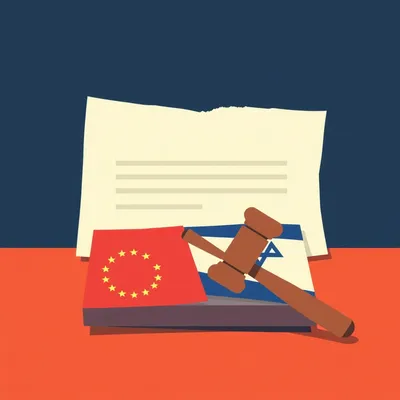
So Daniel sent us a prompt today about what's happening in Brussels this week. Spain, Slovenia, and Ireland, he calls them the usual suspects, are on another push to get Israel booted out of the EU association agreement. They've formally asked to suspend the whole thing.

It's a story that keeps coming back. And I think the honest framing up front is that this is not a new initiative. Spain, Ireland, and Slovenia have been pushing on this for more than two years now. What's new is the specific triggers, the framing, and the political math around it.
Right, and Daniel specifically asked us to unpack what suspension would actually mean in practical terms. Trade, research access, diplomatic standing. And then the politics of the qualified majority voting, which is, you know, not the most intuitive thing in the world.
Let's try to do both. Let's start with what the agreement actually is, because a lot of coverage of this story kind of assumes everyone already knows, and I don't think that's true.
Please. Yeah. Walk me through it.
The EU-Israel Association Agreement entered into force in the year two thousand. It's based on a framework that was signed in nineteen ninety-five. It is, in formal terms, a Euro-Mediterranean Association Agreement, which is the same template the EU uses with a bunch of its southern neighbors. Morocco, Tunisia, Jordan, Egypt, Lebanon. So it's not a one-off bilateral. It's part of a pattern.
And what's in the thing? What does it actually cover?
Three big pillars. The first is a free trade area for industrial goods. So tariff-free access for most manufactured products in both directions. There are separate protocols for agricultural trade and for processed food, which are a little more restricted. The second pillar is political dialogue, regular meetings between EU institutions and Israeli counterparts. And the third pillar is cooperation in specific areas, including science and technology, which is the hook that eventually allowed Israel to associate with the EU research framework programs.
That's the Horizon Europe thing.
Right. So Horizon Europe is the current, as of twenty twenty-one through twenty twenty-seven, research and innovation funding program. Budget of roughly ninety-three and a half billion euros. Israel is an associated country, which means Israeli universities and companies can compete for those grants on the same footing as member states. That participation is technically a separate agreement, but it is legally anchored to the Association Agreement.
Okay, so those are the three pillars. Trade, political dialogue, and cooperation. What's the legal hook for suspending any of it?
That's where Article Two comes in. And I want to be pretty precise about this, because a lot of the reporting is sloppy. Article Two of the Association Agreement says, and I'm paraphrasing, that relations between the parties, and all the provisions of the agreement itself, shall be based on respect for human rights and democratic principles. And it says explicitly that this respect constitutes an essential element of this agreement.
Essential element. That language is doing some work.
A lot of work. That is a standard clause the EU puts into almost all of its external agreements. It's called the human rights conditionality clause, or the essential elements clause. And the reason it matters is that if one party breaches an essential element, the other party is entitled under international law to take what are called appropriate measures in response, up to and including suspension.
So it's a legal off-ramp.
It's a legal basis. Whether it gets used is a political question. And this is really the key distinction Daniel flagged in his prompt, which is that there is a difference between suspending the whole agreement and suspending specific provisions of it. They are different legal acts. They require different voting thresholds. And they have very different practical consequences.
Let's do the voting part. Because I think that's where a lot of people get lost.
Yeah, so the EU Council, when it acts on foreign policy, uses different voting rules depending on what it's deciding. For a full suspension of an association agreement, most legal analysis says the Council would need unanimity, because the original agreement was concluded unanimously, and a so-called parallelism principle says that to undo a unanimous act you need another unanimous act.
So every single member state would need to agree. All twenty-seven.
All twenty-seven. And the moment you say that, you've basically answered the question of whether a full suspension is going to happen. It isn't. Hungary alone would block it. Germany would block it. Italy would probably block it. Austria, Czechia, depending on the day. You have at least four or five countries that would vote no on anything resembling a full suspension.
Even with the Orban government on its way out, apparently.
Even so. So Peter Magyar, who is the leading challenger and likely next prime minister of Hungary, has said publicly that he would continue to block EU decisions on Israel. So this is not purely an Orban-era policy. It's a deeper alignment that crosses the Hungarian political spectrum.
Interesting. I hadn't picked up on that.
Yeah, it surprised a lot of people. Now, the important point is that the qualified majority path exists for parts of the agreement. If you're suspending only the trade provisions, or only the Horizon Europe research association, that can be done by qualified majority, because trade is an exclusive EU competence and research cooperation falls under the same legal basis.
And qualified majority is, remind me of the math.
Qualified majority is fifteen out of twenty-seven member states, representing at least sixty-five percent of the EU population. So it's not just a headcount. You also need the population threshold. Which means if Germany votes no, you have a very hard time getting to sixty-five percent of the population, because Germany alone is something like nineteen percent.
So Germany is functionally a blocker even on the qualified majority track.
Germany is the pivotal country. This is the single most important thing to understand about this whole debate. If Germany changes position, things move. If Germany holds its current position, things don't move. Everything else is commentary.
And Germany has been pretty firm.
Germany has been firm in opposing suspension of any part of the agreement. Chancellor Friedrich Merz has made critical statements about specific Israeli military conduct, particularly about civilian casualties, but the German government has not translated that criticism into a vote in favor of suspension. So there's been a widening gap between German rhetoric and German voting behavior.
Which is its own story, honestly.
It is. And I think we should steelman the German position for a minute, because it's often caricatured.
Please do.
The German argument, roughly, is that Germany has a unique historical responsibility toward Israel's security, that this responsibility is codified in what German politicians call the Staatsrason, the reason of state, and that suspending an economic and political framework with Israel would be inconsistent with that responsibility. There's also a more pragmatic argument that says suspension doesn't actually change Israeli behavior, so it's a symbolic gesture that damages EU credibility by punishing a partner without achieving the stated policy goal. And there's a third argument, which is that isolating Israel diplomatically pushes it further from a two-state outcome, not closer to one.
Okay. And what's the counter-steelman?
The counter-argument, from the Spanish, Irish, Slovenian camp, is that the human rights clause in Article Two is supposed to mean something. If the EU finds, through its own review process, that an essential element has been breached, and then declines to act, then the clause is dead letter in every other agreement the EU has. So there's an institutional credibility argument that says, even if suspension doesn't change Israeli behavior in the short term, not acting damages the EU's ability to ever invoke a human rights clause credibly against anyone else.
That's a real argument.
It is. And the June twenty twenty-five internal EU review found that Israel was, in fact, in breach of Article Two. That's not a Spanish talking point. That's an EU finding. Which made the subsequent political inaction harder to justify on its own terms.
So the EU said, technically, yes, they are in breach, and then didn't do anything about it.
Close to that. The review was launched in May twenty twenty-five by Kaja Kallas, who is the High Representative for Foreign Affairs. The review concluded in June that there were indications of breach. Then in September, Ursula von der Leyen, the Commission president, proposed a partial suspension that would sanction some Israeli ministers and suspend trade-related sections. That proposal needed a qualified majority in the Council. It did not reach that majority. Germany, Hungary, Czechia, and Italy were the core of the no bloc. The proposal was shelved in October, partly because a US-brokered ceasefire in Gaza created space for people to say, well, let's see how this plays out.
And then the situation deteriorated again.
It did. Through the winter and into this spring. You had escalating violence in the West Bank. You had a major Israeli operation in Lebanon that Spain characterized as the heaviest strike since the offensive began. You had the Israeli Knesset passing a death penalty law for Palestinians convicted in military courts, which is what the three foreign ministers specifically cite in their letter.
Which was the immediate trigger.
The Knesset law is the immediate trigger. The letter, sent by Spain, Slovenia, and Ireland to Kaja Kallas last week, cites the death penalty law, attacks on civilians in Lebanon, and continued settler violence in the West Bank as together constituting a further breach of the essential elements clause. And they're asking the Foreign Affairs Council, which is meeting this week in Luxembourg, to formally consider suspension.
So that's the April twenty twenty-six push.
That's what's happening right now, this week.
And the diplomats are basically saying the same thing they said six months ago.
Same thing they said six months ago. A European diplomat told Euronews, quoting, there is no broad consensus among the member states. Germany, Italy, and the rest of the opposition bloc have not changed their positions. So the expected outcome on Tuesday is that the proposal is debated, there is no formal vote because there is no path to a majority, and the political signal is, we're still at an impasse.
Let's talk about what would actually change if suspension happened, or partial suspension happened. Because I think this is the thing most people don't have a concrete sense of.
Let's do it by pillar. Trade first, because it's the biggest number. The EU is Israel's largest trading partner. Total trade in goods reached roughly forty-two point six billion euros in twenty twenty-four. A significant portion of that trade moves on preferential tariffs because of the Association Agreement's free trade provisions. If you suspended those trade provisions, Israeli exports to Europe would face standard most-favored-nation tariffs, which are higher. The estimate I've seen from EU Commission analysis is roughly two hundred twenty-seven million euros per year in new tariff costs for Israeli exporters.
Which is meaningful, but not earth-shattering.
Not earth-shattering, and it's worth being honest about that. It would hurt specific sectors, agricultural exports, some processed food, certain chemical products. But Israel's economy is heavily services-oriented and its trade with the EU is increasingly tech-focused, and services aren't covered by the same tariff structure. So a trade suspension is a real blow but not an economic catastrophe.
What about research and Horizon Europe?
Horizon Europe is more interesting, actually, because it has already partially ruptured. The Commission in July twenty twenty-five proposed a partial suspension specifically excluding Israeli entities from the European Innovation Council Accelerator. That's the big startup and SME funding track. And Israeli participation in Horizon more broadly has halved since the program began in twenty twenty-one, according to data published this month by Science Business magazine. So the boycotts at the university level, plus political pressure, plus the partial suspension proposal, have already done a lot of de facto damage to the research relationship.
Hmm. So the formal suspension would be more of a legal ratification of what's already happening.
In the Horizon case, yes. A formal suspension would confirm and extend what's already happening informally. And that matters because the next framework program, Horizon after twenty twenty-seven, is being designed right now, and Israel's association to that future program is very much up for political negotiation. So the question isn't just will the current program be suspended. It's will Israel be in the next one at all.
And on diplomatic standing, the third pillar.
Political dialogue suspension requires unanimity, so that's off the table as a formal act. But the political dialogue is already quite cold. The EU-Israel Association Council, which is the formal meeting body, has not met in normal form for years. Foreign Ministers meet bilaterally but not through the Association Agreement framework. So diplomatic standing has already degraded, even without a formal suspension. A formal political dialogue suspension would be more of a symbolic marker than a practical change.
Right, so the formal label would catch up with the reality.
In a lot of these cases, yes. The formal mechanisms lag the political temperature by quite a lot. Which is kind of how the EU works in general.
Let me ask you a provocative question. Is there a scenario where this whole push actually changes anything?
I think there are a few scenarios worth considering. The first is the one where Germany moves. And the reason to take that seriously is that German public opinion has shifted quite a lot. Polling shows German voters increasingly critical of Israeli military conduct. If the Merz government faces enough domestic pressure, or if there's a change in coalition arithmetic, the German position could shift, even modestly, and that would unlock a qualified majority.
That's a slow-moving scenario, though.
Very slow. Probably measured in months, maybe a year. The second scenario is what you might call the escalation trigger. If there's a specific event, a major strike on a civilian target, a mass casualty incident in the West Bank, something that crosses a political pain threshold in a pivotal country, that can shift votes quickly. This is essentially what happened in September twenty twenty-five, when von der Leyen felt she had to put the suspension proposal forward. The trigger in that case was the recognition of Gaza as, in her words, a man-made famine.
And the third scenario?
The third is the slow grind. The formal agreement stays in place, but it gets hollowed out progressively. Horizon Europe participation drops further. Universities cut research ties. Individual member states implement their own measures, like Slovenia banning imports from occupied territories, which it did in August twenty twenty-four. Spain did the same through a decree that came into force at the start of twenty twenty-six. You end up with a situation where the agreement exists on paper but its practical content has been reduced country by country.
That's the death by a thousand cuts.
That's the death by a thousand cuts. And I actually think that's the most likely trajectory, based on the current political math. You'll see more national-level measures. You'll see the Horizon Europe question resolved one way or the other by qualified majority. And you'll see the trade preferences formally continue while informal pressure reshapes the actual flows.
What about the European Citizens' Initiative? I saw there was one that crossed a million signatures.
Yeah, so the European Citizens' Initiative is a mechanism that, if it collects one million signatures across at least seven member states, formally requires the European Commission to consider a legislative proposal on the issue raised. The Justice for Palestine initiative crossed that threshold. It requests the Commission to propose full suspension of the Association Agreement.
Does the Commission actually have to do anything?
The Commission has to respond within six months. It has to either bring forward a legislative proposal or explain why it won't. It doesn't have to actually propose suspension. It just has to engage with the initiative formally. So it's a political pressure instrument, not a binding lever. But it does force the Commission to take a public position, which is significant.
And the coalition pushing this, Spain, Ireland, Slovenia. What do they get out of it? Even if they know it's going to fail this week.
That's a good question, and I think there are a few answers. For Spain, the Sanchez government has domestic political incentives. He's a Socialist prime minister, his coalition includes parties that are strongly pro-Palestinian, and taking a visible international stance reinforces his political base. There's also, I think, a genuine ideological commitment. Sanchez has been very consistent on this issue for years.
And Ireland?
Ireland has a long history of foreign policy identification with Palestinian causes. The Occupied Territories Bill, which would ban trade in goods from Israeli settlements, has had unanimous support in the Dail, the lower house of parliament, since twenty eighteen. So this is not a partisan issue in Ireland. It's a cross-party position. And recognizing Palestine as a state, which Ireland did in May twenty twenty-four alongside Spain and Norway, was part of the same trajectory.
Slovenia is the interesting one. Smaller country, less commonly in the foreign policy spotlight.
Slovenia is interesting. I think part of it is that Slovenia was the first EU country to formally ban imports from Israeli-occupied territories, in August twenty twenty-four. And that decision came out of a specific set of political actors, including the prime minister Robert Golob, who has been very vocal on this. It also reflects, I think, a smaller-country approach where symbolic leadership on human rights questions is a way to punch above your diplomatic weight.
And being the first to move can matter. Other countries follow.
Other countries follow. And that's part of the theory of change here. If Spain, Ireland, and Slovenia keep forcing the issue, and the internal EU review keeps piling up findings of breach, and individual member states keep adopting national measures, then over time the political cost of the status quo rises. That's what the Spanish-led coalition is betting on. Not that they win this week's vote. But that they shift the center of gravity slowly.
I want to come back to something you said earlier about precedent. You said the EU has only formally invoked a human rights clause in one other context. What was that?
Under the Cotonou Partnership Agreement, which is the framework the EU uses with African, Caribbean, and Pacific states. Article ninety-six of Cotonou is the formal human rights suspension procedure. It's been invoked against countries like Zimbabwe, Fiji, Niger, Madagascar, Guinea, in cases involving coups or serious human rights deterioration. Usually the result is partial suspension of aid, not full termination of the agreement.
And that's the only precedent?
For formal invocation of the essential elements clause against a state party, yes, the Cotonou cases are the main body of precedent. Which is why the Israel question is so sensitive. It would be the first time the EU used the human rights clause against a country outside the ACP framework. It would set a precedent for how the EU handles these clauses in all of its other agreements. Including the ones with Morocco, Egypt, Tunisia, and others, where similar clauses exist.
So there's a knock-on concern. If you use it here, it raises the question of why you haven't used it against these other partners.
That's exactly the concern the German and Italian camps raise. They frame it as, if we suspend the agreement with Israel over conduct X, we have to be prepared to suspend the agreement with, say, Egypt over conduct Y. And since we're not willing to do that, applying the clause selectively against Israel looks like singling out, not principled enforcement.
And the counter?
The counter is that consistency is desirable but not required. The EU has always made selective political judgments about where to apply its instruments. The EU has sanctioned individual Israeli settlers, it has sanctioned Russian officials, it has sanctioned Belarusian officials, it has not sanctioned officials from other states with comparable or worse records. The charge of inconsistency is true but not dispositive. Each case gets judged on its own political merits.
Both sides have a point, honestly.
Both sides have a point. This is one of those debates where the intellectually honest position is that the arguments cut in multiple directions and the resolution is political, not logical.
Let me ask you about the realistic trajectory. You said the most likely scenario is death by a thousand cuts. Put a time frame on that. What does this look like in a year? Two years?
I'll speculate, with the caveat that these things are impossible to predict precisely. I think in a year you probably see the Horizon Europe question resolved one way or the other. Either the partial suspension of the EIC Accelerator becomes formalized, or it gets unwound as part of some broader deal. The trade preferences, I think, stay formally in place through at least the end of the current Commission mandate, which runs to twenty twenty-nine. But you see more national-level import bans from settlements, and maybe one or two more member states joining the Spain-Ireland-Slovenia core.
Who would those be?
Belgium has been edging toward that position. Luxembourg. Portugal sometimes. Finland under certain governments. Sweden historically but less consistently under the current government. So a group of maybe seven or eight member states moving toward more active measures, while the German-led bloc of maybe ten or twelve holds firm on preserving the core agreement.
And the other ten or so sit in the middle.
Sit in the middle, vote pragmatically, and ultimately determine where the qualified majority lands on any specific measure. Those swing states are the ones to watch. France is the biggest one, and France has been... complicated.
Complicated how?
French position has oscillated more than almost anyone else's. At different moments France has backed stronger action, and at other moments it has softened. The Macron government has made some high-profile statements about the need for a political horizon for Palestinians, and France formally recognized Palestine in twenty twenty-five, which was a significant move. But France's voting behavior in the Council has not been as consistent as its rhetoric.
So France is a wild card.
France is a wild card. And given the size of France, if France moved firmly into the pro-suspension camp, you might actually get a qualified majority on the partial suspension track. That is the single most important political variable to watch, in my view. More than the next Hungarian government, more than the Italian position, it's whether France commits.
Let me ask a big picture question. What does all of this tell us about the EU as a foreign policy actor?
I think it tells us two things, and they're in tension with each other. The first is that the EU has built up real legal machinery for human rights conditionality. The clauses exist, the review processes exist, the findings happen, the proposals get made. That machinery is more developed than almost any other regional organization's.
And the second?
The second is that the political machinery to actually use those instruments is weaker than the legal machinery. The requirement for unanimity on major foreign policy acts, the German-anchored hesitation on any issue involving Israel, the general European reluctance to get out ahead of the United States on Middle East policy. All of those combine to produce an outcome where the EU has extensive tools and very limited ability to deploy them.
So it's a case study in the gap between capacity and will.
That's exactly right. Capacity without will. And I think it's not unique to this file. You see the same dynamic on China, on Russia before twenty twenty-two, on Turkey. The EU has the formal instruments. The EU rarely has the political coherence to use them decisively on major issues. Where it does move, it tends to move slowly, through accumulation of smaller decisions, rather than through the big declarative acts.
Which brings us back to the death by a thousand cuts.
Brings us back to the death by a thousand cuts. And I think that's probably the right mental model for this file specifically, and for a lot of EU foreign policy more broadly. If you're looking for a dramatic break, you're usually going to be disappointed. If you're looking at the long-term trend, it's often more significant than it looks in any given week.
So when people read the news this week and see, Spain's push fails in Brussels, the takeaway should not be nothing happened.
The takeaway should not be nothing happened. The takeaway should be, another increment of political pressure has been registered. The internal review findings have been reinforced. Another set of public statements from foreign ministers is now on the record. Another set of member states has publicly positioned itself. And the cumulative weight of all that matters, even if this specific proposal doesn't succeed.
I think that's a good place to start winding down. Anything we missed?
One thing worth mentioning. We should be careful not to reduce this entirely to Brussels procedure. There are millions of people whose lives are affected by what's happening in Gaza, the West Bank, and Lebanon. The EU debate is important because it's one of the few real policy levers that exists. But it's also not the only dimension of this conflict. International Court of Justice proceedings, ICC warrants, national-level legislation in EU member states, civil society mobilization, all of those are happening in parallel and they all interact with the association agreement question.
That's a good caveat. It's easy to get sucked into the procedural detail and lose sight of what it's actually about.
It's easy to do. And the procedural detail matters precisely because the outcomes shape real policy. But the reason to care about any of this is not the procedure itself. It's the consequences.
Well said. Okay, I think we've gone long enough on this one.
I think we have.
Thanks as always to our producer Hilbert Flumingtop. And big thanks to Modal for providing the compute.
This has been My Weird Prompts. Find us at myweirdprompts dot com for RSS and all your podcast apps.
Take care.
See you next time.