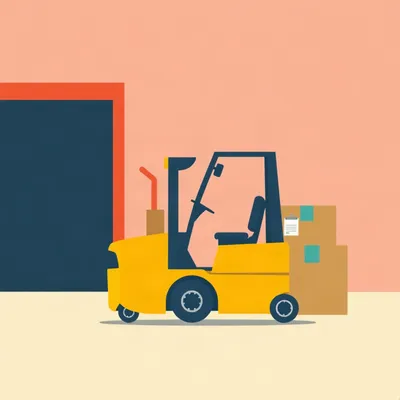
Close your eyes for a second. Imagine the sound of a shipping container's rear doors slamming shut. That hollow metallic boom. You're standing on the curb outside your apartment, and your landlord just gave you sixty days' notice. And in that moment, the fantasy isn't about the container itself. It's about what's inside it. A sixty by forty centimeter plastic box. Four of them to a pallet. Pallets on a forklift. Forklift into the container. And suddenly you're not trapped anymore.

That's the sound of escape. And here's the thing — most people hearing this will think the fantasy is about running away. It's not. It's about readiness. It's about knowing that when the other shoe drops, you have a system.
Daniel sent us this one. And I want to be upfront — this is not our first Eurobox episode. But this one is different. This one is personal. Daniel wrote in about a decade of unplanned moves in Jerusalem, about the psychological weight of housing instability, about building a life when buying property feels like climbing Everest in flip-flops. And about discovering that a sixty-year-old industrial logistics standard — the humble Eurobox — became his mental parking space for something deeply existential.
The question he's really asking is this: how do you own a life when you can't own a house? How do you build a home when your lease can evaporate on a landlord's whim? And the answer he found — the answer we're going to unpack today — is that you don't need to own property to own belongings that bring you joy. You just need a system that makes those belongings as mobile as you are.
The alternative, the one Daniel tried in his twenties, is owning one frying pan and calling it minimalism. It's also immensely depressing. So today we're talking about why a DIN-standard Eurobox might be the most important purchase a renter never considers — and why owning one frying pan is not the only alternative to owning a house.
This is the logistics of belonging. Let's get into it.
Before we get to the box itself, we need to sit with the problem it solves. Because the problem is bigger than most people admit. Israel's rental market is brutal in a very specific way. Leases here are typically annual, and landlords can choose not to renew for any reason or no reason at all. There's no long-term security. You're perpetually sixty days from upheaval.
That upheaval isn't just emotional. Daniel mentioned his last move cost nearly three thousand dollars. That's a professional move between apartments. When you're trying to save for a down payment, dropping three grand every time a landlord changes their mind is like trying to fill a bathtub with the drain wide open.
The numbers on property are even worse. The average apartment in Jerusalem runs somewhere north of seven hundred thousand dollars. For a young family earning local salaries, that's not a stretch goal. That's generational wealth or it's not happening. So you're stuck in a cycle: rent, get displaced, pay to move, lose savings, repeat. And somewhere in that cycle, the question becomes: what am I even allowed to own?
That's the psychological toll Daniel's getting at. When your housing is perpetually temporary, your relationship with objects gets warped. Every purchase becomes a calculation. Do I really want to carry this thing to the next apartment? And the one after that? You start treating your own life like it's on probation.
The rational response, the one a lot of people land on, is to own less. Minimalism as self-defense. One frying pan. Nothing that can't be carried in a single trip. It solves the logistics problem. It just solves it by shrinking your life to fit the constraint.
Daniel's insight — and this is where the episode turns — is that there's another variable you can change. You don't have to shrink your life. You can change the storage system. If your belongings are already containerized, already pallet-ready, already standardized to the exact dimensions of global logistics infrastructure, then the question "how will I move this?" stops being terrifying. It becomes a checklist.
Let's talk about the box itself. The Eurobox is governed by a standard called DIN EN 13199 — that's the European norm — which is identical to ISO 3394 internationally. The base footprint is six hundred millimeters by four hundred millimeters. That's about twenty-four inches by sixteen inches, or for the audio-minded, imagine two vinyl records sitting side by side. That's your footprint.
Two records wide. And height-wise?
Four standard heights. One twenty millimeters, two ten, three twenty, and four twenty. Those aren't random numbers. A one-twenty is shallow — good for cables, small tools, things that lay flat. A three-twenty is your workhorse. A four-twenty can hold a stand mixer or a stack of books. And here's the key that makes the whole system work: that six hundred by four hundred footprint is exactly half a Europallet.
Two of them side by side fill the short edge of a pallet. Four of them fill the whole thing.
A Europallet is twelve hundred by eight hundred millimeters. Four Euroboxes sit on it with zero wasted space. No overhang, no gaps. That means when you stack pallets on industrial racking, when you load them into a shipping container with a forklift, nothing shifts, nothing catches, nothing wastes a single centimeter. The entire global logistics chain is designed around this rectangle. And your belongings are now that rectangle.
Walk me through the chain. Box to ship.
You start with your Eurobox on a shelf in your apartment. When it's time to move, you lift it onto a pallet. Four boxes per layer, typically stacked three or four layers high — that's twelve to sixteen boxes on a single pallet footprint. Wrap it in stretch film. A forklift or pallet jack picks it up. It goes onto a truck, then to a warehouse where the racking is spaced exactly for Europallets. From there, into a twenty-foot shipping container, which holds eleven Europallets. A forty-foot holds twenty-five.
Eleven pallets in a twenty-foot. That's forty-four Euroboxes per layer, stacked two or three high. You're talking about over a hundred of these things in a single container.
Every step of that chain is standardized. The pallet fits the racking. The racking fits the container. The container fits the ship, the train, the truck. Your box of microphone cables and tripods never gets opened, never gets repacked, never gets taped up in a panic. It's container-ready at all times. Daniel called this "decoupling" and it's the right word — your need for housing and your ability to own things become two separate problems.
Which is the whole game. The landlord says sixty days, and instead of a crisis, you're scheduling a forklift.
Now compare this to what most people use. An IKEA SAMLA bin. It's tapered — wider at the top than the bottom — so when you stack them, the weight sits on the lid, not on the bin walls. The lids pop off under load. They're not rated for stacking more than two or three high before they buckle. They're not pallet-compatible at all. You can't forklift them. They slide around.
The universal symbol of moving chaos.
It absorbs moisture. It needs tape. You can't stack it more than three high without the bottom box collapsing. And every time you move, you're buying new ones, assembling them, taping them, labeling them with a Sharpie like an animal. A Eurobox has a stacking load rating of four hundred kilograms or more. It's rated for a decade of use minimum. You buy it once.
The objection writes itself. These things are industrial plastic boxes. They're not beautiful. Someone listening is thinking, I'm supposed to put these in my living room?
I'd push back on that. First, form follows function. A Eurobox stacked in uniform rows on boltless shelving looks intentional. It looks like a workshop, a studio, a space where things happen. It doesn't look chaotic. Mismatched IKEA bins and sagging cardboard boxes look chaotic. Second, there are modular shelving systems — Bott, Sortimo, Raaco — built specifically for these dimensions. They're clean. They're metal. They look like you know what you're doing.
The aesthetic is the readiness. The thing that makes it look good is that it works.
And here's a concrete scenario. Let's say you own sixteen Euroboxes — that's four pallets' worth. Inside them: your tech gear, your tools, your kitchen equipment, your books. That's a quarter of a forty-foot container. Or, more realistically, it fits in a ten-square-meter storage unit with room to walk. Cost for sixteen boxes: roughly fifteen to twenty-five dollars each, so two forty to four hundred total. One professional move in Israel, as Daniel mentioned: three thousand dollars.
The boxes pay for themselves in the first move, just by letting you do part of it yourself.
They keep paying. Every move after that, you're not buying cardboard. You're not paying movers to handle fragile chaos. You're moving standardized units. The Wikipedia entry on the Euro container traces this standard back to the nineteen sixties, developed originally for the German automotive supply chain — the VDA standard. It's been refined for over sixty years for exactly this purpose: dense, modular, transportable storage. The automotive industry doesn't mess around with logistics. They solved this problem before most of us were born.
Here's where we need to zoom out. This isn't just an Israel problem. The data on global rental instability tells the same story in different accents. Young people in San Francisco, in London, in Sydney, in Toronto — they're all living with the same sixty-day ghost. Non-renewal, rent spikes, the impossibility of buying. The precarity is structural now. It's not a phase you age out of.
Daniel's experience isn't niche. It's the leading edge of what an entire generation is navigating. And that means the psychological framework matters as much as the box dimensions.
This is the part I find genuinely interesting. Daniel called the Eurobox a mental parking space for existential anxiety. That's not a metaphor he's reaching for. It's precise. When your belongings are container-ready, the anxiety shifts from "how will I move everything?" to "I have a system." That's the difference between feeling trapped and feeling prepared.
The box doesn't solve the housing market. It solves the thing the housing market does to your head. The constant low-grade awareness that everything you own is one landlord's whim away from becoming a logistics emergency.
That awareness changes your behavior. You stop buying the thing that would make your life better because you're already calculating the cost of moving it. The Eurobox breaks that loop. It says: buy the thing. It has a home. That home is mobile.
Daniel mentioned his earlier minimalism phase in London. One frying pan. That was his twenties. That was a different solution to the same problem. Reduce possessions to zero, eliminate the moving stress entirely. And it worked, technically.
It's also, as he put it, immensely depressing. The Eurobox approach is the mature evolution of that impulse. It's maximalist but organized. You own what brings you joy, but you containerize it. You don't shrink your life to fit the logistics. You make the logistics fit your life.
There's another layer here Daniel touched on that I want to pull forward. The ADHD angle. He mentioned it briefly, but it deserves more air.
This is where the system does double duty. ADHD makes task initiation and sequencing difficult. Packing for a move isn't one task. It's a hundred micro-decisions. What goes where? Do I have enough boxes? Where did I put the tape? The cognitive load is enormous.
When you're already stressed about the move itself, your executive function is the first thing to collapse.
The Eurobox system externalizes that structure. Everything already has a standardized home. The boxes are labeled — contents and destination zone. Kitchen, bedroom, storage. The shelving is built to the box dimensions. When the move comes, you're not making a hundred decisions. You're executing a checklist. Stack on hand truck. The system compensates for what the brain struggles with.
It's not just a storage system. It's a cognitive prosthetic.
And that's why I want to lay out the actual playbook. Because a listener could implement this starting this weekend. Step one: audit your belongings by Eurobox footprint. Everything you own should fit into a multiple of sixty by forty centimeters. If it doesn't, you ask two questions. Does this item need a different storage solution, or do I not actually need it?
That forces the decluttering minimalists advocate for, but without the deprivation. You're not asking "do I own too much?" You're asking "does this fit the system?
Step two: buy boxes in batches of four. That's one pallet layer. Start with the three-twenty height — it's the most versatile. Four boxes, one pallet footprint, and you've already got the basic unit of mobility.
Install shelving that fits the boxes exactly. Industrial boltless shelving — Edsal, Husky, those brands — rated for five hundred pounds per shelf. Typical dimensions are one-eighty centimeters tall, ninety deep, ninety to one-twenty wide. That fits Euroboxes in a two-by-three or three-by-three grid. You build the shelving to the box, not the other way around.
Step four: label everything. Contents and destination zone. Kitchen, bedroom, storage. You want to know what's in the box and where it goes before you even lift it.
Step five: keep a digital inventory. Box numbers, contents, which room they belong in. It sounds obsessive. It's actually freedom. When the move comes, you open the spreadsheet and you know exactly what you have and where it's going.
Someone's listening and thinking, I live in a studio apartment. Where am I putting industrial shelving?
Here's the math. Euroboxes stack five or six high on a sturdy base. A two-by-three grid — that's six boxes per layer, twelve total if you go two layers, eighteen if you go three. Footprint: one point two meters by point eight meters. That's about the size of a single bed. You can put twelve to eighteen boxes of gear in the corner of your bedroom.
A single bed's worth of floor space. That's the tradeoff.
If you ever need to leave the country — this is the international move scenario Daniel alluded to — you call a freight forwarder. They drop a twenty-foot container at the curb. You load your pallets yourself, or you pay them to do it. Your belongings are on a ship within forty-eight hours. No "what do I keep versus throw away" panic at the last minute.
Because the panic was already resolved. It was resolved the day you put everything into standardized boxes and labeled them.
Let me give you a concrete case study. Software engineer in San Francisco. Moves every eighteen months because her rent keeps spiking. She adopted Euroboxes and industrial shelving two moves ago. Her last move took four hours of packing. She stacked boxes onto a hand truck, rolled them to the moving truck, done. Her previous move, pre-system, took two days of chaos. Two days of cardboard, tape, and decisions.
Four hours versus two days. That's not an optimization. That's a different category of experience.
Here's the comparison that matters most. The one-frying-pan minimalist versus the Eurobox owner. Both can move quickly. Both are mobile. But one lives in deprivation. The other lives with the tools, the books, the kitchen equipment, the tech gear that make a life feel like a life. Different quality of existence.
The minimalist solved the logistics problem by shrinking the life. The Eurobox owner solved it by systematizing the life. Same starting constraint. Radically different outcome.
You're convinced. What do you actually do on Monday morning?
Buy four Euroboxes. The six hundred by four hundred by three-twenty size. That's your starting unit. Put your most-moved items in them — tech gear, tools, the kitchen stuff that always ends up in random bags. Use them for one week. Feel what it's like to open a box and know exactly what's inside and exactly where it stacks. You won't go back.
If four boxes feels like a commitment, it's forty to sixty dollars total. That's less than one dinner out in this city.
Open a spreadsheet. List everything you own. And assign each item to a Eurobox number. If something doesn't fit the footprint, you now have a decision to make. Not "do I love this?" but "does this earn its non-standard storage?" Most things won't.
That spreadsheet becomes your move-ready brain. When the landlord calls, you're not deciding what goes where. You're reading a list.
Do not buy shelves and then try to fit boxes into them. Buy the boxes first, measure them, then buy boltless industrial shelving cut to those dimensions. Edsal, Husky — these are eighty-dollar units rated for eight hundred pounds per shelf. They're not furniture. They're infrastructure.
Step four is the one that sounds absurd but is actually the most important. The mock move.
Once a year. Pack everything into Euroboxes. Stack them on a hand truck. Roll it around the block. You'll find the box that's too heavy. The item that doesn't fit. The label that's wrong. And you'll build muscle memory. When the real move comes, your body already knows the sequence.
The mock move is the difference between having a system on paper and having a system that actually works under pressure. Most people discover the weak points of their packing strategy at eleven PM the night before the movers arrive. Do it on a random Saturday in June instead.
Here's the final thing I'd say to anyone who saw themselves in Daniel's prompt. You don't need to own a house to own a life. You need a system that makes your belongings as mobile as you are. The Eurobox is that system. It's not about the box. It's about the freedom the box represents.
The box is boring. The box is sixty years old. The box was designed for German car parts. And it might be the thing that lets you stop treating your own life like it's on probation.
Let's come back to where we started. That shipping container at the curb. The hollow boom of the doors. When Daniel described that fantasy, he said something I think is crucial — he wasn't sure where the container was going. It wasn't about a destination. It was about the mental image he needed to not feel trapped.
The fantasy isn't about escape. It's about readiness. When you have a Eurobox system, you're not waiting for the other shoe to drop. You're prepared for it. That's the difference between feeling trapped and feeling in control. The container doesn't need to go anywhere. It just needs to be possible.
That possibility — knowing you could be on a ship within forty-eight hours — that's what quiets the anxiety. Not the moving itself. The option to move.
Here's an open question for anyone listening. What would you put in your first Eurobox? What's the one category of belongings that you'd want to be container-ready right now? Email us or leave a voicemail. We'll read the best responses in a future episode.
Next time on the show: the dark side of modular storage. What happens when your entire life fits on four pallets and you realize you've optimized yourself into a shipping container? There's a philosophical trap in there and we're going to walk right into it.
My Weird Prompts is produced by Hilbert Flumingtop. If you enjoyed this episode, leave us a review on Apple Podcasts or Spotify. The show notes have links to everything we discussed, including the specific Eurobox models and shelving systems we mentioned. Thanks to Mike for the conversation that sparked this one. And thanks to you for listening.
This has been My Weird Prompts. We'll catch you next time.