You're mid-drill, you've got the bit halfway into the wall, and suddenly the motor cuts. You pull back, check the trigger — nothing. Then you glance down and realize the plug has wiggled a millimeter loose from the extension cord. You haven't even moved the cord. disengaged, like it's bored of the whole project.

It's not your fault.
It's really not. Daniel sent us this one — he's got a corded drill, a budget, and a recurring problem that anyone who's used power tools in Israel knows intimately. The two-pronged Europlug on his drill makes a connection with extension cords that can only be described as emotionally distant. It's flimsy, it pulls out if you breathe on it wrong, and it turns every drilling session into a trust exercise with physics. He's asking: is there an actual fix for this, short of throwing everything out and going cordless?
Three fixes, in fact — none of which require buying new tools or rewiring anything.
The root cause here is genuinely interesting. It's not just cheap extension cords, though that's part of it. It's a mechanical mismatch between two plug standards that were never designed to meet, colliding in the one country where they meet constantly.
Why does this happen? Let's look at the actual hardware involved.
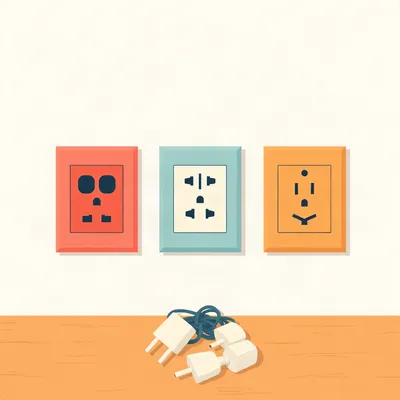
The Europlug — formally CEE seven slash sixteen — has two round prongs, four millimeters in diameter, with those flexible plastic sleeves that cover the outer half of each prong. The sleeves are there so you can't touch live metal while the plug is partially inserted. Meanwhile, the Israeli SI thirty-two plug has flat prongs, four and a half millimeters wide, plus that chunky grounding prong. So right at the dimensional level, the Europlug prongs are narrower than what the Israeli socket was designed to grip.
Half a millimeter doesn't sound like much until you remember we're talking about spring-loaded brass contacts that rely on precise geometry for tension. It's like putting a size eight foot in a size nine shoe — you can walk, but you're going to slide around in there, and eventually you're going to trip.
An Israeli socket's contacts are spaced and angled to clamp onto a flat prong that's four and a half millimeters across. When you stick a four-millimeter round prong in there, the contact surfaces barely graze it. You're not getting the spring force the socket was designed to deliver — you're getting whatever residual friction exists between two shapes that don't match.
It's not the plug's fault, and it's not the socket's fault individually. It's the handshake between two things that were never introduced.
It gets worse with those coiled extension cords Daniel mentioned. The orange and black ones you see at every hardware store — they're usually unmarked, no manufacturer name, no SI certification stamp. Those cords use conductors that are only zero point seven five square millimeters in cross-section. That's thin. And the sockets on the ends are the cheapest possible design — the brass contacts inside are stamped sheet metal with weak springs. Maybe two Newtons of grip force per prong, if you're lucky.
Which means even an Israeli plug can feel loose in those, but a Europlug? It's basically resting in there, relying on gravity and good intentions.
A proper industrial socket — something from Palazzoli or Mennekes — uses formed brass contacts with spring loading that delivers five to eight Newtons per prong. That's the difference between a handshake and a pinky promise.
To put that in terms people can feel — two Newtons is about the force you'd use to lift a small apple. Five Newtons is a firm handshake. Eight Newtons is someone who really doesn't want to let go of your hand. That's what's holding your plug in place.
That's a useful calibration. And the reason we're dealing with this at all is that manufacturers aren't going to make a separate Israeli-plug version of every power tool. The European market is four hundred fifty million consumers. Israel is nine million. The economics don't justify a separate SKU, so the tools arrive with Europlugs, and we're left to figure out the interface.
It's the same reason your imported toaster comes with a Europlug, your coffee grinder, your standing fan. Anything manufactured for the European market and imported here arrives with this plug, and the importers just shrug and say, "They'll figure it out.
Which is the core insight here. The problem isn't the plug, and it isn't the socket. It's the interface. Once you see that, the solutions become obvious — and we'll get to those next.
Let's walk through the fixes, cheapest first. The plug adapter as sacrificial connector. You buy a molded rubber SI thirty-two to Europlug adapter — not the hard plastic ones that crack if you look at them — and you leave it permanently on the tool's Europlug. Push it on once, forget it's there.
This is the fifteen-shekel, zero-seconds-of-labor solution. And it works because you're replacing one bad interface with two good ones. The adapter's Europlug socket is actually designed for four-millimeter round prongs — so it grips properly, full spring tension, full contact surface area. Then the adapter's Israeli prongs go into your extension cord, and that connection is also designed to mate properly.
Instead of a Europlug rattling around in an Israeli socket, you've got a Europlug snug in a Europlug socket, and Israeli prongs snug in an Israeli socket. Two handshakes, both firm.
The key is buying the molded rubber ones. You can find them at any electrical supply store — Malayan, Hachashmal, places like that. They're usually black or dark gray, with a slight give to the body, and they'll have the SI mark stamped on the side. The cheap plastic ones from the supermarket checkout aisle have the same mechanical problem in miniature — the internal contacts are just stamped metal with weak springs.
You're paying fifteen shekels instead of five to get contacts that actually grip. That's the whole difference. Three falafels' worth of budget for a connection that doesn't quit.
Here's a small practical tip with these adapters — when you push it onto the Europlug, push it all the way until you feel a distinct second click. The Europlug's prong sleeves are designed to compress during insertion, and that compression creates a secondary retention point inside the adapter. If you only push until the first resistance, you're missing half the grip.
I've definitely been guilty of that. You think it's seated, but it's only halfway there, and ten minutes later you're on your hands and knees pushing the plug back in.
Everyone's done it. Push until the click. Then push a little more.
Solution two is the upgrade for people who don't mind ten minutes with a screwdriver. Cut off the flimsy socket on the end of your extension cord and install a proper industrial-grade SI thirty-two socket. Palazzoli and Mennekes are the brands to look for — they use formed brass contacts with actual spring loading. Five to eight Newtons of insertion force per prong. Those cheap sockets we talked about earlier are delivering maybe two Newtons. You're tripling the grip.
This handles anything you plug into that cord — Europlug, Israeli plug, whatever. The socket doesn't care about the prong shape because the spring tension is high enough to compensate.
How does that work, practically? If the socket was designed for flat Israeli prongs, how does higher spring tension help it grip a round Europlug prong?
The spring-loaded contact inside an industrial socket isn't a rigid slot. It's a curved brass leaf that flexes outward when you insert the prong, and the spring mechanism behind it pushes back with consistent force regardless of the prong's exact position. So a round prong pushes the leaf to one contact point, a flat prong pushes it to a slightly different one, but the spring force is the same either way. The cheap stamped contacts don't have that independent spring — they rely on the prong itself to deform the metal, and if the prong is too narrow, there's no deformation, no grip.
It's the difference between a clothespin and a paperclip. The clothespin has an actual spring that clamps onto whatever you put in it. The paperclip just bends and hopes for the best.
That's the mechanical elegance of it. A well-designed socket uses spring-loaded contacts that can accommodate slight variations in prong geometry. The industrial ones are designed for workshops where cords get yanked, dragged, and stepped on. Cost is about forty to sixty shekels for the socket, and you need a screwdriver and maybe five minutes of wiring.
I saw a report from a listener in Tel Aviv who did exactly this on a twenty-meter cord — replaced the socket end with a Palazzoli unit — and after six months of weekend drilling, not a single disconnect. That's the benchmark.
One installation note here — when you're wiring the new socket, make sure you strip the cable jacket back far enough that the individual conductors have some slack inside the housing. If the wires are pulled taut, any tug on the cord transfers directly to the screw terminals, and that's how connections loosen over time. Give yourself an extra two centimeters of conductor length inside the socket body.
That's the kind of detail that separates a fix that lasts six months from one that lasts six years.
Solution three splits the difference in cost and labor. Build a short pigtail adapter — about thirty centimeters of one-point-five-square-millimeter rubber cable, with a molded SI thirty-two plug on one end and a Europlug socket on the other. It's essentially a permanent adapter cable that stays attached to the tool.
It's functionally similar to solution one, but instead of a rigid adapter block hanging off the tool, you've got a short flexible tail that moves with the cord. Less leverage on the tool's built-in plug, and it sits flat against the wall if you're drilling near a corner.
Parts cost under thirty shekels, assembly takes maybe fifteen minutes. The advantage over the adapter block is durability — there's no rigid plastic body to crack if you drop the tool, and the rubber cable flexes instead of snapping. For workshop use where tools get knocked around, this is probably the sweet spot.
I can picture the scenario. You're on a ladder, the drill slips out of your hand, and instead of the adapter block hitting the floor and shattering, the pigtail just flops and absorbs the impact.
And if you're building one of these, there's a wiring detail worth getting right. Inside the Europlug socket, the terminals are marked — L for line, N for neutral. On the Israeli plug, line is the right prong when you're looking at the plug with the ground pin at the top. Make sure you match them. It'll work either way electrically, but getting the polarity right means the tool's internal switch is on the line side, which is how the manufacturer designed the safety path.
All three of these share the same underlying principle. You're eliminating the Europlug-to-Israeli-socket interface entirely. Every connection in the chain is now between components that were designed for each other.
Which is why "just push it in harder" never works. You can't compensate for a geometric mismatch with enthusiasm. The contact area between a round prong and a flat contact is a line, not a surface. No amount of shoving changes that. You need the right socket for the right plug.
A line contact versus a surface contact — that's the physics of the whole problem in six words.
Those solutions handle the mechanical side, but there's a deeper question here about safety and tool design. The prompt mentioned feeling unsafe with the two-prong plug, and I think a lot of people have that instinct — no ground pin, therefore dangerous. But the reality is almost the opposite.
This sounds like one of those "everything you know is wrong" moments.
It kind of is. Most corded power tools sold with Europlugs are Class Two — double-insulated. You can spot them by the square-within-a-square symbol printed on the label. That means the tool's internal construction has two layers of electrical insulation between you and anything live. A ground connection is literally unnecessary. The two-prong Europlug is electrically appropriate for these tools.
The missing ground pin isn't the safety hazard. It's not a missing feature — it's a deliberate design decision that the tool is safer without relying on a ground path that might not exist.
The actual safety hazard is the flimsy connection. When a Europlug works loose in an Israeli socket, you get intermittent contact. And intermittent contact causes arcing. Tiny electrical arcs jump between the prong and the socket contact, and each arc generates heat. Over a ten-minute drilling session, that heat accumulates in the plastic housing.
There was a post on the Israeli DIY forum Mivne Ve'Shikutz — a user described their extension cord socket melting during what should have been a routine ten-minute drilling job. The Europlug had wiggled just enough to start arcing, the socket housing softened, and by the time they smelled burning plastic the damage was done. That's the real danger. Not electrocution — fire.
A loose connection is more dangerous than a missing ground. That's the headline. And it's counterintuitive enough that most people never think about it.
It really is. We're conditioned to look for the third prong as the safety indicator, and when it's not there, we assume the tool is less safe. But the safety engineering is happening inside the tool, not at the plug.
Which brings us to a common bad idea: cutting off the Europlug and replacing it with an Israeli three-prong plug. Don't do this. First, it voids the tool's warranty immediately. Second, you're cutting the manufacturer's molded cable, which means you've now introduced a DIY termination point that wasn't tested for strain relief or water ingress. Third, and this is the subtle one — if the tool is Class Two, that grounding prong on your new Israeli plug connects to nothing inside the tool. It's a dummy. But anyone who picks up that tool in the future sees a three-prong plug and assumes it's grounded.
You're creating a false sense of security for the next user. Which might be you, six months later, having forgotten what you did.
It's not just a theoretical risk. Imagine you lend that modified drill to a neighbor. They're working outside, maybe after rain, and they think, "Three prongs, I'm protected." They're not. The ground pin is connected to empty air inside the housing.
The permanent adapter approach — Solution Three — is cleaner precisely because it doesn't modify the tool at all. The Europlug stays intact, the warranty stays intact, the safety certifications stay intact. You're solving the interface problem without touching the certified assembly.
That matters because the tool's certification was tested with that specific molded plug and cable combination. Once you cut into it, you're the manufacturer now, legally speaking.
There's an interesting parallel here with the automotive world. People used to cut into factory wiring harnesses to install aftermarket stereos, and it caused endless electrical problems. The industry eventually standardized on adapter harnesses — plug one end into the car, the other into the stereo, no cutting required. This is the same principle. Adapters preserve the original engineering.
Let's talk about the extension cords themselves, because quality tiers in Israel are surprisingly well-defined once you know what to look for. Bottom tier: those unmarked coiled cords, usually orange or black, sold at supermarket checkout lines and random hardware stores. No manufacturer name, no SI certification stamp, zero point seven five square millimeter conductors. The sockets are assembled rather than molded, which means there are screws inside that can loosen over time. These are basically disposable.
The musical equivalent of beige wallpaper.
That's harsh but fair.
Middle tier: the orange rubber cords from Ace or Home Center. These are better — they usually have the SI mark, one point five square millimeter conductors, and molded plugs. The sockets are still consumer-grade, so the spring tension isn't industrial, but they're adequate for occasional use with Israeli plugs. Europlugs will still be looser than you'd like.
The top tier?
Industrial yellow rubber cords from electrical supply stores. Malayan, Hachashmal, places that sell to electricians, not homeowners. These have one point five or even two point five square millimeter conductors, molded plugs, and the sockets use the same spring-loaded brass contacts as the standalone industrial sockets we talked about. They're fifty to a hundred twenty shekels depending on length, and they'll outlast every tool you plug into them.
The yellow is actually a functional thing, right? It's not just branding.
Yes — the yellow rubber compound used in industrial cords has higher UV resistance and stays flexible at lower temperatures than the orange consumer-grade rubber. If you're working outdoors or in an unheated space in January, the yellow cord won't turn into a stiff, uncooperative noodle.
How do you identify a good cord if you're standing in the aisle?
Look for the SI mark — it's a small Standards Institution of Israel logo, usually molded into the plug body. Check the cable printing for the conductor cross-section — you want one point five millimeters squared minimum. And check whether the plugs and sockets are molded or assembled. Molded means the rubber was formed directly around the contacts in a factory. Assembled means there's a seam, probably screws, and it was put together by hand. Molded is always better for durability and water resistance.
The coiled cords fail all three tests. No SI mark, thin conductors, assembled sockets.
The coiled design itself is a problem for power tools. Coiling concentrates heat because the conductors are packed tightly together with no airflow. At five amps draw — typical for a six hundred watt drill — a twenty-meter cord with zero point seven five millimeter conductors has about zero point nine ohms of resistance. That gives you a four and a half volt drop at the tool. Your drill is getting two hundred fifteen volts instead of two hundred twenty, which is enough to noticeably reduce torque.
Compared to the one point five millimeter cable in Solution Three — three times lower resistance, one third the voltage drop, and the cable stays cool because it's not coiled.
Here's a fun fact about coiled cords specifically — they're not just a heat problem, they're an inductance problem. A coiled conductor forms an inductor. When you're running a universal motor — which is what most corded drills use — the motor's brushes create electrical noise that reflects back into the cord. A coiled cord amplifies that noise through inductive coupling, which can cause additional arcing at the brushes. It's a small effect, but it adds to the overall wear on the tool.
The coiled cord is actively making your drill work harder and die sooner.
In a measurable, if modest, way.
One last thought on the budget question. The prompt mentioned eventually wanting a cordless drill, and I want to flag that a decent twelve-volt cordless — something like a Bosch Go or Makita DF zero one two — runs about three hundred shekels. If someone's extension cord setup is bad enough that they'd need to replace multiple cords and buy adapters, the math might actually tip toward just getting the cordless now.
Though the upgraded extension cord stays useful forever, even after you go cordless. You'll still need it for a circular saw, a sander, a work light. The cord isn't obsolete just because the drill went wireless.
And the pigtail adapter you build for your current drill will work with any future corded tool that has a Europlug. So it's not a sunk cost — it's infrastructure.
That's exactly what we're talking about. Stop thinking of the plug and socket as an afterthought and start treating it as part of the tool system.
I want to pause on that word, "infrastructure," because it reframes the whole conversation. Most people treat extension cords like consumables — you buy the cheapest one, it breaks, you buy another. But a good cord with good connectors is closer to plumbing. You install it once, it works for twenty years, and you stop thinking about it entirely. That's the goal.
The cost difference, amortized over twenty years, is essentially zero. The fifteen-shekel adapter versus the five-shekel one is a ten-shekel difference. Over a decade of weekend projects, that's a shekel a year. You're paying one shekel per year to never have your drill cut out mid-hole.
Let's boil this down to what you should actually do. Three concrete steps, starting today.
Step one — buy a molded rubber SI thirty-two to Europlug adapter. Fifteen shekels, zero labor. Push it onto your drill's Europlug and leave it there permanently. Now every extension cord you own gets a proper Israeli-to-Israeli connection.
Step two — if you own a screwdriver and ten minutes, replace the socket end of your most-used extension cord with an industrial SI thirty-two socket. Palazzoli or Mennekes. Forty to sixty shekels, and suddenly that cord grips anything you plug into it like it means it.
Step three — build the pigtail. Thirty centimeters of one-point-five-millimeter rubber cable, molded Israeli plug on one end, Europlug socket on the other. Under thirty shekels, fifteen minutes to assemble. It's the cleanest solution — nothing dangling off the tool, nothing to crack when you drop it.
Here's what you can do right now, before you buy anything. Look at the socket end of your extension cord. If it has a visible seam with screws, it's assembled — you can replace just the socket with an industrial one. If it's smooth all around, it's molded — go buy the adapter or build the pigtail.
The future-proofing angle here is worth underlining. When you eventually get that cordless drill, these upgraded cords don't become obsolete. They'll work perfectly with your circular saw, your sander, your work light — any future corded tool, whether it arrives with a Europlug or an Israeli plug.
You fix the interface once, and every tool you ever plug in benefits from it.
You've got your drill running reliably. But this raises a bigger question about where power tools are headed. Cordless has been eating corded's lunch for a decade now — better batteries, brushless motors, prices dropping every year. Does the corded drill eventually become a niche product, like the hand brace?
I don't think corded disappears entirely, but it definitely bifurcates. At the consumer end, sure — a twelve-volt cordless handles ninety percent of what a homeowner needs, and the convenience wins every time. But at the high-torque end, the corded tool still has physics on its side. A fifteen-amp corded circular saw can pull eighteen hundred watts continuously. No battery pack on the consumer market can match that without weighing twelve kilos.
Corded becomes the domain of the serious — the workshop tool, the demolition hammer, the thing you buy when you need power density, not portability.
The cheap corded drill might hang on precisely because it's cheap. A hundred-shekel corded drill versus a three-hundred-shekel cordless — if you're drilling six holes a year, the math is straightforward.
The other thing I'm watching is the EU's USB-C mandate. They forced a universal charging connector on phones, tablets, cameras — basically anything that charges under a hundred watts. Power tools are a different beast, but the regulatory instinct is there. Could we see a universal power tool connector standard in the next decade?
That's actually being discussed. The USB Implementers Forum has a working group on higher-wattage standards — USB-C Extended Power Range already goes up to two hundred forty watts. That's not enough for a circular saw, but it's enough for a lot of twelve-volt and eighteen-volt tool chargers. The question is whether the major manufacturers would ever agree to a shared battery interface. Right now, the battery is the lock-in. You buy into Makita's eighteen-volt ecosystem, you're buying Makita tools for a decade.
The razor-and-blades model, but with lithium cells.
And nobody wants to be the first to give that up. But if regulation forces it — the way the EU forced USB-C — then suddenly you'd have interoperable batteries across brands. That would be transformative for the budget-conscious user. Buy one battery platform, use it with everyone's tools.
Though I suspect we're a long way from that. The power tool lobby is not small, and the safety implications of a universal high-current connector are nontrivial.
A poorly designed universal connector that overheats at forty amps is a fire waiting to happen. The engineering has to lead the regulation, not the other way around.
There's an interesting precedent here that didn't go well. In the early 2000s, several European manufacturers tried a shared battery standard called the Cordless Alliance System. Metabo, Rothenberger, a few others — they agreed on a common battery interface. It still exists, but it never gained traction with the big three: Makita, DeWalt, and Milwaukee. The lock-in was too profitable.
CAS is a fascinating case study. It proved the technical interoperability was possible — the batteries worked, the chargers worked, the tools worked. But the market incentives weren't aligned. The big manufacturers looked at it and saw a way to lose battery sales, not gain tool sales.
In the meantime, we've got extension cords and pigtail adapters.
Which do the job. And if you've built one of these — the pigtail, the industrial socket upgrade, or even just found a particularly good adapter — we want to hear about it. Send it to prompts at myweirdprompts dot com. We might feature your hack in a future episode.
There's something satisfying about a solution that costs thirty shekels and fifteen minutes and then works perfectly for years. That's the kind of fix that makes you feel like you've outsmarted the system.
Now: Hilbert's daily fun fact.
Hilbert: A single strand of spider silk from a golden orb-weaver can stretch up to five times its resting length before breaking, and in the early medieval period, fishermen in the Outer Hebrides reportedly used bundled spider silk as a substitute for gut line in small hand nets — though a single thread's tensile strength, at roughly one point three gigapascals, rivals modern high-grade steel wire of the same diameter.
...right.
This has been My Weird Prompts. We'll be back next week with another strange, specific problem you didn't know you had.
Thanks to our producer Hilbert Flumingtop. If you enjoyed this episode, leave us a review wherever you listen — it helps more people find the show.
Until next time.