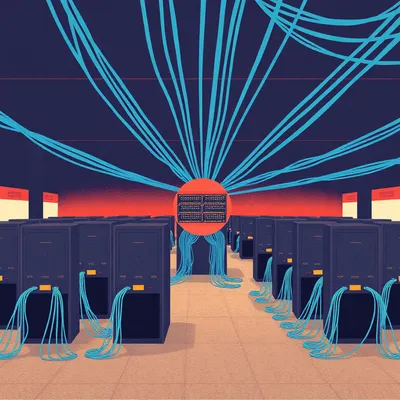
Okay, I'll admit it. When I read the first line of what Daniel sent in this week, I put my coffee down and stared at the wall for a minute.

Which line?
The one where he proposes the government should own the telecom infrastructure. All of it. Sole operator. Everyone else becomes a virtual operator renting space on the state's pipes.
And your first thought was?
That forty years of received wisdom just walked into the room and got hit by a truck.
That's about right. Let me give you the shape of what he actually asked, because it's a long prompt and it's more careful than that one line makes it sound.
Go ahead.
Daniel wrote in about whether any country has seriously considered centralizing the management of critical infrastructure, telecoms specifically. He held up Israel's deregulation as a great case study, the one where physical network operators were compelled to let virtual operators piggyback on their networks, and competition brought prices down across the whole sector. Then he asked the harder question. Has any country gone further than that, to the point where the government is the sole operator of the physical infrastructure and everybody else is a virtual operator on top?
And he has a specific reason for wanting that, which is the part I found most interesting.
He does. He points out that the physical versus virtual split creates a structural problem. Whoever owns the physical network can maintain market primacy by degrading service to the virtual operators on top of it, and they can do it through imaginative means that are hard to catch or prove. So he's not just making an efficiency argument. He's making a fairness argument.
Then the efficiency argument on top of it. He says there's a public interest in having the fewest physical networks required to provision a service, because every duplicate is waste. You dig up the same street twice for fiber, you coordinate the same permits twice, you pay for the same trench twice.
And he's honest that this cuts against the grain. He says outright that privatization has been the mechanism for better consumer prices for forty years, and his proposal is centralization with a decoupled commercial layer. Government takes on the physical infrastructure as a collective good, private market competes on the service layer above it.
He even flags the local context. Israel has been on a privatization trend, the national airline, the postal service, partial or full. So he's asking about movement in the opposite direction, and whether there's an argument for it.
And the two questions he lands on at the end. First, are there examples where governments pursued centralization outright with the explicit aim of improving prices and competition for consumers? Second, is there a boomerang effect, where privatization was reversed and centralizing again turned out to be in the consumer interest?
So let's explore the two sides of that debate, and where the inverse might actually be more helpful to fair, competitive, free markets.
What Daniel is describing has a precise name in telecom policy. It's called an open-access network, and the architecture is what the literature calls horizontally layered. The infrastructure owner does not sell services. Retail providers compete on top of the infrastructure.
So the layers.
Three of them. The passive infrastructure provider owns the physical plant, the ducts, the fiber, the poles. The network provider operates the active electronics. The service provider sells retail services to end users. Passive, network, service.
And the deployment models?
There are three, and they differ by how far down the stack the openness goes. The passive-layer open model opens the physical layer, and competitors install their own active gear on top. That works best in dense cities where there's enough demand to justify several operators running their own electronics. Stockholm's Stokab is the canonical example.
Next one.
The active-layer open model. One entity runs both the passive and active layers, and it's neutral to all the service providers above it. Then the three-layer open model, where the public sector owns the passive infrastructure and a single company runs the active layer, but that company is forbidden from selling services itself. That prohibition is what guarantees non-discrimination.
That last one sounds like it was designed by somebody who'd been burned before.
It was designed by people who understood the incentive problem Daniel raised. Here's the design principle, and I want to read it because it's the whole answer to his degradation concern. The open access provider remains neutral and independent and offers standard and transparent pricing to ISPs on its network. It never competes with the ISPs.
It never competes with them. That's the structural fix.
You don't have to police the infrastructure owner for subtle throttling, delayed repairs, preferential routing, opaque pricing. You remove the reason to do any of it. If the owner can't sell retail, it has no retail business to protect.
So Daniel's proposal isn't fringe. It has a name, a taxonomy, and real-world implementations. Let's start with the case he cited. Israel.
Pre-nineties, Bezeq, a government-owned corporation, dominated the market. The nineties saw the transition from government-owned monopolies to diversified private competition. In 1998 Bezeq's monopoly on international calling ended, and Golden Lines and Barak came in. The landline monopoly ended when HOT started offering telephony over its cable infrastructure.
And the internet market split into exactly the two categories Daniel described.
Infrastructure providers on one side, Bezeq and Hot. Service providers on the other. As of 2023, Israel had ten ISPs, and over fifty historically. Mobile is six network operators, Pelephone, Cellcom, Partner, Hot Mobile, Golan Telecom, we4G, plus MVNOs, Rami Levy, Home Cellular, 019 Telzar, Cellact. That's genuine virtual-operator competition. Sector revenue runs about fifteen billion shekels, roughly two percent of GDP, and average internet speed was ninety-three megabits per second in 2022.
Here's the part I want to sit on, because it's the hinge of the whole episode.
Go on.
The standard telling of Israel's story is deregulation, and then competition, and then lower prices. But the mechanism Daniel is pointing at, compelling physical operators to carry virtual operators, that isn't deregulation. That's local-loop unbundling and MVNO access mandates. Those are regulatory interventions.
That's the right distinction, and it's easy to miss. Israel's consumer benefit came from regulated access to monopoly infrastructure. The state didn't step back. It stepped in and forced the owner of the pipes to rent them out on terms.
Which is itself a form of centralizing the physical layer. Not ownership, but control of the terms on which the physical layer is used.
So even the deregulation success story is really a story about regulating the monopoly layer to enable competition above it. That's the pattern that recurs in every country we're going to talk about.
Now the degradation problem, because I want the mechanism spelled out. How does a physical operator actually degrade service to a virtual operator?
The incentive first. If the infrastructure owner also sells retail services, then it competes with its own wholesale customers. Every customer the virtual operator wins is a customer the infrastructure owner loses. So the owner has a reason to make the virtual operator look worse than it actually is.
And the means are deniable.
That's what makes it nasty. Subtle throttling on the wholesale link. Repair tickets that sit in the queue longer than they would for the owner's own retail arm. Routing that adds a hop or two. Wholesale pricing structures that are technically identical but practically punitive at the volumes a small operator needs. None of it is a smoking gun. All of it adds up.
And Daniel's phrase for it was degrading service through imaginative means.
Which is exactly right, because the imagination is the problem. You can write a rule against throttling. You can't write a rule against every creative way to be unhelpful. The rules chase the behavior. The structural fix prevents it.
Forbid the infrastructure owner from retailing at all.
Then it has no retail arm to favor. The three-layer open model exists precisely because somebody worked out that you can't regulate your way out of this reliably. You have to remove the conflict of interest at the root.
Let's do the efficiency argument, because that's Daniel's public-interest case and I think it's stronger than people give it credit for.
It rests on natural monopoly economics. A natural monopoly is a monopoly in an industry where it's most efficient for production to be concentrated in a single firm. Duplicate fiber is pure waste. The expensive part isn't the glass. It's the trenching, the right-of-way permits, the coordination with every other utility that owns something under the same street.
So the second network doesn't cost twice as much. It costs more than twice as much, because now you've got two sets of crews, two sets of permits, two sets of inspectors, and they're all trying to work the same square meter of pavement.
New Zealand built its entire program around that insight. The Ultra-Fast Broadband program, about one and a half billion New Zealand dollars of public investment, a public-private partnership, and the stated goal was avoiding excessive duplication. They wrote Daniel's argument into the design document.
And that's the country that went furthest structurally, isn't it?
It's the cleanest case of structural separation. In 2011 Telecom New Zealand was split into Chorus, which is wholesale-only infrastructure, and Spark, which is retail. Chorus won sixty-nine percent of the rollout. By 2022 the network covered eighty-seven percent of the population, eighty-nine retail providers were selling services over it, and uptake had gone from twenty-two percent in 2014 to thirty-three percent in 2017 to about seventy percent in 2022. That put New Zealand in the top ten fibre-connected countries.
From a standing start, in about a decade.
And the interesting part is that the Australians were watching. Steven Joyce, the New Zealand communications minister at the time, went to Australia, looked at their approach, and came back saying it was a lesson in what not to do. His point was that relying on Telstra, which could afford to delay action, ended up costing tens of billions of dollars buying infrastructure, the ducts and so on, off Telstra. He said they effectively renationalized it.
Wait. Say that again. The free-market approach ended in renationalization?
That's his word for it, and it's a fair description. Australia tried to get the incumbent to build the network, the incumbent dragged its feet because delay was in its interest, and the government eventually had to buy the infrastructure back. The market approach produced the nationalization it was supposed to avoid.
There's a certain irony there that I'm going to enjoy for the rest of the episode.
Malcolm Turnbull, who was later prime minister, described the New Zealand model this way. They ensured the incumbent telco split its network operations away from its retail operations, and then that network company in effect became the NBN. The virtue of that was you actually had a business that knew what it was doing.
So Australia ended up with NBN Co anyway, just via a worse route.
NBN Co is a government-owned corporation operating a national wholesale open-access network. The retail service providers buy wholesale access and sell to consumers. And the framing in the policy documents is explicit. Given the market failure found in attempting to develop and implement the replacement telecommunications network, a natural monopoly was set up, with the competition regulator safeguarding the interests of end users.
They said the quiet part out loud. Natural monopoly, set up on purpose.
And they built in protections against cherry-picking. New private fibre networks are required to be open access and to charge similar prices, specifically to stop operators from skimming the profitable urban areas and leaving the rest unserved. Wholesale pricing is uniform, with a rural-urban cross-subsidy baked in. That's the collective-good design Daniel is describing, implemented at national scale.
Then the cautionary tale.
The original plan was fibre to the premises. In 2013 the Abbott government downgraded it to what they called a multi-technology mix, which in practice meant fibre to the node, copper for the last stretch. The cost estimate blew out from twenty-nine and a half billion to fifty-one billion. Australia ranked sixty-eighth globally on speed in 2019, fourth-slowest in the OECD.
That's a spectacular own goal for a country that was early.
And in 2025 the Albanese government announced four billion dollars to overbuild the copper with fibre to the premises by 2030. From July 2027, NBN Co will force the remaining fibre-to-the-node users onto fibre. That's a de facto admission that the copper compromise failed.
So the problem wasn't government ownership. The problem was a political decision to use worse technology for short-term cost optics.
That's how I read it. Turnbull called the NBN a calamitous train wreck of a project in 2017, but he blamed the earlier Labor design, not the concept of a wholesale network. The concept survived. The copper didn't.
Sweden next, because that's the model that looks least like a national program and most like a utility.
Stockholm's Stokab is city-owned, wholesale-only, and it offers what's called Layer 1 dark fiber to hundreds of service providers. Dark fiber means unlit glass. The city doesn't run the electronics at all. It rents the strand and the provider does everything above it. That's the purest passive-layer model.
And Västerås?
About forty thousand homes, dozens of providers, over a hundred distinct services available. The Swedish model is decentralized, lots of local fibre networks, often publicly owned, all promoting competition and consumer choice. It's not one national champion. It's a hundred municipal utilities doing the same thing.
There's a Virginia example in the research too, isn't there? The Wired Road.
The Wired Road, yes. Business internet and telephone costs declined fifty to seventy percent because providers were competing over a shared network instead of each defending their own. Same mechanism, small scale, American soil.
Singapore is the one I want to flag, because it's the closest match to what Daniel actually proposed. Not structural separation of an incumbent. The government builds the physical fiber, full stop, and operators rent capacity.
Rent the glass, not the service. That's how it's described. There's no incumbent to separate because the state built the thing from the beginning. If you want the cleanest real-world example of government as sole physical operator with a competitive layer above it, that's it.
Utah's UTOPIA is the American version. Twenty cities in a consortium, open-access fibre, wholesaling capacity to fifteen service providers.
And Italy and France are moving the same direction. Italy's government is trying to establish a single national broadband infrastructure company, with Open Fiber, which is wholesale-only, holding concessions for the publicly funded areas. France's regulator has been facilitating passive co-location and co-investment in the low-density zones where the market won't go on its own.
Now the boomerang, because that was Daniel's second question and it deserves a straight answer.
There's an academic pattern here. Chang, Hevia and Loayza, published in Macroeconomic Dynamics in 2018, found that nationalization follows a cyclical trend. Nationalization rose through the sixties and seventies, privatization through the eighties and nineties, and then nationalization rose again through the 2000s and 2010s. The boomerang isn't a metaphor. It's measured.
So Daniel's hypothesis has empirical backing. Privatization and nationalization come in waves.
They come in waves, and the wave has been turning for about twenty years. There's a contested UK figure, research out of Greenwich in 2019 claiming that nationalizing water, buses, railways and broadband could save the UK thirteen billion pounds a year. I'd treat that as an advocacy number rather than settled economics, but the direction of the argument is what matters.
And the UK broadband story is the best cautionary tale in the whole set.
British Telecom planned nationwide fibre in the 1970s. The Thatcher government shut it down in favor of competition, and invited cable companies to lay competing infrastructure instead. The cable companies laid cable in the lucrative urban areas and nowhere else. No rural infrastructure whatsoever. Then they all merged into Virgin Media. The UK ended up with primarily copper infrastructure, and it stayed on copper for decades.
The market built exactly where the market wanted to build, which is where the money already was.
Which is the predictable outcome. And the Netherlands ran the same experiment in a different sector. During the nineties privatization wave, the rail operator NS and the track infrastructure company ProRail were split, infrastructure separated from operations. Same logic as telecom structural separation, applied to rails.
So let's put the two sides on the table properly, because I don't want this to be a victory lap.
Fair. The case for centralizing the physical layer. Natural monopoly economics, duplicate fibre is waste. Avoiding duplication, New Zealand designed for it explicitly. Non-discrimination by design, because an owner that can't retail has no reason to degrade. Universal service through uniform wholesale pricing and cross-subsidy, which is how rural areas get served at all. And the framing I like best, which is a pick-two. You can have neutrality, universal access, or a mostly privately funded telecom infrastructure. You only get to pick two.
The case against.
Incumbents argue that mandated unbundling stifles infrastructure-based competition and technical innovation, because new entrants would rather rent the incumbent's network than build their own. Opponents of municipal broadband argue public networks have an unfair financial advantage that crowds out private investment. Critics say public networks aren't actually cheaper once you count construction, maintenance and tax subsidization. And there's the innovation argument, that nationalization reduces competition and therefore reduces the incentive to innovate.
The political risk argument is the one I find most serious.
It's the strongest one, and Australia proves it. A government network can be degraded by political reversal. Fibre to the premises became fibre to the node because an election changed hands. That's a real cost of putting the infrastructure in the political system.
Incumbent lobbying is the other half of it. In the US, sixteen states restrict municipal broadband. There's model legislation from ALEC. Comcast spent about a million dollars opposing a single referendum in Fort Collins. Two Supreme Court cases, Nixon versus Missouri Municipal League in 2004 and Tennessee versus the FCC in 2016, both limited municipal entry.
The deck is stacked before the argument even starts.
Here's the synthesis I think Daniel is reaching for, and I want to say it plainly. The debate isn't public versus private. It's which layer should be public.
The emerging consensus, from New Zealand, Australia, Sweden, Singapore, Utah, Italy, is monopolize or centralize the passive physical layer, because it's a natural monopoly, and liberalize the service layer, because that's a competitive market. That's not socialism versus capitalism. It's structural separation that uses centralization to enable competition.
Which is exactly his thesis. The inverse of privatization can be more helpful to fair, competitive, free markets than privatization itself.
The evidence suggests Daniel's proposal isn't just theoretically sound. It's been implemented in multiple countries with measurable consumer benefits.
But there's a catch, and it's a big one.
Hilbert: It's a logistics problem.
How so?
Hilbert: I did a summer of street surveys for a municipal utility that was trying to build its own fibre. I was the guy with the orange paint and the flags, marking where the gas lines and the water mains were before anybody put a shovel in the ground. You're talking about it like it's economics. It's not. It's who shows up first.
Say more about that.
Hilbert: Before anyone digs, gas has to sign off, water has to sign off, electric has to sign off, sewer has to sign off, telecom has to sign off. Every one of them has its own schedule, its own permits, its own inspectors. I waited three weeks one time for a gas company inspector to walk out and confirm a line wasn't where the map said it was. Three weeks, for one man, to look at one spot.
That was for one network.
Hilbert: That was for one network. The idea that four telecom companies are each going to dig their own trench down the same street is the dumbest thing I've ever heard. Not because competition is bad. Because the street is already full. There's no room. It's a highway. You don't build four parallel highways to the same town so four companies can compete on who drives the trucks.
The city you worked for, did it build the network?
Hilbert: No. The incumbent sued them. The council didn't have the stomach for the legal fight, so they dropped it. The incumbent's lawyers argued the city was crowding out private investment.
Crowding out what, exactly?
Hilbert: That's what I said. The private investment in that city was one copper line from 1974 that couldn't handle a fax machine. They were defending a 1974 copper line as private investment. I had marked the whole route in orange paint by then. It's still out there, probably.
The crowding-out argument in practice was a monopoly protecting a line it had no intention of upgrading.
Hilbert: There's a phone call I'm expecting and I won't take it in here.
The reason the model isn't dominant isn't that the economics don't work. It's that the transition costs are real, the legal fights are real, and the incumbents have every reason to make both as expensive as possible.
The ideological baggage does the rest. Privatization good, nationalization bad, as a reflex rather than an argument.
But the pendulum is already swinging. Australia's four billion dollar fibre redo is an admission that the copper compromise failed. The UK is sitting on copper that a better decision in the seventies would have avoided. And the academic evidence says these things come in cycles.
The uncomfortable conclusion is that Daniel's proposal isn't radical. It's the emerging global consensus, just not in the countries that pioneered privatization.
The inverse of privatization, centralizing the physical layer to enable competition at the service layer, may be more helpful to fair, competitive, free markets than privatization itself.
If you enjoyed this episode, leave us a review on your podcast platform of choice. It helps other listeners find the show.
Our producer is Hilbert Flumingtop. This has been My Weird Prompts.
Email us at show at my weird prompts dot com. We'll be back soon.