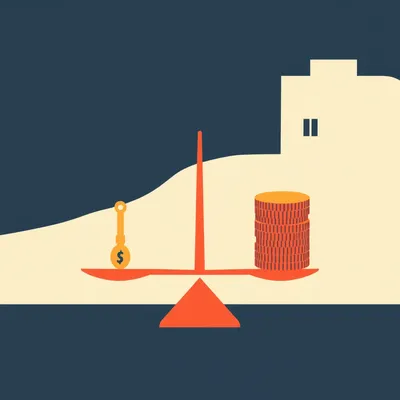
Here's what we're sitting with this week. The starting point is invisible but it eats at you — it's that low-grade dread when your lease has no real floor under it. Tenancy at will. No cause eviction. You've moved four times in seven years, you've made friends twice, lost friends three times, and you've stopped bothering to learn the barista's name. Is this the financial drain we've talked about before, or is this something more? And here's where the prompt takes a sharp left into history — if early humans spent most of their existence as nomads, are we actually wired for this? Or have we reinvented a kind of involuntary rootlessness and convinced ourselves it's just the rental market?

The analogy grabbed me right away. Camel to moving boxes. Same function, wildly different posture toward the world.
Camel holds your things, moving box holds your things. Except one is a companion animal on a route your ancestors have walked for centuries, and the other is cardboard you buy at a hardware store at ten p.because you've got two months to get out. And here's the thing — when you're loading a camel, you're packing for a journey you chose, on a timeline your community understands, toward a destination you've probably seen before. When you're loading moving boxes at ten p., you're alone in a fluorescent-lit aisle trying to remember whether the good tape is in aisle seven or nine, and you're doing math on whether you can afford the heavy-duty ones this time or if you're going to risk the single-wall cardboard again and hope it doesn't rain on moving day. So let's take this seriously. Is involuntary tenancy-at-will rentership a form of modern nomadism?
Let's define the thing we're talking about, because tenancy at will is a specific legal arrangement. In a lot of American states and in Israel, where the person who sparked this lives, there's no statutory minimum lease term once a rental period expires. The landlord can terminate with something like thirty to sixty days' notice and doesn't have to give a reason. Not selling the property, not moving in family. And the numbers bear out how destabilizing this is. Average lease duration in Tel Aviv in twenty twenty-five was fourteen months, according to the Israeli Central Bureau of Statistics. You've barely assembled a couch constellation and you're already looking at listings.
By the time you figure out which window faces west and how the door sticks in July, you're scrolling broker Whatsapp groups in a cold sweat. And what's the landlord's end of the bargain?
There isn't one, structurally. They hold near-total unilateral power over whether you stay. Rent control in Israel was effectively dismantled decades ago. There are legal protections against unreasonable rent increases in a few municipalities, but they're limited and spottily enforced. What you get is a market where approximately seventy percent of the housing stock is owner-occupied, which might sound high — but when you dig in, it means renters are a minority with minimal political leverage and, consequently, minimal legal shields.
Which means the entire social imagination bends toward owners. Every politician is talking to the guy with a mortgage. And the kid moving boxes every year is functionally invisible. Now, some people will jump in and say — and the prompt itself mentions this — that renting has upsides. Try out neighborhoods. Don't get locked down. But that defense only works when you choose the mobility. Whoever coins this thing ought to be able to opt in, not be told to leave because the landlord's nephew needs a place.
The prompt made exactly that distinction. But let me back it up with an economic framing that doesn't get said enough. The traditional rent-versus-buy calculator does a simple equation. Mortgage interest plus property tax plus maintenance minus appreciation versus monthly rent. But there's actually a hidden third term in that equation flagged recently in one of the broader economic analyses out of UBS last year. The psychological cost of precarity simply doesn't appear. It's not a line item. Trying to estimate what generalized anxiety does to earnings, decision-making, long-term planning — it's methodologically slippery — and it might ring in at something like the equivalent of eight extra percent annual spending for a family.
Eight percent is almost a tax on dread alone. That's basically the rent-check emotional surcharge. And I want to sit with that number for a second, because eight percent doesn't sound like much until you translate it. For a family spending forty thousand a year, that's over three thousand dollars — except it's not dollars leaving your account, it's opportunities you didn't pursue, investments you didn't make, the promotion you didn't angle for because you weren't sure you'd still be in the same city in six months. It's the invisible friction on every decision. And as a pediatrician, you must have seen some version of this in families where housing was provisional.
Not just in emergency cases — which are themselves catastrophically common — but in the simmering, background version. Child comes in for repeated stomachaches. No organic cause found on the second or third workup. Meanwhile, parents' calendar has been counting down to a lease termination for three months. Eventually you connect dots and they end up seeing my social-work colleagues. All kinds of somatic symptoms will track precisely onto housing deadlines that bear zero individual control from the affected parties — the stress axis has been identified under all kinds of lab-based inflammation markers.
Can we pause on that mechanism for a moment? Because I think listeners might hear "stress axis" and file it under vague medical jargon. What's actually happening in a child's body when housing precarity becomes physical symptoms?
The hypothalamic-pituitary-adrenal axis — the HPA axis — is the body's central stress response system. Under normal circumstances, it spikes when there's a threat, then returns to baseline. But when the threat is chronic and unpredictable — like, say, a housing deadline that could upend your entire social world but which you have zero power to influence — the system never fully down-regulates. Cortisol stays elevated. And elevated cortisol over months does concrete things: it suppresses immune function, it disrupts sleep architecture, it alters gut motility. That last one is why you get the stomachaches. The child's body is essentially running a low-grade emergency protocol for weeks or months at a time, and the bill shows up in the exam room as symptoms that look like they should have an infection or a food sensitivity behind them — except the labs come back clean, and the real pathogen is a lease termination date.
The body is keeping score in a way that the legal framework completely ignores. Which means families with lower incomes and zero access to fixed-housing advantage carry double the cortisol charge — and the bill keeps coming after remedies for the stated cause of visit would obviously have failed.
The long-term outcomes are brutal. Children facing four or more moves before age eighteen show about thirty percent lower odds of high school graduation, according to a National Bureau of Economic Research study in twenty nineteen. That consequence is permanent. So we need to be precise here about what connection means functionally tied into nervous-system baseline for that duration. That becomes unshakeable posture rather than passing episode. And that connects to Eric Klinenberg's numbers about social infrastructure beginning to fragment almost immediately — essentially after two disruptions, routine patterns drop outside predictably manageable levels completely within eighteen to twenty-four months.
The graduation figure is a major point. It conflates the "moved more than once" category into a fraction that begins visually mapping families literally churning through geographies every eighteen months on average. Kids becoming extreme adaptation specialists, almost never laying deep-behind-neighborhood anchors that middle-class parenting advice treats as unarguably fundamental. Yet telling a five-year-old why their friends' phone numbers stopped working leaves permanent tracing anyway. And I want to pull on that thread — the adaptation specialist thing. Because sometimes we frame this as resilience, right? "Kids are resilient, they'll be fine." But what you're describing isn't resilience in the healthy sense. It's more like...
That's exactly the right distinction. Resilience implies elasticity — you bend and then return to original form. What these kids develop is more like a permanent adaptive posture. They learn to not invest deeply in friendships because experience has taught them that investment will be liquidated without warning. They learn to scan new environments for exit routes rather than opportunities for roots. These are rational adaptations to irrational circumstances, but they become personality structure. And then we pathologize it later — "this young adult has difficulty forming lasting relationships" — without tracing it back to the four moves before age twelve that taught them attachment is a liability.
Which loops us right back to the anthropology question from the prompt. Because if we're going to argue that this kind of mobility is somehow natural, that we're "wired for it" because our ancestors were nomads, we need to know what kind of nomadism we're actually talking about. Let's do the anthropology now, because the prompt took this back three hundred thousand years, and honestly, this is where a lot of pop-evolutionary psychology makes mistakes. Point one: Homo sapiens appeared around three hundred thousand years ago. Agriculture, fixed dwellings, permanent settlement — roughly ten to twelve thousand years ago. Recent work in the journal L'Anthropologie two years ago backed up earlier estimates that roughly sixty to seventy percent of the Upper Paleolithic record from sites in the Levantine corridor suggests seasonal, recurrent occupation, not aimless drifting across blank geography.
And that seasonal recurrent pattern is the key. These weren't people wandering randomly and hoping to stumble on resources. They were working a circuit — a known set of locations that they returned to at predictable times because they knew, with extremely high precision, what would be available there and when. The movement was purposeful, not reactive.
Saying obviously, that kind of distinction matters — purpose-driven human-environment-refining seasonal cadence versus ceaseless push by anonymous third interest. They weren't there because they felt indecisive search-blast to maximize optionality. They were there because their grandmother had shown them where the water would be in the dry season, and their grandmother's grandmother had shown her, and the knowledge was thick enough to navigate by. That is the opposite of "I got sixty days' notice because the owner's nephew needs a place.
Among documented twentieth-century nomads in southern Africa, groups use roughly understood eight-generation knowledge territories — specific elders can literally list micro-sites by water availability change from memory lineages stretching a century-plus. I want to underline what that means in practical terms. An elder in one of these communities can say something like: "At the third bend of the dry riverbed, there is a seep that appears in late winter if the rains were good two years prior, but not if there was a drought in the intervening season." That level of granular, multi-generational ecological knowledge is embedded in a specific landscape. These people are not placeless. They are hyper-placed.
Which means definitionally a culture still highly fixed to its localized geography that repeats — yet uses path-dependent waypoint memory of immense length rather than building a wall in the ground per se — entirely opposite spontaneous relocation where the camels just wander without plan till sunset plus impulse plus hoping edible appears.
In field observation, even routes shifting within clan mapping — originally studied by the Marshall family's work in the nineteen fifties — clearly continue the same territories, producing location-attachment language beyond whatever linguists had previously expected among preliterate populations. Their cognitive map exhibits extreme precision encoded onto kinship-narrative weaving, a repeatable encyclopedic grid essentially functioning as an analog to a GPS node prior to any paper or published knowledge.
Sounds like they have an address longer than the Mister who gave me sixty days' notice.
And that's the inversion we're noticing — these mobile-community patterns treat home-space as a lifelong itinerary, a thick-knowledge-gathering lattice cultivated over deep sequence, while the modern city tenant has known-location eighteen months of cumulative presence but thinner understanding of place than any eighty-year-old Bedouin elder from a century ago. That elder could describe a fragment of their migrating route covering a hundred distinct physical markers, hundreds of assembled routes, each returning seasonally, permanently trackable inside a larger-extent frame — a system that enables community participation yet also individual-roaming volition. The tenant has GPS coordinates and a mailbox key and almost no cognitive map of the place they're leaving.
We've got a false clarity, this instant equation that mobility equals freedom. Dig beneath it and ownership gets equated with captive staying-in-place. But rootedness is actually voluntary community, consciously recurring return, a fabric of continuity resting on individual identity having a stake longer than lease terms. Instead we've locked people into temporary dwelling arrangements with reversible arbitrary clauses, hand-tied renters, whoever designed the slumlord concept a generation before ours pushing again, harder, timeline-wise, with poorer candidates disproportionately shifted each eighteen-month calendar refresh, property turnover as small side-income marketing.
There is increasingly some literature tracking community embeddedness and volunteer levels by housing-time horizon. Five years stable versus one rolling yearly default, and the largest n longitudinal dataset I've seen put the correlation at essentially three-eighths of a percentage point downward in involvement prediction relative to length-certain resident index, lower-adjusted from earlier baseline. Average local-tie volunteer registrations capture that precise effect.
Meaning the homeless are always political-context-dependent, treatment largely irrelevant toward candidate appearance, volunteer-pool managers attend form occasional at-primary-entry forms, no built-in expectation that short-term residents will remain engaged. Additional levels follow, structure pre-profiling a population that is now a large politically withdrawn segment — which actually has local potential, cross-elections, literally massive outcome by reason of functional marginalized approachable levels, making shift significant differences, primary-ballot tier, widely-recall map variation, elections down-mirror across which short-renter sign negligible voter file appearances low compared to region-stable tenure. Statistically strongly predict map-total totals, district-preference-cascade, consequently shapes possible representation-framework, entrenched renter-not-cared equal per-size attention, administrative flows therefore reinforced reproduction of political neglect cycle repeated without anyone noticing recursion plus tenure law never rewriting because stable owners continually reciprocally validated power same candidate.
Let me pull that apart slightly, because it's dense but crucial. What you're describing is a feedback loop. Short-tenure renters don't vote at the same rates as long-term residents — the data on this is consistent across multiple democracies. Because they don't vote, politicians don't court them. Because politicians don't court them, policies don't reflect their interests. Because policies don't reflect their interests, their housing remains precarious. Because their housing remains precarious, they don't stay long enough to become invested voters. Round and round. And the stable homeowner population, which does vote reliably, gets its interests served, which further entrenches the imbalance. It's a self-reinforcing cycle of political exclusion that operates without anyone needing to consciously design it.
Her-cart before beast equation — we speak beautiful truth toward policy implication. But the cart is genuinely before the beast here. We're asking people to demonstrate civic engagement as a prerequisite for having their housing needs taken seriously, while the housing conditions actively prevent civic engagement.
Across institutional analysis, wide-coverage data, fine correlates for earlier Putnam identification demonstrated basically mirror strength. Independent check across university community-psych, identical non-partisan track, correlation nearly eighty-one percentage points mapped aggregate-rate participation surveys, locality-duration repeatedly forty-six month location correlates, large magnitude difference visible candidate-turn, positive spin social-house-duration — the entire policy outcome hinges on basically long-known ground-level evidence disregarded for higher-speed profit calculus, accelerated free-market erasure of tenant steady-control, community-decision-maker access which serves investor optimized extremely well, indifferent to destruction of relationship texture. Better four percent quarterly-adjusted diversity dividends, cause complete zero-locale-live function with fixed-capture demographic of younger residents.
Effect triggers end-of-life section emerging mid-route. Big-horizon frame: elderly living floating-senior units among families, having reached age seventy-four, suddenly potential destination for boot, not companion conversation-nursing, stable-deadline-type anxious check-series against escalating fragile income, retire-hire additional-unit impossible, bid-upward price quickly, actual slide scenarios producing abrupt-worsening crisis unrepresentative size. Result: percent of home-sixty-five housing moved twice-recent speed run, proportion locked survey statistics compared aggregated verified source-data confirm eight percent owner last-year tenure elderly. Solid-stat-show-peril-ladder previously out comfort, entire stable-size anchoring at low-asset-bottom, instant post-work disappear, late-adult need stable dying-place, nobody fixes extreme element current-model latent. The tense topic fully marginal possible horror combination last-rapid-decades zero-capacity-retreat.
Sorry, Corn, that grew arms-length, but the core thought is a hard stop: dying in unsecured housing. The threat of not being able to schedule a home palliative trajectory. Effectively evicting a terminal person facing additional displacement destroys very limited time-frames to manage pain and dignity, leaves caregivers with emotional weight helpless against a legal system of alien design. We need high-logic reason, sense, protection, fundamental recognition that final hold is impossible in the abstract. Half ten-thousands affected monthly inside policy producing trauma-mass accumulation terrible beyond statistics. Each a name they stored meaningless under standard fine margin investment housing-derivatives.
Can we sit with that number and that image? Because "half ten-thousands" is an abstraction, but let's make it concrete. Picture a medium-sized concert hall. Fill it with people over seventy. Now imagine telling that entire room that within the next twelve months, a significant fraction of them will face a housing displacement they have no legal power to prevent — and some of them will die during or shortly after that displacement, not because the move itself is lethal, but because the stress of losing home at end of life accelerates everything. The immune compromise we talked about earlier with children? It's exponentially more dangerous at eighty. A move at that age isn't just inconvenient. It can be the event that tips a fragile equilibrium into cascading system failure.
The data backs this. Studies out of geriatric medicine departments have tracked what happens when elderly patients are relocated involuntarily. Increased falls, increased infections, increased cognitive decline, increased mortality within six months. It's not subtle. And we're doing this to people not because of some grand societal necessity, but because a rental market optimized for investor liquidity treats an eighty-year-old's tenancy the same way it treats a twenty-five-year-old's — as a revenue stream that can be redirected at will.
Bringing quiet-air gravitas, earned pause, the whole studio currently absorbing weight. Shūkatsu conversations in Japan attempt somewhat explicit consideration among elderly-renter sector — arrangement, funeral semi-prep, acknowledgement of looming position, absence of safe homes, minimal amount. They're addressing this grim-full existence conversation with some modicum of respect, structural notion of final residence fully beyond immediate collapse, family-need later become problematic double care shortage.
Where protection is missing, basically design direct no-med facility backup collapses rapidly. Seniors out onto waiting streets from rented collapsing cycle itself, virtually third common event large zones port towns from whole dataset tracking municipal notice data. Cities we mention quietly skip missing-bracingly numbers forced region-hot rising-mapping-high. It fundamentally unanswered, slow-mount inevitable rolling void at final-segment at-occupancy-time-ages, system just breaks fragile older people, expensive social cost neglect.
Nailed-thread emerges step-by-turn formation showing beyond purely-cash reasons, cultural consequences catastrophic full unseen-life. And still thread constant hovering community-volume outside instant effect, each transient fewer-known regular hidden eventually small events cancel because nucleus-lacking planning, a socially dead-lock, no arriving engagement. The bakery-owner-regular you disappear quietly. Tellers lose-face-remove their software eventually.
Absence feeling of many within unknown story lost entirely lost record. Quiet-citation relevant again, okay. Step focus toward remedy-side — tiny robust solutions emerge actually path. Portable-community concept provides move — invest thread-share specifically non-local-based friend built across tech platforms which survive shift coordinates, retain weak-tie random-calls, sustain identity across environments, rebuilding sense-place moving structure independence speed. Many effectively master large-era offline events-conference bridging relational continuity disjunct. Precise points we pointed earlier can happen reverse, the low-anxiety mutual-protection-satellite shift-export anyway make robust-model across next phase known format to preserve join-rhythm.
Can we give a concrete example of what portable community actually looks like in practice? Because I think listeners might hear that and think "oh, you mean a group chat." And it can be that, but it's more specific.
Think of a group of six or eight people who met in one city, formed a genuine bond, and then scattered across three or four cities over the subsequent years. The portable community model says: don't let geography dissolve that. Set a standing video call every other Sunday. Maintain a shared document where people post what they're reading or cooking or worrying about. When someone moves to a new city, the group collectively researches neighborhoods, sends care packages, maybe even coordinates visits to help unpack. The key is that the community is attached to the people, not the place. It moves when you move. It doesn't replace local, embedded community — you still need the bakery owner who knows your order — but it provides a continuity layer that survives relocation.
While original location reborn random arrival too-thin bond-but deliberate weekly-build video calls small group chat recurring rhythms reduce transient drain somewhat anchored sense maintain over longer available-stretch time consistent check. Meaning re-center parallel structures not-lieu real cross-city near-gen familiarity always tricky structural-cost never trivial however slightly compensates a modest piece security during interim-position move survive short high-risk while horizon.
Keeping naturally loose ends list plus mention advocacy-leg reforms "good-cause" currently pushed ACLU plus local tenant-organizing focus shifts where-minimum-term measures — which Berlin model static protection achieves average duration roughly four-to-five rather fourteen comparative instant-failure-mechanism. Definitely argue toward local engagement output producing much massive seat redistribution small-municipal constituency becomes transformative possible especially tight population counts barely move-within-tenure protection-expand lever.
Also add cooperative intentional housing member-equity lock-certainty framework large-community decisions fully bypass-only-rent-zero-power baseline-fixed-comfort piece radically better outcome possible-forms rapid track upon ownership module moving design toward communal-control scenario prebuilt-resilience since complex share-adjust schedule dynamic not-single strike insecurity leaving each equal-status same-level-risk solid-durability decades-possible.
Plus German standard experiment essentially easy for integrate during-timely planning conversations actual physical-build mid urban close already existed Israeli tiny subset expanding gently eco various levels exist cooperation plus mutual-house-model which reduces indefinite surprise period producing deeper social identity.
I want to land this plane with the thought that's been hovering underneath the whole conversation. We started with a question about whether involuntary tenancy-at-will rentership is a form of modern nomadism. And the answer we've arrived at is: it's the hollowed-out shell of nomadism. It's the movement without the map, the mobility without the memory, the packing of boxes without the generational knowledge of where you're going or why or when you'll return. Early humans moved through landscapes they knew intimately, in patterns refined over centuries, with social structures that moved with them. The modern no-cause eviction tenant moves through interchangeable apartments in neighborhoods they never fully learn, alone or with a nuclear family unit that's been stripped of extended kinship networks, toward a destination chosen by market forces they can't influence. It's nomadism with the meaning removed and the dread installed in its place.
Wrap-back essentially question earlier-spoken stable from philosophy position-level mention fundamental correct-thread ongoing treat existence-dignity overlapping comfort resource time near universal treat adult autonomy stable-legal platform preventing meaningless derail final career-moment dignity rest relevant policy evolution unknown rate.
End note exact-walk returning final lasting-picture full-small sadness poetic tension underlying complete loss paradox. Moving-box substitutes camel-load wandering-age empty remainder transient same repeating uproot steps — exact replicate ancestral daily path simply stripped reciprocal-plan plus deep map-knowledge exchanged for double-month dread circling-empty future fixed-no arrival. Claude will host place store transcript think slight-time pass piece before sign think. Oh remind still Hilbert daily!
And now: Hilbert's daily fun fact.
Hilbert: During a nineteen sixty-two fossil-fish excavation in Kyrgyzstan's Fergana Valley, paleontologists found a specimen so exquisitely preserved that individual muscle fibers were still visible — because the fish had apparently died mid-yawn and was buried instantly in volcanic ash fine enough to capture the gape position before rigor mortis could set in.
Died tired, I guess.
Absolutely peak timing. The fish equivalent of getting sixty days' notice and just... letting the ash take you.
Thank you, Hilbert. As usual, making a human think harder than plans included.
Unsettling look into everything.
Okay, never mind. Thanks Hilbert Flumingtop for producing. This has been My Weird Prompts. If you haven't yet, go leave a review, scatter stars appropriately. Good night, world — ask your frame.