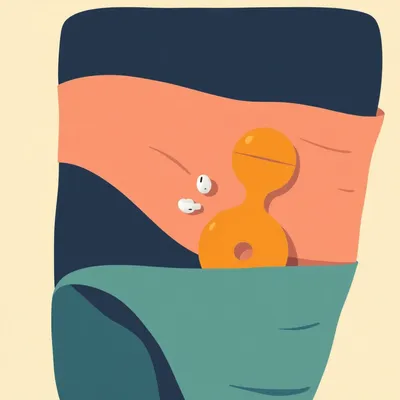
Here's the question. A father is lying in bed, keeping an eye on his napping fifteen-month-old son, he rolls over, and there they are. Both of them. One arm up, same angle, same everything.

Same everything.
And his wife had already noticed it. She's the one who pointed it out first.
Which is usually how these things get noticed. You don't see your own posture. Somebody else has to tell you.
So Daniel wrote in. Ezra is fifteen months old. Daniel doesn't realize he's doing it, he turns over, and it looks like the two of them are imitating each other. His question is whether quirks like this can actually be inherited. We hear it constantly. Kids have the same facial expressions as their parents, some distinctive little habit. But nurture and imitation are just as compelling as genes for explaining that. So can mannerisms be inherited, or is it a comforting pseudoscience myth we tell ourselves?
That's three questions wearing one coat.
It is. And I think we should pull them apart, because the science gives you a different answer to each one. How heritable distinctive behaviors actually are. How much of parent-child similarity is really imitation. And why we're so motivated to believe in inherited resemblance in the first place.
And the third one is the one nobody expects to be interesting.
Start with the first.
So the honest answer to can mannerisms be inherited is that the specific thing Daniel is describing almost certainly has never been studied. Nobody has ever run a twin study on sleeping with one arm up.
That feels like an oversight.
Somewhere there's a grant reviewer who's very relieved. But here's the thing. We do have a huge amount of evidence about behavior genetics in general, and it points in a direction that surprises people. The biggest meta-analysis of twin studies ever done pooled seventeen thousand eight hundred and four traits. Two thousand seven hundred and forty-eight publications. Fourteen and a half million twin pairs.
Fourteen million pairs of twins.
And the average heritability across all of it came out at forty-nine percent. Which sounds like genes explain half of everything. But for sixty-nine percent of those traits, twin resemblance was consistent with additive genetic variation alone, with very little evidence that shared environment was doing anything.
Shared environment being the same house, the same parents, the same dinner table.
Right. And the number people trip over is that forty-nine percent. Because it sounds like it's saying half of you comes from your parents. It isn't.
Explain what it is actually saying, because this is the part I think everybody gets wrong, including me until fairly recently.
Heritability is a population statistic. It measures how much of the variation between people in a group is attributable to genetic variation within that group. It does not tell you what fraction of any individual came from their parents. And it absolutely does not tell you whether a specific gesture passes from a particular father to a particular son.
So a trait can be fifty percent heritable across a population and still not be shared between any given parent and child.
Yes. And that's not a paradox, it's just what the number means. Genes explain why people differ from each other. They don't guarantee that families match.
Which brings us to the study that made the rounds a couple of years ago.
Edinburgh and Tartu, Dr René Mõttus, working out of the Estonian Biobank. Over a thousand pairs of relatives. They put personality heritability at around forty percent, which is higher than the twenty-five percent you typically get from self-report studies. And the headline finding was that people are only slightly more likely to share personality traits with their parents than they are with a random stranger.
Say that again, because it's the kind of sentence that sounds like a mistake.
Slightly more likely to share personality traits with your own parents than with a stranger pulled off the street. And Mõttus's line was that the genes a parent passes on are not sufficient to make most of their personality traits similar.
Which is a strange thing to hear, because personality clearly runs in families. You meet a family and the kids are obviously like the parents.
Or you meet a family and you're pattern-matching on faces and voices and shared jokes, and you're seeing the thing you expect to see. That's the third thread and we'll get there. But there's a second half to that study that I think is more interesting. They looked at adoption. Whether being raised in the same family makes people converge.
And?
It didn't. Adoption into a family did not make personality traits converge. Shared family experience, in that data, was not making people more similar.
Hm.
Which is a uncomfortable result if you've spent any time believing that the home you build shapes who your kids become.
It shapes other things.
It shapes a great deal. It does not appear to shape the personality dimensions they were measuring, at least not in a way that shows up as convergence between relatives.
So that's the broad picture. Genes matter, they matter a lot, but they matter in a way that's about variation, not about transmission of a specific quirk. Now go narrow. Sleep.
Sleep is where it gets fun, because there's real heritability there and it's almost all about timing. A twin study out of the Murcia register, fifty-three female twin pairs, found heritability of taking a siesta at sixty-five percent and daytime sleep duration at sixty-one percent. Other sleep-rhythm parameters ran from thirty-six to sixty-nine percent.
So the urge to nap in the afternoon is substantially heritable.
Substantially. Which you'll be pleased to hear.
I've been saying this for years and nobody takes it seriously. It's in my blood. It's ancestral.
It's in the Murcia Twin Register.
Same thing.
But notice what that's measuring. When you sleep. How long you sleep. Nothing about what your body does while you're asleep. And that's the gap Daniel's question falls into. There is no study on sleeping posture. The closest thing we have is a Korean twin study from twenty eighteen, seventy-two participants, which found high heritability in hyoid position and in the inclination of the cervical column.
Which is what, in English?
The hyoid is a small bone in your neck. And the angle of your cervical spine, the curve of your neck. That study found head and neck posture and airway anatomy are under strong genetic controls.
So posture is heritable.
Skeletal posture is heritable. The shape of your neck and where your airway sits are inherited. Whether you habitually sleep with one arm up is not the same thing. That's a behavior, not a bone.
Your bones may be inherited. Your habit of sleeping like a man flagging down a bus is not.
That's the distinction, yes.
So what about the classic examples? The ones everybody knows. Tongue-rolling. Hand-clasping. Which thumb goes on top.
This is where the textbook has been wrong for decades and nobody has bothered to update it. Hand-clasping, arm-folding, tongue-rolling. All three have been tested repeatedly and they largely fail as genetic traits. There's a Hungarian twin study from nineteen eighty-three that could not confirm a genetic background for any of the three.
Could not confirm. That's careful language.
It's twin-study language. And there's a paper out of the Queensland Institute of Medical Research with a title I want to read you in full, because it deserves it. No evidence for a genetic basis of tongue rolling or hand clasping.
They went with the descriptive approach.
One Russian study concluded flatly that hand clasping does not constitute a hereditary trait. And then there's the genuine disagreement. A Basque familial study from nineteen eighty-eight claimed arm-folding was probably genetic.
Probably genetic. That's the other kind of language.
That's the other kind. And I want to be fair to it, because it's a real minority position and it hasn't been fully put to bed. But the weight of the evidence across decades is that these are not simple inherited traits. They're the examples every school textbook uses, and they're the ones that keep failing.
So the specific quirks people cite as inherited are almost never studied, and when they are studied they usually fall apart. And the heritability that does exist is about broad behavioral tendencies and the shape of your skeleton.
That's the first thread. The specific quirk is probably not genetic.
Then where does it come from?
Imitation. And this is the part where the science surprised me, because the thing we all believe about babies turns out to be wrong. The baby sticks its tongue out back at you. Everybody has seen this. It's in every parenting book.
It's one of the first things people try.
Oostenbroek and colleagues tested over a hundred infants longitudinally. One week, three weeks, six weeks, nine weeks. Nine target actions, eleven stimuli. And they found no evidence of neonatal imitation.
None.
None. Cecilia Heyes at Oxford, commenting on that study in the same journal, put it plainly. These findings indicate that humans learn to imitate. This capacity is not inborn.
So the tongue thing isn't imitation.
The tongue thing is arousal. Babies protrude their tongues when they're stimulated by any interesting sight. You stick your tongue out, the baby gets excited, the tongue comes out. You read it as mirroring because that's what you're looking for.
That's a great trick of perception. The baby is doing a generic arousal response and we're reading it as a conversation.
And it's the same trick as the family resemblance thing, which we'll get to. We see the pattern we expect.
So if imitation isn't inborn, where does it come from?
It's built. And the twin data backs this up. McEwen and colleagues, fifty-two hundred UK twin pairs, found imitative ability at age two was only thirty percent heritable. Forty-two percent shared environment. Twenty-eight percent unique environment.
So the biggest single contributor to how well a two-year-old imitates is the shared environment. The house.
The people in it. And there's a study from twenty twenty-three that shows the mechanism, and this is the one I'd frame if I were framing anything. Being imitated by sensitive caregivers at fourteen months predicted infants' own imitation ability at eighteen months.
So the direction is: you imitate the baby, and that teaches the baby to imitate.
That's the finding. Heyes described imitation as a mighty oak of human cognition that grows from little acorns. It's not a module that switches on at birth. It's a skill built through relationships.
So apply that to Ezra. Fifteen months. The arm pose.
Ezra could be copying Dad. That's entirely plausible at fifteen months, because imitation is up and running by then. Or Dad could have unconsciously adopted the pose while holding Ezra, and the chameleon effect is doing the work.
The chameleon effect being the unconscious mimicry we all do.
Posture, gesture, speech rate, accent drift. You sit with someone long enough and you start matching them without noticing. And the direction of causation in Daniel's bedroom is not obvious. He assumes he's seeing his son's inherited quirk. The science says it might be his own habit, picked up from the baby.
The father is the one who got it from the son.
In that scenario, yes. Which is a much funnier version of the story.
And a much more likely one than most people would guess. So that's the mechanism. Imitation is learned, it's bootstrapped through being imitated, and it runs in whichever direction the household happens to run it. Now the third thread. Why do we believe the inheritance story so readily?
Because the belief has a function. Christenfeld and Hill, in Nature, nineteen ninety-five. Three studies, a hundred men, a hundred women. Participants were shown photos of children and adults and asked how alike they were. When they were told the pairs were related, they rated them as more alike.
Same photos.
The belief in resemblance was driven by knowledge of the genetic link, not by the actual resemblance in the image.
So we're not measuring. We're confirming.
And then the study from last year, which I think is the best thing in this whole literature. Two hundred and thirty participants at a twenty-week ultrasound. Mothers were asked whether the fetus looked more like the father or like them.
At twenty weeks.
Mothers said the fetus resembled the father seventy-four percent of the time. Themselves, twenty-six percent.
Three to one.
And among unmarried mothers, ninety-three percent said it looked like the father.
Ninety-three.
Fathers, when they were asked the same question, split evenly. Forty-nine percent said the baby looked like them, fifty-one percent said the mother.
So fathers aren't doing it. Only mothers are.
And since fathers don't show the bias, the authors argue it isn't about actual resemblance at all. It's an unconscious maternal adaptation to secure paternal investment.
Say the mechanism out loud, because it's darker than it sounds.
A father can never be certain of paternity. The estimated rate of children whose genetic father differs from the alleged father is around ten percent. So there's an evolutionary pressure on the mother's side to reassure the father that this child is his, and one of the cheapest ways to do that is to say, look, he has your nose.
And it works. Fathers who perceive their children as resembling them invest more. More time, more supportive parenting.
That's the finding, yes.
So the comforting myth is real. It's just not a myth in the way Daniel means. It's not a false belief we invented. It's an adaptation that predates us and does something.
It secures investment in a child. And the belief in inherited mannerisms is probably a byproduct of the same machinery. If you're primed to see yourself in your child, you'll see your gestures there too, whether or not they're genetic.
Emily Oster had a piece on exactly this. Whether a child who looks like one parent inherits that parent's mannerisms.
Her line was, there is no data, but we can use some logic. Appearance and behavior are governed by different sets of genes, so looking alike doesn't imply acting alike. But she floats something interesting. The appearance overlap could be driving the behavior overlap.
Through socialization.
If a child looks like Dad, the family treats the child as though he's like Dad. Dad spends more time with him, sees himself in him, mirrors him more. And that's the channel through which the mannerism actually travels.
So the belief in the resemblance creates the resemblance.
That's the loop. The belief is the cause, not the observation.
Which means the thing Daniel is watching in that bedroom is real. The pose is real. The similarity is real. The explanation is just running backwards from how it feels.
There's one more piece I want to land before we move on, because it's the part of the science that's humbling. The Atlantic piece from last year put it well. We do have a substantial genetic tendency to resemble our parents. But the similarity only goes so far.
How far?
For most of the traits that make you recognizably yourself, the answer is: less far than you'd think, and in a different shape than you'd expect. Genes shape why people differ. They don't make families match.
The honest answer to Daniel is that the arm pose is probably not genetic, the belief that it is has real power, and the direction of causation is probably the opposite of what he assumes.
None of that makes the moment in the bedroom less true. It just makes it a different kind of true.
Hilbert: The thing nobody's mentioned is the pillow.
The pillow.
Hilbert: You can't hold your arm up like that on a soft pillow. You need the elbow to have something to rest on. So if the two of them are doing the same thing, they're doing it on the same pillow, or two pillows with the same amount of give. I had one for about eleven years. Foam, not feathers. You can't do it on feathers at all, the elbow sinks.
That's actually a real constraint. The posture isn't free-standing. It's the posture plus the surface.
Hilbert: My sister's boy did the same thing. Arm up, elbow on the pillow edge. She swore it was from his father. His father slept on his stomach with both arms down, never once slept the way the boy slept. She kept saying it anyway. Every time the boy did it she'd say it, for years. By the time he was six he was doing it on purpose, because she laughed every time.
So she built it.
Hilbert: She built it and then pointed at it. And she wasn't lying, she believed it. It was just that the thing she was pointing at was the thing she'd made.
That's the loop, exactly. The belief creates the behavior, then the behavior confirms the belief.
Hilbert: She still says it. He's thirty-one now. He doesn't do the arm thing anymore, but she says he sleeps like his father. He sleeps on his side with his hands together. So does she.
Wait. So the thing she says he inherited from his father is the thing he actually got from her.
Hilbert: That's right.
She's been saying it for thirty years.
Hilbert: She has. It's a good story. She likes it.
The part that gets me is the six-year-old doing it on purpose. That's the mechanism in miniature. The kid learns the gesture because the gesture gets a reaction. And by the time he's an adult, the family has a fact about him that was manufactured by the attention.
The attention came from a belief about genetics that was never true.
Hilbert: It was true enough. He does sleep like somebody in that family. Just not the one she named.
There's something in that I want to sit with. If the belief is doing the work, then the resemblance isn't fake. It's just not ancestral. It's built in the house.
Which is a stranger kind of inheritance than the one Daniel was asking about.
A more durable one. The genes get one shot at you. The house gets eighteen years.
Here's where I've landed. The specific quirk is probably not genetic. The science on that is fairly clear, and the classic textbook examples keep failing. But the belief that it is genetic has real power, and it's not a bug. It's plausibly an adaptation that evolved to secure investment in children. And the imitation that actually carries the mannerism runs in whichever direction the household runs it, which is usually the opposite of what the parent assumes.
The one thing I'd take from all of this is that the resemblance is real and the explanation is real, but the explanation is the belief, not the genes. That's the part that changes how you see it. The gesture travels through attention, not through chromosomes.
It's still a family trait. It's just a family trait the family made.
Which, for what it's worth, is the more interesting version.
As genetic testing gets cheaper and behavioral genetics gets better, we'll probably get sharper answers about what actually passes from parent to child. But I suspect the question that matters won't be the genetic one. It'll be why we want so badly to see ourselves in our children in the first place.
The answer to that one is already in the literature. We're built to look. We're built to find. And then we're built to keep looking until it's true.
Ezra probably didn't inherit the arm pose. He may have learned it. Or Daniel may have learned it from him. Either way the pose is real, the two of them were lying there doing the same thing, and the belief that it means something is not entirely wrong. It just works differently than anyone in that bedroom thinks.
That's the episode.
Thanks to Hilbert Flumingtop for producing.
This has been My Weird Prompts.
If you enjoyed this, leave us a review on your podcast platform of choice. It helps other listeners find the show.
We'll be back soon.