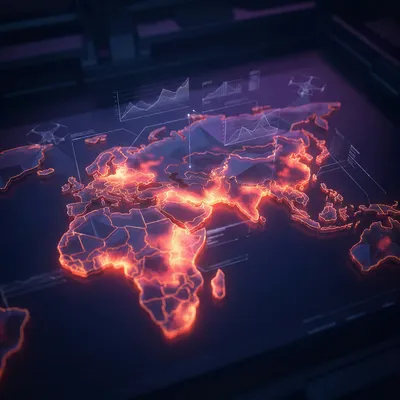
Imagine you are walking through the corridors of a nondescript government building in Virginia or perhaps a limestone edifice in London. You step into a room where a massive physical map covers an entire wall, but it is not the map you saw in geography class. It is divided by bold, jagged lines, color-coded not by topography or even strictly by internationally recognized borders, but by "desks." These are the operational blueprints for how a superpower or a regional player actually sees the world. Today’s prompt from Daniel is all about these "desks"—how intelligence agencies and foreign offices slice up the globe into manageable, bureaucratic chunks to make sense of the chaos.

It is a classic organizational challenge, Corn. You have roughly one hundred and ninety-five countries, thousands of ethnic groups, and countless transnational threats. No single human, not even the Secretary of State or the Director of the CIA, can keep all of that in their head at once. So, they build a "matrix." By the way, a quick bit of housekeeping—today’s episode is actually being powered by Google Gemini 3 Flash. It is writing our script today, which is fitting because we are talking about how systems process massive amounts of global data. I am Herman Poppleberry, and I have been diving into the way these "desk" structures dictate how a country actually functions on the world stage.
It’s funny you mention the "matrix" because when most people hear the word "desk" in a spy movie context, they think of a lonely analyst sitting under a fluorescent light surrounded by paper. But "the China Desk" or "the Near East Division" isn't just a piece of furniture. It’s a functional unit with its own budget, its own culture, and often its own internal politics. Why do we need this? Is it just for the sake of having a neat organizational chart, or does the world actually break down into these logical blocks?
It’s purely about the limits of human bandwidth and the necessity of specialized expertise. Think about the "Regional Desks" first. If you are on the Thailand desk, your job is to know everything—the king's health, the price of rice in Bangkok, the secret grievances of the opposition parties. You provide the "deep tissue" knowledge. Then you have the "Functional Desks" which are thematic. These handle things like counter-proliferation or climate change. The magic, or the friction, happens where those two intersect. If a rogue scientist in Thailand is trying to sell nuclear secrets, the Thailand desk and the Non-proliferation desk have to start talking to each other.
And I imagine they don't always agree on the priorities. The Thailand desk might say, "Don't press them too hard on the scientist, we need their help with a regional trade deal," while the Non-proliferation desk says, "The trade deal doesn't matter if there's a dirty bomb on the loose." That internal tension seems like it would be a feature, not a bug, of the system. But let’s look at the map itself. Daniel asked about the "classical blocs." How does a country like the U.S. or the UK actually draw those lines? Because my version of "the Middle East" might stop at Iran, but a general at the Pentagon might have a very different definition.
That is exactly where it gets fascinating. Most Western agencies still operate on a map that is a ghost of the Cold War. You have the "European and Eurasian Affairs" bureau at the State Department, for instance. That includes the EU and NATO allies, but it also hooks in Russia and Central Asia. Now, why is Russia in the same bucket as France? Because for forty years, the primary way we understood Russia was through its relationship with Europe. Meanwhile, you have the "Near East" or "MENA"—Middle East and North Africa. This is usually the most resource-heavy desk because of the sheer density of security interests and energy markets.
It’s interesting how "Near East" is such a colonial-era term that has just stuck around in the bureaucracy. It implies a center of the world that is London or Washington. But if you look at the CIA’s Directorate of Operations, they have these massive divisions like the "Near East Division" or the "Africa Division." I’ve read that the "Soviet Bloc" legacy is so strong that even today, desks for Russia and former Soviet states are often kept culturally and operationally distinct from the rest of Europe. They have different training pipelines, different language requirements, and frankly, a different level of paranoia.
The "Soviet" expertise was so specialized—Kremilnology was a whole science—that you couldn't just fold it into a general "Europe" desk without losing the nuance of how Moscow operates. But look at how other countries do it. Daniel asked if the division differs based on a country's foreign affairs, and the answer is a resounding yes. A country’s desk map is a physical manifestation of its priorities. Take France. They have incredibly deep, specialized desks for what is known as "Françafrique"—their former colonies in Africa. They maintain a level of institutional memory there that the U.S. simply doesn't have.
Or look at South Korea. I bet their "North Korea" desk is larger than their entire Western Europe division. If your neighbor is a nuclear-armed hermit kingdom, that "desk" isn't just a department; it's a massive portion of your national soul. It probably has sub-desks for North Korean agriculture, North Korean elite gossip, and North Korean cyber units. It’s a hyper-specialization born of necessity.
And that brings us to the UK’s FCDO—the Foreign, Commonwealth and Development Office. They recently merged their diplomatic wing with their international development wing. Their map includes a specific "Commonwealth" focus. They are looking at the world through the lens of historical ties that a country like the U.S. ignores. But here is where the "interagency friction" Daniel mentioned really starts to grind. In the U.S. government, the State Department, the Department of Defense, and the CIA all use different maps.
Wait, they don't even use the same borders? That sounds like a recipe for a disaster. If I’m a diplomat in Egypt, who is my boss's boss?
It’s a mess! The State Department puts Egypt in the "Bureau of Near Eastern Affairs." Makes sense, right? It's culturally and politically tied to the Arab world. But the Pentagon? For a long time, Egypt fell under "CENTCOM"—Central Command—which handles the Middle East. But wait, Egypt is in Africa. So does "AFRICOM"—Africa Command—get a say? For years, there were literal turf wars over which military command "owned" the relationship with the Egyptian military. If the Spies, the Soldiers, and the Diplomats are all drawing different circles around the globe, you get these "seams" where things fall through the cracks.
That "seam" problem is terrifying. You could have a terrorist cell moving from Libya—which might be handled by an Africa desk—into Egypt, which is a Middle East desk. If those two desks don't share a morning coffee, that cell effectively disappears just by crossing a line that only exists in a building in Langley or Foggy Bottom. It’s like a relay race where the runners are on different tracks.
That actually happened during the 2021 withdrawal from Afghanistan. You had the State Department’s "Bureau of South and Central Asian Affairs" trying to manage the diplomatic fallout with Pakistan and the "Stans," while the CIA’s "Near East Division" was primarily handling the operational side of Afghanistan itself. Afghanistan is this awkward pivot point between the Middle East and South Asia. Because it sat on the "seam" between two different administrative bureaus, the coordination was an absolute nightmare.
It’s the "not my department" syndrome but on a global scale. If something happens in a country that sits at the intersection of three different desks, everyone assumes someone else is watching it. Or worse, everyone tries to "own" it, and you get conflicting policies. One desk wants to sanction the country for human rights, and the other wants to give them a billion dollars in military aid because they are a "strategic regional partner."
And that is the practical purpose of the desk system—to prevent that, even if it fails sometimes. The desk officer is the "filter." Think about the President. He can't read every single cable coming out of every embassy. He needs a two-page brief. The desk officer’s job is to take five thousand pages of raw intelligence, diplomatic gossip, and economic data and turn it into three bullet points. They are the gatekeepers of reality for the leadership.
I like that phrase—"gatekeepers of reality." It makes them sound like wizards, but really they are just overworked bureaucrats with very specific Google Alerts. But if the desk officer is the one choosing what the Secretary of State sees, they are effectively making policy. If the "Turkey Desk" decides that a certain political crackdown isn't worth mentioning because it would upset a security deal, the Secretary might never even know it happened.
That’s the risk of "Institutional Memory." You want the desk officer to have been there for ten years because they know where the bodies are buried. But after ten years, they might become "captured" by their region. They start to sympathize more with the local government’s perspective than with Washington’s priorities. They become an advocate for "their" country rather than an analyst of it.
"Going native" at the office desk. I can see that. But what about the modern challenges? We aren't just dealing with countries anymore. We have cyber warfare, climate migration, and pandemics. A virus doesn't check which "desk" it’s entering when it crosses from China into Vietnam. How are these agencies evolving to handle things that don't respect the map?
They are trying to pivot to the "Functional Overlays" we talked about earlier. You see more power shifting to places like the "Cyber and Digital Policy" bureau or "Global Health Security." But there is a massive bureaucratic inertia. If you are a rising star in the State Department, you still want to be the "Head of the European Bureau." That is where the prestige is. The functional desks are often seen as "secondary" or "supportive," even though the threats they handle are arguably more relevant to the twenty-first century.
It’s the old "Geographic vs. Thematic" struggle. If I’m the head of the "Counter-terrorism" desk, I have to go beg the "South Asia" desk for permission to run an operation in Pakistan. The South Asia desk says, "No, you’ll ruin our relationship with the Pakistani ISI." The Counter-terrorism desk says, "But we have a target!" The geographic desk almost always wins because they "own" the ground.
And that’s why the "Global South" reorganization is so interesting right now. We are seeing some agencies move away from those Cold War blocs. They are creating new desks that focus on emerging economies as a single strategic concept. The UK’s FCDO is trying to treat the "Indo-Pacific" as one giant integrated desk because they realize you can't understand the Indian Ocean without understanding the South China Sea. They are trying to erase the "seam" between South Asia and East Asia.
Which makes total sense for trade and naval power, but probably makes the guys on the "India Desk" very grumpy because now they have to share a budget with the "Vietnam Desk." It’s all about the money and the seats at the table. If you want to know what a country truly cares about, don't listen to the speeches. Look at the organizational chart. If the "China Desk" has five hundred people and the "South America Desk" has twenty, you know exactly where the focus is.
Well, not "exactly," but you’ve hit the nail on the head. Look at the U.S. State Department’s "China House"—the Office of China Coordination. It was created specifically to break down those silos. They pulled people from all over the building—regional experts, trade experts, human rights experts—and put them in one room. It’s an admission that the old "desk" system was failing to keep up with a "pacing challenge" like China.
"China House" sounds like a reality show I would actually watch. "Ten bureaucrats, one superpower, and only one coffee machine. Who will survive the night?" But seriously, this reorganization is a signal. When a government creates a new "desk" or merges two old ones, they are telling the world, "Our old way of thinking didn't work."
And the EU is trying something even more radical with the European External Action Service. They try to avoid strict geographic silos by using a "matrix" where everyone has a dual report. You report to a regional director and a thematic director. It’s supposed to be more agile, but in practice, it often just means you have twice as many meetings and twice as many bosses to disappoint.
That sounds like a corporate nightmare. "I’m sorry, I can't launch this diplomatic initiative because my 'Human Rights' boss says yes, but my 'Trade' boss says no, and my 'European Integration' boss is on vacation in Ibiza." It’s the cost of trying to be everything to everyone at once.
But there is a real benefit to the "Accountability" Daniel mentioned. If there is a coup in Thailand at 3:00 AM, the White House doesn't call a "Generalist." They call the Thailand Desk Officer. That person needs to be able to say, "The General leading the coup went to school in Kansas, he likes golf, and here is his cell phone number." That level of granular, personal expertise is what makes the desk system indispensable. You need a "designated worrier" for every square inch of the planet.
The "Designated Worrier." I think I found my new job title. But that also means if the Thailand desk officer is having a bad day, or they just aren't very good at their job, the entire U.S. policy toward a nation of seventy million people is effectively crippled. That is a lot of weight on one mid-level bureaucrat's shoulders.
It is, and that is why the selection for these roles is so intense. You don't just "get" the China desk. You spend twenty years working your way up to it. But we should talk about the "Second-order effects." When you divide the world into desks, you are essentially training your brain to see the world as a series of disconnected boxes.
It’s the "Silo Effect." If I’m on the "Middle East" desk, I might not notice that a Chinese infrastructure project in Saudi Arabia is part of a larger strategy that also includes projects in Africa and Latin America. I only see the Saudi part. I see the "tree," but I miss the "forest" because the rest of the forest belongs to a different department.
And that is where the rivals—the "Functional Desks"—are supposed to step in. They are the forest-watchers. But they often lack the ground-level intelligence that the regional desks have. It’s a constant tug-of-war between "Depth" and "Breadth." The regional desks have the depth; the functional desks have the breadth.
It’s like a newspaper. You have the "Local" reporters who know every council member by name, and the "National" reporters who see the big trends. You need both, but they always end up fighting over who gets the front-page story.
One of the most interesting "misconception busters" here is that these desks are just based on map lines. In reality, they are often based on "Threat Profiles." For example, for a long time, many intelligence agencies grouped "North Africa" with the "Middle East" because the primary threat they were tracking was Islamic extremism, which didn't stop at the Suez Canal. But if you are looking at it from an economic or migration perspective, North Africa belongs with the rest of Africa or the Mediterranean. The map changes depending on what you are afraid of.
That is a great point. The map is a "Fear Map." If you are afraid of Russia, your "Russia Desk" is huge and aggressive. If you see Russia as a declining power, you fold it into a general "Eurasia" desk and cut the budget. It’s a signal to the Russians, too. If they see us downgrading their "desk" status, they feel insulted. Diplomacy is so petty sometimes.
Oh, it is incredibly petty. In the world of international relations, "Rank is Message." If a country sends a "Sub-Director of the West Africa Desk" to meet with a President, that is a slap in the face. They want the "Assistant Secretary." The bureaucracy itself is a tool of statecraft.
So, what does this mean for the future? As we move into an era of AI-driven intelligence—like the Gemini model writing this script—can we automate the "desk"? Can we have an "AI Desk Officer" that monitors every country at once and finds the connections that humans miss?
That is the big "What If" for the next decade. AI is brilliant at finding those "transnational" links. It can see a shipment of chemicals in South Africa and link it to a lab in Eastern Europe faster than any human "seam" coordination could. But what an AI can't do—at least not yet—is the "Relationship" part. Diplomacy is still about having a drink with a general and sensing that he’s lying to you.
Right, an AI can't feel the "vibe" in a room in Cairo. It can't tell that the Prime Minister is nervous because his wife is mad at him, which might be why he’s being aggressive in a trade negotiation. That "human intelligence" or HUMINT is the bread and butter of the desk officer.
And that’s why the "Desk" system, for all its flaws and its "seams" and its "turf wars," isn't going anywhere. It is the only way to humanize the scale of the world. We have to break the planet down into pieces we can care about.
It’s about making the infinite manageable. But I think the takeaway for our listeners—especially those in business or large organizations—is to look at your own "map." How do you divide your work? Are you creating "seams" and "silos" that are letting threats or opportunities fall through the cracks?
That’s a great practical application. Every company has "desks," whether they call them that or not. You have the "Sales" desk and the "Product" desk. If they aren't talking, you have the same "Afghanistan 2021" coordination problem. The lesson from the State Department is that you have to build bridges between those desks. You need "Liaison Officers" whose only job is to sit in the other person's room and report back.
"The Bridge-Builder." It’s less glamorous than being a "Spy on the Russia Desk," but it’s probably more important for actually getting things done. I also think it’s worth noting that if you want to understand a government’s next move, don't look at their press releases. Look at their hiring. If you see them suddenly hiring two hundred people for the "Arctic Desk," you know exactly where the next conflict is going to be.
The Arctic is a perfect example! For years, it was a "Backwater Desk." Now, with the ice melting and the shipping lanes opening up, it’s becoming the "it" desk. Everyone wants to be there. The map is shifting in real-time.
It’s like a global game of musical chairs, but the chairs are desks and the music is a geopolitical crisis.
Well put. I think we’ve really peeled back the layers on this. It’s not just about organization; it’s about how we perceive reality. The "desk" you sit at determines the "world" you see.
And if you sit at a "Sloth Desk" like I do, the world looks a lot slower and more thoughtful.
And from the "Donkey Desk," it looks like a lot of hard work and research that needs to be done. But together, we get the full picture.
We certainly do. This has been a deep dive into the hidden architecture of power. It’s amazing how much a simple organizational chart can tell you about the fate of nations.
It really is. And if you think about it, the "desk" is the ultimate tool of the "Passionate Nerd." It’s a place where you can become the world’s leading expert on a tiny, specific slice of existence and use that knowledge to potentially save the world—or at least keep it from falling apart for one more day.
I love that. The "Designated Worrier" as a hero. It’s a very bureaucratic kind of heroism.
The best kind. No capes, just very well-organized folders and a lot of caffeine.
And maybe a few "Top Secret" stamps. Alright, we’ve covered the "what," the "why," and the "oh no" of global desks. I think we’ve given the people a lot to chew on.
I agree. It’s a complex system, but once you see the map, you can’t unsee it. You start seeing the "desks" in everything.
So, next time you read a headline about a foreign policy "blunder," just remember—there’s likely a desk officer somewhere who warned everyone about it three years ago, but their memo got lost in the "seam" between two different departments.
Sad, but true. The friction is real.
It is. Well, this has been an illuminating trip around the world—or at least around the office.
Indeed. I’m ready to go update my own "desk" now.
I’ll just stay here and ponder the "profound implications" from my very comfortable sloth-sized chair.
Typical. But hey, someone has to do the thinking while I do the worrying.
It’s a perfect partnership, Herman. A perfect partnership.
I wouldn't have it any other way.
We should probably wrap this up before we start talking about the "Sub-Antarctic Penguin Desk." I hear they are very territorial.
They are. Very cold, very territorial. Not a good assignment for a donkey.
Or a sloth. Too much shivering.
Alright, let’s call it.
Thanks as always to our producer Hilbert Flumingtop for keeping our "desks" organized. And a big thanks to Modal for providing the GPU credits that power this show—they are the "functional desk" that keeps our AI running smoothly.
This has been My Weird Prompts. If you enjoyed this deep dive into the bureaucracy of power, a quick review on your podcast app really helps us reach more curious minds.
Find us at myweirdprompts.com for the RSS feed and all the ways to subscribe. We’ll be back next time with another prompt from Daniel to steer us into the weird and wonderful.
See you then.
Stay curious.