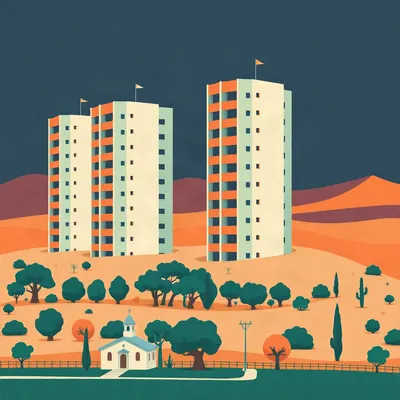
Here's what Daniel wrote in this week. He's picking up the thread from that conversation about housing pressure and noise pushing immigrants to look at places like Kiryat Gat, and he wants to talk about the concept of the periphery in Israel. His words: it's one of those terms that sounds like a geographical descriptor but actually means something very specific, and not necessarily geographically logical. The Hebrew is peripheria. And the idea, roughly, is that everywhere that isn't Jerusalem or Tel Aviv is a place on the fringe of Israeli society. Fewer opportunities, much lower standard of living, and cultural connotations the name has taken on for the people who live there.

Right.
Then he asks how a very young state came to define all other parts of the country by reference to not being the core cities. How big the employment gap actually is. What initiatives the government has proposed over the years, including now, to stimulate growth and settlement out there. And then, for anyone who wants a different side of Israel, one that isn't the Tel Aviv promenade where everybody speaks English, what are the true gems of the periphery worth visiting.
That's five questions in one paragraph. Very Daniel.
He's efficient. So where do we start with this?
With the thing that makes the word strange, which is that it isn't a direction. Peripheria doesn't mean "far away." It means "not the center." Those are different claims and Israel is the proof. Kiryat Gat is fifty-six kilometers from Tel Aviv. That's closer to Tel Aviv than a lot of New Jersey is to Manhattan, and nobody calls Newark a development town.
And Jerusalem itself was given development town status in the sixties.
Which should end the geographic reading right there. The capital of the country, the holiest city in the Jewish world, classified as a development area. Because the label was never about where you are. It was about what the treasury decided to subsidize.
So the core is Gush Dan, the Tel Aviv metro. Jerusalem and Haifa get partial membership. Everything else is the rim.
Everything else. The Galilee, the Negev, the development towns, and a few places that are practically suburbs and still carry the label. There's no English Wikipedia article called "Periphery, Israel." The concept lives inside the development town literature and a couple of geographers, Yiftachel and Tzfadia, who spent careers on it. The absence of the article is itself the finding. Nobody outside Israel knows there's a word for this.
Because inside Israel everybody knows there's a word for this.
Everybody uses it. It's a category people apply to themselves and to other people, and it carries weight in both directions.
Let's go back to 1948, then. Because this thing didn't grow. It was built.
It was built, and fast, and the speed is the whole story. The state declares independence in May of forty-eight. Over the next three years the population doubles to about one point two million. Holocaust survivors arriving from Europe, and then hundreds of thousands of Jews from Iraq, Morocco, Yemen, Egypt, Libya, Syria. By the end of 1951 there are over two hundred and twenty thousand people living in about a hundred and twenty-five ma'abarot. Transit camps. Tents, tin shacks, wooden huts.
And over eighty percent of them are Mizrahi.
Over eighty percent. Jews from the Middle East and North Africa. So you have a brand new state with a housing emergency and a population it did not plan for, and the solution it reaches for is to put them somewhere else.
Somewhere else meaning the Galilee and the northern Negev.
Specifically there. And the language of the policy is worth hearing, because it's not cruel on its face. The stated goal was to expand the population of peripheral areas while easing pressure on the crowded center. Both of those things were real problems. Tel Aviv in 1950 was bursting.
And the first development town is Beit Shemesh, 1950, about twenty kilometers from Jerusalem.
Twenty kilometers. Which again, is not the edge of the earth. It's a short drive from the capital. But it was empty land, it was cheap, and the state could put people there.
Herman, here's the part I keep circling. When you place two hundred thousand people in camps and then in towns, and eighty percent of them share an ethnic origin, you haven't just built housing. You've built a correlation. And the correlation is going to harden into a fact about the country.
It hardens within a generation. By the sixties and seventies, eighty-five to ninety percent of development town residents are Mizrahi Jews. There's a scholar, Khazzoom, who documented a significant relationship between ethnicity and the likelihood of being placed in a development town. Which is a polite academic way of saying the address you got was not random.
The address you got was assigned.
Assigned by a housing authority under emergency conditions, but assigned. And the emergency passed. The correlation didn't.
Then the nineties bring a second wave.
The Soviet collapse. A million people arrive from the former Soviet Union, and a lot of them land in the same towns. By 1998 there are a hundred and thirty thousand Russian-speaking immigrants living in development towns. Which is interesting, because it means the periphery gets a second ethnic layer. It's no longer only a Mizrahi story. It's a story about whoever the state needs to house quickly.
The periphery as the country's landing pad.
Every wave, the same towns. And here's the detail that I find almost too on the nose. In 1984 the Development Towns project won the Israel Prize for its contribution to society.
The state gave itself an award for the thing.
For the contribution. And the same literature, the same sources, will tell you that most of these towns, especially in the south, have fared poorly economically and feature among the poorest Jewish areas in Israel. Both of those are true at once. It won a prize and it didn't work.
Take Kiryat Gat. Founded 1954 as a ma'abara by eighteen Moroccan families. Today, seventy-two thousand people. And sitting inside it, or rather beside it, is Intel Fab 28. One of the most advanced semiconductor fabrication plants on the planet. Seven-nanometer chips. In 2021 Intel announced a ten billion dollar investment.
Ten billion dollars. In a town founded by eighteen families in tents.
And Kiryat Gat still has one of the highest unemployment rates in the country.
Say that again. Slowly.
Ten billion dollars of the most advanced manufacturing on earth, and the town around it still tops the unemployment tables. That's the thesis of the entire episode in one city.
So the plant is an island. It employs people, it exports chips, it plugs into the global supply chain, and it does not lift the town.
It lifts some people in the town. It doesn't change the town's category. And you can see the category in the education numbers. In 2001, only fifty-four point seven percent of Kiryat Gat's twelfth graders graduated with a matriculation certificate. That's the mechanism, by the way. That's how a gap reproduces itself. The jobs that exist require a bagrut, the bagrut rate is low, so the good jobs go to commuters from the center, and the town stays where it is.
The plant hires from outside.
Not exclusively, but enough. And the town keeps its label.
Zoom out. What does the whole Negev look like?
Fifty-five percent of Israel's land area. About eight point two percent of its population. As of 2010, roughly six hundred and thirty thousand people, and that's seventy-five percent Jewish, twenty-five percent Bedouin.
Over half the country, under a tenth of the people.
That's the structural fact underneath everything else. The state owns the land, the land is empty, and the people are crowded into the center. Every policy from 1950 onward is an attempt to move the second number toward the first.
And there's a Bedouin layer in there that's its own thing entirely.
About a hundred and seventy-five thousand Bedouin in the Negev, many in unrecognized villages. Different legal status, different relationship to the state, different set of grievances. It sits inside the periphery story but it isn't the same story, and I'd rather flag that than flatten it.
Fair. So the state keeps trying to fill the map. Let's do the initiatives, because Daniel asked specifically.
The fifties are the ma'abarot and the development towns. That's the original engineering. Then the eighties, Operation Promised Land, large-scale development aimed at absorbing Soviet and Ethiopian immigration. Same logic, bigger scale.
Then 2005.
Blueprint Negev. Jewish National Fund, six hundred million dollars, and the headline goal was to attract five hundred thousand new Jewish residents to the Negev. Later reframed as two hundred and fifty thousand over ten years, which tells you something about the first number.
Five hundred thousand was the pitch. Two hundred and fifty thousand was the plan.
The plan had parts. The Be'er Sheva River Walk, a nine-hundred-acre park modeled on the San Antonio River Walk. Twenty-five planned new suburban communities. Sansana, Tzukim, Merchav Am, Giv'ot Bar, Haruv, Be'er Milka, Karmit, Kasif. And an explicit effort to steer English-speaking immigration to the Negev.
There it is. The Anglo targeting goes back twenty years.
It goes back further than people think. In 2006 Shimon Peres becomes Minister of Development of the Negev and Galilee. A cabinet-level post for the periphery. And Ynet at the time reported on a new community designated for wealthy, young American immigrants who want to live in style.
"Live in style." In the desert.
That was the pitch, verbatim.
Then the army moves south.
Major IDF training bases relocated to the Negev. One base alone for ten thousand personnel plus twenty-five hundred civilian staff. And the stated reason is exactly the logic we've been describing. Bring jobs and investment to the south, and vacate land in Tel Aviv and the center.
The state moving its own payroll to fix the map.
It's the most reliable lever it has. An army base is a guaranteed customer base. It doesn't boom and bust.
And 2012, the OECD weighs in.
A paper on clean-tech clustering in the Negev, citing fifty clean-tech businesses and four tech incubators as a serious comparative advantage. Which is real. The Negev has sun and space, and those are the two inputs for solar.
So we've got Intel, the army, the JNF, the OECD, a cabinet minister. Has any of it changed the label?
That's the question, and I think the honest answer is that it changed the map without changing the category. Which brings us to the thing that's happening right now.
Carmei Gat.
Carmei Gat. A new neighborhood north of Kiryat Gat. About ten thousand housing units, with plans to double the city's population. The Times of Israel called it Israel's newest Anglo boomtown.
And this is where Daniel's original thread closes the loop. The people leaving Jerusalem and Tel Aviv because of price and noise are being courted to settle the exact place that has carried the periphery label for seventy years.
At a discount.
And here's the irony I can't get past. If you move enough English speakers into Carmei Gat, you don't fix the periphery. You build a small Tel Aviv inside it. The cafes, the Facebook group, the English-language preschool.
You recreate the center's culture at the edge of the map. Which is either the solution or the problem restated, depending on what you think the problem was.
And Blueprint Negev had critics saying this at the time. Environmental groups arguing it produces water-intensive suburban sprawl in a desert. Social groups arguing the money per capita went to relatively well-off immigrants in a high-poverty region.
Both criticisms are on the record and both have teeth. The water one especially. You're building lawns in the Negev.
So the state's answer to "the periphery is poor" is to subsidize middle-class people to move there, which helps the newcomers and maybe not the people who were already there.
It's a real tension. I don't think it's resolved.
Now let's do the part Daniel actually wants for himself. The gems. He wants to see the Israel that isn't the promenade.
This is the fun half. Start in the south. Mitzpe Ramon. A small town on the rim of Makhtesh Ramon, which is the largest erosional crater on earth. Not a volcanic crater, an erosion crater. The whole thing is carved out.
How big are we talking?
Forty kilometers long. You stand on the edge and it's a hole in the planet.
And it's a town. People live there.
About five thousand of them. It's the quietest place in the country. The stargazing is world-class because there's no light pollution.
Ein Avdat.
A canyon in the Negev with year-round water. Which sounds unremarkable until you remember where you are. You hike in and there are pools and ibex on the cliffs.
The Nabataean cities.
Avdat, Mamshit, Shivta, Haluza. Ancient desert cities on the Incense Route. UNESCO-listed. Shivta has Byzantine churches standing in a place with essentially no water, and nobody has ever fully explained to my satisfaction how they farmed there.
Timna.
Timna Park. Ancient copper mines, the Solomon Pillars, Egyptian engravings in the rock. Copper mining in that valley goes back thousands of years.
Red Canyon.
Wadi Shani, near Eilat. A slot canyon that people describe as a mini Petra. You scramble through it, it takes an hour, it's spectacular.
Then Yotvata Hai-Bar, which is the nature reserve where they've reintroduced Arabian oryx, wild ass, ostriches. It's a breeding and reintroduction operation for animals that had been wiped out of the region.
Neot Smadar.
Kibbutz Neot Smadar. An eco-village with an arts center built in a Gaudi-like organic style, and a winery that people take seriously. UN Tourism named it one of the world's best tourism villages in 2025.
A kibbutz in the middle of nowhere gets a UN tourism award.
That's the periphery in one sentence. It's simultaneously the poorest part of the country and the part with the most awards per capita.
Sde Boker.
Ben-Gurion's desert home and his tomb. And the desert research institutes of Ben-Gurion University. The man who ran the country retired to the Negev on purpose, to make a point about where the country should be going.
The point being that he thought the future was down there.
He said so repeatedly. And then the country kept building in the center.
Bedouin hospitality.
Rahat is the largest Bedouin city in Israel. You can eat in a tent, ride a camel, and be fed more than any human should eat. It's a completely different Israel and it's forty minutes from Be'er Sheva.
Neve Midbar.
A desert hot-spring spa near Revivim. Which is the Lonely Planet angle. Lonely Planet put the Negev at number two on its top ten regional destinations for 2013, citing the spas, the wineries, and Ramon airport, which opened in 2019.
The airport being the thing that makes it work. You can now fly into the desert.
Directly. You don't have to drive from Tel Aviv.
And the Galilee.
Kiryat Shmona as the gateway to the Upper Galilee and Mount Meron. Safed, Tzfat, the mystical city with the artists' colony and the narrow stone streets. Beit She'an with the Roman city ruins, which are some of the best in the region. Karmiel. And the Druze and Arab towns of the Western Galilee, which is its own food culture.
So the answer to Daniel's last question is that the periphery has the best landscapes and the oldest history.
And the lowest incomes. That's the paradox and I don't think it resolves.
Hold on. Before we close this, there's a cultural connotation question we haven't answered. Daniel asked what the term means to the people who live there.
Politics, mostly. In the 2022 election, seventy-four percent of Kiryat Gat voted for the right-wing coalition, twenty-four percent center-left. That's a distinct political identity and it's not an accident. It's a population that has spent seventy years being governed by people from Tel Aviv.
That's the resentment, and it's earned.
And religiosity. A 2003 survey found thirty-nine percent of development town residents would rather Israel be run more by halakhic law. That's a much higher number than you'd get in the center. Which is part of the same cultural package. More traditional, more religious, more working-class, less English.
And that package is what the word peripheria actually carries. It's not a compass direction. It's a whole set of assumptions about who lives there.
Which is why the high-tech plant doesn't fix it. You can put a fab in Kiryat Gat. You can't put a fab in the word.
The word is the thing that persists.
Hilbert: Fifty-four point seven.
Sorry?
Hilbert: The bagrut number. Fifty-four point seven percent in 2001. You said it right. I just wanted to say the number out loud because I drove that route.
You drove Kiryat Gat?
Hilbert: Be'er Sheva to Tel Aviv. Two years. Early nineties, before the highway was what it is now. Picked up at the central station in Be'er Sheva at five in the morning, and you'd have a full bus by the time you hit Kiryat Gat, and half of them would sleep the whole way in because they'd been up since three to make a shift in Tel Aviv. Every one of them going to work in a city they couldn't afford to live in.
That's a commute of what, an hour?
Hilbert: An hour and change, each way. And the ones going the other way, the ones coming down from Tel Aviv to work at the plant, they'd sit at the front and talk on their phones the whole ride. Different bus, same road.
So the labor flowed both directions.
Hilbert: It flowed both directions and only one direction got to sleep. That's what I remember. I don't know anything about the policy. I know who was on the bus.
Did you ever eat down there?
Hilbert: There was a place off the Be'er Sheva road, a little hummusiya, no sign in English, and the man who ran it would not give you a menu. He'd look at you and decide what you were having. Best hummus I've ever eaten in my life and I ate it standing up next to the bus because we had eleven minutes.
Eleven minutes.
Hilbert: Eleven minutes. And I've thought about that hummus for thirty years. You can't get it in Tel Aviv. You can get hummus in Tel Aviv, you can't get that.
So the periphery has something the center doesn't.
Hilbert: It's got the thing the center is trying to buy back. That's what I came out here to say. You two spent an hour on the label and the plant and the prize, and you're right about all of it. But the consequence nobody said out loud is that the minute enough people from Tel Aviv find out about the hummus, the hummus place puts up an English menu and doubles the price and hires somebody to stand outside. That's what happens. I've watched it happen to four towns.
You're saying the discovery is the damage.
Hilbert: I'm saying the thing that makes it good is that nobody's found it yet. And your boomtown is a hundred buses of people finding it.
That's a dark conclusion.
Hilbert: It's not dark, it's just how it goes. Anyway. I'm due at the tax office and I want to be early, because being early in that queue is worth more than being right in this one.
The queue at the tax office.
Hilbert: There's a man there who knows how to fix the thing I need fixed and he's only there until noon.
Well. There's a whole other Israel, and it's in a queue at the tax office.
And he's not wrong about the hummus. That's the part I can't get past. The thing that makes the periphery worth visiting is the same thing that makes it vulnerable to being visited.
Which is the trap in Daniel's last question. He asked for the gems. The gems are the parts that haven't been discovered, and the act of answering him is the act of discovering them.
Every travel recommendation is a small act of colonization. That's a heavy note to end a travel segment on.
It's the honest one though. The periphery has spent seventy years being defined by the center. The one thing it has that the center can't manufacture is that it isn't the center yet. And the Intel plant, the airport, the Anglo boomtown, all of it is an attempt to fix that.
So the open question is whether the periphery's cultural richness and its landscapes outweigh the structural disadvantage, or whether the disadvantage is precisely what preserved the richness.
And whether government policy can ever erase the label, or whether it just builds enclaves with better coffee inside the same category.
Which is where I'd leave it. The label outlives the plant. It outlived the prize. It'll probably outlive Carmei Gat.
Thanks to Hilbert Flumingtop, our producer, who has strong views about hummus and the tax office.
This has been My Weird Prompts. Check the website and the RSS feed for the back catalogue, and send us your own weird prompts.
Email us at show at my weird prompts dot com. We'll be back soon.