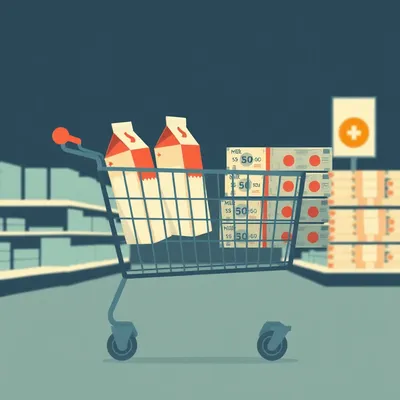
Daniel sent us this one — he was in a Swiss supermarket recently, just passing through for a night, and noticed something off. The dairy aisle was cheap, abundant, almost absurdly so. Meanwhile, back home in Israel, basic milk costs more than it does in Zurich — a country with forty percent higher GDP per capita. And that observation, that inversion, is the puzzle. Why are necessities luxury-priced in Israel while Switzerland treats cheese like a loss leader? Is any developed economy actually solving the cost-of-living crisis, or are they just masking it in different ways? There's a lot to unpack here.

That supermarket trip got us thinking — what does the data actually say about how different countries price their necessities? Let's start with the numbers. The OECD publishes two metrics that matter here. The first is Comparative Price Levels, or CPL — that's the actual price of a basket of goods and services across countries, with the OECD average set at one hundred. The second is purchasing power parity adjusted disposable income, which is what people can actually buy with what they earn. The distinction matters because a country can look rich on GDP per capita and still leave its median worker unable to afford milk.
Which is Israel's entire story in one sentence.
So let's anchor this in the most recent data. The OECD released its twenty twenty-four Comparative Price Levels dataset in March of twenty twenty-five. OECD average is one hundred. Israel's overall CPL came in at one hundred eighteen. The US at one hundred twelve. Switzerland at one hundred forty-five — the highest in the OECD. Japan at ninety-eight, actually below the average.
On the headline number, Switzerland is the most expensive country in the developed world, and Israel is above average but not catastrophic. That doesn't match the lived experience at all.
Because the aggregate hides everything. The composition of prices — what's expensive and what's cheap within a country — that's the real story. And this is where I want to introduce something I'm calling the necessity premium. It's the ratio of food and housing prices to the overall CPL. If your food prices are way above your general price level, you're taxing necessities.
Switzerland could be one hundred forty-five overall but have food at one hundred ten, while Israel is one hundred eighteen overall but food at one hundred twenty-five. The aggregate makes Switzerland look worse, but the Swiss shopper buying dinner is having a better time than the Israeli shopper.
That's precisely the pattern. And it gets sharper when you zoom in on specific categories. Israeli food prices sit at one hundred twenty-five percent of the OECD average. But dairy specifically — milk, cheese, yogurt — comes in at one hundred forty percent of the OECD average. That's despite government price controls on raw milk that have been in place since the twenty fourteen dairy reform.
Wait — dairy is the most controlled food category in Israel and it's also the most expensive relative to other countries. That's not what price controls are supposed to do.
This is the first big misconception to bust. Price controls don't automatically lower prices. In Israel's dairy market, they created a floor, not a ceiling. Here's how the mechanism works. The Dairy Council regulates raw milk production through a quota system. Farmers are guaranteed a minimum price for raw milk. That price is set through negotiations between the government, the dairy producers, and the farmers — and it's consistently above what you'd get in a competitive market. The Bank of Israel put out a report on this in twenty twenty-three that found the price controls reduced price dispersion across stores — meaning milk costs roughly the same everywhere — but they didn't lower the average price. The controlled price became the floor, and everything else floated above it.
The government says "milk shall not exceed this price," but the regulated price is already high because of the production quotas, and then anything not covered by the control — yogurt, cream, specialty cheeses — has no ceiling at all. You get a two-tier market where the cheap stuff is expensive and the premium stuff is even more expensive.
That's the twenty fourteen "five shekel yogurt" law in a nutshell. After the twenty eleven social protests — hundreds of thousands of Israelis in the streets over the cost of living — the government introduced price controls on a basket of basic dairy products. White cheese, basic milk, that kind of thing. The law was sold as making yogurt cost five shekels. But the controls only covered a narrow set of items. So what happened? The controlled items immediately rose to the cap — because why would anyone sell below the legal maximum if the production cost is already near it? And the uncontrolled items — flavored yogurt, cream cheese, hard cheeses — their prices kept climbing because now producers had to make their margins somewhere.
Like squeezing a balloon. You cap one end, the other end bulges.
The balloon analogy is actually generous, because squeezing a balloon doesn't raise the pressure at the squeezed end — it just redistributes it. Here, the cap became the new minimum. So you walk into an Israeli supermarket and the basic white cheese is at the regulated maximum, which is already high by international standards, and the Greek yogurt next to it is even more expensive because that's where the margin lives.
Let's put actual numbers on this. You mentioned specific prices in the prompt. What does a liter of milk actually cost?
In Tel Aviv, a liter of milk runs about seven and a half shekels — that's roughly two dollars and five cents. In Zurich, the same liter costs about one Swiss franc thirty, which is about a dollar forty-five. Switzerland has forty percent higher GDP per capita, and their milk is thirty percent cheaper.
The Swiss dairy aisle — what Daniel walked into and found almost surreal — that's not an accident. That's engineered.
It's a deliberate retail strategy, and it's worth understanding because it's the mirror image of Israel's approach. Switzerland has a retail duopoly — Migros and Coop control something like seventy percent of the grocery market. They use dairy as a loss leader. Milk, cheese, basic yogurt — these are priced at or below cost to drive foot traffic. Once you're in the store buying your cheap milk, you also pick up the things where margins are forty to sixty percent. High-end pens, electronics, specialty foods, wine. The Swiss Federal Statistical Office's twenty twenty-four household expenditure survey shows this pattern clearly — the basket of necessities is cheap, the basket of luxuries is expensive.
Switzerland runs a regressive subsidy on necessities — everyone gets cheap milk regardless of income, which means wealthy households get more absolute benefit because they consume more — and a progressive tax on luxuries, because rich people buy more high-end pens. Israel runs the opposite. Expensive necessities are a regressive tax — they hit low-income households hardest because food and housing consume a larger share of their budget.
That's the structural inversion. And the Swiss agricultural subsidy system reinforces it. Switzerland spends about three and a half billion Swiss francs annually on agricultural subsidies, which works out to roughly twenty percent of farm income. That keeps domestic production high and prices low at the retail level, even before the duopoly's loss-leader strategy kicks in. Israel's agricultural subsidies exist but they're structured differently — they protect producer incomes through quotas and price floors rather than subsidizing consumer prices directly.
The Swiss government pays farmers to produce, and the retail duopoly competes on necessities to get people in the door. The Israeli government protects farmers by guaranteeing high prices, and the retail market is concentrated enough — Shufersal and Rami Levy have about sixty percent of the market — that there's no competitive pressure to use basics as loss leaders.
The concentration numbers are actually worse than they sound because geographic segmentation means many neighborhoods effectively have one chain. But let me pull back to the macro picture, because Israel's food prices don't exist in isolation. The real cost-of-living crisis is a housing plus food crisis.
The dual economy problem.
Israel has what economists call a dual economy. The high-tech sector employs about fifteen percent of the workforce but generates roughly fifty percent of exports. Those salaries — we're talking median tech wages around twenty-five to thirty thousand shekels a month — pull up the national average. But the bottom fifty percent of earners are mostly in services, retail, education, and they're facing housing costs that have risen sixty percent since twenty nineteen, according to the Central Bureau of Statistics' twenty twenty-five report. Median wages over the same period rose eighteen percent. So housing costs grew more than three times faster than paychecks.
That's the squeeze in one statistic. Your rent goes up sixty percent, your salary goes up eighteen percent, and your milk is more expensive than Switzerland's.
This is where the purchasing power parity data gets brutal. Israel's GDP per capita is at the OECD average — respectable, developed-economy territory. But the median wage, about twelve thousand shekels a month in twenty twenty-four, is only sixty percent of the OECD median when you adjust for purchasing power. The OECD Employment Outlook for twenty twenty-five lays this out. Israel has high output per worker, but that output is concentrated in a small slice of the workforce. The median Israeli worker produces less, earns less, and then pays more for basics.
The Israel paradox — high GDP per capita, low living standards for the median worker — is really a distribution story. The average is pulled up by the top quartile, and the median is dragged down by everything underneath.
Inflation has made this worse. Let me give you the cumulative picture since twenty twenty-one. Food prices in Israel rose about twelve percent cumulatively. Rents in Tel Aviv rose eighteen percent. The Bank of Israel calculated in their twenty twenty-five financial stability report that a typical household's disposable income for non-essentials — what's left after housing and food — has shrunk by twenty-two percent in real terms.
A family that had a thousand shekels a month for everything beyond rent and groceries now has seven hundred eighty. That's a felt loss, even if the number on the paycheck went up.
This brings us to the second big question from the prompt. Is any developed economy bucking the inflation trend? The answer is yes, but "bucking the trend" doesn't always mean what people think it means.
Let's hear the Japan story, because I know you've been digging into this.
Japan is the standout on headline inflation. Core inflation in twenty twenty-four was one point eight percent, compared to the OECD average of four point two percent. That's remarkably low. But the mechanism behind it is thirty years of deflationary psychology. Japanese consumers and businesses have spent decades expecting prices to stay flat or fall. That suppresses demand, which suppresses price increases, which reinforces the expectation. It's a self-fulfilling cycle.
The flip side is wage stagnation.
Nominal wage growth in Japan has been below one percent for twenty-five years. The Ministry of Internal Affairs data for twenty twenty-five shows wages grew zero point seven percent in twenty twenty-four. So yes, prices are stable. But incomes aren't growing either. The OECD Economic Survey of Japan from twenty twenty-four is blunt about this — Japan's low inflation is a symptom of structural stagnation, not brilliant economic management. Real wages have been flat for decades. Things aren't getting more expensive, but they're not getting more affordable either, because affordability is a ratio of prices to income.
Japan is "cheap" in a way that doesn't help the median worker. The prices are low but the paychecks are lower than they should be. It's stability without growth.
Then there's the US comparison, which is almost the inverse. US inflation in twenty twenty-four was three point five percent — higher than Israel's three point eight, actually quite similar on the headline. But US wage growth over the same period was four point two percent. Real wages grew. Prices went up, but paychecks went up faster.
The American consumer felt inflation, but their purchasing power actually improved. The Israeli consumer felt similar inflation, but wage growth was only two point one percent — real wages fell. Same inflation story, opposite outcome for the household budget.
That's the critical distinction. Headline inflation numbers dominate the news, but what matters for living standards is the gap between price growth and wage growth. The US had a positive gap. Israel had a negative gap. Japan had low everything — low inflation, low wage growth — so the gap was roughly zero, but from a baseline of decades of stagnation.
You mentioned their food inflation was the lowest in the OECD.
Switzerland's overall inflation in twenty twenty-four was one point four percent. Their food inflation specifically was zero point eight percent — the lowest in the entire OECD, according to the OECD Economic Outlook from May twenty twenty-five. This is the Switzerland exception in a different sense. They're not just low-inflation — they're low-food-inflation in a way that's structurally engineered. The strong Swiss franc imports deflation — when your currency appreciates, imports get cheaper. And the retail duopoly keeps margins thin on essentials while making their profit on luxuries. The result is that the things you have to buy stay cheap, and the things you choose to buy are where the cost lives.
Three very different models. The US model — let inflation run a bit, but make sure wages outpace it. The Japan model — suppress inflation through decades of deflationary expectations, but accept wage stagnation as the tradeoff. The Swiss model — use currency strength and retail strategy to make necessities artificially cheap, and recoup on luxuries.
Israel doesn't fit any of these. Israel has US-level inflation with Japan-level wage growth for the bottom half of earners, plus a Swiss-level concentration of retail power but without the loss-leader strategy. It's the worst combination.
The concentrated retail power in Israel is an interesting parallel to Switzerland, actually. Both countries have a grocery duopoly — Migros and Coop in Switzerland, Shufersal and Rami Levy in Israel. But the Swiss duopoly competes on basics. The Israeli duopoly doesn't have to, because the price controls create a floor that eliminates price competition on the controlled items, and the geographic segmentation means many consumers don't have realistic alternatives.
The Bank of Israel has been saying this for years. Their twenty twenty-three report on the food market found that concentration isn't just about market share — it's about the structure of competition. When price controls set a floor, the competitive dynamic shifts from "who can sell milk cheapest" to "who can sell milk at the cap and make up margin elsewhere." The competition moves to the uncontrolled items, where there's no ceiling, and prices drift up.
The well-intentioned twenty fourteen reform — let's cap basic dairy so poor families can afford yogurt — actually created a market where basic dairy is expensive by international standards and premium dairy is even worse. The people it was supposed to help are paying more for the controlled items than Swiss consumers pay for uncontrolled ones.
This connects to a broader point about how governments are approaching the cost-of-living crisis globally. There are roughly three strategies in play across the OECD. One is monetary — central banks raising rates to cool demand, which the US Fed and the European Central Bank have done aggressively. Two is fiscal — direct transfers to households, tax cuts on essentials, rent controls. Three is regulatory — price controls, competition policy, breaking up monopolies.
Israel has tried all three and the results are...
Israel's central bank raised rates from zero point one percent in early twenty twenty-two to four point seven five percent by mid-twenty twenty-three, which did cool housing demand but also made mortgages more expensive — so it hurt the same people it was supposed to help. The government has done periodic direct transfers — the twenty twenty-three cost-of-living payment was a few hundred shekels per household — but those are one-offs that don't change the structural price level. And the regulatory approach, as we've seen with dairy, created floors rather than ceilings.
What about countries that are actually trying something different? Is anyone innovating on this?
Spain introduced a VAT cut on basic foods in twenty twenty-three — olive oil, bread, milk, eggs — dropping the rate from four percent to zero. That's a direct price reduction that doesn't distort producer incentives the way price controls do. The producer still gets the market price; the government just takes less tax. Early data from Spain's national statistics institute suggests it shaved about one and a half percentage points off food inflation. It's not transformative, but it's targeted and doesn't create the floor problem.
South Korea has been experimenting with something more aggressive on housing, right?
South Korea's housing crisis makes Israel's look tame — Seoul apartment prices rose something like fifty percent between twenty nineteen and twenty twenty-two. The government responded with a massive public housing construction program and tighter lending rules. But the more interesting intervention was on food — they've been using a public online platform to sell basic foods at near-wholesale prices, effectively creating a government-run competitor to the retail chains. It's too early to say if it's working at scale, but it's a structural attempt to inject price competition rather than just capping prices.
That's the Swiss loss-leader strategy but implemented by the state instead of a duopoly. Use cheap basics to draw people in.
It raises the question of whether Israel could do something similar. The agricultural quotas and the Dairy Council's price-setting power are deeply entrenched — they've survived multiple reform attempts. But the Swiss model shows that making necessities cheap isn't impossible. It just requires either a competitive retail market that treats basics as loss leaders, or a state mechanism that achieves the same effect.
Let me pull us to the framework that I think ties this all together. You mentioned the necessity ratio earlier — food plus housing as a percentage of median disposable income. That's the number that actually captures whether a country is affordable to live in. What do those ratios look like across the countries we've been discussing?
The OECD Better Life Index for twenty twenty-five gives us this. The OECD average for the necessity ratio — that's food plus housing costs divided by median disposable income — is zero point three eight. So the median household in a typical developed economy spends thirty-eight percent of their after-tax income on food and housing. Switzerland comes in at zero point three five — below the average, despite being the most expensive country on headline CPL. The cheap necessities strategy actually works. Israel is at zero point fifty-two.
Fifty-two percent. More than half of median income goes to food and housing.
That's the number that explains the feeling Daniel described — leaving Israel and finding everything cheap. It's not that other countries have lower absolute prices on everything. It's that the things you have to buy — the non-negotiable basket — consume a much smaller share of your income elsewhere. In Switzerland, the necessities are cheap and the luxuries are expensive, so your disposable income goes further on the things you can't avoid buying. In Israel, the necessities eat your paycheck before you get to the discretionary stuff.
Japan's necessity ratio is around zero point thirty-six, similar to Switzerland's, but for different reasons. Japan's housing costs are low — decades of flat or falling land prices outside central Tokyo — and food is cheap because of the deflationary environment. But remember, that comes with wage stagnation. A low necessity ratio is great, but if your denominator — your income — hasn't grown in twenty-five years, you're treading water.
The US sits somewhere in the middle on the necessity ratio, but the wage growth story makes it feel different.
The US necessity ratio is about zero point thirty-nine, right at the OECD average. But the wage growth trajectory matters. If your income is growing at four percent and your necessity costs are growing at three and a half percent, you're slowly gaining ground. If your income is growing at two percent and your necessity costs are growing at four percent — Israel's situation — you're losing ground every year.
That's the dynamic that makes the cost-of-living crisis feel acute even when headline inflation is similar to other countries. It's not just the price level — it's the direction and speed of change relative to income.
Let me give you the cumulative numbers that make this concrete. Between twenty twenty-one and the end of twenty twenty-four, Israel's cumulative consumer price inflation was about fourteen percent. Cumulative wage growth for the median worker was about eight percent. So the median worker lost about six percent of their real purchasing power over three years. In the US, cumulative inflation was about sixteen percent, but cumulative wage growth for the median worker was about fifteen percent — roughly breaking even. In Switzerland, cumulative inflation was about seven percent and wages grew about six percent — again, roughly even, but from a much lower inflation baseline.
The Israeli worker is uniquely squeezed. Not because inflation is uniquely high — it's in line with the developed world — but because wages aren't keeping pace.
This brings us back to the dual economy. The high-tech sector in Israel has seen wage growth that outpaces inflation. Software engineers, data scientists, cybersecurity people — their salaries have grown fifteen to twenty percent over the same period. But they're fifteen percent of the workforce. The other eighty-five percent are in sectors where wage growth is sluggish and inflation bites hard. The aggregate statistics hide this bifurcation.
When the government points to GDP growth and average wage growth, they're technically telling the truth — the average is going up. But the median is stagnating or falling in real terms. The high-tech elite pulls the average up; the median worker feels the squeeze.
This is where the cost-of-living crisis becomes a political crisis. People don't experience the average. They experience their own paycheck and their own supermarket bill. If your salary went up five percent and your grocery bill went up twelve percent, you don't care that the national average wage grew eight percent. You know you're falling behind.
Let me ask you the forward-looking question. The OECD is forecasting global inflation to moderate to about three point two percent for twenty twenty-six. If that happens, does the structural disparity between countries persist? Or does moderation smooth everything out?
The structural disparity almost certainly persists, because it's baked into regulatory and retail structures, not just macroeconomic cycles. Switzerland's cheap necessities aren't a product of low inflation — they're a product of agricultural subsidies and a retail strategy that's been in place for decades. Israel's expensive dairy isn't a product of high inflation — it's a product of quota systems and price floors that predate the recent inflationary episode. Inflation amplifies these structural differences, but it doesn't create them.
Even if global inflation settles back to two or three percent, the Israeli shopper will still pay more for milk than the Swiss shopper. The gap might stop widening, but it won't close.
Closing the gap would require structural reform — reforming the dairy quota system, introducing real competition in retail, addressing housing supply constraints. Those are politically difficult and have been stalled for years. The twenty eleven protests led to some reforms, but the core structures — the Dairy Council, the agricultural quotas, the concentrated retail market — are still in place.
The housing side is even harder to fix. You can't quickly build enough housing to reverse a sixty percent price increase, especially in a country with Israel's land constraints and planning bureaucracy.
The Bank of Israel estimated in their twenty twenty-four report that Israel needs to build about seventy thousand new housing units per year just to keep up with population growth. Actual construction has been around fifty-five thousand. That annual deficit accumulates, and it's been accumulating for years. Housing is a supply problem, and supply problems don't resolve quickly.
If I'm a listener trying to make sense of international cost-of-living comparisons — whether I'm traveling, considering a move, or just trying to understand the news — what should I actually look at? What's the framework?
Don't look at aggregate Comparative Price Levels. They're misleading. Switzerland's CPL is one hundred forty-five but its necessity ratio is below the OECD average. Israel's CPL is one hundred eighteen but its necessity ratio is the highest among developed economies. The headline number tells you the wrong story.
Look at the necessity basket — food, housing, transport — as a percentage of median disposable income. That's the real affordability measure.
Within that basket, pay attention to the composition. Are necessities cheap and luxuries expensive, like Switzerland? That's a progressive pricing structure — it protects low-income households. Are necessities expensive and luxuries relatively cheap, like Israel? That's regressive — it squeezes the bottom. Are necessities and luxuries both cheap, like Japan? That's great for current purchasing power but might signal wage stagnation. Are necessities and luxuries both expensive but wages are growing faster, like the US? That's inflationary but not necessarily a crisis for living standards.
The pattern of what's cheap and what's expensive tells you more about a country's economic structure than any inflation statistic. Next time you're in a supermarket abroad, don't just look at the prices — look at what's cheap and what's expensive. That pattern is the real story.
If you want to put a number on it, the necessity ratio is the metric to calculate. Take the median monthly cost of rent plus utilities plus food for a typical household, divide by median monthly disposable income. If it's above zero point forty-five, that country has a structural affordability problem regardless of what the GDP per capita says. If it's below zero point thirty-five, they're doing something right — either through deliberate policy like Switzerland or through structural factors like Japan.
The cost-of-living crisis is really a distribution crisis. The countries that appear to solve it do so by making tradeoffs. Switzerland trades expensive luxuries for cheap necessities. Japan trades wage growth for price stability. The US trades higher inflation for higher wage growth. There's no free lunch — just different patterns of who pays and how.
Israel's pattern is the one where the median worker pays the most and gets the least in return. That's not a macroeconomic inevitability. It's a set of policy choices — about agricultural quotas, retail competition, housing supply, and wage bargaining — that have accumulated over decades.
The Swiss dairy aisle isn't cheap by accident. And the Israeli dairy aisle isn't expensive by accident either. Both are the visible end of a long chain of policy decisions.
Now: Hilbert's daily fun fact.

In the eighteen-tens, a Tasmanian naturalist recorded that certain jellyfish species can revert from their adult medusa stage back to their polyp stage — essentially aging backwards — which means if you convert their lifecycle to human terms, it's as if a butterfly could decide to become a caterpillar again, and then a butterfly again, indefinitely.
Jellyfish are just... opting out of mortality.
That's unsettling.
This has been My Weird Prompts. Thanks to our producer Hilbert Flumingtop for the fact and the production. If you enjoyed this episode, leave us a review wherever you listen — it genuinely helps people find the show. We're at myweirdprompts.com for past episodes and transcripts. I'm Corn.
I'm Herman Poppleberry. We'll be back next week.