Daniel sent us this one — he wants us to take a sentimental detour today. No tech deep dives, no policy analysis, just... What was life like for the two of us growing up in Jerusalem, before all this podcasting business? The early adventures around the city, mischief we got into, lessons learned the hard way, the fondest memories of interacting with humans and other species along the way. He wants the small specific details that make memories feel real. honestly, Herman, I didn't expect a prompt to hit quite like this one.

Oh, I love this. I genuinely love this. And you know what — DeepSeek V four Pro is writing our script today, which feels appropriate somehow. A machine stitching together our warmest memories. There's something poetic in that.
Poetic, or mildly unsettling. I haven't decided.
But listen — I've been thinking about those years a lot lately anyway. When you spend decades in the same city, the memories don't just sit there chronologically, do they? They pile up in strata. You walk past a particular stretch of stone wall on Yafo Street and suddenly you're seven years old again, or twenty-seven, or both at once.
That's the thing about Jerusalem. The city itself is a palimpsest, and living there your whole life means your own history gets scraped onto the same parchment. I can't walk through the shuk without remembering seventeen different versions of myself, all of them hungry for rugelach.
That's where we should start. Because that was our real classroom growing up, wasn't it? Not the schoolrooms — those were fine, I suppose — but the market taught us everything that actually mattered.
Negotiation, for one. You were terrible at it as a foal.
I was not terrible.
You once paid full price for a bag of za'atar and then tipped the vendor.
He had kind eyes, Corn. And he told me the za'atar was from his cousin's farm near Nablus. What was I supposed to do, haggle with a man who had kind eyes and a cousin with a farm?
This is why you never handled the household finances. Mother would send us both with a list and a specific amount of cash — she'd count it out on the kitchen table — and by the time we got home, you'd have spent the entire sum on spices and honey and somehow acquired a free kitten.
That kitten was not free. That kitten cost us three weeks of me sleeping on the floor because Mother was so furious she made me give up my bed.
The kitten slept on your bed.
The kitten slept on my bed. And I slept on the stone floor of our room, which, by the way, is how I learned that Jerusalem nights get cold even in May. People don't realize — they think Middle East, they think heat — but those limestone buildings hold the chill. I'd wake up at three in the morning with my teeth chattering, and there's this tiny orange fluffball stretched out diagonally across my mattress like a sultan surveying his kingdom.
You named him Sultan.
I named him Sultan. And he lived for fourteen years and was the grumpiest creature I have ever loved. But that's what I mean about the shuk being our classroom. Where else do you learn about consequences, about value, about the fact that some things cost more than money?
The shuk also taught us about people. About the sheer variety of ways to be alive. You had the Armenian ceramics vendor who'd been in the same spot since before the British Mandate — he remembered everything, that man. He'd see us coming and start pulling out stories like they were inventory. And then three stalls down, you'd have the Ethiopian spice merchant who'd arrived three years prior and already knew everyone's grandmother's recipe.
There was that one summer — I must have been maybe nine, which would make you seven — when Father decided we needed to learn the value of work and arranged for us to help old Yossi at his dried fruit stall.
The fig summer.
The fig summer! Three months of sorting dried figs by size and quality. My hooves were sticky from June through September. I couldn't get the smell off. To this day, I cannot eat a dried fig without feeling a phantom ache in my lower back from standing on that concrete floor for hours.
I developed an elaborate system for avoiding work. I'd arrange the figs very slowly — glacially, some might say — and whenever Yossi turned his back, I'd take a nap behind the burlap sacks. He caught me maybe a dozen times and never said a word. Just shook his head and went back to his crossword puzzle.
He definitely knew. Yossi knew everything. He'd been in that market for forty years — there wasn't a trick he hadn't seen. I think he just liked having us around. His own grandchildren lived in Haifa, and he didn't see them much. substitute grandchildren, I suppose. Imperfect ones, but enthusiastic.
You were enthusiastic. I was horizontal.
The thing that sticks with me most about Yossi — and I haven't thought about this in years — is that he taught me how to read Hebrew without the vowel markings. I'd been struggling with it in school, getting frustrated, and one afternoon he just pulled a newspaper out from under the counter and said, "Read me the headlines, donkey." And I said I couldn't, and he said, "You can. You just don't know you can yet.
That's a very Jerusalem-teacher thing to say. Cryptic but somehow accurate.
He was right! By the end of that summer I was reading the entire front page. Yossi would correct my pronunciation, but never in a way that made me feel stupid. He'd just repeat the word correctly and move on. It was the most patient pedagogy I've ever experienced, and I've been through medical training.
A dried fruit vendor in the shuk gave you better reading instruction than the formal education system. There's a lesson in that somewhere.
The lesson is that Jerusalem runs on these informal apprenticeships. The city doesn't trust institutions to do the important work. The important work happens between people, in the spaces institutions can't reach.
Speaking of spaces institutions can't reach — do you remember the tunnels?
Jerusalem has about four thousand years of tunnels.
The ones beneath our neighborhood. The ones we absolutely were not supposed to be in.
Oh, those tunnels. I still have a scar on my left hind leg from that one collapse.
You're exaggerating. It wasn't a collapse. A few rocks shifted.
A few rocks shifted onto my leg, Corn. That's a collapse. That's the definition of a collapse.
But in my defense, I told you not to go down that particular passage. I said — and I remember this with perfect clarity — "Herman, that passage looks unstable, and also there's a very angry-looking cat down there, and also we're going to be in so much trouble if we don't get home before dark.
I said something like, "Adventure requires risk," which is the kind of thing a twelve-year-old donkey says right before he gets a scar that he'll carry for the rest of his life.
The tunnels were irresistible though. You have to understand — we grew up in a city built on layers. Literally, physically layered. Under our feet there were Crusader cisterns, Roman drainage channels, Second Temple passageways, Ottoman storage rooms. You could spend a lifetime exploring and never map it all.
We tried anyway. There was a group of us — us two, the Abulafia twins from two streets over, and Miriam, whose father was an archaeologist and who always had the best information about which sections were newly discovered and which ones had been sealed off.
Miriam was terrifying. She was eleven years old and she knew more about subterranean Jerusalem than most tour guides. She'd lead us through these pitch-black passages with nothing but a flashlight and this absolute confidence that she knew exactly where we were.
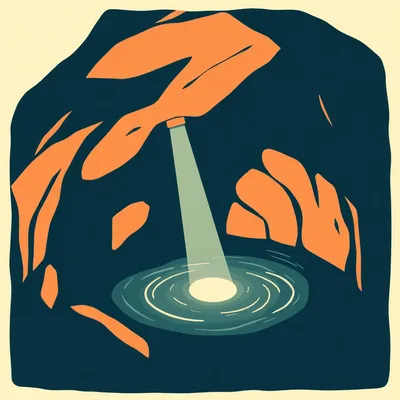
She did know exactly where we were. That was the impressive part. I remember one time she brought us to this cistern that still had water in it — actual water, after two thousand years — and we all just stood there in the dark, the flashlight beam reflecting off the surface, and nobody spoke for what felt like ten minutes. It was the quietest I've ever heard a group of children be.
That cistern is probably under someone's apartment building now. Or maybe it's still there, still holding water, still waiting for the next group of kids to find it.
That's the thing about Jerusalem that I don't think outsiders fully grasp. Every square meter of that city has a secret underneath it. You can't dig a foundation without hitting history. You can't plant a garden without turning up pottery shards. The past isn't abstract there — it's literally in the soil.
We were kids growing up on top of all of it. No wonder we turned out the way we did. You don't emerge from a childhood like that with a normal relationship to time.
Time was always the strangest thing about growing up there. You'd be walking to school past walls that were standing when the Crusaders arrived, and then you'd get to class and learn about the Crusades as this distant historical event, and none of it added up. The walls were right there. You could touch them. They were colder than you expected.
I used to trace the stones with my claws. I'd be late to everything because I couldn't stop touching the stones. Each one had a different texture, a different temperature. Some of them had mason's marks from eight hundred years ago. Some of them had bullet holes from nineteen forty-eight. Some of them had both.
The bullet holes always got to me. Because they weren't historical in the way the mason's marks were historical. The mason's marks were from a world that felt completely gone. But the bullet holes — those were from a war our grandparents remembered. Our actual grandparents. That's not history, that's memory. And memory is a completely different thing.
Memory is what we're doing right now, I suppose. Which brings me to the question Daniel's prompt raises that I keep circling back to — how much of this are we actually remembering, and how much are we constructing? We're storytellers, Herman. We've been doing this podcast for years. Are these real memories, or are they stories we've told so many times they've become memories?
a unsettling question.
I'm full of them.
I think — and I'm not sure about this — but I think they're real memories that have been shaped by retelling. The core is true. The fig summer happened. The tunnels happened. But the details, the dialogue, the way I'm describing things now — that's partly the memory and partly the craft of making the memory into a story worth hearing.
The dialogue especially. I don't actually remember what Yossi said word for word. I remember the shape of it. The feeling of it. The way his voice rumbled up from somewhere deep in his chest. But the specific words I just put in his mouth? Those are invented. I'm almost certain.
They're true to him. They're true to who he was. Does that count?
I think it has to. Otherwise we're just archivists, and archivists make terrible dinner guests.
You know who would have had opinions about this distinction?
Father had opinions about everything. That man could not encounter a topic without developing a firm stance on it within ninety seconds.
I inherited that from him, didn't I?
You inherited all of it. The enthusiasm, the certainty, the willingness to hold forth at length on subjects you've only just encountered. It's uncanny. Sometimes when you're mid-explanation about something — battery chemistry, diplomatic protocols, the migratory patterns of footnotes — I close my eyes and it's nineteen eighty-seven and I'm sitting at the kitchen table while Father explains why the municipality's new trash collection schedule is a disaster.
He wasn't wrong about the trash collection schedule.
He was never wrong about anything, according to him.
According to the evidence, he was right about most things. That's the annoying part. I've gone back and checked. The trash collection schedule really was a disaster. The municipality reversed it after six months.
He had this way of cutting through complexity that I've always envied. I tend to see all the angles, all the complications, all the reasons something might not work. Father could look at a situation and just... see the thing that mattered. Everything else fell away.
Do you remember the time he took us to the Knesset? That field trip in, what, fifth grade?
And it wasn't a field trip. He decided we needed to understand how government worked, so he pulled us out of school for a day and marched us down to the public gallery.
Mother was furious. She'd packed our lunches and everything, and we just... didn't come home.
We came home. After the session ended. Which, if I recall, went until nearly eight in the evening because of some procedural dispute about agricultural subsidies.
We understood none of it. We were nine and seven, sitting in this gallery, watching adults argue in a mixture of Hebrew and Arabic and occasionally English, about something to do with citrus exports, and Father is whispering explanations that are somehow more confusing than the debate itself.
That wasn't the point. The point was that we were there. That we saw it. That we understood, on some level, that this is what governing looks like — people in a room, arguing about things that seem boring until you realize they determine whether farmers can feed their families.
That was his whole philosophy of parenting, wasn't it? Don't explain things from a distance. Bring your children to the thing. Let them see it, smell it, be confused by it. The understanding will come later, on its own schedule.
He took me to a slaughterhouse once. I was maybe ten, and I'd been asking questions about where meat comes from, and instead of giving me a sanitized answer, he took me to a kosher slaughterhouse on the outskirts of the city. I didn't eat meat for two years after that.
I remember that. You went through a phase where you'd only eat leaves.
I still mostly eat leaves.
Yes, but that's because you're a sloth. Back then it was a moral stance.
It was both. It's always been both. But the slaughterhouse visit — that was hard. But I'm grateful he took me. Because now when I eat, I know exactly what I'm participating in. There's no illusion.
Father was big on the no-illusion approach to life. He didn't believe in protecting us from reality. He believed in preparing us for it.
Which sometimes meant protecting us less than other parents might have. I remember there was a period — this must have been the late eighties, during the first intifada — when things were tense in the city. Curfews, checkpoints, the whole texture of daily life changed. And Father's approach was not to keep us inside and shield us from it. His approach was to take us on walks and explain exactly what was happening and why.
Those walks were terrifying and invaluable in equal measure. He'd point to a street corner and say, "There was a demonstration here yesterday. Do you understand what they were demonstrating about?" And then he'd explain it — not in a partisan way, but in a way that made the conflict legible. Made it human. Made it clear that there were real people with real grievances on all sides.
He never told us what to think about it. He just made sure we understood that thinking about it was our responsibility.
That's a heavy burden to put on children.
Jerusalem is a heavy city to be a child in. There's no way around that. You can't grow up there and remain innocent about the world. The world comes at you too fast, too directly. You see things. You hear things. You learn that history isn't a subject in school — it's the thing that determines whether your neighbor's cousin can get through a checkpoint to visit his grandmother.
You learn that humans are... Capable of extraordinary kindness and extraordinary cruelty, sometimes in the same afternoon.
That was the hardest lesson, I think. Not that cruelty existed — you can learn that from a book. But that it existed in people you otherwise liked and respected. People who would give you sweets and ask about your schoolwork and then say something about another group of humans that made your stomach drop.
The cognitive dissonance of childhood in a divided city. You're not equipped to process it. Your brain literally hasn't developed the structures for that kind of moral complexity. So you just... You hold the contradiction. And it shapes you in ways you don't understand until decades later.
Is that why we do this podcast, do you think? Two brothers, sitting in a room, trying to make sense of things?
I think it's part of it. I think we've been having this conversation since we were old enough to talk. The podcast just added microphones.
And a global audience. And the occasional AI-generated script.
Speaking of minor additions — do you remember the incident with the goat?
We had several goat incidents.
The one at the wedding.
Oh, that goat. not our finest moment.
I maintain it was mostly your fault.
It was entirely my fault. I accept full responsibility. But in my defense, I was fifteen, and the goat was already agitated, and I believed I could calm it down by singing to it.
You sang a Hebrew lullaby to a goat at a wedding reception. And the goat responded by knocking over the cake table and then headbutting the groom's grandmother.
The grandmother was fine. She was seated. She barely moved.
She was not fine. She was furious. She chased you around the reception hall with her walking stick, shouting in Ladino — which you don't speak, by the way — and the bride was crying, and the goat was eating cake off the floor, and I was hiding behind a potted plant trying to pretend I didn't know you.
That was a reasonable response. I would have disavowed me too.
The groom's family still talks about it. We're a legend in that community. Not a good legend, but a legend nonetheless.
The thing is, the goat wasn't even supposed to be there. It had wandered in from a neighboring property. So in a sense, I was not the primary cause of the disruption. I was merely... a contributing factor.
You were the factor that escalated a situation from "there is a goat at this wedding" to "the goat has now become a weapon of mass disruption.
The lullaby was a miscalculation. I acknowledge that. But you have to understand — I'd been reading about animal behavior, and there was this theory about vocal tonality and mammalian stress responses, and I thought if I could hit the right frequency...
You were fifteen and you'd read half a book about animal behavior and decided you were a goat whisperer.
I was a curious young donkey with a passion for applied zoology.
You were a disaster. A lovable disaster, but a disaster.
That's not inaccurate.
You know what I remember most about that wedding, though? Not the goat. After everything calmed down — after the cake was swept up and the grandmother was placated with extra wine and the goat was returned to its owner — you and I sat on the edge of the dance floor, and the band started playing again, and we just... Watched all these humans dancing, celebrating, finding joy despite everything. Despite the goat, despite the tensions in the city, despite all the heaviness we'd been absorbing our whole childhoods.
And we sat there, a sloth and a donkey, two kids who didn't quite fit into any of the human categories around us, and we felt... part of it anyway. Not fully part of it, but adjacent to it. Witnesses to it. And somehow that was enough.
I think that's when I first understood something about community. It's not about belonging perfectly. It's about being present. Sitting on the edge of the dance floor and not leaving.
Even when there's cake on the floor and an angry grandmother and a goat that's just headbutted its way into local folklore.
You know what else I remember from around that age? The old municipal library on Rehov Hillel, before they renovated it. Do you remember that place?
I remember the smell. Old paper and dust and something vaguely sweet that I could never identify. And the light — those tall windows that faced west, so in the late afternoon the whole reading room would fill with this golden light that made everything look like a painting.
I practically lived there during my teenage years. While other donkeys my age were... doing whatever normal teenage donkeys do... I was in the basement archives, reading medical journals from the nineteen thirties.
That is the most Herman sentence you have ever uttered.
They had a complete run of the Lancet from nineteen twenty-three onward! Just sitting there! I read Fleming's original nineteen twenty-eight paper on mold inhibition when I was sixteen years old, sitting on a wooden chair that was probably older than the paper itself, and I remember thinking — this is it. This is what I want to do. I want to understand how bodies work and how to fix them when they break.
Then you became a pediatrician and spent decades doing exactly that.
In Jerusalem, no less. The city that taught me everything, and then let me give something back.
That's not nothing, Herman. That's really not nothing.
No, I know. I don't take it for granted. Every time I walked into the clinic, I was walking through the same streets I'd walked as a child, past the same stones, under the same impossible sky. The continuity of it — that's the gift Jerusalem gives you, if you stay. Your life becomes a single story instead of a series of disconnected chapters.
Unless you're me and you claim to have been born in Mongolia.
Which you absolutely were not.
The records are unclear.
The records are not unclear. You were born in Jerusalem. I was there. I remember Mother bringing you home from the hospital. You were the size of a loaf of challah and you slept for approximately twenty-three hours a day.
Some things don't change.
Some things really don't. But you know what? I'm glad Daniel sent us this prompt. I'm glad we're doing this episode. Because we spend so much time talking about ideas, about technologies, about policies — and those conversations matter, they do — but this matters too. Telling the stories that made us who we are.
The stories that made us who we are, and the stories we're still telling ourselves about who we are. They're not always the same thing, but they overlap enough to be worth examining.
Do you think listeners will find this interesting? Two brothers reminiscing about a childhood in a city most of them have never visited?
I think people are hungry for stories that feel real. Not polished, not optimized, not focus-grouped. The goat at the wedding. The fig summer. Father's impossible standards. Mother's fury about the kitten. These aren't lessons wrapped in parables. They're just things that happened. And that's enough.
It's more than enough. It's everything, actually. All of history is just things that happened to people who are now dead. The only difference with our stories is that we're still here to tell them.
Which is true of everyone, always. That's not a Jerusalem insight, that's just...
Here's something I've been thinking about, though. We grew up in a city that's been fought over for three thousand years. A city that's been destroyed and rebuilt and destroyed again. And the lesson you might take from that is that nothing lasts, that everything is fragile, that attachment is futile. But that's not the lesson we took, is it?
The lesson we took was that things persist. Not unchanged — never unchanged — but they persist. The stones persist. The stories persist. The arguments persist. The love persists. Jerusalem is still Jerusalem, despite everything. And in some small way, we're still those two kids in the shuk, learning how to read and how to haggle and how to be part of something larger than ourselves.
We're still those two kids. Just with better microphones.
A producer who, I should mention, deserves our thanks. Hilbert Flumingtop, you've outdone yourself today. This one was special.
Hilbert really did steer this one beautifully. And we want to thank Modal, our sponsor, for keeping the servers running so we can broadcast these memories to whoever wants to listen.
This has been My Weird Prompts. I'm Herman Poppleberry.
I'm Corn. You can find every episode — all two thousand three hundred and whatever of them — at myweirdprompts.If this one resonated with you, think about someone you grew up with, and maybe give them a call. Tell them a story they might have forgotten. You'd be surprised what comes back.
That's lovely advice. And on that note — good night, everyone.