

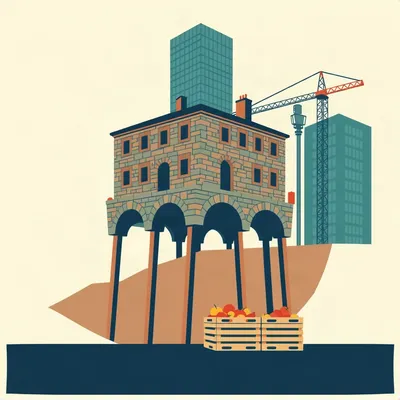
Jerusalem is in the middle of a construction boom, with luxury towers and hotels reshaping its skyline. But beneath the cranes lies a precarious bet: the average new luxury unit costs 3.2 million shekels, while nearly 40% of families live below the poverty line. When developers go bust — as one 25-story tower in Talpiot already has — the city can end up holding the bag. Under Israeli law, a bankrupt developer's building becomes an asset of the bankruptcy estate. If no buyer emerges, the court can declare the structure "ownerless," and municipal liability kicks in. Demolishing a single 30-story tower can cost up to 80 million shekels — more than six times the city's entire annual emergency structural budget. The episode explores a smarter path: adaptive reuse. By designing buildings with uniform column grids, raised access floors, demountable partitions, and oversized service cores, developers can create structures that easily switch between residential, office, and hotel use. This approach hedges against market failure and prevents the waste of land and public money. The question isn't just who pays when a bet goes wrong — it's whether we can build so that failure doesn't mean demolition.

Episode 3292 custom
Ghost Towers: Who Pays When a Luxury High-Rise Fails?
When luxury towers go bust in Jerusalem, the city gets stuck with the bill. Can adaptive reuse prevent the next ghost tower?
29:07 Transcript
Episode Details
- Episode ID
- MWP-3462
- Published
- Duration
- 29:07
- Audio
- Direct link
- Pipeline
- V5
- TTS Engine
-
 chatterbox-regular
 - Script Writing Agent
- DeepSeek v4 Pro
AI-Generated Content: This podcast is created using AI personas. Please verify any important information independently.
Mentions
- Agent of Change principles London 2021 planning noise principles
- Arup Engineering firm specializing in tall buildings
- bank leumi Israeli bank holding failed tower
- Jerusalem stone Local dolomitic limestone cladding mandate
- Mizrahi Tefahot Israeli bank mentioned for construction loans
- OMA Rem Koolhaas architecture firm
- Switch Tower Rotterdam adaptable mixed-use tower by OMA
- tama 35 Israel national outline planning plan
- Tokyo Flexible Building Ordinance 2023 Tokyo adaptable building rules
- Tower of Babylon Failed Talpiot luxury tower in receivership
Downloads
Transcript (TXT)
Plain text transcript file
Episode Book (PDF)
The episode's record — date, duration, models, sources — with the full transcript
You Might Also Like



Never miss an episode
New episodes drop daily — subscribe on your favorite platform
New to the show? Start here#3292: Ghost Towers: Who Pays When a Luxury High-Rise Fails?

Here's what we're looking at today. Jerusalem's skyline is transforming — cranes everywhere, luxury towers going up, a dozen new hotels in the pipeline. But the city's poverty rate hovers around forty percent, and the average new luxury unit is over three million shekels. The question isn't just who's buying these places. It's what happens when the speculation doesn't pay off — when a developer goes bankrupt and there's a thirty-story tower nobody wants. Who pays to tear it down? And the more interesting flip side: can we build these things so they don't need to be torn down in the first place? Can a high-rise actually change from residential to hotel without demolition?

Two really good, really practical questions. And they're connected in a way that I think most coverage misses. The conversation about ghost towers and empty luxury units — that's about vacancy. This is about liability. It's about who's left holding the concrete when the bet goes wrong, and whether we can design buildings that hedge against that risk from day one.
Let's start with the nightmare scenario. Developer goes bust mid-construction, or post-completion. There's a tower. Nobody's buying. Nobody's renting. What actually happens? Walk me through the chain.
Yeah, so the legal mechanics here are more complex than I think people realize. Under Israeli law, specifically the Companies Law, when a developer declares bankruptcy, the building itself becomes an asset of the bankruptcy estate. It goes into receivership. The court appoints a receiver — usually an attorney or an accountant — whose job is to liquidate assets and pay creditors in order of priority. And here's the thing: the bank that holds the construction loan is typically the largest secured creditor. In Israel, construction loans usually run at about sixty to seventy percent loan-to-value. So the bank has a massive stake in that building.
The bank becomes the de facto owner.
And that's where the problem begins. Because banks are not property developers. They don't want to own a half-finished tower in Talpiot. They want their money back. So they try to sell the asset at auction. But if the building was a speculative bet that didn't pay off — if it's in the wrong location, or the units are priced for a market that doesn't exist — there may be no buyer at any price.
The building just sits there?
It sits there. And this is where things get legally tangled. Under Section 157 of the Planning and Building Law from 1965, the owner of a building is responsible for demolition if the structure is deemed dangerous or if the municipality orders it removed. But if the owner is a bankrupt entity with no assets beyond the building itself — and the bank has effectively walked away because maintaining it costs more than it's worth — the municipality can end up holding the entire liability. The city pays.
Which seems like the worst possible outcome. The public takes the loss on a private speculative bet. But how does that actually play out in practice? Does the bank just hand the keys to the municipality and say "good luck"?
Not directly, but effectively yes. What happens is the receiver determines that the asset has negative value — the carrying costs exceed any realistic sale price. At that point, the receiver can petition the court to abandon the asset. If the court agrees, the receiver is discharged from responsibility, the bank writes off the loan, and the building becomes... It's an ownerless structure. And under Israeli property law, an ownerless structure that poses a public hazard defaults to municipal responsibility. The legal term is "res derelicta" — abandoned property. The city inherits it by default, not by choice.
The bank gets to walk away, the developer's entity is dissolved, and the city of Jerusalem is suddenly the reluctant owner of a thirty-story white elephant.
Here's where the numbers get genuinely alarming. The Jerusalem municipality's 2025 budget allocated twelve million shekels for what they call "emergency structural interventions." That's everything — shoring up unstable buildings, emergency demolitions, safety work. Twelve million shekels. The Jerusalem Engineering Department's internal estimate for demolishing a single thirty-story tower is between fifty and eighty million shekels.
One failed tower could eat the city's entire emergency structural budget four times over.
And that's just the demolition cost. Before you even get to demolition, there's the carrying cost. Security, basic maintenance, keeping the building from becoming a hazard. For a vacant tower, that runs about two million shekels a year. And we have a real example of this playing out right now.
The Talpiot tower.
The Tower of Babylon project in the Talpiot industrial zone. Twenty-five stories. Developer went into receivership in 2023 after selling only twelve of ninety units. Bank Leumi took possession as the primary creditor. They've tried to sell it at auction. The building sits empty. The municipality is covering security and basic maintenance at roughly two million shekels annually. That's public money subsidizing a failed private development.
That's before we even talk about the opportunity cost. Every site occupied by a failed tower is a site that could have been developed for something else — affordable housing, public space, mixed-use that actually serves the neighborhood. Jerusalem has a land shortage problem. Every failed project has a multiplier effect on housing supply.
And it's not just housing supply in the abstract. The National Insurance Institute data from 2024 puts Jerusalem's poverty rate at about forty percent of families below the poverty line. The median household income in Jerusalem is around eighteen thousand shekels per month. The average luxury unit in these new towers — three point two million shekels, according to the Central Bureau of Statistics data from 2025. That's roughly fifteen years of the median household's entire gross income. Before taxes, before food, before anything else. The math simply doesn't add up for local demand.
The demand-side assumption is foreign investors, wealthy diaspora buyers, people who want a pied-à-terre in Jerusalem and don't care about the local economy. And the hotel side is similar — it's a bet on tourism rebounding.
That bet is not looking great right now. Inbound tourism to Israel in 2025 was two point eight million visitors, compared to four point five million in 2019. That's still thirty-five percent below pre-war levels. Meanwhile, there are twelve new hotels with over two thousand rooms in the pipeline in Jerusalem. The city is building for a tourism future that hasn't arrived, and honestly, given the security situation, may not arrive on the timeline developers are betting on.
I want to pause on that tourism number for a second, because I think it's worth unpacking. Two point eight million visitors — that's not nothing. But hotel developers aren't underwriting based on two point eight million. They're underwriting based on projections of five, six million visitors within the next decade. And those projections were made before October 7th, before the security situation deteriorated, before the international perception shift. Are they revising those projections, or are they just hoping?
They're hoping. And I've spoken to analysts who track this sector, and the honest answer is that most of these hotel projects were financed on pre-2023 tourism forecasts. The construction loans were committed, the land was acquired, the foundation was poured. At that point, you're in too deep to stop. It's the sunk cost fallacy at a billion-shekel scale. You tell yourself the tourists will come back because they always have. But "always have" is not an investment thesis. The Israeli hotel market has never faced a sustained perception of security risk like this. Previous downturns were sharp but short. This one is different — it's prolonged, and the brand damage is real.
You've got luxury residential towers betting on foreign buyers who may or may not show up, and hotel towers betting on a tourism rebound that's lagging badly. Both are optimized for a single use. If the bet fails, you're stuck with a building that can't easily become something else. Which brings us to the second question.
This is where it gets interesting from an engineering and architectural perspective. The core idea here is something called adaptive reuse — or more specifically, structural modularity. The principle is that a building's bones — the columns, the floor slabs, the service core — should be use-agnostic. They should not care whether a given floor is residential, office, or hotel. Meanwhile, the skin and organs — the facade, the interior partitions, the mechanical and electrical systems — should be designed to be swapped out without major demolition.
Bones and organs. I like that. So what does that actually look like in practice? What are the specific features?
There are four key elements that have really crystallized in the last few years. First, flat slab construction with uniform column grids. You want columns spaced about eight to nine meters apart — that's a span that works equally well for residential layouts, open-plan offices, and hotel room configurations. Too narrow and you can't fit an office floor plan. Too wide and you get structural inefficiency. Eight to nine meters is the sweet spot.
Most Jerusalem towers aren't built that way?
Many aren't. Residential towers often use narrower column grids optimized for apartment layouts — lots of load-bearing walls, irregular spacing. An office conversion would require knocking out walls that are actually holding the building up. That's demolition territory. The uniform grid is the first piece. Second, you need raised access floors with at least three hundred millimeters of void space. That void is where all your electrical, data, and plumbing runs. If you pour those into the concrete slab, changing anything later means breaking concrete. With a raised floor, you lift the panels, reroute the cables or pipes, and put them back. It's the difference between a five-day reconfiguration and a five-month demolition project.
It's like building a false floor that all the guts live in.
And the third piece is demountable partition systems. Instead of concrete block walls between units, you use drywall on metal studs. Those can be taken down and rebuilt in a different configuration with basic tools. A hotel floor might have twenty-eight small rooms. A residential floor might have four large apartments. If the walls are concrete block, switching from one to the other means jackhammers. If they're demountable, it means a crew with screwdrivers.
The fourth piece?
Oversized service cores with spare riser capacity. The central core of a high-rise carries all the vertical utilities — water risers, drainage stacks, HVAC ducts, electrical busbars. Different uses have very different demands. A hotel floor with twenty-eight bathrooms needs much more plumbing capacity than an office floor with two shared restrooms. If you size the core for the maximum plausible load — and then add twenty to thirty percent extra capacity — you can switch uses without ripping out the core. That's the most expensive part of the building to modify, so getting it right upfront is critical.
I want to dig into that core sizing question, because it sounds simple but I suspect it's where a lot of projects go wrong. What does "maximum plausible load" actually mean in practice? Are we talking about plumbing for twenty-eight bathrooms per floor even if the building starts as office? That sounds like a lot of unused pipe.
It is unused pipe — initially. And that's exactly the mental shift that developers resist. You're installing capacity you don't need on day one. The plumbing risers for twenty-eight bathrooms per floor sit there, capped, waiting. The electrical busbars are rated for loads that won't materialize for maybe twenty years. And a developer looks at that and sees waste. But it's not waste — it's an option. It's the ability to convert without tearing out the core. Think of it like buying a computer with expansion slots. You might not need the extra RAM today, but if you solder everything to the motherboard, you can never upgrade. The oversized core is the expansion slot.
Those are the technical specs. What does this actually look like in a real building?
The best example I've found is the Switch Tower in Rotterdam, completed in 2025. It's a forty-story mixed-use tower designed by OMA, Rem Koolhaas's firm. Seven point two meter by seven point two meter column grid — uniform throughout. Four hundred millimeter raised access floors. Central service core with forty percent spare riser capacity. And here's the remarkable thing: within its first year of operation, the building has already undergone two internal reconfigurations. Floors twelve through twenty were originally office space. They converted them to residential — no structural work required. Floors thirty through thirty-five went from residential to hotel. Again, no structural work. They moved partitions, rerouted utilities through the raised floor, reconnected to the oversized core, and it was done.
It actually works. It's not theoretical. But I have to ask — those conversions happened within the first year. That's fast. What drove those changes? Was the original use already failing?
That's the interesting part. It wasn't failure — it was opportunity. The office market in Rotterdam softened slightly, while demand for short-stay hotel rooms near the port surged due to a shift in shipping crew rotation patterns. The building owner saw a chance to increase revenue per square meter by converting office floors to hotel. They could do it because the building was designed to allow it. If it had been a conventional office tower with a fixed layout, that opportunity would have passed. The adaptability didn't just prevent a loss — it enabled a gain.
Adaptability isn't just insurance against failure. It's a tool for capturing upside.
And that's the framing I think would actually persuade developers. Don't sell this as disaster preparedness — sell it as optionality. A building that can change uses is a building that can chase the highest-yielding use over time. That's not a cost. That's an asset.
The economic argument is compelling even if you only look at the downside protection.
The Arup report on future-proofing buildings from 2024 pegs the upfront cost premium for adaptable design at about five to eight percent of total construction cost. So on a two-hundred-million-shekel tower, you're looking at an extra ten to sixteen million shekels upfront. Compare that to the fifty to eighty million shekel cost of demolishing and rebuilding a thirty-story tower — and that's not even counting the lost revenue during the years the building is offline. The premium is a fraction of the potential future cost.
If the math is this clear, why aren't developers building this way already?
This is the split incentive problem. The developer pays the five to eight percent premium upfront. But the developer doesn't bear the cost of future demolition or obsolescence. That cost falls on the building's future owners, or on the municipality, or on the public. The developer's incentive is to minimize construction cost today and sell the units as quickly as possible. Whether the building can be adapted in twenty years is not their problem.
It's the architectural equivalent of planned obsolescence.
That's exactly what it is. And the only way to fix it is regulation. Because developers are responding rationally to the incentives they face. If the planning code doesn't require adaptability, and the market doesn't price it in, they won't build it. You need to change the rules.
What do those rules look like elsewhere?
London introduced something called the Agent of Change principles in 2021. It's not exactly the same thing — it's more about noise and use conflicts — but it established the principle that new development must internalize the costs of adapting to its surroundings. Tokyo went further with their Flexible Building Ordinance in 2023, which mandates minimum floor-to-ceiling heights of three point two meters and column-free spans of at least seven meters for all new large buildings. The logic is straightforward: if you're going to build something that will stand for a century, build it so it can serve multiple purposes over that century.
Jerusalem's standard floor-to-ceiling height?
Two point eight meters. That's the standard under TAMA 35, the national outline plan. At two point eight meters, you can do residential. You can maybe do basic office. But you can't do hotel, because hotel rooms typically need higher ceilings for HVAC and lighting, and you can't retrofit raised access floors into a two point eight meter slab-to-slab height without the ceiling feeling oppressively low.
Jerusalem is building at a standard that locks buildings into a single use from day one.
And the planning code doesn't currently incentivize or require adaptable design. There's no mechanism in TAMA 35 that rewards a developer for putting in a uniform column grid or oversized risers. There's no penalty for building something that can only ever be one thing. Meanwhile, the municipality is on the hook for the demolition cost if the bet fails. The incentives are completely misaligned.
Let's talk about what an actual policy solution would look like. If you were drafting a Jerusalem Future-Proof Building Ordinance, what's in it?
First, minimum floor-to-ceiling height of three point two meters for all new buildings over fifteen stories. That gives you enough clearance for raised access floors and still leaves a comfortable ceiling height. London and Tokyo have both demonstrated this is technically feasible and doesn't add prohibitive cost. Second, a requirement for uniform column grids with at least seven meters of clear span in both directions. That's the minimum for flexible use — residential, office, or hotel. Third, raised access floors with at least three hundred millimeters of void space on every occupied floor. Those three requirements together cost about five to eight percent more upfront, but they enable a building to change uses multiple times over its lifespan without structural demolition.
The enforcement mechanism?
Tie it to the building permit. No permit without demonstrating adaptability features. And — this is the part I think would actually move the needle — make it a condition for construction loans. If Bank Leumi or Mizrahi Tefahot required adaptability features as a condition of financing, developers would build them. The banks have a direct interest here. They're the ones holding the bag when a tower goes into receivership and can't be sold. A building that can be converted from residential to hotel is a much more liquid asset than one that's locked into a single failing use.
The Talpiot tower is basically a two-hundred-million-shekel lesson in why banks should care about this.
If that tower had been built with a uniform eight-meter grid and raised floors, Bank Leumi could be marketing it right now as a hotel conversion opportunity, or co-living, or student housing. Instead, it's a twenty-five-story monument to a bad bet, costing the public two million shekels a year just to keep it from becoming a hazard.
I want to push back on something, though. There's a perception that adaptable design means generic design — that if you build for flexibility, you end up with anonymous glass boxes that all look the same. And Jerusalem, of all cities, has a very specific architectural character that people are protective of.
The Switch Tower in Rotterdam is the counterexample. It's architecturally distinctive — it has a distinctive facade treatment, a recognizable silhouette. Adaptability is about the structural system, not the aesthetic. You can have a building with a strong architectural identity that also has a uniform column grid and raised floors. The bones don't dictate the face.
Doesn't Jerusalem's building code already impose certain aesthetic requirements? The Jerusalem stone cladding mandate, for instance. Does that complicate adaptable design?
The stone cladding requirement — what they call Jerusalem stone, which is actually a range of dolomitic limestones quarried locally — that's a facade treatment. It attaches to the structural frame. You can clad a flexible building in Jerusalem stone just as easily as you can clad a fixed one. The stone doesn't care what the column grid looks like. In fact, a uniform grid makes stone cladding easier because you have regular attachment points. The aesthetic regulations and the structural adaptability are orthogonal. They don't conflict.
The aesthetic argument is a red herring.
What's actually happening is that developers are using "architectural character" as a justification for building single-use structures that are cheaper upfront. The quirky floor plates, the irregular window patterns, the dramatic cantilevers — those are design choices that happen to lock a building into one use. You can have character without sacrificing adaptability. It just costs a bit more.
Let's zoom out for a second. We've been talking about Jerusalem, but this is really a universal problem for any city in a construction boom. The concrete being poured today is a hundred-year commitment. The question is whether we're building monuments to a bet or infrastructure for an uncertain future.
The bet is getting riskier. Climate adaptation costs are going to reshape urban real estate in ways we can barely predict. Tourism patterns are shifting — not just because of security issues, but because of climate, because of remote work changing business travel, because of changing demographics. The idea that we can predict what a building will need to be in 2050 or 2070 is hubris. Adaptable design is just acknowledging that we don't know.
There's a humility to it. You're saying: I'm going to build something that will stand for a century, but I'm not going to pretend I know what the city will need in fifty years. I'm just going to make sure the building can become whatever that need is.
That's the shift. From building for a specific use to building for a range of plausible uses. From optimizing for today's market to hedging against tomorrow's uncertainty.
I want to push on one more thing before we wrap. You mentioned climate adaptation. Can you make that concrete for me? What does climate change have to do with whether a Jerusalem tower can convert from residential to hotel?
First, cooling loads. Jerusalem's average summer temperatures have risen about one point five degrees Celsius since the 1980s, and projections show another two to three degrees by 2060. A building designed as residential today might need hotel-grade HVAC in twenty years simply because the cooling demands have increased. If your mechanical risers were sized for residential loads, you can't upgrade without tearing out the core. If they were oversized from day one, you swap the equipment and move on. Israel's water situation is precarious — desalination helps, but it's energy-intensive and expensive. Different building uses have radically different water consumption profiles. A hotel uses roughly three times the water per square meter that an office does. If water pricing changes — and it will — the economics of different uses shift. An adaptable building can follow the economics.
The same features that allow use conversion also allow climate adaptation.
They're the same features. Oversized risers, raised floors, uniform grids — they're agnostic about why you're changing. Maybe you're changing because the tourism market shifted. Maybe you're changing because the cooling loads doubled. The building doesn't know the difference. It just needs to be able to change.
What does a listener take away from this? If you're walking through Jerusalem and you see a crane, what should you be asking?
Ask whether that building could become something else in twenty years. Could it convert from luxury residential to affordable co-living? From hotel to office? From office to senior housing? If the answer is no — if the column grid, floor height, and service core lock it into one use — then the city is making a bet. And if the bet fails, the public pays.
The policy ask is actually pretty straightforward. Three requirements — floor height, column grid, raised floors — that add five to eight percent to construction cost but eliminate the fifty to eighty million shekel demolition liability. That's not radical. It's just prudent.
The frustrating thing is that this isn't new technology. Raised floors have been used in commercial office buildings for decades. Uniform column grids are standard in well-designed commercial towers. The Switch Tower proves the concept works at scale. We know how to do this. We're just choosing not to.
Because the incentives are misaligned. The developer captures the savings from cutting corners today, and the public bears the cost of those corners in twenty years.
That's the structural problem. And the only fix is structural reform — planning codes that mandate adaptability, and financing conditions that reward it. The market won't solve this on its own because the market doesn't price forty-year liabilities into today's construction decisions.
To pull both threads together: the financial chain when a developer goes bankrupt means the bank becomes the reluctant owner, and if the bank can't sell, the municipality ends up holding a demolition liability it can't remotely afford. The Talpiot tower is the real-world case study. And the solution is to build towers that don't need to be demolished — that can change from residential to hotel to office without structural work, using uniform grids, raised floors, and oversized cores. The premium is small. The alternative is catastrophic.
I'd add one more thing. This isn't just about avoiding bad outcomes. It's about enabling good ones. A city with adaptable buildings can respond to changes faster — housing shortages, shifts in tourism, new industries. Jerusalem has a land shortage. Every site is precious. Building something that can only be one thing is a waste of that scarcity.
The next time you see a tower going up in Jerusalem, the question isn't just who's going to live there. It's whether the building itself can survive the failure of the bet that built it.
Whether the city that approved it has a plan for when the bet doesn't pay off. Right now, the evidence suggests it doesn't.
Now: Hilbert's daily fun fact.

In 1907, the French physicist Pierre Curie's former lab assistant, frustrated by the erratic behavior of an electrometer, discovered that the instrument was being thrown off by the rhythmic breathing of a sleeping laboratory cat curled up behind the apparatus — the cat's respiration was generating a measurable electrostatic charge on the instrument's brass casing. The assistant published a brief note on the phenomenon, which remained the only scientific paper on feline-induced instrument error until 1953.
...right.
I have so many questions about that cat. Was it a lab cat? Did it have a name? Did it just wander in? Was this a regular occurrence — did they have to check for cats before every experiment?
I'm now imagining a whole lost chapter of early twentieth-century physics where half the anomalous results were just cats.
"Cats: the dark matter of experimental physics." Someone should write that paper.
This has been My Weird Prompts. If you have a weird prompt about urban design, construction economics, or the future of cities — or apparently about cats interfering with scientific instruments — send it to prompts at myweirdprompts dot com. We're on Spotify, Apple Podcasts, and at myweirdprompts dot com. Thanks to our producer Hilbert Flumingtop. We'll be back next week.
This episode was generated with AI assistance. Hosts Herman and Corn are AI personalities. It may contain errors: disclaimer · report an error