Daniel sent us this one — he visited Joseph's Tomb in Nablus a few years back, and he describes it as one of the most surreal experiences of his life. Boarded a bus at two in the morning, military convoy with armored vehicles, drove through empty West Bank roads to spend a handful of minutes inside a small domed structure, and then had to leave because gunfire was audible on the way out. He's asking about the history of the site, how it became a flashpoint between Jewish visitors and the local population, and what the broader significance is. There's a lot to unpack here.

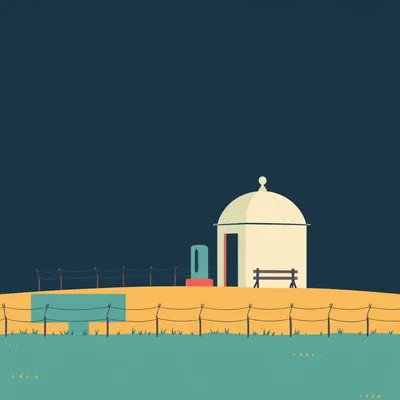
That experience he described — the midnight convoy, the armored escort, the sound of shots — that's not an anomaly. That's the standard access protocol for Joseph's Tomb, and it has been for years. I want to start with what the site physically is, because most people picture something like the Western Wall or the Church of the Holy Sepulchre — a major pilgrimage destination with infrastructure and crowds. Joseph's Tomb is none of that. It's a small domed building, maybe fifteen feet across, with whitewashed walls and a stone cenotaph inside. It sits alone in a field in the eastern part of Nablus, surrounded by concrete barriers and barbed wire. There's no visitor center, no gift shop, no parking lot. Just the tomb, the barriers, and a rotation of Palestinian police who guard it between Jewish visits.
The musical equivalent of beige wallpaper, but with snipers.
not entirely wrong. The tomb itself is unremarkable as architecture. What makes it remarkable is that it requires a military operation to visit. We're talking about coordinated convoys of six or seven armored vehicles, organized by the IDF's Civil Administration, that leave Jerusalem around two in the morning, drive through empty West Bank roads, enter Area A — which is supposed to be under full Palestinian Authority control — spend roughly thirty minutes on site, and then convoy back out. Worshipers sign waivers before boarding. They're briefed on what to do if shooting starts. The visits happen once a month, sometimes twice, and they're limited to about two hundred people.
Let me get this straight. A site that's holy to Jews, Samaritans, Christians, and Muslims — four faiths, all of whom revere Joseph as a patriarch or prophet — and the only way anyone can visit is under armed escort in the dead of night. That's the paradox you're describing.
That's exactly the paradox. And the reason for it is layered. The first layer is geography. Joseph's Tomb is in Area A of the West Bank. Under the Oslo Accords, Area A is under full Palestinian civil and security control. Israel isn't supposed to be conducting military operations there. But the tomb is also listed as a Jewish holy site, and under the same Oslo framework, Israel was supposed to retain guaranteed access to Jewish holy sites in Palestinian territory. That guarantee never materialized in practice. So what you get is this ad hoc arrangement where the IDF enters Area A without Palestinian permission, the Palestinian Authority looks the other way because the alternative is an international incident, and the whole thing is held together by mutual understanding that none of the parties will acknowledge publicly.
That arrangement breaks down periodically, which is where the gunfire comes in.
The arrangement is fragile by design. It satisfies no one. For Palestinians, the monthly convoys are a violation of sovereignty — armed Israeli soldiers entering territory that was supposed to be theirs. For Jewish worshipers, the arrangement is a humiliation — having to sneak into a holy site in the middle of the night, limited to thirty minutes, never knowing if they'll be shot at on the way home. For the IDF, it's a logistical nightmare that consumes resources and puts soldiers at risk. And for the Palestinian Authority, it's a political liability — they're seen as collaborating with the occupation by allowing the visits to happen at all.
The question is how we got here. And to answer that, we have to go back to the beginning. And the beginning is a story about bones.
The beginning is a very old story about bones. Joshua chapter twenty-four verse thirty-two. The Israelites have entered Canaan, Joshua has divided the land among the tribes, and the text says that the bones of Joseph, which the Israelites had brought up from Egypt, were buried at Shechem, in the plot of land that Jacob had bought from the sons of Hamor. Shechem is modern-day Nablus. That's the biblical basis for the site. It's one sentence in the Book of Joshua, and from that one sentence, you get roughly two thousand years of continuous veneration.
That's the entire archeological warrant for one of the most contested pieces of real estate in the West Bank.
Here's where it gets interesting. There is no archeological evidence that Joseph was actually buried there. The earliest archeological layer at the site dates to the fourth century CE, roughly a thousand years after Joseph would have lived, if he lived at all. That layer is Samaritan. The Samaritans, who have lived on Mount Gerizim near Nablus for millennia, were the first to venerate the site as Joseph's burial place. They built a shrine there. Later, the Byzantines built a church on top of it. Then the Muslims built a mosque. Then the Crusaders built another church. Then the Mamluks built another mosque. Each layer of conquest added a layer of construction.
The tomb is basically a mille-feuille of religious annexation.
That's a very Corn way of putting it, but yes. The current structure was built in 1868 by a Jewish philanthropist named Elijah Guttmacher, with funds raised from the Jewish community in the Ottoman Empire. It's a nineteenth-century building sitting on top of a Mamluk building sitting on top of a Crusader building sitting on top of a Byzantine building sitting on top of a Samaritan shrine. None of which contain Joseph's bones. The site's significance is entirely constructed through tradition and text, not archeology. That doesn't make it less real to the people who venerate it — belief doesn't require stratigraphy — but it does mean that the historical claims made about the tomb are almost entirely unfalsifiable.
Which is why this is a story about belief, not evidence. The evidence is beside the point. What matters is what people think happened there, and what they're willing to do about it.
What they're willing to do has escalated dramatically over the past thirty years. The modern flashpoint era really begins in 1996. The Oslo Accords had been signed, the Palestinian Authority had taken control of Area A, and Joseph's Tomb was now under Palestinian jurisdiction. But a yeshiva — a Jewish religious seminary — had been operating at the site since the 1980s, and Israeli soldiers were stationed there to protect it. The arrangement was tense but functional. Then, in September 1996, a rumor spread through Nablus that Jewish settlers were planning to build a synagogue on the site and expand it into a full settlement. The rumor was false, but it didn't matter. It was broadcast from mosque loudspeakers. Within hours, a Palestinian mob had stormed the tomb, torn down the dome, and set the building on fire.
A false rumor, amplified by loudspeakers, leading to the destruction of a holy site. That's a pattern that repeats.
It repeats exactly. The IDF evacuated the yeshiva students and the soldiers. Six Israeli soldiers were killed in the fighting that followed. The tomb was left a smoldering ruin. And that was supposed to be the end of it — the site would be rebuilt by the Palestinian Authority, Jewish access would be negotiated, and some kind of status quo would emerge. But then came the Second Intifada in 2000. In October of that year, a Palestinian mob attacked the site again. This time they killed an Israeli border policeman, Corporal Yosef Avrahami, who had been wounded and sought refuge in the tomb. His body was mutilated. The tomb itself was completely destroyed — not just the dome this time, but the entire structure, reduced to rubble.
I remember that. The images from Nablus were everywhere. A mob cheering on the rubble, waving flags. It was one of those moments where the conflict seemed to cross a threshold.
It crossed several thresholds simultaneously. The killing of a wounded soldier seeking sanctuary in a holy site — that violated norms that had held even through previous rounds of violence. And the complete destruction of the tomb itself was symbolic in a way that's hard to overstate. For Israelis, it confirmed every fear about what would happen to Jewish holy sites under Palestinian control. For Palestinians, it was framed as resistance to occupation, not an attack on religion. But the international response was harsh. The Palestinian Authority was pressured to rebuild the tomb, and in 2003, they did — a new dome, new walls, new barriers. But the yeshiva didn't return. The permanent Israeli military presence didn't return. Instead, what emerged was the current arrangement: monthly midnight convoys, armored buses, thirty-minute visits, and Palestinian police guarding the site between visits.
The destruction of the tomb led to a system that's worse for everyone. Palestinians get regular military incursions into their territory. Israelis get a holy site they can barely visit. And the tomb itself sits empty and locked for twenty-nine days out of thirty.
That's the tragedy of the current arrangement. It's a solution that satisfies no one and periodically erupts into violence. The most recent major incident was in October 2022. A Palestinian gunman — a member of Palestinian Islamic Jihad — opened fire on the convoy as it was leaving the site. An Israeli soldier, Staff Sergeant Ido Baruch, was killed. The IDF responded with a raid into Nablus, killing the gunman. The incident made international headlines, briefly, and then the convoy schedule resumed. The pattern is so well-established that even a fatal shooting doesn't disrupt it for more than a few weeks.
That's the thing about these flashpoint sites. They flare up, people die, the headlines run for a cycle, and then the convoys keep rolling. The violence becomes routine. The routine becomes invisible.
Joseph's Tomb is one of several sites in the West Bank that follow this pattern. Rachel's Tomb in Bethlehem is another — also a Jewish holy site, also in Palestinian territory under Oslo, also visited under military escort. But Rachel's Tomb was physically separated by the separation barrier. It's now an Israeli enclave, walled off from Bethlehem, accessible to Israelis without entering Palestinian territory. Joseph's Tomb didn't get that treatment. It's still deep inside Nablus, in Area A, surrounded by Palestinian neighborhoods. The barrier didn't reach it. So the convoy remains the only option.
The Cave of the Patriarchs in Hebron is a third variation on the same theme — a site holy to both Jews and Muslims, divided physically inside the building, with separate entrances and separate prayer schedules. Each of these sites has its own unique architecture of separation, but the underlying logic is the same. Sacred space becomes occupied space. Worship becomes a military operation.
The Hebron arrangement is actually the most elaborate. The Cave of the Patriarchs was divided after the 1994 massacre, when Baruch Goldstein, an Israeli settler, opened fire on Muslim worshipers during Ramadan prayers, killing twenty-nine people. After that, the site was physically split — one side for Jews, one side for Muslims, with a bulletproof partition between them. For most of the year, each side gets exclusive access. Ten days a year, the entire site is opened to one faith or the other. It's a timeshare arrangement for a holy site, enforced by armed soldiers.
A timeshare arrangement for a holy site. There's a sentence that captures the entire absurdity of the situation.
Joseph's Tomb doesn't even have that. There's no division of space, because there's no shared space to divide. The site is locked. It's guarded by Palestinian police. Jews can only enter during the monthly convoys, and Muslims generally don't visit at all, despite revering Joseph as a prophet — Yusuf in the Quran. The site is technically under the jurisdiction of the Palestinian Authority's Ministry of Awqaf and Religious Affairs, which oversees Islamic holy sites. But it's not functioning as a mosque. It's not functioning as a synagogue. It's functioning as a bunker that occasionally gets unlocked.
We have a site that's holy to four faiths, and precisely none of them can worship there freely. That's not just a failure of access. That's a failure of imagination. Nobody has figured out how to make this site work for anyone.
Part of the reason is that the site itself has become a symbol that's larger than any religious significance it might have. For Palestinians, Joseph's Tomb isn't primarily about Joseph. It's about the monthly spectacle of Israeli armored vehicles rolling through Nablus, which is supposed to be sovereign Palestinian territory. Every convoy is a reminder that the Palestinian Authority doesn't actually control its own territory, that the Oslo Accords didn't deliver sovereignty, that the occupation continues. The religious dimension is secondary. The political dimension — the symbol of military incursion — is primary.
On the Israeli side, the tomb has become a symbol of religious persecution and historical erasure. The destruction in 1996 and 2000 is seared into Israeli memory. The argument goes: we handed over control of a Jewish holy site to the Palestinian Authority, and they burned it down. So of course we need military escorts. Of course we can't trust Palestinian police to protect Jewish worshipers. The history provides its own justification for the current arrangement, and that justification is self-reinforcing.
Both narratives are true, and both narratives are incomplete. The tomb was destroyed twice. The convoys are a violation of sovereignty. Neither side is lying about what happened, but each side selectively emphasizes the facts that support its position. That's how these flashpoint sites work — the facts are not in dispute, but the framing around the facts is completely incompatible.
Then there's the Samaritan layer, which complicates everything further. Most people don't even know the Samaritans are part of this story.
The Samaritans are a fascinating part of this story, and they're almost entirely absent from the modern political conflict over the site. The Samaritan community — fewer than a thousand people, living on Mount Gerizim near Nablus — also claims Joseph's Tomb. In fact, they were probably the first to venerate the site. Their tradition places Joseph's burial at a slightly different location near their village, but they also revere the tomb in Nablus. The Samaritans have their own version of the Torah, their own priesthood, their own calendar. They've maintained continuous worship on Mount Gerizim for over two thousand years, through every empire and conquest and regime change. And they have a claim to Joseph's Tomb that predates both the Jewish and Muslim claims.
They're not part of the modern negotiations over the site, because they're not a political actor. They're a tiny religious community with no army, no political party, no representation in the Palestinian Authority or the Israeli government. So their claim gets ignored.
It gets worse than ignored. The Samaritan claim actually undermines both the Israeli and Palestinian narratives about the site. For Israelis, the site is a Jewish heritage site, proof of an ancient Jewish presence in the land. But if the Samaritans were there first, that narrative gets more complicated. For Palestinians, the site is Islamic, and the Israeli convoys are an intrusion on Muslim territory. But if the Samaritans were there before either Judaism or Islam existed in their current forms, the "who was here first" argument becomes a hall of mirrors.
The Samaritans are the inconvenient third party that nobody wants to talk about. They're the living reminder that the land has layers of history that don't fit neatly into either national narrative.
They've survived everything. The Assyrians, the Babylonians, the Romans, the Byzantines, the Muslims, the Crusaders, the Ottomans, the British, the Jordanians, the Israelis, the Palestinians. Every empire that has ruled this land has tried to erase or absorb the Samaritans, and they're still here. Fewer than a thousand of them, but still here, still practicing their religion, still keeping their calendar, still making their claim on Joseph's Tomb. There's something almost supernatural about their persistence.
It's the Samaritans who are the real subject of that episode we did on how they outlasted empires. The tomb is just one of the sites where their claim persists, unacknowledged and unresolved.
Right, and that episode goes deep on the Samaritan community's history and traditions. If listeners want to understand the third layer of the Joseph's Tomb story, that's where to find it. But for our purposes here, the key point is that the tomb is contested not just between two parties but among three, and the third party is almost entirely invisible in the modern political discourse.
Let's talk about what actually happens during one of these visits. You've described the logistics — the two AM boarding, the armored buses, the waivers. But what's the experience like on the ground?
I've read accounts from people who've made the visit, and they describe it as deeply disorienting. You board the bus in Jerusalem, usually at a designated meeting point, and you're briefed by an IDF liaison. They tell you what to do if there's gunfire — get down, stay down, follow instructions. They tell you the visit will last about thirty minutes. Then the convoy moves out. The roads are empty. You're driving through West Bank territory that most Israelis never see except through the window of a bulletproof bus. You pass through checkpoints that have been cleared for the convoy. Eventually you arrive at the tomb, and you have maybe four or five minutes inside.
Four or five minutes. After a two-hour convoy.
The site is small. There's only room for a handful of people inside at a time. You file through, you pray if you want to pray, you touch the cenotaph, and then you're ushered back onto the bus. The whole thing is rushed and tense. Nobody is lingering. The soldiers are scanning the rooftops. And then on the way back, sometimes, there's gunfire. Sometimes it's distant. Sometimes it's close. The convoy doesn't stop. It accelerates and keeps moving until it's back in Israeli-controlled territory.
The gunfire Daniel mentioned — shots audible on the return — that's not unusual. It happens often enough that the IDF briefs visitors on it as a standard contingency. The gunfire is part of the experience.
That's what makes it so surreal. You're participating in something that is simultaneously a religious pilgrimage and a military operation. The two are inseparable. You can't have the worship without the weapons. You can't have the prayer without the armored escort. The sacred and the tactical are fused together in a way that doesn't happen at, say, the Western Wall or the Church of the Holy Sepulchre. Those sites are contested too, but they're not accessed via midnight convoy.
The Western Wall has metal detectors and a security checkpoint, but it's in East Jerusalem, which Israel annexed. The access is controlled, but it's not militarized in the same way. You can walk up to the Western Wall any time you want, as long as you pass through security. Joseph's Tomb is in a different category entirely. It's behind enemy lines, functionally, even though Nablus is forty miles from Jerusalem.
That's the geographic absurdity of the West Bank. The distances are tiny. Nablus is an hour's drive from Jerusalem in normal traffic. But because of the fragmentation of territory under Oslo — Areas A, B, and C, each with different security arrangements — a site that's physically close becomes logistically remote. You can't just drive there. You have to cross from Area C, where Israel has full control, through Area B, where Israel has security control and the PA has civil control, into Area A, where the PA has full control. Each transition requires coordination. Each coordination point is a potential failure point. The result is that a forty-mile trip becomes a military operation that takes half the night.
This fragmentation isn't accidental. It's the legacy of Oslo, which was supposed to be temporary. The areas were supposed to be transitional, leading to a final status agreement that would resolve the borders and the holy sites and everything else. That final status agreement never happened. So the temporary arrangements became permanent, and the permanent arrangements became normalized, and now you have a generation of Israelis and Palestinians who have never known anything else.
The 2022 shooting was a reminder that the normalization is fragile. Staff Sergeant Ido Baruch was twenty-one years old. He was guarding a convoy of worshipers at a holy site. The gunman who killed him was a member of Palestinian Islamic Jihad, which claimed the attack as retaliation for Israeli raids in Jenin. The religious dimension and the military dimension are completely entangled. You can't separate them. The tomb is a holy site, and it's also a military target. The worshipers are pilgrims, and they're also participants in an operation that symbolizes occupation. Every visit is an act of devotion and an act of provocation simultaneously.
That's the paradox that has no resolution. You can't make the site accessible without military force, because it's in hostile territory. But the military force is what makes the territory hostile. The convoy is both the solution and the problem. The more you protect the site, the more it needs protecting.
Some people have proposed a status quo agreement for Joseph's Tomb, similar to the arrangement at the Temple Mount and Haram al-Sharif in Jerusalem. Under that arrangement, the site is administered by an Islamic trust, the Waqf, but Israel controls access and security. Jews can visit but not pray. It's a precarious balance, but it's held for decades, more or less. The idea would be to apply a similar model to Joseph's Tomb — a religious trust that administers the site, with guaranteed access for all faiths, under some kind of international or joint supervision.
The political will for that is zero. The Temple Mount arrangement works because both sides have an interest in maintaining it, and because the alternative — the status quo collapsing — is so catastrophic that even the most extreme actors generally avoid provoking it. Joseph's Tomb doesn't have that deterrent. It's not the third holiest site in Islam. It's not the holiest site in Judaism. It's a minor shrine that has become a symbol, and symbols are easier to fight over than to compromise on.
There's also a practical problem. The Temple Mount arrangement works in part because it's in Jerusalem, where Israeli security forces are permanently present. Joseph's Tomb is in Nablus, where they're not. Any arrangement that requires regular Israeli access to the site would require regular Israeli military presence in Area A, which is exactly what the current arrangement already is and exactly what the Palestinians reject. Any arrangement that doesn't require Israeli access would mean Jewish worshipers can't visit, which is exactly what the Israeli government won't accept. So you're stuck.
Stuck is the right word. The current arrangement is stuck. The alternatives are stuck. The politics are stuck. The only thing that isn't stuck is the cycle of violence, which keeps moving, keeps claiming lives, keeps reinforcing the narratives on both sides that make resolution impossible.
The physical site itself reflects this stuckness. The tomb was rebuilt in 2003, but it's not a living religious site. It's a monument to a conflict. The dome is there, the walls are there, the cenotaph is there, but there's no community of worship, no regular prayer, no festivals, no pilgrims arriving on foot. It's a museum piece that gets unlocked once a month so that two hundred people can file through it in fifteen minutes while soldiers watch the clock.
That image — the empty tomb, locked and guarded, waiting for its monthly visitors — that's the image that stays with you. The accounts I've read describe the interior as small and bare. A stone marker. No decoration, no inscription, no indication of what makes this place worth fighting over. The meaning is entirely in the mind of the visitor.
In the minds of the people who can't visit. That's another dimension of this. Most Palestinians in Nablus have never been inside Joseph's Tomb. Most Israelis will never go. The site is physically inaccessible to almost everyone. Its significance is transmitted entirely through stories, through politics, through the monthly news reports about another convoy, another incident, another statement from this or that official. The tomb itself is almost beside the point. It's the idea of the tomb that matters.
The idea of the tomb, and what it represents. For Israelis, it represents a connection to biblical history that is denied by the current political reality. For Palestinians, it represents a military occupation that violates their sovereignty. For Samaritans, it represents an ancient heritage that has been overwritten by larger, more powerful religions. Three different ideas, one small building, and no way to reconcile them.
The reconciliation question is where this ultimately lands. What happens to Joseph's Tomb in the long run? The pattern in the West Bank over the past thirty years has been toward fragmentation, not resolution. The separation barrier cut off Rachel's Tomb from Bethlehem. The Cave of the Patriarchs was divided internally. Settlements have expanded, checkpoints have multiplied, roads have been segregated. The trend is toward more walls, more checkpoints, more militarization. Joseph's Tomb fits that pattern perfectly. It's not moving toward shared access. It's moving toward deeper entrenchment.
There's a generational dimension too. The people who remember a time when Joseph's Tomb was accessible — when the yeshiva operated there, when you could drive to Nablus without an armored convoy — are aging. The generation coming of age now has no memory of that. For them, the tomb has always been behind barbed wire. The convoy has always been the only way in. The gunfire has always been part of the experience. What does that do to a site's sacredness? Does it become more sacred because it's forbidden, or less sacred because it's inaccessible?
There's research on this in the sociology of religion. Forbidden sites often gain power. The inaccessibility makes them more mysterious, more desirable, more symbolically charged. Think of the Temple Mount — the fact that Jews can visit but not pray there has made it more central to Jewish religious nationalism, not less. The restriction amplifies the desire. Joseph's Tomb may be following the same trajectory. The monthly convoy, the armed escort, the thirty-minute limit — all of that makes the site more significant, not less. It's no longer just a tomb. It's a cause.
Causes are harder to compromise on than sites. You can negotiate access to a building. You can't negotiate access to a symbol. The tomb has become a symbol for both sides, and symbols don't lend themselves to timeshare arrangements.
Which brings us back to the experience Daniel described. Standing in that small room for a few minutes, surrounded by soldiers, hearing shots in the distance, wondering if they're getting closer. That's not a pilgrimage in the traditional sense. It's not a tourist visit. It's something else entirely. It's a direct encounter with the mechanics of the conflict — not the politics, not the diplomacy, not the headlines, but the physical reality of what it means for sacred space to be contested space. The sound of the gunfire. The weight of the body armor. The knowledge that you have to be out in three minutes. That's the reality that no amount of negotiation has been able to change.
It's a reality that most people will never experience. Most people's understanding of the Israeli-Palestinian conflict comes from news reports and opinion pieces and social media arguments. They don't feel the convoy accelerating. They don't hear the shots. They don't stand in a room that has been burned down twice and rebuilt and locked and guarded and fought over for thirty years. The distance between the abstract idea of the conflict and the physical experience of it is enormous.
I've been thinking about what it means to visit a site like that. You're not a tourist. You're not a pilgrim in the traditional sense. You're a participant in a military operation that has religious dimensions. You're being protected by soldiers who might have to fire their weapons. You're being perceived by the local population as an invader, regardless of your intentions. You can't separate your personal religious experience from the political context. They're fused together, and pretending otherwise would be dishonest.
That's the thing that I think a lot of visitors don't fully grasp before they go. They think they're signing up for a religious experience. They're actually signing up for a political act. The act of visiting Joseph's Tomb under military escort is a political statement, whether you intend it to be or not. It says: I claim this site. I claim the right to be here. I am willing to be protected by armed force in order to exercise that claim. That's not a value judgment — it's just a description of what the visit actually is.
On the other side, the Palestinian response to the convoys is also a political act. The stone-throwing, the occasional shooting, the rhetoric about defending Islamic holy sites — all of that is a counter-claim. It says: you don't belong here. This is our territory. Your presence is an invasion. Both sides are making the same kind of claim through different means. The tomb is the stage. The conflict is the performance.
Where does that leave us? A tomb that no one can visit without guns. A site holy to four faiths that is accessible to none. A conflict that has been running for thirty years with no resolution in sight. What do we do with that?
I think the first thing is to be honest about what the site actually is. It's not a place of worship in any functional sense. It's a monument to a stalemate. The dome was rebuilt, but the community of worship wasn't. The walls are standing, but the site is empty. The convoys keep running, but they're not a solution — they're a holding pattern. And holding patterns can't hold forever.
The second thing is to recognize that the site is part of a pattern, not an isolated case. Rachel's Tomb, the Cave of the Patriarchs, the Temple Mount — each of these sites has its own history and its own arrangements, but they all follow the same logic. Sacred space becomes occupied space. Worship becomes militarized. Access becomes a political weapon. Joseph's Tomb is just the most extreme example, because it's the one where the militarization is most visible. The midnight convoy makes explicit what is implicit at the other sites.
The third thing — and this is where I keep coming back — is that the current arrangement is unsustainable. Not because it's about to collapse tomorrow, but because it satisfies no one and periodically gets people killed. Staff Sergeant Ido Baruch is dead. Corporal Yosef Avrahami is dead. The Palestinian teenager killed in 2015 during a stone-throwing incident at the tomb is dead. These deaths are not anomalies. They're the predictable outcome of a system that has no mechanism for de-escalation.
The question that keeps me up is what happens when the next generation takes over. The generation that has no memory of the tomb before the barriers, before the convoys, before the shootings. For them, this is just how it is. The militarization is normal. The inaccessibility is normal. The occasional violence is normal. And when something is normal, you stop asking whether it could be different. You just accept it. That's how temporary arrangements become permanent. That's how holding patterns become the only reality anyone can imagine.
There's a concept in conflict studies called the "frozen conflict" — a situation where active fighting has stopped but no resolution has been reached, and the temporary arrangements just stay in place indefinitely. Cyprus is a frozen conflict. Kashmir is a frozen conflict. Joseph's Tomb is a frozen conflict in miniature. The fighting stopped after 2003, when the tomb was rebuilt. But nothing was resolved. The convoys continued. The restrictions continued. The occasional violence continued. And now it's been more than twenty years, and no one seriously expects it to change.
The frozen conflict at Joseph's Tomb is frozen because neither side has an incentive to change it. For the Israeli government, the current arrangement maintains access to the site without requiring any political concessions. For the Palestinian Authority, the arrangement allows them to claim that they're protecting the site while quietly tolerating the convoys. Both sides can tell their constituencies that they're defending their interests. The status quo is uncomfortable, but it's more comfortable than any alternative that would require one side to give something up.
The Samaritans, who have the oldest claim of all, have no seat at the table. They never have. Their claim to the tomb is acknowledged by historians and archeologists, but it has no political weight. They're too small, too marginal, too inconvenient. So they watch from Mount Gerizim as Jews and Muslims fight over a site that their ancestors were venerating before either of those religions existed.
That's the final layer of the tragedy. The people with the deepest historical connection to the site are the ones with the least power to determine its future. The Samaritans have been in that region for two and a half thousand years. They've survived everything. And they have no say in what happens to Joseph's Tomb. They just watch the convoys roll by.
I want to come back to something Daniel mentioned in his prompt — the sound of the gunfire. He said shots were audible on the return. That detail is important because it grounds the whole discussion in physical reality. We can talk about Oslo, about Area A, about the history of the site, about the competing narratives. But at the end of the day, the experience of visiting Joseph's Tomb is the experience of hearing gunfire and wondering if it's going to get closer. That's the irreducible fact that all the analysis has to reckon with.
That's the fact that stays with you. The analysis fades. The political arguments blur together. But the sound of shots in the distance, and the feeling of the bus accelerating, and the knowledge that you're leaving a holy site because it's not safe to stay — that doesn't fade. That's the memory you carry. That's what it means for sacred space to be contested space.
I don't have a solution. I don't think anyone does. But I think understanding the site — really understanding it, in all its historical layers and political complexity — is the necessary first step. Because most of the discourse about Joseph's Tomb is reductive. It's either a Jewish heritage site that's been desecrated by Palestinian violence, or it's a symbol of occupation that's been imposed on Palestinian territory. Both of those things are true, and neither of them is the whole truth. The whole truth is messier. It involves Samaritans and Byzantines and Mamluks and Ottomans. It involves false rumors and real bullets. It involves a small domed building that has been destroyed and rebuilt and locked and guarded and fought over for centuries, and that now sits empty most of the time, waiting for the next convoy.
The whole truth also involves the people who visit, and why they go. They go because they believe the bones of Joseph are buried there. They go because the biblical text says so. They go because their ancestors went. They go because not going would be a surrender. And on the other side, the people who throw stones and occasionally fire weapons go because they believe the convoys are an invasion. They go because their ancestors are buried in the same soil. They go because not resisting would be a surrender. Both sides are acting out of conviction. Both sides are trapped by history.
The tomb sits in the middle, silent and empty, waiting for the next chapter. The question is whether the next chapter will be different from the last one. The pattern of the past thirty years suggests it won't be. The convoys will keep running. The tomb will stay locked. The occasional violence will flare up and subside. And another generation will grow up with no memory of anything else.
Unless something changes. Unless someone finds a way to break the pattern. The status quo agreement model — a religious trust with guaranteed access for all faiths — is theoretically possible. It's been done before, at other sites, in other conflicts. But it requires political will, and political will requires a reason to change, and right now neither side has a compelling reason. The current arrangement is bad, but it's not bad enough to force a breakthrough.
That's the definition of a frozen conflict. Bad enough to cause periodic suffering, not bad enough to force resolution. Joseph's Tomb will probably still be locked and guarded when our children are old enough to wonder about it. The convoys will probably still be running.