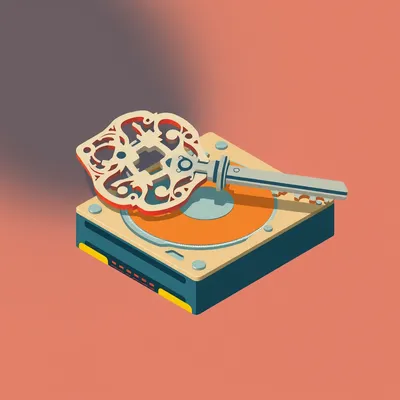
Imagine you are holding a vinyl record, but instead of the warm grooves of a jazz quartet, it contains a high-definition, or at least high-definition for the seventies, laser-read movie. It is twelve inches wide, it weighs about half a pound, and it shimmers like a giant, iridescent dinner plate. Today’s prompt from Daniel is about the Laserdisc, that magnificent, oversized ancestor of the DVD that most people have completely wiped from their memory banks.

Herman Poppleberry here, and Corn, I have been waiting for someone to ask about Laserdisc. It is arguably the most fascinating "failure" in the history of consumer electronics because it wasn't really a failure of technology, it was a failure of timing and economics. By the way, quick shout out to our script power today, we are being fueled by Google Gemini three Flash. But back to the discs. Daniel is right to call them weird. They are the missing link between the purely analog world of magnetic tape and the digital revolution of the nineties.
It is the platypus of home media. It has features of a record, features of a CD, but it doesn't quite fit into either family. I remember seeing these in high-end stereo shops back in the day—usually tucked away in a corner with a price tag that made your eyes water. They looked like something pulled out of a science fiction movie set, like a prop from 2001: A Space Odyssey. But for the uninitiated, let’s get the basics down. This isn't just a big CD, right? There is a fundamental technical difference in how a Laserdisc actually stores a movie compared to how a DVD does it.
That is the biggest misconception right there. People see an optical disc and assume "digital." But Laserdisc, which launched in nineteen seventy-eight as MCA DiscoVision, was actually an analog video format. The video signal is stored as a composite analog waveform. It uses pulse width modulation to represent the analog signal on the disc. It’s essentially a record that uses a laser instead of a needle to read frequency variations. Think of it like a shoreline—a CD or DVD is like a series of distinct, individual stepping stones (the ones and zeros), whereas a Laserdisc is a smooth, continuous wave of sand. The audio eventually became digital—you had Pulse Code Modulation, or PCM, and later even Dolby Digital and DTS—but that picture? That was pure, unadulterated analog.
So it’s basically a record that plays pictures. Which explains why the discs were so massive. You can’t exactly compress an analog signal the way we do with a modern MP4 file. But if it was analog, why did it look so much better than VHS? Because if you look at a Laserdisc next to a VHS tape from the same era, the Laserdisc wins every single time. It’s not even a contest. I mean, I’ve seen side-by-side comparisons of Top Gun on both formats, and the VHS looks like it was filmed through a screen door covered in Vaseline.
It comes down to bandwidth and physical contact. A VHS tape has a horizontal resolution of about two hundred and forty lines. Laserdisc pushed that to four hundred and twenty-five lines. That’s nearly double the detail! More importantly, because it’s an optical format, there is no physical wear. Every time you play a VHS tape, the magnetic heads are physically rubbing against the tape, scraping off tiny particles of magnetic oxide and degrading it. With Laserdisc, the laser just bounces light off the aluminum layer. As long as you don't grow a forest of fungus on the disc, the quality on the thousandth play is the same as the first.
But wait, how does that work if the disc is spinning so fast? Does the laser ever lose its place? I’d imagine even a tiny bit of dust would cause a massive skip, like a record player when someone jumps in the room.
It’s surprisingly resilient because the "pits" on the disc are protected by a thick layer of clear plastic. The laser actually focuses past the surface scratches and dust onto the reflective layer deep inside. It’s like looking through a chain-link fence at a baseball game; if you focus on the players, the fence almost disappears. However, that brings us to the "dreaded" issue Daniel mentioned in his notes.
Right, the "laser rot." I remember that being the boogeyman of the Laserdisc community. It sounds like something a robot would get if it didn't wash its hands. What was actually happening there? Was the disc literally rotting away in the sleeve?
It was a manufacturing defect, mostly. These discs are a sandwich. You have two plastic sides with an aluminum reflective layer in the middle, held together by adhesive. If the adhesive was poor or the sealing wasn't airtight, oxygen would seep in and oxidize the aluminum. It turns the reflective silver into a dull, white crust. When the laser hits those oxidized spots, it can’t reflect back properly, and you get "snow" on the screen—colored speckles that look like electronic rain—or the player just gives up. Some factories, like the Sony DADC plant in Indiana, became infamous for "rotter" discs in the late eighties. There are some movies where almost every copy in existence has some level of rot now.
So you’d spend a hundred bucks on a "Special Edition" of a movie, put it on your shelf, and five years later it was a very expensive coaster. That’s a tough sell for a consumer format. But let’s get into the mechanics of how these things actually spun, because this is where the "nerdy donkey" energy really needs to come out, Herman. I’ve heard about these two modes, CLV and CAV. Why did the disc need to change its behavior depending on what you were watching?
This is where Laserdisc gets brilliant and frustrating at the same time. Let’s start with CAV, or Constant Angular Velocity. In this mode, the disc spins at a steady eighteen hundred RPMs. One rotation of the disc equals exactly one frame of video. Because of that one-to-one relationship, the player can do things that were impossible on any other format at the time. You could freeze-frame perfectly. You could do slow motion, or scan forward and backward with zero distortion. It was a film student’s dream. If you wanted to analyze the shower scene in Psycho frame by frame, CAV was the only way to do it at home. But the trade-off was capacity. You could only fit thirty minutes of video per side.
Thirty minutes? So for a standard two-hour movie, you’re looking at four sides? That means you’re getting up to flip or change the disc every half hour. That sounds like a workout, not a movie night. I guess that’s why they invented the other mode?
Well, not exactly, I mean, precisely—wait, I’m not allowed to say those words. Let’s just say you hit the nail on the head. CLV, or Constant Linear Velocity, was the "Extended Play" mode. To keep the data density consistent as the laser moves from the inside of the disc to the outside, the player actually slows down the spin speed. It starts at eighteen hundred RPMs at the center and slows down to six hundred RPMs by the time it reaches the outer edge. This allows for sixty minutes per side. You lose the fancy freeze-frame and slow-motion features on most players—if you hit pause on a CLV disc, the screen just goes black—but you can actually fit a whole movie on two discs.
It’s wild to think about a mechanical device having to constantly adjust its motor speed just to keep the picture stable. The precision required for that in nineteen seventy-eight is staggering. I mean, we take digital buffers for granted now, but back then, that was all hardware and timing. It explains why the players were the size of a microwave oven and cost a small fortune. But Herman, what happened if the motor drifted just a tiny bit? Did the movie start playing in fast forward?
The player actually used the "burst" signal in the video itself to lock the motor speed. It was a constant feedback loop. If the disc slowed down by even a fraction of a percent, the color would drop out or the picture would tear. It was an incredible feat of analog servo-mechanics. And they were loud! You have this twelve-inch platter spinning at nearly two thousand miles per hour at the edge—not literally, but you get the point—it creates a lot of wind resistance and vibration. High-end Pioneer players had these massive dampened chassis and heavy copper-plated screws just to keep the "whirring" from drowning out the movie. But for the cinephiles of the eighties and nineties, it was worth it. Laserdisc was the first time you could actually see a movie in its original aspect ratio at home.
Right, the "letterbox" format. I remember people complaining that the black bars on the top and bottom of their TVs meant they were "missing part of the movie," when in reality, the Laserdisc was showing them the whole frame while VHS was cutting off the sides to fit a square tube TV. Laserdisc really pioneered the idea of the "home theater" as a serious pursuit. It turned watching a movie into an event.
It did. The Criterion Collection, which everyone knows today as the gold standard for film preservation, actually started on Laserdisc. Their first release was Citizen Kane in nineteen eighty-four. They were the ones who invented the audio commentary track. They realized that Laserdisc had extra audio channels—the analog tracks and the digital tracks—so they put the director or a scholar on one of them. You could literally toggle a switch on your remote and listen to Orson Welles’ colleagues talk about how they shot the scenes while the movie played. That was revolutionary. Before that, if you wanted to know how a movie was made, you had to buy a book or hope for a magazine article.
It’s funny how we just expect that now. Every DVD and Blu-ray has ten hours of "making of" fluff, but Laserdisc made it an art form. But let's talk about the downfall. Because as cool as it was for nerds like us, it never became the dominant format. It was always the "rich guy’s" hobby. Why couldn't it beat VHS? Was it just the price, or was there a fundamental flaw?
It was a combination of things. First, you couldn't record on it. In the eighties, the "killer app" for home video was time-shifting. People wanted to record Jeopardy or the football game while they were at work. VHS allowed that. Laserdisc was read-only. Second, the Price. A Laserdisc player in the early eighties could cost a thousand dollars. Adjusting for inflation, that is nearly four thousand dollars today. And the movies themselves? You were looking at forty to a hundred dollars per film. Imagine paying a hundred dollars for a copy of The Hunt for Red October.
That’s a steep entry fee for a format that makes you get off the couch every forty-five minutes to flip a giant shiny pancake. I can see why the average family stuck with their grainy VHS tapes. It’s the classic "convenience vs. quality" struggle. But even though it "died" when DVD arrived in ninety-seven, the market didn't actually vanish, did it? Daniel mentioned that you can still buy these things in twenty-six.
It’s become the vinyl of the video world. There is a massive secondary market. If you want a player today that actually works and won't eat your discs, you have to be prepared to hunt. The "cheap" way is eBay, where you can find untested units for two hundred bucks, but that’s a gamble. These machines have rubber belts that perish over time and specialized grease that turns into glue after thirty years. If you buy an old player and just plug it in, there's a good chance you'll hear a "pop" and see a puff of smoke from a thirty-year-old capacitor.
And I’d imagine shipping a thirty-pound delicate optical instrument is a recipe for a box of broken glass and disappointment. So if someone actually wants to get into this in twenty-six, where are they going? Are there still "Laserdisc doctors" out there?
There are a few specialized shops. Companies like SpenCertified or individual enthusiasts on forums like Laserdisc Forever specialize in refurbishing these. A fully serviced Pioneer DVL-909—which is a cool "combo" player that plays both Laserdiscs and DVDs—will run you about a thousand dollars today. If you want the "Holy Grail," like the Japanese HLD-X9, you are looking at three to five thousand dollars. That machine used a shorter wavelength laser—a red laser instead of the standard infra-red—to get every possible drop of detail out of the analog signal.
Five thousand dollars for a player that plays analog video? That seems insane when I can stream 4K Dolby Vision for fifteen bucks a month. What is the draw? Is it just the giant covers? Because I will admit, a twelve-by-twelve inch movie poster looks a lot better on a shelf than a tiny little plastic Blu-ray case.
The art is a huge part of it. It’s tactile. When you hold a Laserdisc, you feel the weight of the cinema. But there’s also the "unreleased" factor. There are hundreds, maybe thousands, of movies and specific cuts that never made the jump to digital. For example, the original theatrical versions of the Star Wars trilogy—without the CGI "special edition" additions—exists in its best non-remastered form on the "Definitive Collection" Laserdisc set. If you want to see the movie exactly as it looked in theaters in seventy-seven, that analog disc is often the purist’s choice.
I also suspect there’s a bit of that "analog warmth" argument, similar to what you hear from vinyl enthusiasts. Digital video, especially early DVDs, can look very "crunchy" with compression artifacts. If you have a fast-moving scene in a DVD, you might see "blocks" or "macroblocking." Laserdisc doesn't have blocks or pixels. It has "noise," which looks more like natural film grain. On a high-end CRT monitor or a well-calibrated projector, it has a very cinematic, soft look that people find nostalgic.
It’s a very specific aesthetic. It feels more "organic." And let's not overlook the "MUSE" discs. In the early nineties, Japan actually had a high-definition Laserdisc format called MUSE. It was an early attempt at 1080i video on an analog disc. It required a special player and a special decoder, and the discs are incredibly rare now. But seeing a movie like Back to the Future in HD on a giant gold disc is the ultimate flex for a media collector. It’s like owning a prototype of the future that never quite happened.
I love that humanity tried to shove high-definition video onto an analog platter. It feels so delightfully over-engineered. But for the person listening who thinks, "Okay, I want to try this," what are the practicalities? If I go buy a player tomorrow, am I going to be able to find movies, or are they all sitting in museums?
Oh, the movies are everywhere. You can go to almost any large used media store or record shop and find a Laserdisc bin. Usually, they are priced between five and ten dollars because most people don't have players. You can pick up blockbusters like Jurassic Park or Terminator 2 for pennies on the dollar compared to what they cost originally. I’ve seen people find rare Disney titles for three dollars because the shop owner just wanted the "big shiny things" out of the way. The challenge isn't the discs; it’s the display.
Right, because these were designed for tube TVs. If you plug a forty-year-old analog video signal into a modern eighty-five inch OLED, it’s going to look like a Jackson Pollock painting. The TV tries to "sharpen" the analog noise and it just becomes a mess. You need upscalers, right? Or do people actually keep those giant heavy CRT monitors in their living rooms?
A lot of "hardcore" collectors use what’s called a Retrotink or a FrameMeister. These are specialized boxes that take an analog signal and intelligently upscale it to HDMI. They try to preserve that "analog" look while making it playable on a modern screen. But the real purists? They have a Sony PVM—a professional video monitor—which weighs a hundred pounds and has about twenty inches of screen real estate. It’s a commitment. It’s not a casual hobby. You have to be okay with your living room looking like a nineteen-eighties NASA control room.
It sounds like owning a vintage car. You don't buy a sixty-seven Mustang because it’s the most efficient way to get to the grocery store. You buy it because you want to hear the engine and feel the road. Laserdisc is "driving" your movie. You have to interact with it. You have to flip the disc. You have to clean the lens. There is a ritual to it that streaming just doesn't have. When you click a button on Netflix, it’s invisible. When you slide a Laserdisc into the tray, you hear the motor spin up, you feel the vibration—it’s alive.
That ritual is exactly why it’s surviving. In an era where media is "ethereal"—where your favorite movie can vanish from a streaming service overnight because of a licensing dispute—owning a physical, twelve-inch analog artifact feels like an act of rebellion. And honestly, the technology that Laserdisc pioneered paved the way for everything we use now. The CD used the same laser tracking tech. The DVD used the same disc structure. We owe a lot to this "failed" dinner plate. It’s the foundation of the optical age.
It’s the grandfather that went to war so we could live in peace with our tiny, five-inch Blu-rays. But I have to ask, since you mentioned the "flipping" thing earlier—did they ever solve that? Or did the "elite" movie fans just accept that they had to get up mid-scene? I can’t imagine being halfway through the climax of Die Hard and having to jump up to flip a disc.
They did solve it, in the most "Herman" way possible. Late-era high-end players had what was called "Both-Side Play." Instead of you flipping the disc, the player had a U-shaped track. When side A finished, the laser would physically travel around the edge of the disc to the top side, flip over, and start reading side B. It sounded like a transformer was changing in your living room—lots of mechanical whirring and clunking—and it took about fifteen seconds, but it meant you could stay on the couch. Some players even had a "Gamma Turn" mechanism that was slightly faster, but it was still a mechanical ballet.
That is peak engineering. Why simplify the format when you can just build a robot inside the box to do the work for you? I love it. It’s over-complicated in the best way. So, if I’m going to start a collection, what’s the "actionable" advice here? Because I don't want to buy a thousand-dollar brick.
First, look for a Pioneer player. They were the kings of the format—they actually bought the technology from MCA—and their parts are the most common if you need a repair. Specifically, look for the DVL series I mentioned, like the DVL-909 or 919. They are "modern" by Laserdisc standards, produced in the late nineties, so the components are a bit more reliable. Second, storage. You have to store these like vinyl—vertically. If you stack them flat, the weight of the discs at the bottom of the pile will warp the plastic or cause the layers to delaminate over time.
And what about the "sticky shed" syndrome? I know that’s a thing with magnetic tape where the glue breaks down and gums up the machine. Does that happen to Laserdiscs?
Not exactly, but they are sensitive to humidity. If you live in a swampy environment, that "laser rot" we talked about is much more likely to accelerate. Keep them in a cool, dry place. And for the love of all things holy, don't leave them in a hot car. They are plastic; they will turn into a taco very quickly. I once saw a rare copy of Criterion’s Akira that had been left in a sunny window—it looked like a Pringle. Totally unplayable.
A taco that costs fifty dollars. Got it. I think what fascinates me most about this is the "alternate history" aspect. Laserdisc was technically superior to its competition for nearly twenty years, yet it remained a niche. It’s a reminder that the "best" technology doesn't always win. Convenience and price usually beat quality. It took the DVD—which combined the quality of Laserdisc with the convenience of a small disc and the price of a VHS—to finally kill it. It’s like the Laserdisc was the blueprint, but the DVD was the finished house.
It’s a classic case study. But even then, Laserdisc hung on in Japan until two thousand and nine! That’s when the last player was manufactured by Pioneer. That is a thirty-one year production run. For a "failed" format, that’s an incredible life span. It survived the transition from the seventies to the internet age. It saw the rise and fall of the Sony Betamax, the dominance of VHS, and the birth of the DVD.
That’s longer than most marriages. There is something noble about that. It’s the "weird oversized CD that refused to die," just like Daniel said. And honestly, looking at one of those gold-tinted discs today, it still feels like the future. It has a physical presence that a file on a hard drive just can’t replicate. You can’t hold a "stream" in your hand and admire the way the light hits it.
It’s the soul of the machine, Corn. Every time that laser tracks across the pits and lands of an analog signal, you’re seeing a physical representation of light and sound. It’s beautiful, it’s bulky, and it’s completely unnecessary in twenty-six—which is exactly why people love it. It’s a hobby for people who want to slow down and actually watch a movie, rather than just scrolling through a menu for two hours.
Well, I’m sold. I’m going to go find a copy of The Hunt for Red October on a twelve-inch disc and spend my Saturday flipping it every forty minutes. It’ll be great. I’ll just tell my wife it’s "vintage exercise." Thanks to Daniel for sending us down this rabbit hole. It’s a good reminder that the tech we have now didn't just appear out of nowhere; it’s built on the shoulders of giant, shiny, spinning giants.
Giant giants. Very eloquent, Corn. But you’re right. The "special features" we love, the aspect ratios we demand, even the way our computers read data—it all traces back to those early experiments with DiscoVision. It’s a legacy worth preserving, even if it takes up three shelves in your living room and requires a specialized technician to fix.
And with that, I think we have successfully resurrected the Laserdisc for the digital age. This has been My Weird Prompts. Big thanks as always to our producer, Hilbert Flumingtop, for keeping the gears turning behind the scenes—hopefully with more reliability than a nineteen-eighty-two DiscoVision player.
And a huge thanks to Modal for providing the GPU credits that power our show. Without those serverless GPUs, we’d be as obsolete as a player with a broken belt and a rotted disc.
If you enjoyed this dive into the analog past, do us a favor and leave a review on your favorite podcast app. It helps more than you know in getting the show in front of new people who might also have a basement full of oversized media.
You can also find all our episodes and the RSS feed over at myweirdprompts dot com. We have a whole archive of weirdness waiting for you.
We’ll be back next time with whatever weirdness Daniel throws our way. Until then, keep your lasers clean and your discs vertical.
Stay nerdy, everyone. Bye.