The lighthouse keeper is one of the few jobs in history that came with its own mythology built in. A person, alone, at the edge of the sea, keeping a light burning so that other people don't die. It sounds like something invented for a novel. And then you find out it was a real job with a real timesheet, and somehow that makes it stranger, not less strange.

And it's gone. Almost entirely gone. That's the part that gets me. We automated away a whole way of life in the space of about forty years, and the people who did it are still around to tell us what it was like.
Which is exactly what Daniel wants to know. He wrote in about this. He spent most of his summers growing up in County Cork, surrounded by lighthouses, and one in particular stuck with him, Galley Head, near Ardfield and Clonakilty. And what fascinates him isn't the postcard version. It's the keeper as a kind of hermit who still had to show up for work. His phrase: a version of hermetism that survives contact with the reality of needing to have some kind of a job. Not a religious recluse in a forest, but someone with a pragmatic purpose who is nonetheless profoundly detached from the world.
That's a sharp distinction.
He wants the real thing. What was the job actually like for the last people who did it, in remote conditions. The daily reality. The isolation. The relationship with a sea that was mostly calm and sometimes terrifying, and he mentions photographs of lighthouses swallowed by waves during storms. He's also curious about the helicopter, which he says always sounded strange to him, the image of a keeper being brought ashore by air, and he'd read that was actually how it was sometimes done. And finally, what the memoirs and stories from keepers tell us about what it was like in practice. So let's start with the place that sparked this, Galley Head, and work outward to the job itself.
Galley Head is a good anchor because it's almost a textbook case of the whole arc. It sits on the Dundeady headland outside Rosscarbery, looking out over the Celtic Sea, with Red Strand to the east and the Long Strand to the west. The headland is actually cut off from the mainland by the walls of an old Norman fort, Dun Deidi, which belonged to the Ó Cobhthaigh clan.
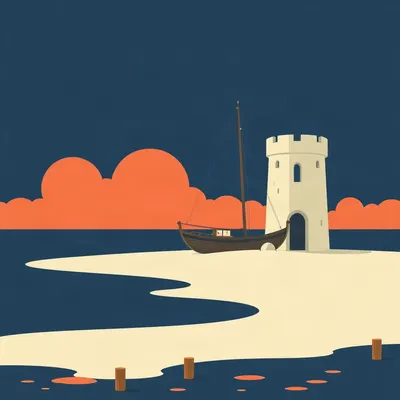
A lighthouse behind a fortress wall. That's already the right image.
Built in 1875, first lit in 1878. And the original light was extraordinary for its time. A revolving octagonal optic, powered by coal gas burners, switched on and off every two seconds, producing six or seven white flashes within sixteen seconds of each minute. Sixteen nautical mile range. Galley Head and Fastnet are two of the most powerful lights in Europe.
And the quirk. Tell them the quirk.
Galley Head throws an unusual arc of light inland, back toward the land, which is not what a lighthouse is supposed to do. The story is that the Sultan of Turkey asked to be able to see it from nearby Castle Freke during a visit. Castle Freke is a Gothic ruin now. But the light still sweeps across the land because a visiting dignitary wanted a view.
A lighthouse with a diplomatic accommodation built into its optics.
And then the ending. Automated in 1978. And today the two keeper's houses have been restored to their original symmetrical layout and are rented out as holiday accommodation by the Irish Landmark Trust. They sleep four to six each, and there's an internal door so you can book both together for a party of eight to twelve.
The keeper's cottage is a holiday let. That's the whole story of the profession in one sentence. You can rent the life for a weekend.
That's the setting. Now let's talk about what the keeper actually did all day. And all night.
Start with the nickname, because it tells you what the job actually was.
Wickies. From trimming the wicks of the oil lamps. That was the core task for most of the profession's history, and it's the one everybody forgets, because we think of the keeper standing nobly beside a great lens. The actual job was maintenance. Trim the wicks, replenish the fuel, wind the clockwork mechanisms that rotated the light, clean the Fresnel lens and the windows, maintain the fog signal, run the weather station, and take a major part in search and rescue at sea.
The fog signal. That's the one nobody photographs.
Nobody photographs the fog signal. And in a lot of conditions the fog signal mattered more than the light, because fog is exactly when you can't see a light. So there's a keeper, in the nineteenth century, standing next to an exploding compressed air or explosive fog signal, in the wet, at three in the morning, keeping it running. That's the job. The light is one duty among many.
And because the stations were so remote, the work tended to be hereditary. Passed from parent to child, with families living at or near the light.
In the United States there was a specific term for the isolated stations that were operated by men only, without families. They called them stag lights. The distinction mattered, because a station with a family was a different kind of place. A station without one was just a rock with a man on it.
Which brings us to the hermetic question, and I think there's a much stronger historical bridge here than Daniel might expect. He framed it as an analogy. It turns out it was sometimes literally the same people.
Hook Head.
Hook Head, County Wexford. The second-oldest operating lighthouse in the world. Manned continuously from at least 1207 until 1996. And from its thirteenth-century construction until the mid-seventeenth century, it was home to an early Christian monastery. William Marshal, Lord of Leinster, enrolled the monks as the first lighthouse keepers, and they remained the custodians for several centuries.
The monks of Rinn Dubháin may have lit a beacon there as early as the fifth century, to warn shipping off the rocks.
So the same men, in the same building, doing both jobs. Praying and keeping the light. The hermit and the keeper aren't two things that resemble each other. At Hook Head they were one thing for four hundred years.
And that reframes Daniel's intuition in a way I find interesting. He described the keeper as a hermit who survives contact with reality. At Hook Head, the religious life and the practical life weren't in tension at all. The monastery was the lighthouse crew.
The contemplative life and the navigational aid were the same institution. That's not a metaphor. That's a rota.
It also tells you something about why the job attracted that framing in the first place. A monastery is already a place of regulated hours, repetitive physical work, and separation from the world. A lighthouse is the same thing with a more urgent reason.
Now. The sea. Daniel said mostly calm and sometimes terrifying, and I want to spend some time on the terrifying, because the specifics are remarkable.
Fastnet Rock is the example. Off the Cork coast. They called it Ireland's Teardrop, because for nineteenth-century emigrants it was the last sight of Ireland as they sailed away. And the first lighthouse there, completed in 1854, turned out to be too weak for the site.
How do we know it was too weak.
Because of what the gales did to it. The storms shook the tower so violently that crockery was thrown off the tables inside. And a two hundred and seventy litre cask of water, lashed to the gallery forty-one metres above high water, was washed away.
Forty-one metres above the waterline, and the sea took it off the gallery.
And it gets worse. In 1881, the nearby Calf tower was carried away entirely in a gale. On the same day, the sea broke the glass of the Fastnet lantern.
So on a single day, one tower was destroyed and the other had its window punched in.
And then 1985. Fastnet was struck by a rogue wave roughly forty-eight metres high. A hundred and fifty-seven feet.
That's taller than the tower.
Considerably taller than the tower. That's the thing about Fastnet. The structure is built to survive conditions that would destroy almost anything else we make, and the sea still occasionally reminds it who's in charge.
And this is the sea the keeper lived inside. Not visited. Lived inside. The Fastnet sea area is one of the named zones of the BBC Shipping Forecast, so the keeper's working environment was literally a byword for dangerous weather. If you grew up in Britain or Ireland, you heard the word Fastnet on the radio and you knew it meant bad.
The second lighthouse, built between 1897 and 1904, is the one standing today. Two thousand and forty-seven dovetailed blocks of Cornish granite, weighing four thousand four hundred tonnes. They had a steamship purpose-built to carry the blocks out to the rock, the Ierne. And the foreman, James Kavanagh, personally set every single stone.
Every stone. By hand. On a rock in the Atlantic.
That's the part that stays with me. We talk about automation replacing the keeper, and it did, but the thing being automated was built by men who set four thousand tonnes of granite by hand in open ocean, and who could not have done it if the tower hadn't held while they worked.
So the keeper's relationship with the sea is this strange thing. Most days, nothing happens. The sea is a view. And then one day the sea comes over the gallery and takes a water cask off it, and the only reason anyone knows is that a man was inside the tower at the time, keeping records.
Which is the unromantic truth underneath the drama. The keeper's job during a storm wasn't to fight the sea. It was to stay alive, keep the light running, and write down what happened.
That's the job and the sea. But how did they get there, and what happened when the job went away?
The getting there is the part Daniel flagged, and he's right that the helicopter sounds strange. It sounds strange because we've forgotten what came before it.
Which was ships.
A whole maritime supply infrastructure. Irish Lights, the Commissioners of Irish Lights, operated a fleet of lighthouse vessels. And then in the 1960s, helicopter operations were introduced, alongside electrification, radar and radio beacons. And that reduced the lighthouse vessel fleet from four ships to one.
Four ships to one. The helicopter didn't just change how a keeper got to work. It collapsed an entire industry that existed to service the lights.
Crew, cooks, engineers, the shipyards that built and maintained those vessels. All of it, gone, because a helicopter could do the same job in an afternoon.
And the helicopter is also the detail that proves the job was still dangerous in the modern era. It wasn't just a quaint way to commute. In October 2017, a keeper named Marcelo Escobar, at the Diego Ramírez Islands in Chile, the southernmost lighthouse in the world, was airlifted to Punta Arenas after breaking his arm.
And in 2022, a keeper in British Columbia had to make a five hundred kilometre trip for heart surgery, after being evacuated in heavy fog.
Five hundred kilometres for heart surgery. That's the remoteness, still live, for the small number of people still doing this.
So the helicopter is a genuine improvement and it's also the thing that made the job survivable in places where it previously just wasn't. There's a version of this story where the keeper is a romantic figure alone with the sea, and the real version is that for most of history, if something went badly wrong medically, you died, and the light kept running because someone else was on the roster.
Now. Automation. And I want to be careful here, because the popular version is that it happened suddenly.
It didn't. It began in the 1960s, with electrification, remote monitoring, and automatic bulb changing. And then it stretched across decades, and different countries did it at wildly different speeds.
Give me the timeline.
Ireland first. Automation began in the 1980s, with central remote monitoring for offshore lights, which led to reduced employee numbers by the late 1990s. Hook Head automated in 1996. Baily Lighthouse at Howth, County Dublin, became the last Irish lighthouse with a resident keeper, automated in 1997. Fastnet automated in March 1989, monitored by UHF telemetry to Mizen Head, then by landline to the Irish Lights control centre at Dún Laoghaire. And Galley Head, where we started, automated in 1978.
So Galley Head went first, and Baily went last, and the whole thing took about twenty years.
About twenty years for Ireland. Britain's last manned lighthouse was North Foreland in Kent. And the last six keepers, Dave Appleby, Colin Bale, Dermot Cronin, Tony Homewood, Barry Simmons and Tristan Sturley, completed their service in a ceremony attended by Prince Philip on the twenty-sixth of November, 1998.
A royal ceremony for the end of a profession.
And one of them, Dermot Cronin, said something to the BBC that I think is the best single line about this whole subject. He said, I had no idea I would be closing the door of the last manned lighthouse in the British Isles.
He didn't know. He went to work one day and it turned out to be the end of a thousand years of something.
Scotland's last was Fair Isle South in Shetland, keepers left on the thirty-first of March, 1998. Sweden had started automating back in the 1930s and was down to three staffed lights by this century, the last being Holmögadd in 2003. Finland's last manned light closed in 1987. Norway's last keeper left Runde in 2002. Iceland dismissed its last keeper in 2010. Japan automated its last manned light, Meshima, in 2006. New Zealand was fully automated by 1990.
So the profession didn't end. It unravelled, country by country, over about seventy years, at different speeds, for the same reason.
And the reason is always the same. Once you can monitor a light remotely and change a bulb automatically, a resident human being is a cost with no navigational function.
Except where the human being has a function that isn't navigational.
Right. Canada had fifty-one staffed lighthouses as of 2017, twenty-three in Newfoundland and Labrador, twenty-seven in British Columbia, with ninety keepers employed as of 2022. And one of them is Machias Seal Island, which is staffed for sovereignty reasons, because the United States and Canada both claim it.
So there's a lighthouse keeper standing on a rock right now because of a border dispute.
There is. The light could be automated tomorrow. The person is there because a person being there is the claim.
The job persisted for geopolitical reasons, not navigational ones. That's a strange afterlife for a profession. Elsewhere, Brazil had thirty-three staffed lights as of 2020. Chile around twenty inhabited as of 2003. Italy sixty-two staffed as of 2011. France about a dozen as of 2011. Singapore's Raffles and Pulau Pisang lights are crewed by eight keepers working ten-day shifts in pairs.
Ten-day shifts in pairs. That's a very specific working arrangement.
And the United States is the cleanest ending. The last civilian keeper, Frank Schubert, died in 2003. The last officially manned light, Boston Light, was manned by the Coast Guard until 1998, and now has volunteer Coast Guard Auxiliary keepers who serve mainly as interpretive tour guides.
So the American keeper is now a docent.
The American keeper is now a docent in a period costume, explaining to tourists what the job used to be.
Which brings us to the memoirs, because that's what Daniel actually asked for. What did the people who did this say about it.
The first thing to say is that the keeper is one of the most durable literary archetypes we have, precisely because the job combines isolation, adventure and mystery in a way that almost nothing else does. Jules Verne wrote The Lighthouse at the End of the World in 1905. Poe left an unfinished piece called The Light-House in 1849. Sienkiewicz wrote Latarnik in 1881. More recently, Emma Stonex's The Lamplighters in 2021, M.L. Stedman's The Light Between Oceans, which was filmed in 2016, Robert Eggers' The Lighthouse in 2019. And Van der Graaf Generator's A Plague of Lighthouse Keepers from 1971.
A prog rock epic about lighthouse keepers. Of course there is.
And the real-world testimony is collected mostly by the Association of Lighthouse Keepers, which preserves keeper memoirs and oral histories. The US Lighthouse Society does the same on the American side. And the Coast Guard named a whole class of buoy tenders after famous keepers. Ida Lewis, Abbie Burgess, Marcus Hanna.
Named ships after them. That's how seriously the service took its own history.
And what comes through in the memoirs is not what you'd expect. It's not storms. It's routine. It's the specific texture of a life organized around a light. The keeper's day is structured by the light's needs, not by the keeper's. You wake when the light needs you. You sleep when it doesn't. And that's a very strange way to live, because your body's clock is set by a machine.
Which is the hermetic thing again. The monk's hours are set by prayer. The keeper's hours are set by a lamp.
And the other thing that comes through is that the job was often a family job. Wives kept the light when husbands were ill. Children grew up in the tower. There are keeper dynasties that span three or four generations at the same station. That's not a career. That's a lineage.
The image of the solitary keeper is partly wrong. At a lot of stations it was a household.
The solitary figure is the stag light, the men-only station, which is real, but it's not the whole picture. And the memoirs from those stations have a different tone entirely. Bleaker. More like a military posting than a family home.
That's the job, the sea, the transport, the automation, and the memoirs. And I want to land on what this all means, because there's a real question underneath Daniel's prompt about what it means that a job defined by isolation and duty has been replaced by remote monitoring and telemetry. But before we get there, there's a thing I keep thinking about. The keeper's cottage at Galley Head is a holiday let. You can book it. You can sleep in the room where somebody spent thirty years watching a light.
You can. And there's something almost perfect about that as a symbol. The vocation became a heritage experience. The thing that was hard about the job, the isolation, the routine, the being-away, is now the thing people pay for on a weekend.
Because it's only appealing when you can leave.
That's the whole difference between a life and a holiday.
Which raises the question of what the keepers themselves thought, at the end. Dermot Cronin didn't know he was closing the door on the last manned lighthouse in Britain. What did the others say.
A lot of them said versions of the same thing. That they'd do it again. That they missed it. And almost none of them said they missed the light. They missed the life. The station. The people they worked with. The rhythm.
Not the purpose.
Which is interesting, because the purpose was saving lives. And yet what they missed was the shape of the days.
I want to sit with that for a second.
Take your time.
The thing they missed wasn't the heroic part. It was the ordinary part. The routine. Which is what most people miss about most jobs, when they're gone.
Which is also what makes the memoirs so valuable. They're not adventure stories. They're records of a way of organizing a life that no longer exists anywhere.
That's the thing I keep coming back to. The keeper is gone, but the image endures, and the image keeps getting written about, and I think that's because the job was a rare case of a life that was legible. You could explain it in one sentence. A person, alone, keeping a light. Nobody's job is legible like that anymore.
Almost nobody's job is legible like that. Try explaining what either of us does in one sentence.
I'd rather not.
Exactly.
The keeper is a figure we can still understand, in a world where almost nobody's work can be explained in a sentence. That's why the novels keep coming.
That's a good note to end on, the job as a job, and what it means that it's gone.
Hilbert: Forty-one pounds.
Sorry?
Hilbert: Forty-one pounds. That's what the fog signal cost. The replacement gong, the brass one, for the station I was at. The original was cracked and they sent a new one and it came with a receipt and the receipt is the thing I kept. I've still got it in a folder with the wiring diagram for the compressor and a letter from the Northern Lighthouse Board about the clockwork.
You were a keeper.
Hilbert: Relief keeper. One winter. Not the romantic kind. The kind where you're basically a janitor with a weather station. The light was already automatic by then, mostly, but the fog signal and the weather reporting and the building still needed a person, and I was the person.
Where.
Hilbert: A rock off the Scottish coast. I'm not going to name it because the man who trained me is dead and I don't want to get the name wrong. But it was a rock. You could walk the whole of it in about four minutes and then you'd be back where you started.
What do you remember.
Hilbert: The clockwork. There was still a clockwork mechanism in the older part of the apparatus, and it would wind down in the small hours, and you'd hear it, this slowing tick, and then you'd get up and wind it back by hand. Crank. About forty turns. And that was the most meditative thing I've ever done in my life. Forty turns of a crank at three in the morning with nothing but the sea outside.
That's the rhythm you were talking about.
Hilbert: That's the rhythm. And I'll tell you what nobody says about it. The isolation wasn't the hard part. I was fine with the isolation. The hard part was the return. You'd come back to a town and nobody understood why you'd been away, and the thing you'd been doing felt, to everyone else, like nothing. You'd try to explain the fog signal and you'd watch their eyes go. So you'd stop explaining.
The keepers you knew. Did they talk about the sea.
Hilbert: Not much. They talked about the paperwork. The logbook. The returns. The stores inventory. The thing that killed you wasn't the storm, it was forgetting to sign something. And the sea was just the thing outside the window.
The job was a job.
Hilbert: The job was a job. And I'll tell you the other thing. The Fresnel lens is overrated. Everybody photographs the lens. It's a beautiful object, I'm not saying it isn't, but the real hero of a lighthouse is the fog signal. The thing nobody photographs. The lens is for clear nights when you can see for miles anyway. The fog signal is for the nights when you can't see your own hand, and that's when people die. And nobody's ever written a poem about the fog signal.
What happened to the keepers at the end. The ones you knew.
Hilbert: Some of them were offered the chance to stay on as attendants. Caretakers for the automated equipment. Basically a maintenance man for a machine. Almost none of them took it. I can think of one who did and he lasted about a year.
Why.
Hilbert: Because it wasn't the light. It was never the light. It was the life. If you take away the life and leave the light, there's nothing there to stay for. That tells you everything about whether the job was about the lamp or about the way you spent your days.
The keepers who turned down the attendant job were telling us the same thing the memoirs tell us.
Hilbert: They were telling us the same thing. And I should go. I'm due somewhere and there's going to be a queue, and I'd rather be early in it than late.
That's a good note to end on, the job as a job, and what it means that it's gone. The keeper's cottage at Galley Head is a holiday let now. You can book it for a weekend. And the thing you're renting isn't the work. It's the view.
Which is the whole story of the profession in one sentence. The vocation became a heritage experience, and the only people who still do the job are doing it for reasons that have nothing to do with navigation. Machias Seal Island is staffed because two countries disagree about a border. Boston Light is staffed by volunteers in period costume. The light is a machine now, and the person is a symbol.
The open question is what happens to the symbol when the last person who actually did the job is gone. The memoirs are still being collected. The Association of Lighthouse Keepers is still gathering testimony. But there's a finite number of people who stood in a tower at three in the morning and wound a crank, and that number is going down every year.
When it hits zero, the keeper becomes purely literary. Which is a strange fate for a job that was, for most of its history, about as practical as work gets.
If you enjoyed this one, a review helps other listeners find the show. It does.
Thanks as always to our producer, Hilbert Flumingtop, who is currently standing in a queue somewhere.
This has been My Weird Prompts.
The human-AI collaboration podcast. We'll be back soon.