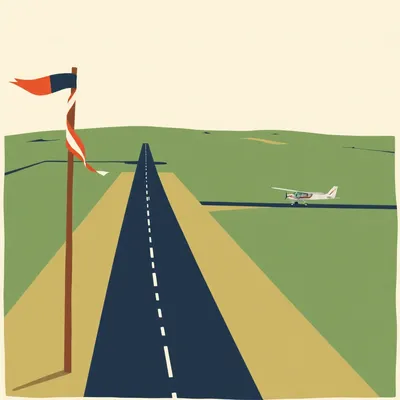
Daniel sent us this one — he spent his teenage years planespotting at Cork Airport with his best friend, right up against the perimeter fence. The authorities mostly left them alone. But he's wondering, in today's hyper-security-conscious environment, how do airport police around the world handle this now? He also mentions that here at Ben Gurion there's actually a designated public viewing platform, not signposted but built expressly for planespotters, which he thinks is a nice approach. So the question is, what are the most common approaches globally, and how has planespotting enforcement evolved over the years?

The short answer is, it's a patchwork. There's no global standard, and the approach a given airport takes usually tells you more about that country's broader security culture than about any specific threat assessment of people with binoculars and logbooks.
Planespotting becomes a Rorschach test for a nation's anxiety levels.
And the spectrum runs from "here's a dedicated viewing platform with a café" to "you will be detained, interrogated, and your camera's memory card confiscated." Sometimes at the same airport, depending on the decade.
Let's start with the hostile end. What's the worst-case scenario for someone just standing near a fence with a camera?
The canonical horror story is the Greek planespotters case. In November 2001, twelve British and two Dutch planespotters were arrested at a Greek air force base near Kalamata. They were charged with espionage — espionage — and faced up to twenty years in prison. They'd been attending an air show and were collecting aircraft serial numbers, which is the most mundane planespotting activity imaginable. It took until April 2002 for a Greek court to acquit them, and even then the prosecutors appealed. The appeals court finally cleared them in November 2002, a full year after their arrest.
A year of legal limbo for writing down tail numbers.
This was in the immediate aftermath of nine-eleven, so security services everywhere were operating on hair-trigger alert. But here's the telling detail — Greek military intelligence had actually been monitoring the group for days before the arrest. They knew exactly what these people were doing and chose to interpret it as hostile reconnaissance anyway.
The institutional version of "we've come too far to admit we're wrong.
That case became a watershed. It galvanized the planespotting community and forced a lot of aviation authorities to clarify their policies, because suddenly hobbyists across Europe realized they could face espionage charges for doing what they'd done peacefully for decades. The British Foreign Office had to get involved. MPs raised it in Parliament.
Yet here we are, a quarter century later, and people still get hassled. What changed and what didn't?
What changed is that many countries developed formal policies. What didn't change is that enforcement at the ground level — the individual police officer or security guard who spots someone at a fence — often has no idea what those policies are.
The policy exists in a binder somewhere while the officer on the ground is operating on instinct.
And instinct, post nine-eleven and post a dozen other incidents, defaults to suspicion. Let me give you the typology. There are broadly four approaches airports take. One, designated viewing areas — purpose-built facilities on or near airport property. Two, tolerated zones — unofficial spots where authorities know planespotters gather and leave them alone as long as they behave. Three, prohibition with discretionary enforcement — technically not allowed, but whether you get moved on depends on the day, the officer, and how you look. And four, zero tolerance — anyone near the perimeter without a ticket or badge gets challenged immediately, and in some jurisdictions, detained.
Where does Ben Gurion's platform fit in?
Ben Gurion is firmly in category one, and it's actually a fascinating case study. The viewing platform is located near the old Terminal 1, and it's been there for years. It's not advertised, there's no sign on the highway saying "plane spotting this way," but it's a known location — you can find it on Google Maps, planespotting forums have detailed directions. It gives you a clear view of the active runway and a good portion of the airfield.
Which is remarkable given that Ben Gurion is arguably one of the most security-conscious airports on the planet.
That's exactly the paradox. Israel has the most rigorous aviation security apparatus in the world — behavioral profiling, armed air marshals on every El Al flight, multiple security perimeters, the whole layered defense model. And yet the authorities made a deliberate decision to accommodate planespotters rather than drive them underground or into more sensitive locations.
It's the "give them a designated spot or they'll find their own" logic.
And from a security perspective, it's actually brilliant. If you provide a known, observable location where aircraft enthusiasts gather, you've just concentrated your monitoring problem into one place. You know who's there, you can put cameras on them, you can run license plates on the cars in the parking lot. It's far easier than trying to police a twelve-kilometer perimeter fence for individuals with cameras.
The panopticon, but make it hospitable.
And other countries have reached the same conclusion independently. Frankfurt Airport has a famous visitor terrace that's been operating since the nineteen sixties — it's a major tourist attraction, not just for hardcore planespotters. Zurich has observation decks. Narita in Tokyo has viewing facilities. Amsterdam Schiphol has a panorama terrace on top of the terminal, post-security even, so you can watch the ramp operations while waiting for your connection.
Schiphol's terrace is post-security? So you can plane-spot while in transit?
Yes, and it's brilliant. It turns what would otherwise be dead time between flights into an amenity. There's an actual Fokker 100 aircraft on the terrace that you can walk through. It's part aviation museum, part observation deck.
That's the Dutch approach to everything, isn't it. Don't fight the human behavior, build infrastructure around it.
The Netherlands has a long tradition of this. They were also one of the first countries to formally engage with planespotting communities after the Greek arrests. The Dutch aviation police actually maintain communication channels with major spotting groups. They share information — if there's an unusual military movement or a dignitary flight, sometimes the spotters know about it before the police do, because they're monitoring transponder data and flight plans.
The relationship can be symbiotic rather than adversarial.
In the best cases, yes. The UK is another interesting example. After the Greek case, the British government worked with the Civil Aviation Authority and airport operators to develop what's essentially a code of conduct. Most major UK airports now have a formal or semi-formal planespotting policy. Heathrow, for instance, has designated viewing areas and even publishes a guide for spotters on its website — or at least it did for many years. Manchester Airport has a dedicated aviation viewing park with a café, a playground, and raised viewing mounds.
So they've turned planespotting into a family day out.
Manchester's viewing park is genuinely popular. You pay a small entry fee for parking, and you get a clear view of the runways, a shop selling aviation memorabilia, and picnic areas. It's a revenue stream for the airport and it keeps spotters in a defined, monitored space.
Which brings us to the revenue question. Are these viewing areas moneymakers, or are they loss leaders for goodwill?
Frankfurt's visitor terrace charges admission — it's a few euros. The Manchester viewing park charges for parking. Schiphol's terrace is free once you're through security. Zurich charges a small fee. None of these are massive profit centers, but they offset costs and generate foot traffic for airport retail. More importantly, they're insurance against the reputational damage of a planespotter arrest making international news.
Because nothing says "visit our country" like detaining a Dutch retiree with a telephoto lens.
And those arrests still happen. Even with all the policy development since 2001, you get regular incidents. In 2023, a British planespotter was detained in Saudi Arabia for several weeks. In various African and Asian countries, spotters are regularly picked up, questioned, and released — or worse, held without clear charges. The risk map for planespotting is essentially the same as the risk map for journalism.
That's a useful heuristic. If you wouldn't feel safe photographing a government building in that country, don't photograph its airport perimeter either.
That's the rule of thumb. And it's not just authoritarian regimes. India has been notably hostile to planespotters. Despite having a massive aviation enthusiast community, Indian airports have repeatedly arrested spotters under colonial-era laws. The Official Secrets Act of 1923 — still on the books — has been used to prosecute people photographing aircraft. There was a case in 2020 where a man was arrested at Delhi airport for filming a plane from a parking lot.
A parking lot. Not breaching a fence, not using a drone, not accessing a restricted area. Standing in a parking lot.
With a phone camera. And this is where the legal framework matters enormously. In countries with strong civil liberties protections and clear public photography rights, planespotters have a much stronger position. In the United States, for instance, photography from public property is generally protected under the First Amendment. There's no reasonable expectation of privacy for aircraft taking off and landing. The TSA and airport police can't prohibit you from photographing planes from outside the fence if you're on public land.
That's the key distinction, isn't it. Public land versus airport property.
That's the entire ballgame. And it's where a lot of the friction happens, because the boundary isn't always clear. Many airports have approach roads, service roads, and buffer zones that are technically airport property but not behind the security fence. A spotter might think they're on public land when they're actually on airport-controlled property. And even when they are on genuine public land, police can still use catch-all charges like "suspicious behavior" or "obstruction" to move them along.
The Cork experience Daniel described — perimeter fence, authorities didn't bother them — that sounds like category two, tolerated zones. But was it actually public property?
That's the question. At Cork Airport, like many smaller regional airports, the perimeter fence is often set back from public roads and footpaths. In some spots, you can be on a public right-of-way and still be within fifty meters of the fence. The Irish approach has generally been relatively relaxed — Ireland isn't a high-threat environment for aviation, and the Gardaí have historically used discretion rather than blanket prohibition.
Has that changed?
Post nine-eleven, everywhere tightened up, at least temporarily. But the bigger shift has been the proliferation of drone incidents. The Gatwick drone shutdown in 2018 changed the calculus for a lot of airport security teams. Suddenly, anyone near the perimeter with equipment — any equipment — was viewed through the lens of drone risk, not just photography risk.
Right, because a drone operator needs line of sight to the airport, which puts them near the perimeter fence, just like a planespotter.
Exactly the same locations. So the security response that might have been "keep an eye on the guy with the camera" became "approach and question anyone loitering near the fence with a bag." Gatwick was shut down for thirty-three hours in December 2018. Over a thousand flights were canceled or diverted. A hundred and forty thousand passengers were affected. The economic damage was enormous. And in the aftermath, perimeter security everywhere got re-evaluated.
Even though, worth noting, the Gatwick drone incident has never been conclusively attributed to anyone. No arrests were ever made, and some analysts have questioned whether there was ever a drone there at all.
That's correct. Sussex Police arrested a couple who were completely uninvolved — they were released without charge, and the force later paid compensation. The whole thing remains unresolved. But the policy response was very real. The UK introduced drone exclusion zones around airports, and police powers to stop and search near airport perimeters were expanded.
The planespotter's experience got collateral damage from a drone panic that may or may not have involved an actual drone.
That's a fair summary. And it connects to the broader pattern — planespotting enforcement isn't really about planespotting. It's about whatever the current security anxiety happens to be. In the nineteen seventies and eighties, it was hijackings and terrorist attacks. In the early two thousands, it was nine-eleven. In the late twenty-tens, it was drones. Planespotters are just the most visible people near the fence, so they absorb whatever suspicion is in the air.
The canary in the perimeter coal mine.
And this is why the Israeli approach at Ben Gurion is so instructive. They've essentially decoupled planespotting from the anxiety cycle. The viewing platform exists, it's known, it's monitored, and that's the end of the discussion. There's no policy oscillation depending on the latest threat assessment. The security apparatus has already factored it in.
Though I'd add a caveat — Ben Gurion's platform gives you a view of the airfield, but you're not up against the fence. You're at a distance, in a location the authorities control. It's accommodation within containment.
That's the trade-off. The dedicated viewing area is always going to be less exciting than finding that perfect spot where the approach path puts aircraft directly overhead at two hundred feet. The hardcore spotters want to be as close as possible, ideally at the touchdown zone, because that's where you get the best photographs and the most detailed observations.
The designated area solves the security problem but creates a quality problem for the hobbyist.
That tension is what drives some spotters to keep seeking out the unofficial spots, even at airports that have viewing facilities. You see this at Heathrow — there's a famous spot called Myrtle Avenue where the aircraft on approach to the northern runway pass about eighty feet above the street. It's a public road, it's not on airport property, and it's been a planespotting mecca for decades. The police know about it, the airport knows about it, and it's generally tolerated because it's clearly public land and there's nothing they can legally do.
Eighty feet above a public street. That must be spectacular.
It's one of the great planespotting locations in the world. You get a triple-seven or an A380 coming in, and it fills your entire field of vision. There are videos on YouTube that give you a sense of it, but being there in person, feeling the jet blast and the noise — it's visceral.
Heathrow manages to coexist with both the official and unofficial approaches. How does that work operationally?
The Metropolitan Police have a dedicated aviation policing unit that's been doing this for a long time. They understand the hobby, they know the regulars, and they focus their attention on actual suspicious behavior rather than the mere presence of a camera. The UK also benefits from the fact that planespotting is culturally legible there — it's a recognized hobby with a long history. Police officers have grown up knowing what a trainspotter or planespotter is. It's not exotic or inherently suspicious.
Whereas in a country without that cultural familiarity, a guy with a notebook and binoculars reads very differently.
And that cultural gap has caused real diplomatic incidents. In 2019, a British Airways pilot was arrested in South Africa for planespotting at Johannesburg's OR Tambo airport — on his day off, while in uniform. He was held for several hours. The South African police simply couldn't process the idea that a pilot would want to watch planes for fun.
Arrested for looking at planes.
You can't make this up. And it illustrates the point perfectly — planespotting enforcement is a function of local knowledge, cultural context, and institutional training. When any of those are missing, the default is suspicion.
Let's talk about the technology angle. Planespotters today are carrying equipment that would have looked like intelligence-grade surveillance gear thirty years ago. High-res DSLRs with telephoto lenses, ADS-B receivers, flight tracking apps, sometimes even radio scanners. Does the gear escalation change how authorities perceive them?
It absolutely does, and it creates a genuine dilemma. On the one hand, all of that equipment is commercially available and has legitimate hobbyist uses. On the other hand, it's also exactly what a hostile actor would use for reconnaissance. A DSLR with a 400-millimeter lens can capture details of aircraft configurations, sensor placements, security patrol patterns. An ADS-B receiver can track military movements if the transponders are on. A radio scanner can monitor ATC communications.
The hobbyist and the threat actor are using identical tools.
Identical tools, identical locations, often identical behavior. The only difference is intent, and intent is invisible. This is why behavioral analysis becomes so important, and it's why the Israeli model of engagement — talking to spotters, understanding the community, building relationships — is more effective than blanket prohibition. If you know the regulars, the unfamiliar face with the same equipment stands out immediately.
The human intelligence layer on top of the hardware.
And some airports have gotten quite sophisticated about this. At major European hubs, the airport security teams include officers whose job is specifically to engage with the spotting community. They know the forums, they monitor the social media groups, they show up at spotting events. It's community policing applied to a very niche community.
Versus the alternative, which is what — cameras and motion sensors on the perimeter fence, and a patrol car dispatched for every alert?
Which is expensive, generates huge numbers of false positives, and alienates the very people who could be your best early warning system. Planespotters notice when something's off. They know the normal flight patterns, the normal ground movements. If a vehicle is in a place it shouldn't be, or an aircraft is behaving oddly, they'll see it. There have been cases where spotters have reported suspicious activity to airport authorities.
The enthusiast community is a distributed sensor network.
A distributed sensor network that's self-funded, highly motivated, and on site at all hours. Any security professional should see the value in that.
Yet many don't.
Because the institutional instinct is to control, not to collaborate. It's the same dynamic you see with a lot of security domains — the default is to expand the perimeter, restrict access, and treat everyone outside the fence as a potential threat. The more sophisticated approach recognizes that security isn't just about exclusion — it's about managing the interface between the secure and non-secure zones in a way that doesn't create more problems than it solves.
Speaking of problems — what about the United States? You mentioned the First Amendment protections, but my impression is that the American approach is wildly inconsistent.
Wildly inconsistent is exactly right. The legal framework is clear — photography from public property is protected. But that doesn't stop individual officers from challenging, detaining, or harassing planespotters. The TSA has repeatedly been sued over this. There was a case in 2010 where a photographer was detained at a subway station for taking pictures — not even an airport — and the TSA eventually issued a memo clarifying that photography is permitted in publicly accessible areas of transportation facilities.
The most passive-aggressive form of policy clarification.
Memoranda don't necessarily reach the officer on the beat. So you get this Kafkaesque situation where the law is on the spotter's side, but the practical experience depends entirely on who's working the patrol that day. Some US airports are known to be spotter-friendly — Los Angeles International has a famous spotting location called the In-N-Out Burger on Sepulveda Boulevard, where you can eat a Double-Double while aircraft pass directly overhead on approach.
The In-N-Out Burger. Of course there is.
It's one of the best planespotting locations in North America. The approach path to LAX's northern runways goes right over it. The restaurant even has a patio that faces the airport. It's become a tourist attraction in its own right. And the airport and the LAPD tolerate it completely, because it's on private property, it's a known quantity, and there's nothing illegal happening.
The American solution is to let capitalism handle it. A fast-food chain becomes the de facto observation deck.
Unintentionally, but yes. Other US airports have been much more hostile. Miami International has a reputation for aggressive security that challenges photographers even in public areas. Boston Logan had issues for years. It really does come down to local culture and whether the airport security director has ever been briefed on the distinction between planespotting and surveillance.
Is there any move toward standardization? An international best-practices document, an ICAO guideline?
ICAO — the International Civil Aviation Organization — has touched on this indirectly through its guidance on airport security perimeters and public engagement, but there's no specific standard for planespotting. The closest thing to an international framework is the work done by enthusiast organizations themselves. There's a group called the Aviation Enthusiasts Association that has lobbied for spotter-friendly policies, and various national organizations have developed codes of conduct.
It's all bottom-up rather than top-down.
And that means the quality of the experience depends on whether you're at an airport that has decided to be smart about this or one that hasn't. Singapore Changi is an example of the smart approach — they've integrated planespotting into the airport experience. The Jewel complex has viewing areas. There's a rooftop garden in Terminal 1 with runway views. It's not marketed as planespotting necessarily, but the infrastructure is there.
Changi treats the airport as a destination, not just a transit point. The planespotting amenity fits that philosophy.
And on the opposite end of the spectrum, you have airports in countries where aviation is still heavily militarized or where the security apparatus has broad discretionary powers. Russia, China, much of the Middle East outside Israel and the UAE — planespotting in these places ranges from "not recommended" to "actively dangerous.
The UAE is an interesting case. Dubai and Abu Dhabi are major aviation hubs, but they're also in a region where photography restrictions are generally strict.
The UAE has managed this by providing designated areas and being clear about boundaries. Dubai International has viewing facilities, and the Dubai Airshow is one of the world's major aviation events, attracting thousands of photographers. The authorities have essentially said, "do it here, not there," and it mostly works. The lines are clear, which is what spotters actually need — clarity, not necessarily permissiveness.
Because the worst experience isn't being told you can't be somewhere. It's not knowing whether you can.
That's the anxiety that kills the hobby. If you're constantly looking over your shoulder, waiting for a security vehicle to pull up, you can't enjoy the experience. And that uncertainty is more corrosive than an outright ban, because a ban lets you make other plans. Ambiguity just leaves you in limbo.
If you were advising an airport that currently has no planespotting policy — a mid-sized regional airport somewhere — what would you tell them?
I'd tell them to do three things. First, map out where spotters are actually congregating. They're already there. You're not deciding whether planespotting happens — you're deciding whether you engage with it or ignore it. Second, designate and signpost. Put up clear signage indicating where photography is permitted and where it isn't. Eliminate the ambiguity. Third, brief your security staff. The single biggest source of conflict is a security officer who doesn't know the policy and defaults to "move along." If the staff know that planespotting is permitted in zone A and prohibited in zone B, they can enforce consistently.
The cost of that is essentially zero.
The signage costs something. The staff briefing costs an hour of training time. Compared to the cost of a single wrongful arrest lawsuit or a PR disaster when a foreign tourist is detained, it's trivial.
What about the argument that any designated spotting area is itself a security risk — that you're concentrating potential adversaries in a location with a clear view of the airfield?
That argument misunderstands how hostile reconnaissance works. A dedicated adversary isn't going to use the designated spotting area where they know they're being watched. They're going to find a discreet location that isn't monitored. The designated area doesn't enable the threat — it channels the harmless hobbyists away from the places you actually need to watch.
It's security through attraction rather than security through denial.
The track record supports it. I'm not aware of a single terrorist attack or successful act of aviation sabotage that was facilitated by information gathered from a designated public viewing area. The threats come through other vectors — insider access, cargo compromise, cyber intrusion. The guy with the camera and the logbook is not your problem.
Which brings us back to Daniel's experience at Cork and the question of how things have changed. If he were a teenager today, standing at that same perimeter fence, what would be different?
A few things. First, there'd be more cameras on him — not necessarily police cameras, but CCTV coverage of airport perimeters has expanded enormously. Second, his equipment would draw more attention. A smartphone is less conspicuous than a notebook and binoculars, but a telephoto lens on a DSLR is more conspicuous. Third, and this is the biggest change, the police response would be less predictable. In the nineteen nineties or early two thousands, at a regional Irish airport, the default was "they're just kids watching planes." Today, the default is "let's check it out," even if the outcome is the same.
The encounter happens, even if the result is benign.
And the encounter itself changes the experience. Even if the officer is friendly and just asks what you're doing, you've been noticed, you've been questioned, you're aware that you're being watched. That changes the feeling of the hobby from something innocent and free to something monitored and conditional.
The panopticon effect, but at the hobbyist scale.
For some people, that ruins it. For others, it's just the price of doing business in a more security-conscious world. The smart airports minimize that friction. The dumb ones maximize it.
To answer the prompt directly — the most common approaches are, in order of prevalence: tolerated but unregulated planespotting at regional airports in low-threat environments, designated viewing areas at major hubs in security-conscious but planespotter-aware countries, and prohibition with variable enforcement pretty much everywhere else. The trend over time has been toward formalization — more policies, more designated areas, more engagement with enthusiast communities — but that trend is uneven and easily reversed by a security incident or a change in police leadership.
That's a solid summary. I'd add that the trajectory since 2001 has been a slow, halting movement toward the Ben Gurion model — acknowledge the hobby, provide a space, monitor it — but we're nowhere near universal adoption. And in some parts of the world, the situation has actually deteriorated as governments have expanded surveillance powers and restricted public photography.
The open question, I suppose, is whether the drone era accelerates formalization or kills tolerance entirely. If every perimeter loiterer is a potential drone pilot, does the planespotter get lumped in permanently?
That's the tension. And the answer probably depends on how good drone detection technology gets. If airports can reliably distinguish between a planespotter with a camera and a drone operator with a controller, the hobby survives. If they can't, the perimeter becomes a no-loitering zone by default, and planespotting gets pushed to designated areas or dies out in places that don't provide them.
The fate of a century-old hobby, determined by signal processing algorithms.
Welcome to the twenty-first century.
Now: Hilbert's daily fun fact.
Hilbert: In the 1920s, a Russian zoologist working near the Caspian Sea published a manuscript on the platypus that included a hand-drawn diagram of the animal's bill, annotated with speculation that the platypus might navigate murky water by sensing faint electrical currents from its prey — a mechanism now known as electrolocation. The manuscript was rejected by three journals and sat unpublished until a graduate student found it in a Saint Petersburg archive in 2003.
The Caspian platypus paper. Of course there is.
I have so many questions, and I know none of them will be answered.
Thank you Hilbert. That was our producer Hilbert Flumingtop with his daily fact. This has been My Weird Prompts. If you want more episodes, we're at myweirdprompts.com, and we'd love a review wherever you listen. For Herman Poppleberry, I'm Corn. We'll be back next time.