You know the thing about electricity and water? Everyone knows they don't mix. And then everyone immediately proceeds to mix them.

In specific, carefully rationalized ways.
Daniel's got a whole thing about this. He wants to keep a Bluetooth speaker on AC power in the bathroom — the outlet's got one of those little plastic flaps — and he's asking whether the plug body itself, just sitting there in the socket, is enough of a seal to keep shower steam out. Then he zooms out to the patio: outdoor lighting, outdoor speakers, things that died after a few years of rain exposure, and whether the only actually reliable way to do any of this is to skip the plug entirely and hardwire straight through the wall with sealant as your water block. He's in Israel, so three-pin grounded outlets are standard, but a lot of what he buys online shows up with two-pin Euro plugs. And the bathroom outlet — required by code, protected by a flap — has no gasket, no compression seal, nothing. So the question is: is any of this safe, or is everyone just getting lucky?
The short answer is that most people are getting lucky, and the ones who aren't find out through corrosion rather than electrocution — which is its own kind of lucky. But let's unpack what the standards say, because the gap between what feels safe and what's engineered to be safe is wider than most people think.
The gap between the flap and the outlet face, you mean.
That one too. So let's start with the vocabulary. A bathroom outlet near a sink or shower is classified as a damp location — subject to humidity, condensation, occasional splash, but not direct spray. An outdoor outlet exposed to rain is a wet location — water can hit it directly. Different rules, different hardware. And the Israeli bathroom standard, SI 614, which is based on the international IEC 60364-7-701...
Herman Poppleberry, citing chapter and verse before I've even finished my coffee.
It's afternoon.
It's always afternoon somewhere. Go on.
SI 614 requires bathroom outlets to be on a thirty-milliamp RCD — what Americans call a GFCI — and they have to be at least one meter from the edge of the shower or bath. Those are the two main requirements. What it does not require is that the outlet itself carry an IP rating when a plug is inserted. The flap is a splash deflector. It's not a seal.
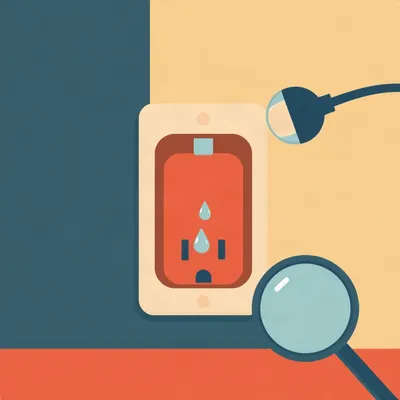
So the flap does its job when nothing's plugged in. The moment you insert a plug, the flap is held open, and the only thing between your bathroom steam and the live contacts is the plastic face of the plug sitting flush against the plastic face of the outlet.
Two smooth plastic surfaces. No gasket, no compression, no o-ring. And here's where the physics gets uncooperative. Steam from a shower condenses on cool surfaces — the outlet face is typically cooler than the surrounding air because it's mounted in an exterior wall, especially in Israeli construction where interior walls are often block and exterior walls are... also block. Condensation forms. And the gap between plug and outlet — we're talking fractions of a millimeter — is wide enough for capillary action to pull that moisture inward. Water doesn't have to be sprayed at the outlet. It can just... creep.
So the plug isn't a seal. It's a suggestion.
It's a dust cover at best. And over time, what you get isn't a dramatic short circuit with sparks and a tripped breaker — usually. What you get is corrosion on the plug pins and the outlet contacts. The brass oxidizes. Resistance goes up. The connection gets warm. The speaker stops charging reliably. And one day you unplug it and the pins are green.
Which is probably what happened to Daniel's outdoor spotlight, by the way. Different scenario, same failure mode.
We'll get to the patio. Let me finish the bathroom first, because there's a specific piece of hardware that actually solves this and almost nobody has it. It's called a weatherproof-while-in-use cover.
That is a deeply inelegant name.
It is. But it does exactly what it says. Instead of a little spring-loaded flap that snaps shut when nothing's plugged in, it's a larger housing with a gasketed door that closes around the cord while the device is plugged in. The door has a compressible seal — usually silicone or neoprene — that conforms to the cord. When it's closed and latched, the whole assembly is rated IP54 or IP55. That means it's protected against splashing water and, in the IP55 case, low-pressure water jets.
And a standard Israeli bathroom flap cover with a plug in it is rated... what?
Nothing. There's no IP rating for that configuration because it's not a configuration the standard contemplates. The flap is rated IP44 when closed — protected against splashing water from any direction. Open, with a plug inserted? You're relying entirely on the RCD.
Which, to be fair, is not nothing. A thirty-milliamp RCD will trip fast enough to prevent electrocution in almost all cases. The problem is it won't prevent the slow death of your electronics.
Right. And that's the distinction I want to draw, because when Daniel asks "is this safe," he's really asking two questions. One: am I going to get shocked? Two: is my gear going to survive? The answer to the first one is — probably not, if the RCD is working. The answer to the second one is — probably not, over a long enough timeline.
So what's the correct approach for the bathroom speaker?
Option one, and the one I'd actually recommend for most renters — keep it on battery and charge it outside the bathroom. It's inelegant, it's annoying, it's what the charging indicator is for. Option two: install a weatherproof-while-in-use cover. Legrand and Hubbell both make them, they're about forty to sixty shekels, and they replace the existing flap cover with something that actually seals around the cord. Option three: if you absolutely must have AC power in there permanently and you own the place, hardwire it. But we'll get to that.
Let me ask the question I think Daniel's actually asking, which is: if I plug the speaker into the bathroom outlet with the flap and I just... leave it... how risky is that, honestly?
Low, in the short term, if the RCD is functional and the outlet is at least a meter from the shower. The risk of electrocution is small. The risk of the speaker dying from corroded contacts inside the plug after six to eighteen months — much higher. And there's a secondary risk worth mentioning: if the corrosion gets bad enough, you can get arcing at the contact point. Arcing generates heat. Heat can melt the outlet face. It's rare, but it's not hypothetical. I've seen photos.
So the flap is a gamble where the stakes are your speaker and, in the worst case, a melted outlet. The RCD is the thing standing between you and a much worse outcome.
And that's the part most people don't think about. The RCD is the safety net, not the flap. The flap is just there to keep the outlet dry when it's not in use. Once you plug something in, you've removed the flap from the equation. You're flying on the RCD alone.
Alright. So that's the bathroom. Steam, condensation, capillary action, slow corrosion. What about when you take this whole problem outside, where the water isn't condensing — it's falling from the sky?
The stakes go up. And the standards change with them.
Daniel had a Zigbee spotlight, marketed as outdoor-rated, plugged into an outdoor outlet. It died after a few years. He doesn't know if it was water damage or just a light that gave up. But the question is — was that setup actually correct?
Let's work backward from the failure. An outdoor outlet in Israel is required to be on a thirty-milliamp RCD, same as the bathroom. And it needs an IP rating — at least IP44 if it's under an eave or otherwise protected from direct rain, IP55 if it's exposed. A standard outdoor outlet with a spring-loaded flap is typically IP44 when closed. Open, with a plug inserted? Same problem as the bathroom. No seal.
So an outdoor outlet with a flap is basically a bathroom outlet that's having a worse day.
A much worse day. Because outdoors you've got not just condensation but direct rain, wind-driven rain, water pooling on the plug body and running down the cord, UV degradation of the plastic flap over time — the spring gets weak, the flap doesn't close fully, and now you've got an outlet that's IP nothing. And the light itself — "outdoor" on a product label can mean IP44, which is splash-proof, or IP65, which is dust-tight and protected against water jets. If it was IP44 and mounted where water could hit it directly, or where water could pool around the lens seal, failure after a few years is... completely expected.
You sound almost cheerful about it.
I'm cheerful about the predictability. The physics is reliable. Water finds the lowest point, it finds the gap, and it gets in. The question is just how long it takes.
And then there's the plug type. Daniel mentioned the two-pin Euro connectors versus the Israeli three-pin with the grounding strip.
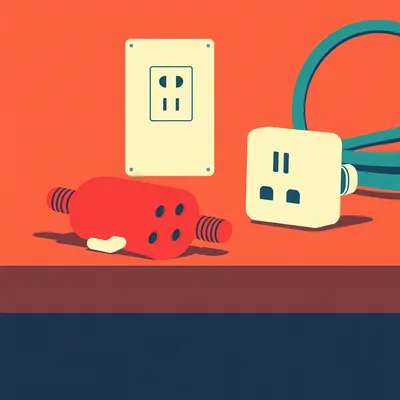
This is where it gets unsafe, not just inconvenient. Israeli outlets have that grounding strip — it's a flat contact on the top and bottom of the socket that engages with the corresponding contacts on an Israeli plug. A Euro plug is two round pins, no ground. It fits physically, but it doesn't engage the grounding strip. For a Class Two device — double-insulated, marked with a square within a square — that's legal. Class Two devices don't need a ground. But many outdoor lights, especially the kind with metal housings, are Class One. They require a ground connection for safety. If you plug a Class One light into a Euro adapter or a Euro plug into an Israeli outlet, the ground is floating. If there's an internal fault and the housing becomes live, the RCD is your only protection. And RCDs can fail. That's why we have grounding as a second layer.
So Daniel's outdoor spotlight — if it was Class One, if it had a metal body, if it was plugged in with a two-pin Euro connector — was running without a ground. For years.
Possibly. And it worked until it didn't. Which is how most electrical safety violations play out. Nothing happens, nothing happens, nothing happens — and then something happens.
Alright. So we've established that the plug-and-socket interface is the weak point, indoors and out. What's the fix for the patio scenario?
Same hierarchy as the bathroom, but with higher stakes. First option: a weatherproof-while-in-use cover on the outdoor outlet. These are more common outdoors than in bathrooms, actually — you see them on construction sites, on the sides of houses for holiday lights, that kind of thing. The gasketed door closes around the cord and gives you IP54 or IP55 even with something plugged in. That's the minimum I'd recommend for anything that lives outdoors permanently.
And if that's not enough?
If you want something that will survive a decade of Jerusalem winters — and Jerusalem gets real rain, concentrated in a few months — you eliminate the plug entirely. You hardwire.
Which is what Daniel was getting at with the direct-wire question. Run cable through the wall, seal the penetration, terminate in a weatherproof junction box.
And this is where the gold standard lives. You drill through the wall — preferably from inside to outside, sloping slightly downward so water doesn't run inward — you run the cable through a conduit or a sealed gland, you fill the penetration with polyurethane or silicone sealant, and you terminate inside a weatherproof junction box rated IP66 or higher. The junction box has cable glands on the bottom — never the top, never the sides if you can avoid it — and those glands compress around the cable to form a watertite seal. Inside the box, you make your connections with lever nuts or wagos, close it up, and you're done. No plug. No socket. No gap for water to find.
And the sealant around the cable penetration becomes your water block, which is what Daniel suggested.
It's part of the water block. The sealant handles the wall penetration. The cable glands handle the junction box entry. The insulation on the cable itself — that's the primary insulation around the conductors — handles the rest. You've got three layers of protection: the conductor insulation, the outer cable jacket, and the gland seal. That's a system designed to keep water out for decades.
Versus a plug, which is designed to... make contact.
Right. A plug is an electrical interface first and a weather seal never. It was never designed for that job. The weatherproof-while-in-use cover is a retrofit that says "alright, we know people are going to leave things plugged in outdoors, let's build a box around the box." It works, but it's a workaround. Hardwiring is the solution that doesn't need the workaround.
So let's rank them. Bottom of the list: indoor outlet used outdoors. Just... don't.
Never. That's how you get water inside your walls through the outlet box.
Next up: standard outdoor outlet with a flap, plug inserted, no additional cover. This is what most people have. It's IP44 when closed, IP nothing when in use. It'll work until it doesn't. The RCD is your safety net, but your gear is on borrowed time.
And if you're using a Euro plug on a Class One device, you're also ungrounded, which is a separate and more serious problem.
Then: outdoor outlet with a weatherproof-while-in-use cover. This is the minimum I'd call actually correct for anything plugged in permanently. The gasket around the cord gives you a real seal, IP54 or better. Your gear will survive. The connection is protected. This is what the Canadian Electrical Code requires within one meter of a water source, by the way — they don't mess around with just a flap.
The Canadians have seen things freeze and thaw and they've learned.
And at the top: direct wire through a sealed wall penetration into a weatherproof junction box with cable glands. No plug, no socket, no gap. This is the gold standard for permanent outdoor fixtures. It's also what you'd do for a bathroom if you were building new and wanted a permanent powered speaker or heated mirror or whatever.
The catch is that in Israel, permanent wiring requires a licensed electrician. You can't just drill through the wall and call it a day — the Electric Inspector has to approve new circuits. For renters, that usually means the hardwire option is off the table unless the landlord is unusually cooperative.
Which brings us back to the weatherproof-while-in-use cover as the practical sweet spot for most people. It's a forty-shekel part, it takes ten minutes to install, and it moves you from "probably fine" to "actually fine."
I want to add one thing about the bathroom specifically, because there's a detail in the Israeli standard that most people don't know. SI 614 doesn't just require the RCD and the one-meter distance. It also specifies that bathroom outlets must be on a dedicated circuit or shared only with other bathroom outlets — not with general lighting or bedroom outlets. The reasoning is that if someone trips the RCD with a hair dryer, you don't want the bathroom lights going out and leaving them in the dark, wet, and confused.
That's thoughtful.
The standard was written by people who thought about failure pattern. The problem is that in older Israeli apartments — and Daniel rents, so he's probably in a building that's at least a few decades old — the bathroom outlet might be on a shared circuit. The RCD might be at the main panel rather than at the bathroom sub-panel. The flap might be brittle and not closing fully. The cumulative effect is that you're relying on layers of protection that may or may not all be intact.
So the practical advice for a renter in Daniel's position: test the RCD. There's a little test button on it — press it once a month, make sure it trips. If it doesn't, call the landlord immediately. That's not a "nice to have," that's the only thing standing between you and a very bad day.
And for the speaker — either charge it outside the bathroom, or get a weatherproof-while-in-use cover. They make them in the Israeli form factor. It's not exotic hardware.
The other thing I keep thinking about is that Daniel's dead spotlight might not have died from water at the plug. It might have died from water at the lens seal or the housing gasket. Outdoor lights fail in two places: where the electricity goes in, and where the light comes out. The lens seal is just as vulnerable as the plug.
And harder to inspect. With a plug, you can see the corrosion. With an internal gasket, the first sign of failure is usually water inside the lens — and by then the LED driver board is already damaged. IP65 lights are supposed to be sealed for life, but "for life" in a consumer product often means "for the warranty period plus a little bit." UV degrades the gasket material. Thermal cycling — hot when on, cold when off — makes the housing expand and contract, and eventually the seal gives way. A hardwired junction box has the same vulnerability at the box gasket, but at least you can open it, inspect it, and replace the seal if needed.
So even the gold standard has a maintenance requirement.
Everything has a maintenance requirement. The difference is whether the maintenance is possible. You can't re-seal a molded plastic spotlight. You can re-seal a junction box.
Alright. I think we've covered the physics, the standards, and the practical hierarchy. But there's something about all of this that bothers me, and it's not the electrical part.
Go on.
It's that the market has decided that the plug-and-socket interface is good enough for outdoor smart home gear, and it just... isn't. We're putting Wi-Fi cameras, Zigbee lights, smart speakers, all of it outside, and the connection method hasn't changed in fifty years. It's still a plug designed for indoor use, stuck into an outlet with a plastic flap, and everyone crosses their fingers. The weatherproof-while-in-use cover is a retrofit that acknowledges the original design was wrong for the application. And hardwiring, while correct, is the kind of thing most people won't do because it requires an electrician.
You're describing a standards gap. The devices are evolving faster than the connection standards. There are weatherproof connectors that exist — the circular connectors you see on professional outdoor equipment, the kind with threaded locking rings and silicone gaskets, IP67 rated. But they're not on consumer gear because they cost more and they're bigger and consumers don't demand them.
Because consumers assume the flap is enough.
Because the flap looks like it should be enough. It snaps shut satisfyingly. It's got a little spring. It feels engineered. And it is engineered — for keeping dust and occasional splashes out of an empty socket. Not for keeping rain out of a live connection for three years.
I'm going to remember that line. The flap is engineered for an empty socket.

You're both right about the mechanism. But you've got the scale wrong.
How so?
You said most people are getting lucky. I'd say almost everyone is getting lucky, and the number who aren't is smaller than you think. I know because I used to count them.
Count... the people who weren't getting lucky?
The failures. I did a stint with a company that maintained outdoor sound systems for venues — theaters, wedding halls, that kind of thing. My job was to drive out after a rainstorm and figure out why the PA was dead. And it was always water. Always. But not at the plug.
Where, then?
The junction boxes. The ones that were supposed to be sealed. You'd open them up and there'd be a teaspoon of water in the bottom, just sitting there, corroding the terminals. The gasket looked fine. The gland looked tight. But water got in anyway. Condensation, mostly. The box heats up during the day, the air inside expands and pushes out through the tiniest gap. At night it cools, contracts, and pulls moisture in. Over and over. After a year, you've got a puddle.
So even the gold standard fails.
The gold standard fails if nobody checks it. The systems that lasted were the ones where someone opened the boxes once a year, wiped them out, and replaced the silica gel packets. The ones that failed were the ones where someone said "it's IP66, it's fine" and walked away.
That's... actually a really important point. The rating is a laboratory condition. Real-world performance depends on installation quality and maintenance.
We had one venue where the outdoor speakers were wired through a junction box mounted on a north-facing wall. Never got direct sun. The box was always cold. Condensation was constant. We ended up drilling a tiny drain hole in the bottom — which technically voids the IP rating, but it stopped the water from pooling. Sometimes the spec is wrong for the actual conditions.
A drain hole in a waterproof box. That's a beautiful piece of field engineering.
It worked. The other thing that worked — and this is going to sound stupid — was wrapping the connections in a plastic bag and gaffer tape. We did that for temporary setups, festivals and things, where you couldn't hardwire. Plug the cable in, wrap the whole connection in a bag, tape it tight around the cord. It looked terrible. But it kept the rain out better than the flap covers. The bag creates a drip loop — water runs down the outside of the bag and off the bottom, never reaches the plug.
That's... not code-compliant.
No. It's a plastic bag. But it worked for a weekend run with a hundred-volt PA system on an RCD. I wouldn't do it on mains voltage at home. But it taught me something about what actually keeps water out. It's not seals. It's geometry. Water runs downhill. If you give it a path that doesn't lead to the contacts, it'll take it.
The plastic bag is the poor man's weatherproof-while-in-use cover.
The poor man's drip loop. Same principle, less plastic.
The drip loop is actually code in a lot of places for outdoor cabling. You leave a loop of cable below the entry point so water drips off the lowest point instead of running into the gland. It's one of those details that costs nothing and prevents most failures.
We learned it the hard way. Show went silent for twenty minutes while I dried out a connector with a hair dryer I borrowed from the caterer. The bride was not pleased.
I bet she wasn't.
After that, every cable got a bag and tape. Never had a rain failure again.
The hierarchy we built still stands — but with an asterisk. The gold standard works if you maintain it. The weatherproof cover works if it's installed right. And the plastic bag works if you're desperate and temporary and know exactly what you're doing and also don't mind voiding every warranty and code provision in the book.
The bag is not advice. I want to be clear about that.
It's a story, not a recommendation.
Right. But the principle underneath it — manage the water path, don't just trust the seal — that's transferable. That's why cable glands go on the bottom of junction boxes. That's why outdoor outlets are installed with the receptable facing down. That's why the drip loop exists. Water is predictable. Gravity is reliable. Seals are neither.
I think that's the thing I'm going to take from this whole discussion. Everyone focuses on the seal — the flap, the gasket, the IP rating. But the real question is: where does the water go? If the answer is "it pools against the seal and waits," you've already lost. If the answer is "it runs away from the connection and drips off harmlessly," you've probably won.
That's why the direct-wire approach with a properly designed junction box — glands on the bottom, drip loop in the cable, sealant around the wall penetration, silica gel inside the box — is the gold standard. Not because it's magically waterproof. Because it manages water in layers, and each layer has a job, and none of them is "hope the plug is tight enough."
Daniel, if you're listening: test your RCD. Get a weatherproof-while-in-use cover for the bathroom if you're keeping the speaker on AC. For the patio, hardwire if you can, weatherproof cover if you can't, and for the love of everything, make sure your outdoor lights are actually grounded. That Euro plug might fit, but if the light needs a ground, it's not optional.
The dead spotlight — open it up if you're curious. I'd bet you find water inside the housing, not just at the plug. The lens seal is the other failure point nobody talks about.
One more thing from the research that I thought was interesting. The Canadian Electrical Code doesn't just require weatherproof-while-in-use covers near water sources. It also requires that outdoor outlets be individually protected by a GFCI — what we'd call an RCD — and that the GFCI be located somewhere accessable, not behind furniture or in a crawl space. The logic is that if it trips in the rain, you need to be able to reset it without a ladder and a flashlight.
That's the kind of detail that comes from people who've actually dealt with tripped GFCIs in the rain. Which, I suspect, is also the kind of person Hilbert was, standing in a field with a hair dryer.
Probably. Alright. One open question before we close out. As more smart home gear moves outdoors — cameras, speakers, lights, sensors — are we going to see a shift toward standardized weatherproof connectors that eliminate the plug-and-socket weak point? Something like the circular locking connectors on professional gear, but for consumers? Or is the market just going to keep shipping indoor plugs and relying on RCDs to catch the failures?
I think the market will do what it always does — follow the cost. Weatherproof connectors cost more. Until consumers demand them or regulators require them, we'll keep getting indoor plugs and plastic flaps. The one thing that might change it is insurance. If outdoor smart home failures start showing up in claims data — water ingress causing electrical fires, that kind of thing — you'll see standards tighten fast. But until then, the flap is cheap and the RCD is the safety net and everyone assumes it'll be fine.
Most of the time, it is fine. Until it isn't.
Until it isn't.
This has been My Weird Prompts. Thanks to our producer Hilbert Flumingtop, who has apparently dried out more connectors than the rest of us combined.
If you've got a weird prompt about electricity, water, or anything else that shouldn't mix but somehow does, email us at show at my weird prompts dot com.
We'll be back soon.